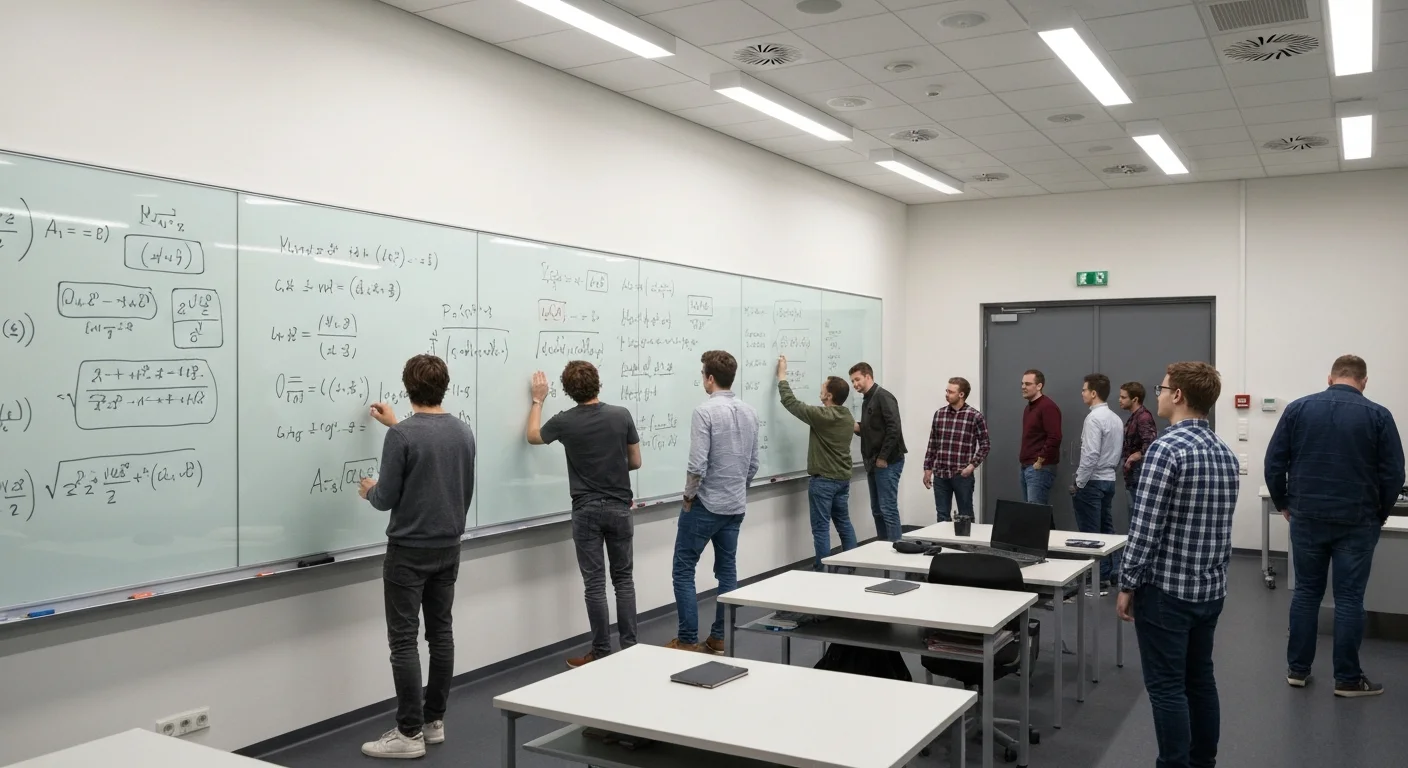
Study Mathematics in Germany
Germany is the birthplace of modern mathematics. Study at universities where Gauss, Hilbert, and Riemann shaped the discipline — with free tuition at public universities, world-class research, and outstanding career prospects in finance, tech, and academia.
Leading Universities in Germany
World-class education with strong industry ties and international recognition.
Technische Hochschule Deggendorf
Deggendorf, Bayern
Applied mathematics with focus on data analytics, statistics, and computational methods.
Rheinische Friedrich-Wilhelms-Universität Bonn
Bonn, Nordrhein-Westfalen
Home to the Hausdorff Center. One of the world's top mathematics departments.
Technische Universität München
München, Bayern
Top-ranked for applied mathematics with strong ties to engineering and natural sciences.
Ruprecht-Karls-Universität Heidelberg
Heidelberg, Baden-Württemberg
Historic mathematics tradition with excellent pure and applied mathematics programmes.
Georg-August-Universität Göttingen
Göttingen, Niedersachsen
Birthplace of Gauss and Riemann. Historic mathematics faculty with world-class research.
Freie Universität Berlin
Berlin, Berlin
Strong mathematics department with focus on algebra, geometry, and mathematical physics.
Showing 433–456 of 493 programmes
Technomathematik, B.Sc.
Karlsruher Institut für Technologie · Karlsruhe
Technomathematik, B.Sc.
Universität Paderborn · Paderborn
Technomathematik, B.Sc.
Technische Universität Hamburg · Hamburg
Technomathematik, B.Sc.
Universität Duisburg-Essen · Essen
Technomathematik, B.Sc.
Hochschule Koblenz · Remagen
Apply by 30 Sep · 14d leftTechnomathematik, M.Sc.
Universität Kassel · Kassel
Technomathematik, M.Sc.
Technische Universität Dortmund · Dortmund
Technomathematik, M.Sc.
Universität Paderborn · Paderborn
Technomathematik, M.Sc.
Karlsruher Institut für Technologie · Karlsruhe
Technomathematik, M.Sc.
Universität Duisburg-Essen · Essen
Technomathematik, M.Sc.
Technische Universität Berlin · Berlin
Technomathematik, M.Sc.
Technische Universität Kaiserslautern (jetzt: RPTU) · Kaiserslautern
Technomathematik, M.Sc.
Bergische Universität Wuppertal · Wuppertal
Versicherungs- und Finanzmathematik, B.Sc.
Universität des Saarlandes · Saarbrücken
Versicherungs- und Finanzmathematik, M.Sc.
Universität des Saarlandes · Saarbrücken
Wirtschafts-/Technomathematik, B.Sc.
Technische Universität Clausthal · Clausthal-Zellerfeld
Apply by 15 Oct · 29d leftWirtschafts-/Technomathematik, M.Sc.
Technische Universität Clausthal · Clausthal-Zellerfeld
Wirtschaftsmathematik (dual), B.Sc.
Hochschule Koblenz · Remagen
Apply by 30 Sep · 14d leftWirtschaftsmathematik (Ein-Fach-Studiengang), M.Sc.
Universität Rostock · Rostock
Apply by 30 NovWirtschaftsmathematik-Aktuarwissenschaften, B.Sc.
Technische Hochschule Rosenheim · Rosenheim
Apply by 30 NovWirtschaftsmathematik, B.Sc.
Friedrich-Schiller-Universität Jena · Jena
Wirtschaftsmathematik, B.Sc.
Ludwig-Maximilians-Universität München · München
Wirtschaftsmathematik, B.Sc.
Universität Bayreuth · Bayreuth
Wirtschaftsmathematik, B.Sc.
Universität zu Köln · Köln
Check My Fit
3 quick questions — every result gets a fit tag based on your budget and languages. Stored only on this device.
Tags are an indication based on tuition and teaching language — for a real assessment, get a free profile evaluation.
What You’ll Study & Specializations
A German mathematics degree generally starts with a rigorous foundation in pure and applied theory before letting you specialise. Bachelor’s programmes typically build the core; master’s programmes are where you focus on a research track. Most maths departments also require a minor or application subject — commonly computer science, physics, or economics.
Core foundations
Across the first years you can generally expect analysis (calculus), linear algebra, abstract algebra, probability and statistics, numerical methods, and an introduction to proofs and mathematical logic. Programming and scientific computing are increasingly part of the standard curriculum.
Common specialization tracks
- · Pure mathematics — algebra, topology, geometry, number theory
- · Applied & numerical mathematics — modelling, optimisation, PDEs
- · Stochastics & statistics — probability, data analysis
- · Financial & actuarial mathematics — quantitative finance, risk
- · Mathematics in data science & machine learning
Exact module names vary by university, and many master’s programmes are research-led, so the available tracks depend on each department’s focus groups. If you are unsure which specialisation fits your background, a free profile evaluation can help you match your goals to the right programme.
Entry Requirements for Mathematics in Germany
Requirements differ between universities and between bachelor’s and master’s entry, so always check the specific programme page. The points below are the typical pattern international applicants encounter.
Academic background
For a master’s, you typically need a recognised bachelor’s with a strong mathematics component (analysis, linear algebra, stochastics). Selective programmes generally look for solid grades. Bachelor’s entry may require a recognised school-leaving qualification or a Studienkolleg foundation year.
Language proof
English-taught master’s usually ask for IELTS around 6.5 or an equivalent TOEFL score. German-taught programmes generally require TestDaF or DSH at roughly C1 level. Check each programme, as thresholds and accepted tests vary.
APS certificate
Applicants with qualifications from India, China, and Vietnam generally need an APS certificate verifying their documents before applying. It is issued once and can be reused for multiple applications — start it early.
uni-assist
Many universities route international applications through uni-assist, which checks and converts your credentials. There is typically a per-application handling fee, and processing takes several weeks, so apply well ahead of deadlines.
GRE — usually not required
Unlike the US, most German mathematics master’s do not require the GRE. A small number of international or elite programmes may ask for it, so confirm on the programme page rather than assuming.
Proof of funds
For the student visa you generally need to show living costs for your first year, often via a blocked account. The exact amount is set by the German authorities and is revised periodically, so verify the current figure before you apply.
Careers & Salaries for Maths Graduates
Mathematics is one of the most flexible degrees on the German job market. Graduates are valued for analytical and modelling skills across finance, insurance, technology, and research — not only in roles with “mathematician” in the title. The figures below are approximate ranges and vary by employer, city, role, and experience.
Typical roles
- · Data scientist & data analyst
- · Quantitative analyst (“quant”) in finance
- · Actuary in insurance
- · Software & algorithm engineer
- · Operations research & optimisation specialist
- · Researcher or PhD candidate in academia
Approximate salary ranges
Entry-level roles for maths graduates typically pay around €45,000–€60,000 per year. With a few years of experience, and especially in quantitative finance, data science, or actuarial work, total compensation can rise well beyond that. Salaries are generally higher in financial hubs such as Frankfurt and Munich and depend heavily on the sector.
Staying in Germany after graduation
International graduates of German universities can generally apply for an 18-month residence permit to look for work related to their qualification. Once you secure a qualifying job, you can usually move on to a work permit or EU Blue Card, which can lead toward longer-term residence. Germany’s persistent demand for analytical and STEM talent makes maths graduates well positioned in this route. Explore your options with a free profile evaluation or browse more guidance on the GradGermany homepage.
Frequently Asked Questions About Mathematics Studies in Germany
Germany holds an unrivalled place in the history of mathematics. The country produced Carl Friedrich Gauss, David Hilbert, Bernhard Riemann, Felix Klein, Emmy Noether, and Karl Weierstrass — figures whose work forms the foundation of modern mathematics as we know it today. The University of Göttingen was the intellectual centre of the mathematical world for over a century, and Germany’s tradition thrives through institutions like the Hausdorff Center for Mathematics in Bonn (a DFG Cluster of Excellence), the Max Planck Institutes for Mathematics in Bonn and Leipzig, and the Berlin Mathematics Research Center MATH+. German mathematics departments consistently rank among the global top 50 in QS and Shanghai rankings. With free tuition at public universities, world-class research infrastructure, and an 18-month post-study work visa, Germany is an ideal destination for international mathematics students at all levels.
Yes. Nearly all German public universities charge no tuition fees for mathematics programmes, including for international students from outside the EU. Students pay only a semester contribution of approximately €150–€350, which typically includes a public transport pass, student union membership, and full library access. Over a three-year Bachelor’s programme (six semesters), total fees amount to just €900–€2,100. The only exception is Baden-Württemberg, where non-EU students pay €1,500 per semester. To obtain a student visa, international students must open a blocked account (Sperrkonto) with €11,904 per year to cover living expenses. Monthly living costs average €850–€1,100 depending on the city, with university cities like Göttingen, Bonn, and Heidelberg being significantly more affordable than Munich or Frankfurt. A full mathematics degree in Germany therefore costs a fraction of what it would at comparable world-class institutions in the US, UK, or Australia.
The University of Bonn is widely regarded as Germany’s leading mathematics department, home to Fields Medal laureate Peter Scholze and the Hausdorff Center for Mathematics, a DFG Cluster of Excellence. Other top-ranked institutions include TU Munich (strong in applied mathematics and data science), Heidelberg University (renowned for scientific computing and mathematical physics), the Free University of Berlin and Humboldt University of Berlin (both part of the MATH+ research centre with over 400 researchers), the University of Göttingen (the historic home of Gauss and Hilbert), RWTH Aachen (applied mathematics and engineering mathematics), and the University of Münster (algebraic geometry and mathematical logic). Many of these institutions participate in the German Excellence Strategy, which provides substantial research funding, state-of-the-art computing resources, and world-class library facilities for mathematics students and researchers at all levels from bachelor’s to doctoral.
German universities offer programmes spanning pure mathematics (algebra, analysis, geometry, number theory, topology), applied mathematics (numerical methods, optimisation, mathematical modelling, and differential equations), financial mathematics (particularly strong in Frankfurt, Germany’s banking capital, home to the European Central Bank and major financial institutions), computational mathematics, statistics and data science, and actuarial science (Versicherungsmathematik). Many programmes are interdisciplinary, combining mathematics with physics, computer science, economics, or biology. Emerging specialisations include mathematical machine learning, stochastic analysis, and quantum computing mathematics, offered at leading institutions like TU Berlin and the University of Tübingen. At the master’s level, you can often tailor your curriculum through elective modules that align precisely with your research interests or career goals, supported by internationally recognised faculty and access to collaborative research projects funded by the DFG or EU Horizon programmes.
An increasing number of Master’s programmes in mathematics are taught entirely in English, making them accessible to international students without prior German language skills. Institutions like TU Munich, the University of Bonn, Heidelberg University, and the Berlin Mathematical School (a joint graduate school of the three Berlin universities) offer fully English-taught master’s programmes in pure mathematics, applied mathematics, and mathematical finance. English-taught programmes typically require IELTS 6.5+ or TOEFL 90+. Bachelor’s programmes are predominantly taught in German, requiring B2 or C1 proficiency via TestDaF or DSH, though bilingual options exist at several universities including Constructor University Bremen. Learning German alongside your studies provides a significant career advantage, especially for positions in the German financial, insurance, and consulting sectors. Most universities offer free German language courses to enrolled international students, helping you reach the B2 level that opens many additional job opportunities.
Mathematics graduates are among the most sought-after professionals in the German labour market, with an unemployment rate consistently below 3% and tens of thousands of unfilled quantitative positions. Key career paths include quantitative finance (especially in Frankfurt, home to the European Central Bank and major banks like Deutsche Bank, Commerzbank, and KfW), data science and analytics, actuarial science at major insurers like Allianz and Munich Re, software development, management consulting at firms like McKinsey and BCG, cryptography, and academic research. Starting salaries typically range from €45,000 to €60,000 per year, with quant finance and data science roles at leading firms often commanding €65,000–€85,000 or more. Germany’s 18-month post-study work visa and the new Chancenkarte (Opportunity Card) provide clear immigration pathways for international graduates seeking to build a long-term career in Europe’s largest and most dynamic economy.
For Bachelor’s programmes, a recognised secondary school certificate with strong marks in mathematics is required, equivalent to the German Abitur. Indian students typically need an APS certificate from the Akademische Prüfungsstelle and may need to complete a Studienkolleg preparatory year if their qualifications are not directly recognised by the German system. For Master’s programmes, a Bachelor’s degree in mathematics or a closely related field (physics, computer science, statistics) is needed, typically with a minimum GPA of 2.5 on the German scale (equivalent to approximately 65%+ in the Indian grading system). Language requirements include IELTS 6.5+ or TOEFL 90+ for English-taught programmes, or TestDaF 4×4 / DSH-2 for German-taught programmes. Applications often go through the uni-assist portal, which requires additional processing time. German universities generally do not require the GRE, removing a significant barrier compared to US graduate school admissions.
Yes. International graduates receive an 18-month post-study work visa (Section 20 (3) AufenthG) to find employment in their field, with no restriction on the type of work during this search period. Germany’s strong demand for STEM graduates, particularly in finance, technology, insurance, and management consulting, means mathematics graduates enjoy excellent employment prospects in Europe’s largest economy, with an unemployment rate below 3% for maths graduates. Once you secure a qualifying position, you can transition to a work permit or EU Blue Card, which requires a minimum salary of approximately €43,800 for STEM shortage occupations. The EU Blue Card offers a fast-track pathway to permanent residency, typically reached within 21–33 months with basic German skills (B1 level). The new Chancenkarte (Opportunity Card) introduced in 2024 offers additional points-based immigration routes for qualified STEM professionals seeking opportunities across the European Union.
Explore More Programmes in Germany
Ready to Study Mathematics
in Germany?
Get a free profile evaluation from our experts. We will assess your academic background, recommend the best mathematics programmes for your profile, and guide you through the entire application process to study in Germany.