The New 70% Rule for Germany: What Indian Students Need to Know (2026 Update)
The New 70% Rule for Germany: What Indian Students Need to Know (2026 Update)
TL;DR: From March 15, 2026, Indian students need at least 70% in Class 12 board exams to qualify for an APS certificate to pursue undergraduate studies in Germany. The change does not affect Master's applicants. Applications submitted before that date are still assessed under the previous (~50%) criteria.
Germany has long been the premier destination for Indian students seeking world-class education with minimal tuition fees. However, a major shift in eligibility criteria is sending ripples through the student community.
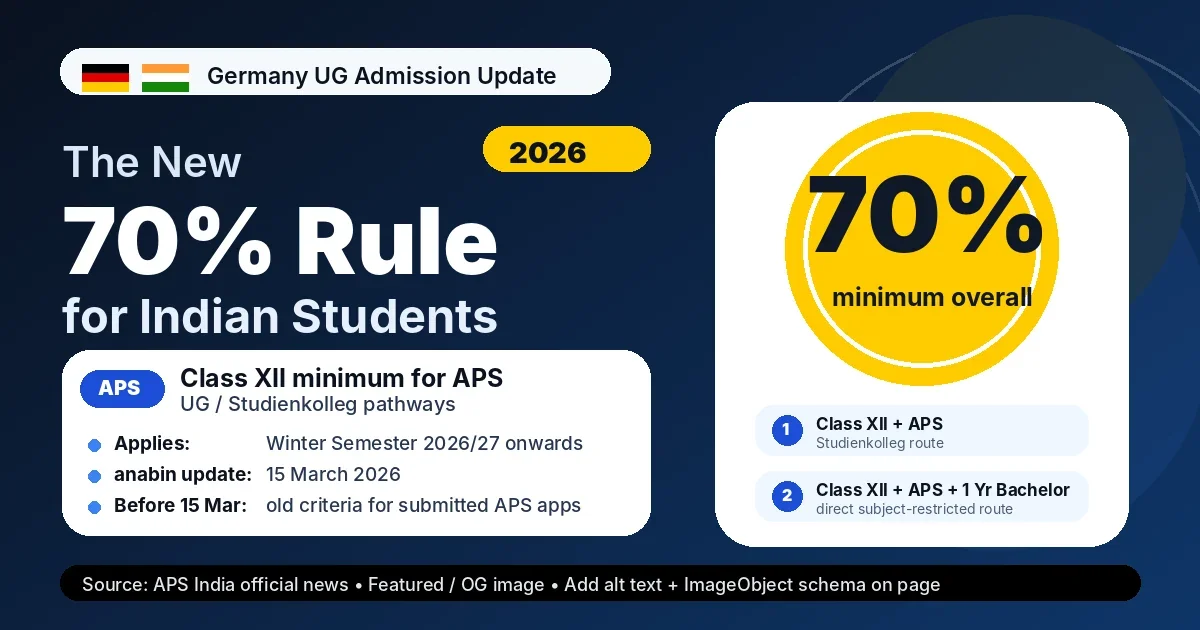
As of the latest update from APS India, the "bar" for entry is officially being raised. From the Winter Semester 2026/27 onwards, Indian applicants must secure at least 70% in their Class XII Board Exams to qualify for an APS certificate for undergraduate studies.
Whether you are aiming for Studienkolleg or direct admission, this change is non-negotiable. Here is everything you need to know to stay ahead of the curve.
The Research: What Exactly is Changing?
The Academic Evaluation Centre (APS India), in coordination with the German anabin database, has updated the evaluation criteria for Indian qualifications.
Key Timelines:
- Effective Date: The new rules will be reflected in the anabin database on March 15, 2026.
- Applicability: These rules apply to all admissions starting from the Winter Semester 2026/27.
- Safe Zone: Applications submitted before March 15, 2026, will still be assessed under the previous criteria (usually 50%).
The New Pathways for Undergraduate Applicants:
- Route 1: Class XII + APS (Studienkolleg): You need a minimum of 70% overall in Class XII to enter a foundation year in Germany.
- Route 2: Class XII + APS + 1 Year Bachelor: Even if you complete one successful year of a Bachelor’s degree in India, you still need that 70% minimum in Class XII to qualify for direct, subject-restricted admission in Germany.
Old Rule vs New 70% Rule, At a Glance
| Criterion | Before March 15, 2026 | From Winter Semester 2026/27 |
|---|---|---|
| Class 12 minimum % | ~50% | 70% |
| Studienkolleg eligibility | Open to most Class 12 graduates | Only ≥70% in Class 12 |
| Direct UG admission (with 1 year of Bachelor) | Allowed with average Class 12 | Requires ≥70% in Class 12 |
| AP exam substitution | Could offset weak board scores | Supplement only, board % is gatekeeper |
| Master's applicants | Bachelor's CGPA assessed | Unchanged, Bachelor's CGPA |
Why the Change? The Reasoning Behind the 70% Floor
While no single official reason is cited, the shift points toward a more rigorous "quality filter" for several reasons:
- Academic Rigor: German German universities are notoriously difficult. Setting a 70% baseline ensures that students have the foundational knowledge required to pass the Feststellungsprüfung (FSP) and university exams.
- Standardization: With the volume of Indian applications skyrocketing (now the largest international student group in Germany), the APS needs a clear, standardized metric to manage the surge while maintaining quality.
- Preventing "AP Loopholes": Some students were using 2 or 3 AP (Advanced Placement) exams to bypass very low school board scores. This rule ensures that standardized tests are a supplement to, not a substitute for, a strong school record.
The Positive Impact: The Silver Lining
- Higher Success Rates: Students with 70%+ scores generally have higher retention rates. This rule helps prevent students from facing academic failure and visa issues later.
- Increased Credibility: Raising the entry bar increases the "brand value" of Indian applicants. When German universities know every Indian student has a strong board score, trust in our academic system grows.
- Faster Processing: Clear-cut percentage rules can simplify the verification process for APS officers, potentially leading to faster certificate issuance for eligible candidates.
The Negative Impact: The Challenges
- Pressure on Undergrad Aspirants: For students who may have struggled in their 12th-grade year but excel in specific subjects, this 70% floor is a hard barrier.
- Board Disparities: Scoring 70% in certain rigorous State Boards in India can be significantly harder than scoring 70% in others. The rule currently does not account for "marking leniency" variations.
- Path Correction Needed: If a student scores 65% in Class 12, they may now be forced to complete a full 3 or 4-year Bachelor’s degree in India before they can consider Germany for a Master’s degree (where this specific rule is less restrictive).
Strategic Advice: Your 2026 Roadmap
- Prioritize Boards: If you are in Class 11 or 12, do not neglect your school curriculum for the sake of entrance exams or APs. Your Board percentage is now your gatekeeper.
- Apply Early: If you have already graduated with between 50% and 69% and want to study in Germany, apply for your APS immediately. Any application submitted before March 15, 2026, is exempt from the new rule.
- Does this affect Masters? Generally, no, use our German grade converter to see your Bachelor's CGPA on the German 1.0-4.0 scale. This specific update focuses on undergraduate pathways. Master's applicants are evaluated primarily on their Bachelor's CGPA.
Final Thoughts
The 70% threshold is a clear signal that Germany is looking for academic consistency across its international intake. By establishing this benchmark, the APS is essentially defining a new standard of "university readiness" for the Indian student community. While this shift undeniably narrows the window of opportunity for those who may have underperformed in high school, it simultaneously constructs a more transparent and predictable roadmap for others. Instead of navigating vague admission "grey areas," students now have a concrete target to aim for from the very beginning of their Class 12 journey.
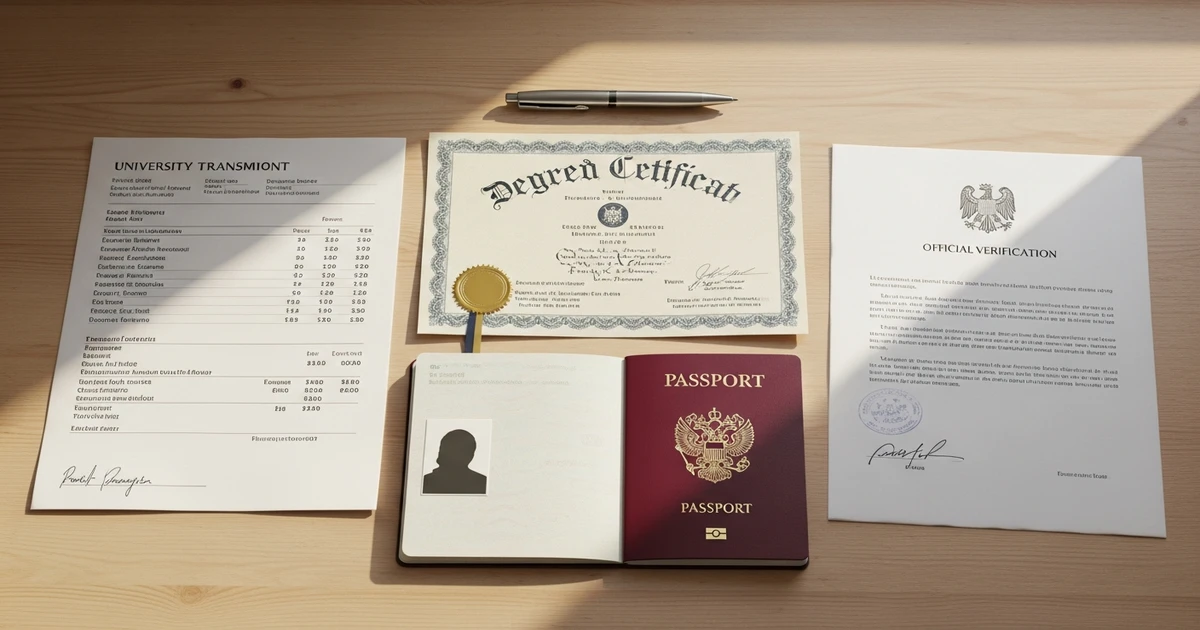
Moving forward, the focus must shift toward a balanced academic profile; your school boards are no longer just a formality to be completed alongside test prep, but the very foundation of your international application. To avoid last-minute hurdles, it is vital to stay organized: keep your transcripts, degree certificates, and identification documents ready for verification well in advance. Most importantly, treat the March 15th update as a hard deadline for your planning, this is the date that separates the old system from the new, and being on the right side of that timeline could determine your eligibility for years to come.
Frequently Asked Questions
You probably qualify for more than you think.
Students who get evaluated find programmes they had no idea existed — at universities that charge nothing. 2 minutes, no cost. The only downside is not checking.
Want our guides higher up in Google?
Mark GradGermany as a preferred source and Google gives our pages more room when you search about studying in Germany. Takes one tap, and you can undo it any time from the same screen.
Get new guides as soon as they go live
Add our feed to Feedly, Inoreader or any RSS reader and every new guide on studying in Germany shows up there by itself. No email, no sign-up.
Living this, or on your way to it? Tell your story.
If you are already in Germany and finding it hard, or still fighting to get here, other students need to hear it from someone real. Share your honest journey. We help shape it, and nothing goes live until you approve it.
Free German Quiz · No Login
Can you score 10/10 on today's German challenge?
10 new words every day · 4,500+ words from A1 to C1 · takes about a minute.