Cost of Studying in Germany: Complete Breakdown (2026)
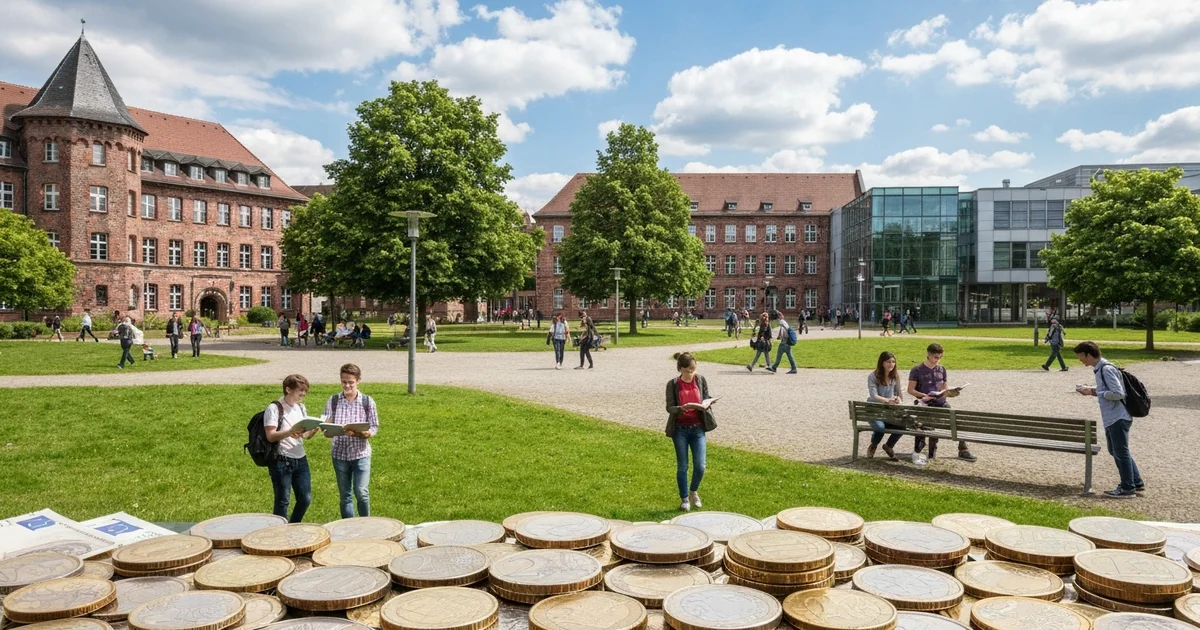
Cost of studying in Germany 2026, at a glance
Public university tuition is €0. The real cost is living expenses and the semester contribution, which together average €934 per month for a typical student. Here's how it breaks down by city:
| Cost item | Typical (avg) | Berlin | Munich | Leipzig |
|---|---|---|---|---|
| Tuition (public uni) | €0 | €0 | €0 | €0 |
| Semesterbeitrag | €150-€350 | €315 | €144 | €220 |
| Rent (shared, monthly) | €350-€600 | €500 | €700 | €350 |
| Health insurance | €110 | €110 | €110 | €110 |
| Food + transport | €250-€350 | €280 | €320 | €240 |
| Total monthly | €934 | ~€1,005 | ~€1,275 | ~€820 |
| Blocked account (visa) | €11,904 / yr | required | required | required |
2026 figures, sourced from DAAD and Studierendenwerk averages. The full breakdown below covers all 10 major German cities, how to keep monthly costs under €820 in cheaper student towns, and the line-item rules behind the €11,904 blocked account.
Germany is one of the most affordable countries in the world for higher education, and it's not even close. While students in the USA and UK graduate with EUR 30,000-100,000 in debt, German public universities charge zero tuition fees for most programmes, including for international students. The only significant costs are living expenses, and even those are lower than in most Western countries.
This guide provides a complete, itemised breakdown of what it actually costs to study in Germany in 2026, based on current figures from the German Federal Statistical Office, student surveys, and our own data from hundreds of Indian students we've helped relocate.
Tuition Fees: The EUR 0 Advantage
At Germany's public universities (which include most of the country's top institutions like TU Munich, LMU Munich, Heidelberg, and the TU9 universities universities), tuition is free for Bachelor's and Master's programmes, regardless of your nationality.
There's one exception: Baden-Württemberg (the state that includes universities in Stuttgart, Heidelberg, Karlsruhe, and Freiburg) charges non-EU international students EUR 1,500 per semester (EUR 3,000/year). This was introduced in 2017 and remains the only German state with such fees.
What you do pay at every university is a semester contribution (Semesterbeitrag), which covers student services, public transport, and administrative costs:
| Component | Typical Cost per Semester |
|---|---|
| Studierendenwerk (student services) | EUR 50-80 |
| Semester ticket (public transport) | EUR 100-200 |
| Student union / AStA fee | EUR 10-20 |
| Total semester contribution | EUR 150-350 |
Since 2024, most German states offer the Deutschlandticket for students at a heavily discounted rate (around EUR 29.40/month), which gives you unlimited public transport across all of Germany, buses, trams, regional trains, and U-Bahn/S-Bahn in every city. This is included in the semester contribution at many universities.
Private University Tuition
Private universities in Germany (like ESMT Berlin, Frankfurt School, or WHU) charge tuition ranging from EUR 5,000 to EUR 30,000+ per year. These are the exception, not the rule. Over 85% of German students attend public universities.
Living Costs: Monthly Breakdown
The German government requires international students to prove they can cover EUR 11,208 per year (EUR 934/month) in living expenses to obtain a student visa. This is the blocked account (Sperrkonto) amount, and it's a reasonable estimate of actual costs.
Here's a detailed monthly breakdown based on the 2025 DSW Social Survey and real student budgets:
| Expense | Monthly Cost (EUR) | Notes |
|---|---|---|
| Rent (student dorm / shared flat) | 350-500 | Dorms: EUR 250-400. WG: EUR 350-600. Munich: EUR 500-750. |
| health insurance | 120 | Mandatory. Public insurance ~EUR 120/month for students under 30. |
| Food and groceries | 200-250 | Cooking at home. Mensa (university canteen): EUR 2-4 per meal. |
| Public transport | 0-30 | Often included in semester ticket. Deutschlandticket ~EUR 29. |
| Phone and internet | 15-30 | Mobile plans start at EUR 8/month. Internet often included in dorms. |
| Study materials | 20-50 | Most textbooks available free in university libraries. |
| Clothing and personal | 50-70 | Budget for winter gear in your first year. |
| Leisure and social | 50-100 | Cinema, cafes, sports. Student discounts everywhere. |
| Total | EUR 850-1,150 | Average: ~EUR 950/month |
Cost by City: Where Is Cheapest?
Living costs vary dramatically by city. Munich is roughly 40% more expensive than Leipzig or Dresden for the same standard of living. Here's a comparison of average monthly rent for a room in a shared flat (WG) and overall cost of living:
| City | Avg. WG Rent (EUR) | Total Monthly Cost (EUR) | Rating |
|---|---|---|---|
| Munich | 550-750 | 1,100-1,400 | Most expensive |
| Frankfurt | 450-600 | 1,000-1,250 | Expensive |
| Hamburg | 420-550 | 950-1,200 | Above average |
| Berlin | 400-550 | 900-1,150 | Above average (rising fast) |
| Cologne | 380-500 | 900-1,100 | Moderate |
| Stuttgart | 400-520 | 950-1,150 | Above average + EUR 1,500/sem tuition |
| Aachen | 300-400 | 800-950 | Affordable |
| Dresden | 280-370 | 750-900 | Very affordable |
| Leipzig | 270-350 | 700-880 | Cheapest major city |
| Chemnitz | 220-300 | 650-800 | Cheapest overall |
Tip: Eastern German cities (Dresden, Leipzig, Chemnitz, Jena) offer the best value for money. University quality is comparable, TU Dresden is an Excellence University, and Leipzig is one of Germany's oldest universities (founded 1409).
The Blocked Account (Sperrkonto)
To get a German student visa, you must open a blocked account and deposit EUR 11,208 (the 2026 amount, it increases slightly each year). This money is released monthly (EUR 934/month) to cover your living expenses.
Key facts about the blocked account:
- It's not a fee or payment to anyone. It's your own money, held in a German bank, released to you monthly.
- You can open it from India through providers like Expatrio, Fintiba, or Deutsche Bank.
- Processing time: 1-5 business days (Expatrio/Fintiba) or 2-4 weeks (Deutsche Bank).
- Cost to open: EUR 0-89 depending on provider.
- Alternative: A formal obligation letter (Verpflichtungserklärung) from a German resident, or a scholarship award letter, can replace the blocked account requirement.
For a detailed walkthrough, see our blocked account setup guide.
One-Time Costs (Before Arrival)
These are expenses you'll incur before you even set foot in Germany:
| Expense | Cost (EUR) | Notes |
|---|---|---|
| Blocked account deposit | 11,208 | Refunded to you monthly (EUR 934/month) |
| Visa application fee | 75 | Paid at the German Embassy |
| Health insurance (first month) | 120 | Must be active before visa appointment |
| uni-assist fee (if applicable) | 75 + 30/additional | First application EUR 75, each additional EUR 30 |
| APS certificate (Indian students) | ~EUR 150 (INR 13,000) | Required for Indian students applying to German unis |
| Language test (IELTS/TestDaF) | EUR 200-250 | IELTS: ~INR 16,250. TestDaF: ~EUR 195. |
| Flight (one-way, India to Germany) | 400-700 | Book 2-3 months ahead for best prices |
| First month's rent deposit | 300-700 | Usually 1-2 months' rent as Kaution (refundable) |
| Total one-time costs | ~EUR 12,500-13,300 | Most of this is the blocked account (your own money) |
Germany vs USA vs UK vs Canada vs Australia
Here's why Germany is in a league of its own for affordable quality education:
| Factor | Germany | USA | UK | Canada | Australia |
|---|---|---|---|---|---|
| Annual tuition (public uni) | EUR 0-3,000 | USD 25,000-55,000 | GBP 15,000-38,000 | CAD 20,000-40,000 | AUD 25,000-45,000 |
| Monthly living cost | EUR 850-1,100 | USD 1,200-2,500 | GBP 1,000-1,800 | CAD 1,000-2,000 | AUD 1,500-2,500 |
| 2-year Master's total cost | EUR 20,000-27,000 | USD 70,000-170,000 | GBP 30,000-65,000 | CAD 45,000-90,000 | AUD 60,000-110,000 |
| post-study work visa | 18 months | 1-3 years (OPT) | 2 years (Graduate) | 3 years (PGWP) | 2-4 years |
| Work during studies | 140 full days/year | 20 hrs/week (on-campus only first year) | 20 hrs/week | 20 hrs/week | 48 hrs/fortnight |
Bottom line: A 2-year Master's in Germany costs EUR 20,000-27,000 total (living expenses only). The same degree in the USA would cost EUR 60,000-150,000. That's a savings of EUR 40,000-120,000.
How to Reduce Costs Further
- Live in student dorms (Studentenwohnheim). At EUR 250-400/month, they're the cheapest housing assistance option and include utilities and internet. Apply early through the Studierendenwerk, waiting lists can be long.
- Cook at home. A weekly grocery shop at Aldi, Lidl, or Netto costs EUR 30-40. Eating out daily can triple your food budget.
- Use the Mensa. University canteens offer full meals for EUR 2-4. Most students eat lunch there daily.
- Apply for scholarships. Besides DAAD, check the Deutschlandstipendium (EUR 300/month), political foundation scholarships, and university-specific awards. See our DAAD scholarship guide.
- Work part-time. International students can work 140 full days or 280 half days per year. Werkstudent jobs jobs pay EUR 13-18/hour. Read our part-time jobs guide.
- Use student discounts. Flash your student ID everywhere: museums, cinema, software (Microsoft, Adobe), Spotify, Amazon Prime, gym memberships, and the Deutschlandticket.
- Choose an affordable city. The difference between Munich and Leipzig is EUR 300-400/month. Over a 2-year Master's, that's EUR 7,200-9,600 saved.
Sample Monthly Budget: Indian Student in Berlin
Here's a realistic monthly budget for an Indian Master's student living in Berlin in 2026:
| Expense | Amount (EUR) |
|---|---|
| Rent (shared flat, Neukölln/Wedding) | 420 |
| Health insurance (TK public) | 120 |
| Groceries (cooking at home) | 200 |
| Mensa lunches (weekdays) | 60 |
| Public transport (Deutschlandticket) | 29 |
| Mobile phone (prepaid) | 10 |
| Internet (shared in WG) | 12 |
| Leisure, social, personal | 80 |
| Total | EUR 931 |
This is right at the blocked account allowance of EUR 934/month, which is exactly what it's designed to cover. Any part-time work income is extra savings.
Frequently Asked Questions
You probably qualify for more than you think.
Students who get evaluated find programmes they had no idea existed — at universities that charge nothing. 2 minutes, no cost. The only downside is not checking.
Want our guides higher up in Google?
Mark GradGermany as a preferred source and Google gives our pages more room when you search about studying in Germany. Takes one tap, and you can undo it any time from the same screen.
Living this, or on your way to it? Tell your story.
If you are already in Germany and finding it hard, or still fighting to get here, other students need to hear it from someone real. Share your honest journey. We help shape it, and nothing goes live until you approve it.
Free German Quiz · No Login
Can you score 10/10 on today's German challenge?
10 new words every day · 4,500+ words from A1 to C1 · takes about a minute.