Student Work Limit Germany 2026: 140-Day Rule Explained
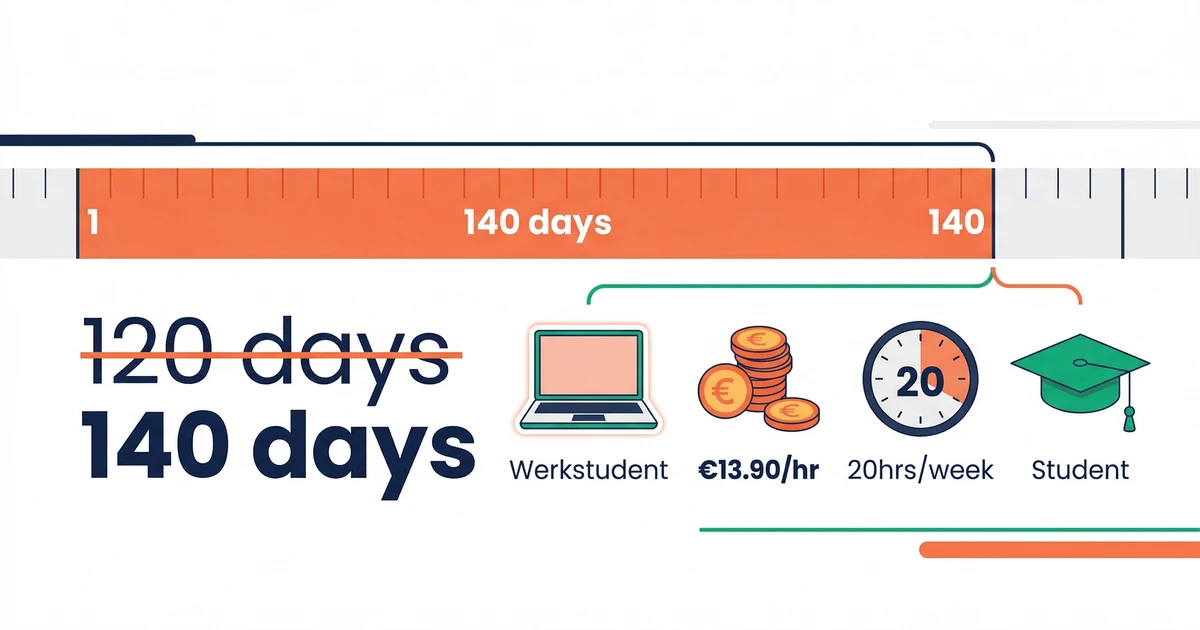
Germany student work hours 2026, the new 140-day rule
From 1 March 2024 Germany raised the annual work cap for international students. The change took full effect for the 2026 academic year. Here's the old rule vs. the new rule:
| Rule | Until 2024 | From 2026 (current) |
|---|---|---|
| Annual work cap | 120 full days or 240 half days | 140 full days or 280 half days |
| Hours per week (during semester) | ~20 h | ~20 h (unchanged) |
| Werkstudent role | Allowed, capped | Allowed, expanded cap |
| Annual earning ceiling (typical) | ~€10,500 | €12,000+ |
| Tax-free threshold (Grundfreibetrag) | €11,604 (2024) | €12,084 (2026) |
| Mini-job limit (no tax) | €520 / mo | €538 / mo |
| Applies to | Bachelor, Master, PhD | Bachelor, Master, PhD (unchanged) |
The full case-by-case breakdown below: how the day-counting actually works (full vs half day), which jobs are exempt from the cap, the six best Werkstudent platforms in Germany 2026, and the tax filing rules every international student needs to know.
Updated March 2026
Minimum wage increased to EUR 13.90/hour in 2026. The 140-day work limit remains unchanged. Earnings calculations and Chancenkarte info updated.
In a landmark decision for international students, the German government has increased the annual work limit from 120/240 days to 140 full days or 280 half days per year, effective since 2024. This change, part of the broader Fachkräfteeinwanderungsgesetz (Skilled Immigration Act) reforms, gives international students in Germany more flexibility to earn money, gain work experience, and build their careers while studying.
What Changed: Old vs New Work Limits
| Rule | Before 2024 | Since 2024 |
|---|---|---|
| Full working days per year | 120 days | 140 days |
| Half working days per year | 240 days | 280 days |
| Hours per full day | Up to 8 hours | Up to 8 hours |
| Hours per half day | Up to 4 hours | Up to 4 hours |
| Werkstudent exception | 20 hrs/week during semester | 20 hrs/week during semester |
| Semester break work | Unlimited hours | Unlimited hours (counts toward day limit) |
| Minimum wage | €13.90/hour | €13.90/hour (2026) |
How Much Can You Earn as a Student in Germany?
With the new 140-day limit and the 2026 minimum wage of €13.90/hour, here's what you can realistically earn:
| Work Type | Hours/Week | Hourly Rate | Monthly Income | Annual Income |
|---|---|---|---|---|
| Minijob | ~10 | €13.90 | €538 (max) | €6,456 |
| Werkstudent (average) | 15-20 | €14-18 | €840-1,440 | €10,080-17,280 |
| Werkstudent (tech/IT) | 15-20 | €18-25 | €1,080-2,000 | €12,960-24,000 |
| Full-time in semester break | 40 | €13.90+ | €2,200+ | Varies |
Key insight: A Werkstudent position at a tech company paying €18/hour for 20 hours/week earns you approximately €1,440/month, enough to cover your entire living expenses in most German cities outside Munich.
What is a Werkstudent Position?
A Werkstudent (working student) is Germany's unique part-time employment model specifically for enrolled university students. Unlike regular part-time jobs, Werkstudent positions offer significant advantages:
- Tax benefits: Exempt from unemployment insurance and nursing care insurance contributions, you keep more of your earnings
- Career relevance: Werkstudent jobs are in your field of study (software development, engineering, marketing, finance, etc.)
- Pay premium: Typically €14-25/hour, significantly above minimum wage
- CV building: German employers highly value Werkstudent experience, it often leads directly to full-time job offers after graduation
- Networking: You build professional contacts at companies like SAP, Siemens, BMW, Bosch, and startups
During lecture periods, Werkstudenten work a maximum of 20 hours per week. During semester breaks (vorlesungsfreie Zeit), you can work full-time. This 20-hour rule applies to weekly averages, not strictly per week.
Types of Student Jobs in Germany
1. Minijob (€538/month limit)
A Minijob is capped at €538/month (2024 limit). Income is tax-free for the employee. Common in hospitality, retail, tutoring, and delivery. No social insurance contributions required. Ideal for students who want simple, flexible work without paperwork.
2. Werkstudent (Working Student)
The gold standard for student employment in Germany. Must be enrolled and work max 20 hrs/week during semester. Higher pay (€14-25/hr), career-relevant experience, and reduced social insurance. Found on Stepstone, Indeed, LinkedIn, and company career pages.
3. Studentische Hilfskraft (HiWi)
A university research or teaching assistant position. Pay is lower (€12-15/hr) but the work directly supports your academic career. Excellent for students planning PhD studies or academic careers. Available through your department or professor.
4. Freelance Work (Freiberufliche Tätigkeit)
Self-employed work such as tutoring, translation, web development, or graphic design. Requires registering with the Finanzamt and managing your own taxes. Caution: Freelance work counts toward your 140-day limit and requires Ausländerbehörde approval if exceeding the limit.
Where to Find Student Jobs in Germany
| Platform | Best For | URL |
|---|---|---|
| Stepstone | Werkstudent positions at large companies | stepstone.de |
| Indeed Germany | All job types including Minijobs | indeed.de |
| Werkstudent at tech companies and startups | linkedin.com/jobs | |
| Studentjob.de | Student-specific positions | studentjob.de |
| Jobmensa | Flexible student jobs | jobmensa.de |
| University job boards | HiWi and campus jobs | Your university career centre |
| German professional network | xing.com |
Rules You Must Follow
Read Also: The Study Shift: What You’ll Pay in 2026
- 140/280 day limit is per calendar year (January to December), not per academic year
- A "half day" means up to 4 hours, even if you work only 1 hour, it counts as a half day
- Exceeding the limit requires approval from the Ausländerbehörde (foreigners' office)
- Mandatory internships (Pflichtpraktikum) do NOT count toward the 140-day limit
- Werkstudent 20-hour rule applies during lecture periods only, semester breaks allow full-time work
- Self-employment and freelance work generally requires separate Ausländerbehörde approval
- You must remain enrolled, losing student status means losing work privileges
Tax and Insurance: What Gets Deducted?
Understanding German payroll deductions helps you plan your actual take-home pay:
| Deduction | Minijob | Werkstudent | Regular Part-Time |
|---|---|---|---|
| Income tax (Lohnsteuer) | €0 | €0 if under €11,604/year | Varies by Steuerklasse |
| health insurance | €0 | Student rate (~€140/mo separately) | ~7.3% of gross |
| Pension insurance | €0 (opt-out) | ~9.3% of gross | ~9.3% of gross |
| Unemployment insurance | €0 | €0 (exempt!) | ~1.3% of gross |
| Nursing care insurance | €0 | €0 (exempt!) | ~1.7% of gross |
Key advantage of Werkstudent status: You're exempt from unemployment and nursing care insurance, saving approximately 3% of gross salary compared to regular employees. Combined with the tax-free basic allowance of €11,604/year, many Werkstudenten keep 85-90% of their gross earnings.
How the New 140-Day Rule Compares Internationally
| Country | Student Work Limit | Minimum Wage |
|---|---|---|
| Germany | 140 full days / 280 half days per year | €13.90/hr |
| UK | 20 hours/week during term | £11.44/hr |
| USA | 20 hours/week on-campus only | $7.25/hr (federal) |
| Canada | 20 hours/week (24 hrs off-campus from 2024) | CA$16.65/hr (Ontario) |
| Australia | 48 hours per fortnight | AU$23.23/hr |
| Netherlands | 16 hours/week | €13.68/hr |
Germany's system is unique because it counts days, not weekly hours. This gives you more flexibility, you can work intensively during semester breaks and barely work during exam periods, as long as you stay within 140 full days total.
Tips to Maximize Your Student Earnings in Germany
- Start as Werkstudent, not Minijob, the pay is 50-100% higher and the experience is career-relevant
- Work full-time during semester breaks, this is unlimited hours and the fastest way to earn (many students earn €2,000-3,000/month during breaks)
- Track your days carefully, keep a spreadsheet of worked days to avoid accidentally exceeding the 140-day limit
- File a tax return (Steuererklärung), even as a student, you can claim deductions for study materials, travel, and work expenses. Average refund: €900+
- Look for English-speaking positions, startups in Berlin, Munich, and Hamburg frequently hire in English
- Use your university career centre, they have exclusive job listings and can review your German CV
- Consider HiWi positions if you plan to pursue a PhD, research assistant experience is invaluable
Frequently Asked Questions
You probably qualify for more than you think.
Students who get evaluated find programmes they had no idea existed — at universities that charge nothing. 2 minutes, no cost. The only downside is not checking.
Want our guides higher up in Google?
Mark GradGermany as a preferred source and Google gives our pages more room when you search about studying in Germany. Takes one tap, and you can undo it any time from the same screen.
Get new guides as soon as they go live
Add our feed to Feedly, Inoreader or any RSS reader and every new guide on studying in Germany shows up there by itself. No email, no sign-up.
Living this, or on your way to it? Tell your story.
If you are already in Germany and finding it hard, or still fighting to get here, other students need to hear it from someone real. Share your honest journey. We help shape it, and nothing goes live until you approve it.
Free German Quiz · No Login
Can you score 10/10 on today's German challenge?
10 new words every day · 4,500+ words from A1 to C1 · takes about a minute.
Related Articles


Study in Germany
Architektur und Umwelt, M.Sc.
Hochschule Wismar - University of Applied Sciences: Technology, Business and Design
Wismar
B.A.Betriebswirtschaft, B.A.
FHDW Fachhochschule der Wirtschaft
Bielefeld, Paderborn, Marburg, Bergisch Gladbach, Mettmann
B.Eng.Maschinenbau, B.Eng.
Technische Hochschule Ingolstadt
Ingolstadt