Best Universities in Germany for International Students 2026
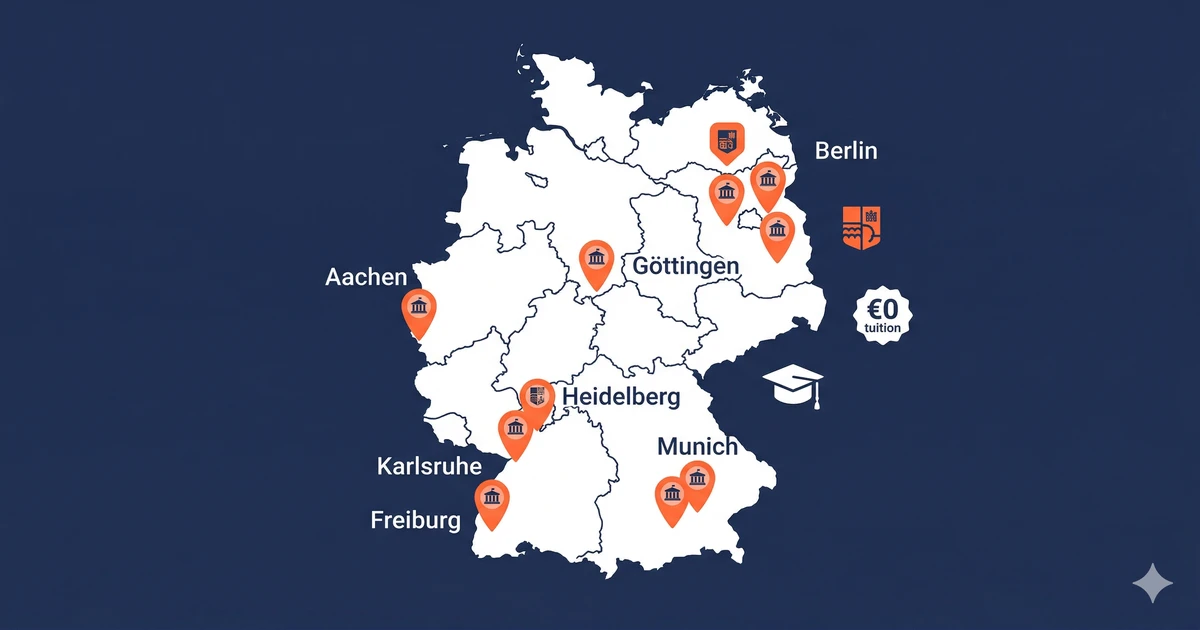
TL;DR: TUM, LMU, RWTH Aachen and other top choices give the best mix of reputation, English programmes and job links. You'll find 50+ English-taught master's at TUM, strong life-sciences at Heidelberg, and low costs in Göttingen (~€650/month). For 2026 international students, prioritize English instruction, city cost and nearby industry; most public universities charge no tuition and you get 18 months post-study job search.
Public universities in Germany charge zero tuition. The degrees are globally respected. After graduating, you get 18 months to find a job and stay. Over 400,000 international students are already enrolled, making Germany the most popular non-English-speaking study destination in the world.
Choosing where to go is the hard part. There are over 400 universities, and the rankings only capture a slice of what matters. We focused on what's actually useful if you're moving from abroad: how many programmes are in English, what the city costs to live in, and whether companies in your field are nearby.
Quick comparison: top 10 at a glance
| University | Best subjects | English master's | Tuition | City cost/month |
|---|---|---|---|---|
| TU Munich (TUM) | Engineering, CS, Business | 50+ | Free | ~EUR 1,000+ |
| LMU Munich | Medicine, Law, Humanities | 30+ | Free | ~EUR 1,000+ |
| Heidelberg | Medicine, Life Sciences, Physics | 20+ | EUR 1,500/sem (non-EU) | ~EUR 800 |
| RWTH Aachen | Mechanical, Electrical Eng. | 30+ | Free | ~EUR 750 |
| Humboldt Berlin | Humanities, Social Sciences | 15+ | Free | ~EUR 800 |
| FU Berlin | Political Science, Earth Sci. | 20+ | Free | ~EUR 800 |
| TU Berlin | Engineering, CS, Urban Planning | 25+ | Free | ~EUR 800 |
| KIT Karlsruhe | Engineering, Informatics | 15+ | EUR 1,500/sem (non-EU) | ~EUR 750 |
| Freiburg | Medicine, Environmental Sci. | 15+ | EUR 1,500/sem (non-EU) | ~EUR 800 |
| Göttingen | Agriculture, Biology, Chemistry | 20+ | Free | ~EUR 650 |
1. Technical University of Munich (TUM)
TUM is #1 in Germany across most rankings and it's not particularly close. Engineering, computer science, and management are the strongest departments. They run over 50 English-taught master's programmes, and the international office is genuinely helpful (not always a given at German unis). Munich puts you next to BMW, Siemens, and Allianz, which matters when you're looking for a Werkstudent position or post-graduation job.
Around 40% of TUM students are international. Tuition is free, you pay about EUR 150 per semester in administrative fees.
2. LMU Munich
LMU is TUM's neighbor and rival. Where TUM leans technical, LMU is stronger in medicine, law, humanities, and economics. It regularly lands in the global top 40. Most bachelor's programmes are in German, but the master's level has a growing number of English options. The downside: Munich is expensive. Budget at least EUR 1,000/month for living costs.
3. Heidelberg University
Founded in 1386, Germany's oldest. Heidelberg is a small, walkable city that basically exists because of the university. Medicine, life sciences, and physics are the strong suits. The German Cancer Research Center and several Max Planck Institutes are in town, so research access is hard to beat.
One catch: Heidelberg is in Baden-Württemberg, which charges non-EU students EUR 1,500/semester. Still far cheaper than the UK or US, but worth noting. Check our free tuition universities guide for the full picture.
4. RWTH Aachen
If you want to study engineering in Germany, RWTH Aachen is the name that comes up first. It's the country's largest technical university with deep partnerships in automotive and manufacturing. The campus sits close to the Dutch and Belgian borders, which gives it a more international feel than you'd expect from a mid-sized German city. 30+ English master's programmes, free tuition.
5. Humboldt University of Berlin
29 Nobel Prize winners came out of Humboldt. It's strongest in humanities, social sciences, and physics. But honestly, a big part of the appeal is Berlin itself, cheapest major city in Germany, massive startup scene, and enough going on to fill every evening. The campus sits in Mitte, right in the center. Consider studying in Berlin if city life matters to you.
6. Freie Universität Berlin
Berlin's second big university. FU Berlin does well in political science, area studies, and earth sciences. It has one of the highest percentages of international students in the country. The Dahlem campus in southwest Berlin feels more like a traditional campus with green space, different vibe from Humboldt's city-center setting. 20+ English master's programmes, free tuition.
7. TU Berlin
The third of Berlin's big universities, and the technical one. Strong in engineering, computer science, and urban planning. If you want to work in Berlin's tech industry, TU Berlin is probably the most direct path, startups and tech companies actively recruit here.
8. Karlsruhe Institute of Technology (KIT)
KIT is a merger of a university and a national research center, which gives it an unusually large research budget. Students get pulled into actual research work early. Engineering, informatics, and physics are the standout fields. Karlsruhe costs significantly less to live in than Munich or Berlin, a practical consideration that rankings don't capture. Non-EU tuition: EUR 1,500/semester (Baden-Württemberg).
9. University of Freiburg
Freiburg is good for medicine, biology, and environmental science. The city sits in the southwest corner of Germany, close to France and Switzerland. Warm climate by German standards, bike-friendly, and obsessed with sustainability. University College Freiburg runs an English-taught liberal arts bachelor's, which is rare.
10. University of Göttingen
A quarter of Göttingen's population are students, which shapes everything about the city. 47 Nobel laureates have some connection to the place. Agriculture, biology, chemistry, and mathematics are the headline subjects. Cost of living is low, think EUR 600-700/month, and you can bike everywhere.
How to actually choose the right university
Rankings matter less than people think. Here's what to focus on:
| Factor | Why it matters | Resource |
|---|---|---|
| Language of instruction | No German? Filter for English-taught first | English programmes finder |
| Tuition fees | Most public unis are free; 3 Baden-Württemberg unis charge EUR 1,500/sem | Free tuition guide |
| City cost | Munich: EUR 1,000+/mo vs. Göttingen: EUR 650/mo, adds up over 2-3 years | Cost breakdown |
| Industry proximity | Automotive → Stuttgart/Munich. Tech → Berlin. Finance → Frankfurt | Programme finder |
| Programme structure | Research-heavy vs. practical, read the module handbook, not just the title | University directory |
Application basics for international students
German university applications work differently from most countries. A few things that catch people off guard:
- Know the deadlines, Winter semester: May-July. Summer semester: December-January. These are hard deadlines.
- Check uni-assist, Many universities route international applications through uni-assist, which adds processing time. Submit early.
- Prepare documents, Certified transcript translations, motivation letter, language certificates (IELTS 6.5+ or TOEFL 90+ for English programmes), and sometimes a CV.
- Apply broadly, Apply to 3-5 universities. Acceptance rates vary wildly between programmes.
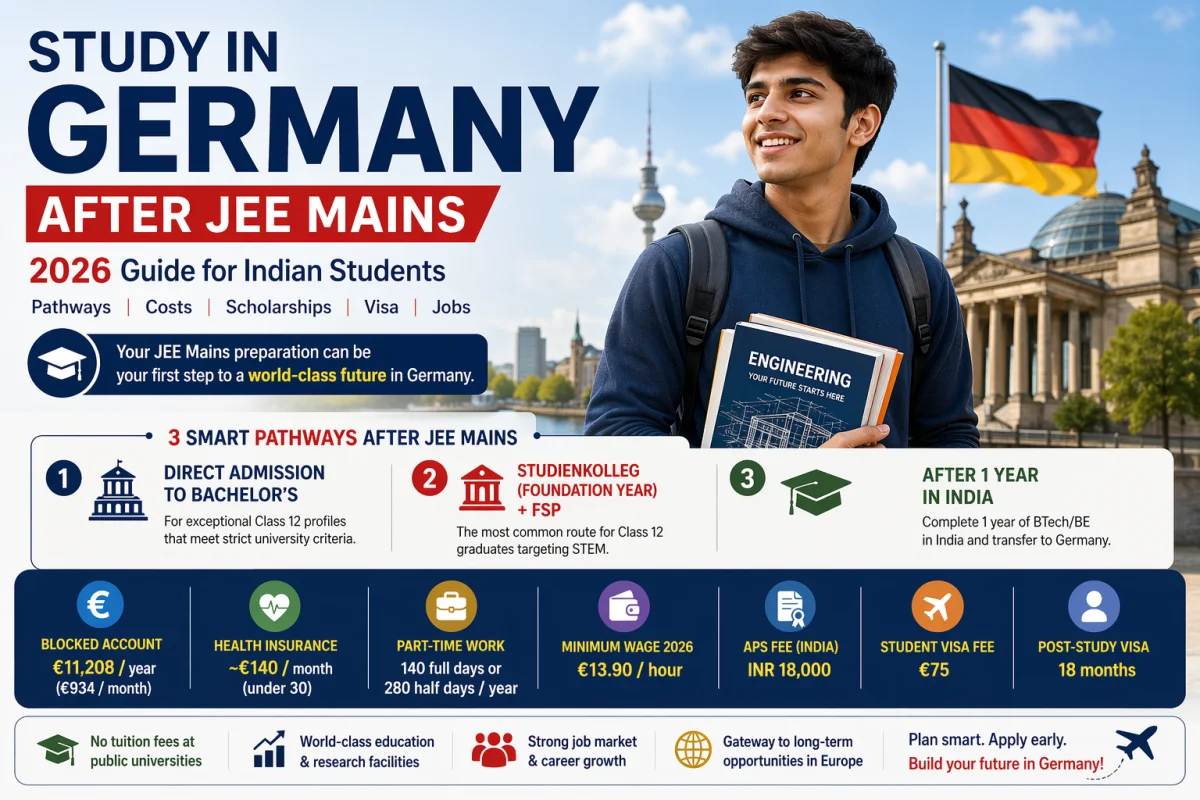
- Get your APS certificate, Required for Indian and Chinese students. Takes 4-8 weeks.
After graduation: why Germany stands apart
After finishing your degree, Germany gives you an 18-month job-seeker visa to find work in your field. Once employed, you move to an EU Blue Card. Many graduates qualify for permanent residency after two years of working.
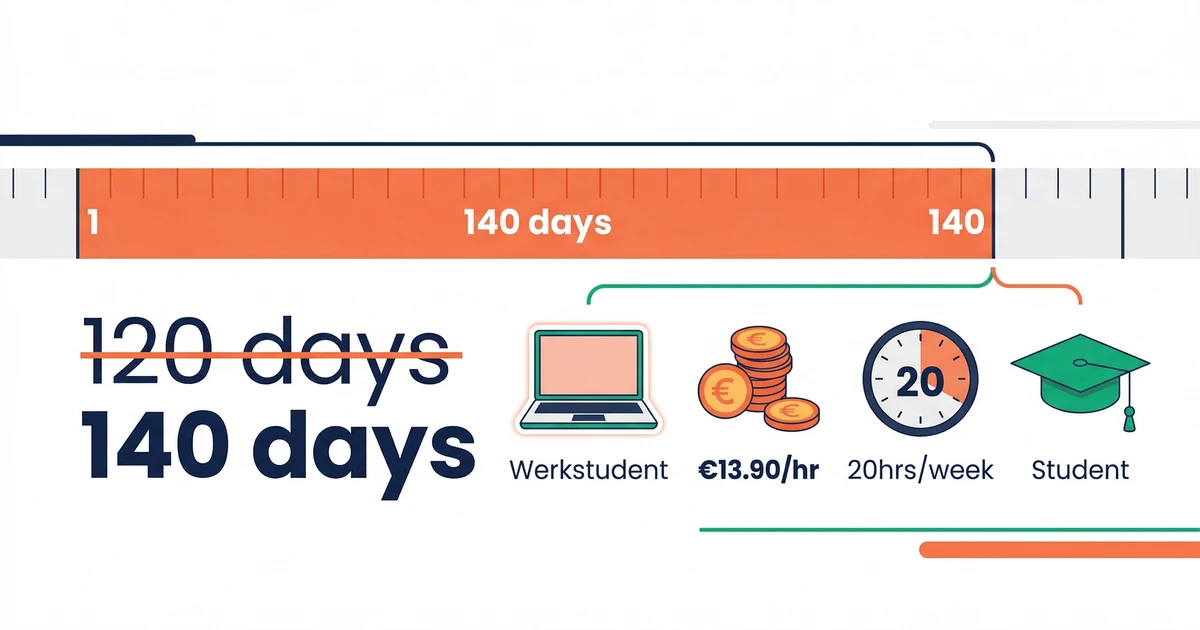
The Chancenkarte (Opportunity Card) introduced in 2024 opened up additional pathways. Between the job-seeker visa and the Chancenkarte, staying after studying is increasingly straightforward. You can also work up to 140 days/year while studying to gain experience and earn money.
Figure out where you fit
If you're serious about this, get a free profile evaluation from our team. We'll look at your academic background, tell you which universities match your profile, and walk you through the application. No cost, no obligation.
You can also browse all 20,000+ programmes in our database, or go straight to subjects like data science, civil engineering, or business and analytics.
Frequently Asked Questions
You probably qualify for more than you think.
Students who get evaluated find programmes they had no idea existed — at universities that charge nothing. 2 minutes, no cost. The only downside is not checking.
Want our guides higher up in Google?
Mark GradGermany as a preferred source and Google gives our pages more room when you search about studying in Germany. Takes one tap, and you can undo it any time from the same screen.
Living this, or on your way to it? Tell your story.
If you are already in Germany and finding it hard, or still fighting to get here, other students need to hear it from someone real. Share your honest journey. We help shape it, and nothing goes live until you approve it.
Free German Quiz · No Login
Can you score 10/10 on today's German challenge?
10 new words every day · 4,500+ words from A1 to C1 · takes about a minute.
Related Articles

Study in Germany
Chemie und Nachhaltige Prozesse, B.Sc.
Hochschule Reutlingen
Reutlingen
B.A.English and American Studies/Anglistik und Amerikanistik (Nebenfach), B.A.
Albert-Ludwigs-Universität Freiburg im Breisgau
Freiburg
M.Ed.Wirtschaftswissenschaften (Lehramt an berufsbildenden Schulen), M.Ed.
Universität Osnabrück
Osnabrück