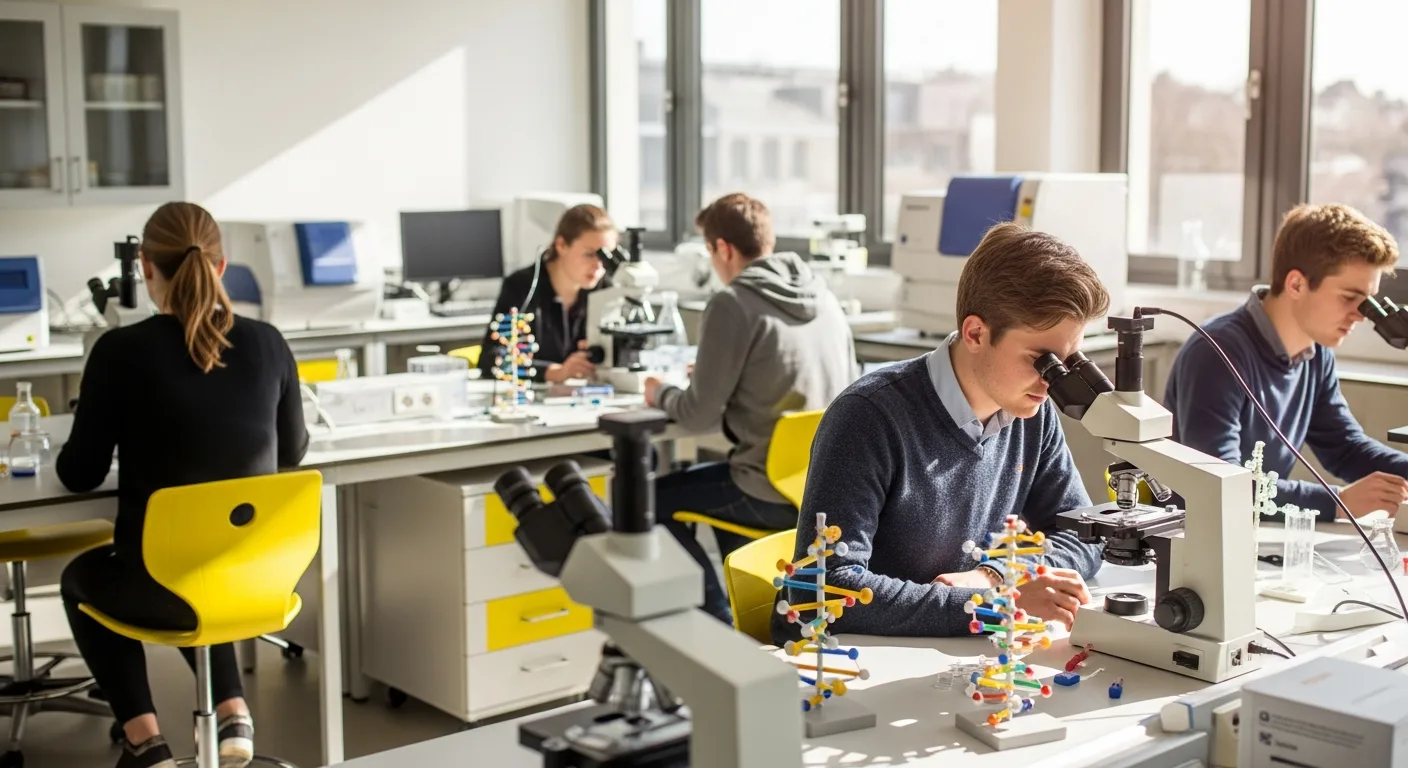
Biology & Life Sciences
Programmes in Germany
Germany is home to the Max Planck Society, Helmholtz Association, and dozens of world-ranked research universities — all offering tuition-free biology programmes. From molecular biology and neuroscience to ecology and evolutionary biology, launch your life sciences career in Europe's research powerhouse.
Biology Programmes
Tuition at Public Universities
Max Planck Institutes
Month Post-Study Work Visa
Showing 97–120 of 584 programmes
Biologie - Lehramt der Sekundarstufe I, M.Ed.
Universität Potsdam · Potsdam
Apply by 30 Sep · last dayBiologie - Lehramt der Sekundarstufe II, B.Ed.
Universität Potsdam · Potsdam
Apply by 30 Sep · last dayBiologie - Lehramt der Sekundarstufe II, M.Ed.
Universität Potsdam · Potsdam
Apply by 30 Sep · last dayBiologie - Lehramt für das Gymnasium (auch Gesamtschulen) (Erstfach), B.A. / B.Sc.
Gottfried Wilhelm Leibniz Universität Hannover · Hannover
Biologie - Lehramt für das Gymnasium (auch Gesamtschulen) (Erstfach), M.Ed.
Gottfried Wilhelm Leibniz Universität Hannover · Hannover
Biologie - Lehramt für das Gymnasium (auch Gesamtschulen) (Zweitfach), B.A./B.Sc.
Gottfried Wilhelm Leibniz Universität Hannover · Hannover
Biologie - Lehramt für das Gymnasium (auch Gesamtschulen) (Zweitfach), M.Ed.
Gottfried Wilhelm Leibniz Universität Hannover · Hannover
Biologie - Lehramt für die allgemeinbildenden Fächer der Sekundarstufe II und das Gymnasium (auch Gesamtschulen), 2-Fach-Bachelor
Universität Münster · Münster
Apply by 9 Oct · 9d leftBiologie - Lehramt für die allgemeinbildenden Fächer der Sekundarstufe II und das Gymnasium (auch Gesamtschulen), B.A./B.Sc.
Universität Duisburg-Essen · Essen
Biologie - Lehramt für die allgemeinbildenden Fächer der Sekundarstufe II und das Gymnasium (auch Gesamtschulen), B.Sc.
Universität Ulm · Ulm
Apply by 15 Nov · 46d leftBiologie - Lehramt für die allgemeinbildenden Fächer der Sekundarstufe II und das Gymnasium (auch Gesamtschulen), M.Ed.
Ruprecht-Karls-Universität Heidelberg · Heidelberg
Biologie - Lehramt für die allgemeinbildenden Fächer der Sekundarstufe II und das Gymnasium (auch Gesamtschulen), M.Ed.
Universität Münster · Münster
Apply by 9 Oct · 9d leftBiologie - Lehramt für die allgemeinbildenden Fächer der Sekundarstufe II und das Gymnasium (auch Gesamtschulen), M.Ed.
Bergische Universität Wuppertal · Wuppertal
Biologie - Lehramt für die allgemeinbildenden Fächer der Sekundarstufe II und das Gymnasium (auch Gesamtschulen), M.Ed.
Freie Universität Berlin · Berlin
Biologie - Lehramt für die allgemeinbildenden Fächer der Sekundarstufe II und das Gymnasium (auch Gesamtschulen), M.Ed.
Universität Ulm · Ulm
Apply by 15 Nov · 46d leftBiologie - Lehramt für die beruflichen Fächer der Sekundarstufe II, B.Sc.
Universität Münster · Münster
Apply by 9 Oct · 9d leftBiologie - Lehramt für die beruflichen Fächer der Sekundarstufe II, B.Sc.
Universität Duisburg-Essen · Essen
Biologie - Lehramt für die beruflichen Fächer der Sekundarstufe II, M.Ed.
Bergische Universität Wuppertal · Wuppertal
Biologie - Lehramt für die beruflichen Fächer der Sekundarstufe II, M.Ed.
Universität Münster · Münster
Apply by 9 Oct · 9d leftBiologie - Lehramt für HRSGe, B.Sc.
Universität Bielefeld · Bielefeld
Apply by 15 Nov · 46d leftBiologie - Lehramt Grundschule, M.Ed.
Universität Koblenz-Landau (jetzt: Universität Koblenz/RPTU) · Koblenz
Biologie - Lehramt Gymnasium, M.Ed.
Universität Koblenz-Landau (jetzt: Universität Koblenz/RPTU) · Koblenz
Biologie - Lehramt Gymnasium, M.Ed.
Technische Universität Kaiserslautern (jetzt: RPTU) · Kaiserslautern
Biologie - Lehramt Realschule plus, M.Ed.
Universität Koblenz-Landau (jetzt: Universität Koblenz/RPTU) · Koblenz
Check My Fit
3 quick questions — every result gets a fit tag based on your budget and languages. Stored only on this device.
Tags are an indication based on tuition and teaching language — for a real assessment, get a free profile evaluation.
Entry Requirements for a Biology Master's in Germany
Requirements vary by university and programme, but most life sciences master's degrees in Germany share a common core. Use the checklist below as a starting point, then confirm the exact criteria with each department — or get a free profile evaluation to see where your background fits.
Academic background
A recognised bachelor's degree (typically 3–4 years) in biology, biotechnology, biochemistry, molecular life sciences or a closely related field. Programmes generally expect a solid grounding in cell biology, genetics, chemistry and statistics, and a competitive grade average. Many specialised master's also look for relevant lab experience or a research-oriented thesis.
Language of instruction
A large share of biology and life sciences master's programmes are taught fully in English, usually requiring around IELTS 6.5 or TOEFL iBT 90–95. German-taught programmes generally ask for proof of German at roughly C1 level (TestDaF or DSH). Even on an English track, basic German (A1–B1) helps enormously for lab work, part-time jobs and daily life.
APS certificate & uni-assist
Applicants from India, China and Vietnam typically need an APS certificate verifying their academic documents before they can apply or receive a student visa. Many universities also route applications through uni-assist, which checks foreign qualifications for a fee. Both steps take time, so start them early in your application cycle.
GRE & other tests
The GRE is generally not required for biology master's programmes in Germany — only a small number of international or interdisciplinary tracks request it. Most departments weight your bachelor's transcript, motivation letter, references and (where relevant) research experience far more heavily than standardised admission tests.
What You'll Study — Specialization Tracks
Biology in Germany has broadened well beyond the classic lab bench. Most master's programmes combine taught modules in your first year with an extended research thesis in the second, and let you specialise in one of several tracks. Common focus areas include:
Molecular & Cell Biology
Gene expression, protein function, signalling pathways and the molecular machinery of the cell — the foundation for much of biotech and pharma research.
Neuroscience
From cellular and systems neuroscience to cognition, supported by strong Max Planck and university research clusters across the country.
Genetics & Genomics
Heredity, gene editing, sequencing technologies and the analysis of large genomic datasets.
Microbiology & Immunology
Bacteria, viruses, host–pathogen interaction and the immune system — closely tied to medical and industrial applications.
Ecology & Evolution
Biodiversity, conservation, evolutionary biology and the response of ecosystems to environmental change.
Bioinformatics & Systems Biology
Computational analysis of biological data, modelling and the increasingly data-driven side of modern life sciences.
Whatever the track, expect a strong research culture: hands-on lab rotations, close ties to non-university institutes such as the Max Planck and Helmholtz networks, and a thesis project that often doubles as your entry point into a PhD or industry role.
Careers & Salaries After a Biology Degree in Germany
Germany's life sciences sector — spanning pharmaceuticals, biotechnology, diagnostics, agritech and academic research — offers graduates a broad range of paths. The figures below are typical, approximate gross ranges and vary widely by role, region, company size and your level of experience.
Common roles
- · Research scientist / lab scientist (industry & academia)
- · Biotech & pharmaceutical R&D associate
- · Quality control & regulatory affairs specialist
- · Bioinformatics / data analyst
- · Clinical research associate
- · PhD researcher (a very common next step)
Typical salary ranges
- · Entry-level industry roles: generally around €42,000–55,000 per year
- · Experienced scientists: often around €55,000–75,000+
- · Funded PhD positions: typically paid as research roles, commonly a partial to full public-sector (TV-L) salary
Ranges are approximate and depend heavily on sector, location and specialisation.
The 18-month post-study job-seeker permit
After graduating from a German university, international students can generally apply for a residence permit of up to 18 months to look for a job related to their qualification. During this period you can usually work to support yourself, and once you secure a qualifying role you can switch to a work residence permit or EU Blue Card. This pathway makes Germany one of the more accessible places to convert a life sciences degree into long-term career experience.
Not sure which programmes match your goals and budget? Explore options from our GradGermany homepage, or start with a free profile evaluation.
Frequently Asked Questions About Biology in Germany
Yes, public universities in Germany charge no tuition fees for biology and life sciences programmes, regardless of your nationality. Students pay only a small semester contribution of €150–€350, which typically includes a public transport pass for your city or region. The sole exception is the state of Baden-Württemberg, where non-EU students pay €1,500 per semester — still dramatically less than comparable programmes in the US ($30,000–$60,000 per year), UK (£20,000–£35,000), or Australia (AUD 35,000–70,000). Monthly living costs average €934 according to the DAAD, meaning a two-year biology Master's degree can be completed for under €25,000 in total. Students may work up to 140 full days or 280 half days per year to offset expenses. Many biology students also secure paid research assistant (HiWi) positions in university laboratories, earning €12–€15 per hour while gaining invaluable hands-on experience in molecular techniques, bioinformatics, and experimental design.
Germany hosts several world-ranked universities for biology and life sciences. LMU Munich and Heidelberg University consistently rank in the global top 50 for biological sciences, offering outstanding research infrastructure and close ties to Max Planck Institutes. Freie Universität Berlin excels in neuroscience and evolutionary biology, while University of Freiburg is renowned for ecology, plant biology, and its Cluster of Excellence in biological signalling. University of Tübingen offers exceptional neuroscience and cognitive science programmes with direct links to the Max Planck Institute for Biological Cybernetics. Georg-August-Universität Göttingen provides a research-intensive environment through its joint programmes with the Max Planck Institutes for Multidisciplinary Sciences and Biophysical Chemistry. Technical University of Munich (TUM) leads in molecular biotechnology and computational biology. The Excellence Strategy of the German federal government funds several biology-related Clusters of Excellence, providing world-class funding for cutting-edge research in areas from synthetic biology to neuroscience.
Yes, many German universities offer biology and life sciences programmes taught entirely in English, particularly at the Master's and PhD level. Popular English-taught programmes include Molecular Biology, Neuroscience, Ecology, Bioinformatics, and Developmental Biology at universities such as Heidelberg, Göttingen, LMU Munich, Freie Universität Berlin, and the International Max Planck Research Schools (IMPRS). The IMPRS programmes are especially noteworthy, as they combine graduate education with direct integration into Max Planck research groups and are fully conducted in English. Admission typically requires IELTS 6.5+ or TOEFL 90+ alongside a relevant Bachelor's degree. At the Bachelor's level, most biology programmes are taught in German, though some universities offer bilingual tracks. While German is not needed for your studies in English-taught programmes, learning it to A2 or B1 level significantly improves your daily life, social integration, and career prospects in Germany, especially if you plan to work in German-language laboratory environments or clinical settings after graduation.
Admission requirements vary by programme level and university but generally include a Bachelor's degree in biology, biochemistry, or a closely related natural science with a minimum GPA equivalent to the German grade of 2.5 or better (on the 1.0–5.0 scale, where 1.0 is best). Most Master's programmes require at least 180 ECTS credits and expect coursework in core biology subjects including cell biology, genetics, biochemistry, and statistics or bioinformatics. For English-taught programmes, proof of English proficiency is required — typically IELTS 6.5+ or TOEFL iBT 90+. Indian applicants must additionally obtain an APS certificate (Akademische Prüfungsstelle) from the German Embassy in New Delhi, which verifies academic qualifications. Some competitive programmes, especially in molecular biology and neuroscience, may require a letter of motivation, letters of recommendation, and evidence of laboratory research experience. PhD positions in Germany are typically structured as employed researcher roles at Max Planck Institutes or university labs, where you apply directly to a research group or an IMPRS programme.
Biology graduates in Germany earn competitive salaries that vary by specialisation and sector. Entry-level positions in the pharmaceutical and biotech industry typically offer €42,000–€55,000 per year, while roles in clinical research, quality assurance, and regulatory affairs range from €45,000 to €60,000. Graduates specialising in bioinformatics or computational biology command higher starting salaries of €50,000–€65,000, reflecting the growing demand for data-driven life sciences expertise. Postdoctoral researchers at German universities and Max Planck Institutes earn according to the TV-L E13 pay scale, approximately €45,000–€58,000 depending on experience. Senior scientists and group leaders in industry can earn €80,000–€120,000+. Major employers include Bayer, BASF, Merck, Boehringer Ingelheim, BioNTech, CureVac, and hundreds of biotech startups concentrated in Munich, Berlin, Heidelberg, and the Rhine-Neckar metropolitan region. Germany's 18-month post-study work visa allows international graduates to remain and find employment, and the EU Blue Card provides a fast-track immigration pathway for qualifying professionals.
The Max Planck Society operates 86 institutes across Germany, many of which focus directly on biological and life sciences research. Key institutes include the Max Planck Institute for Molecular Cell Biology and Genetics (Dresden), Max Planck Institute for Brain Research (Frankfurt), Max Planck Institute for Developmental Biology (Tübingen), Max Planck Institute for Infection Biology (Berlin), and Max Planck Institute of Neurobiology (Martinsried near Munich). Students can access these institutes through International Max Planck Research Schools (IMPRS), which offer structured PhD programmes with full funding, or through Master's thesis projects and research internships arranged via partner universities. IMPRS programmes are fully funded, providing a generous stipend of approximately €2,000–€2,200 per month, and are conducted entirely in English. Beyond the Max Planck Society, biology students in Germany benefit from the Helmholtz Association (18 research centres including DKFZ for cancer research), the Leibniz Association, and Fraunhofer Institutes focused on applied biomedical research. This dense research landscape gives biology students in Germany unparalleled access to cutting-edge laboratories, advanced imaging facilities, genomics platforms, and mentorship from world-leading scientists.
Explore More Programmes in Germany
Start Your Biology Career
in Germany
Get a free profile evaluation from our experts. We'll assess your academic background, recommend the best Biology & Life Sciences programmes, and guide you through the entire application process.