MS in Germany Cost in Indian Rupees 2026: Tuition, Living Costs & Blocked Account

TL;DR: For 2026, an MS in Germany usually needs about INR 13.2 lakh upfront for the blocked account (€11,904 at roughly INR 111/EUR), plus visa, APS, flight, insurance and semester-fee planning. A realistic two-year master's budget is INR 28-38 lakh at most public universities with no tuition; add INR 3.3 lakh per year in Baden-Württemberg or INR 8.9-13.3 lakh per year for many non-EU master's students at TUM.
MS in Germany cost in Indian Rupees: 2026 quick answer
If you are searching for MS in Germany cost in Indian rupees, use a planning rate of 1 EUR = INR 111 as of early June 2026 and keep a buffer at INR 112-115/EUR for bank margins and transfer delays. The biggest visa number is the blocked account: €11,904, which is about INR 13.2 lakh. This is not a university fee; it is your own living-expense money released monthly in Germany.
| Cost item | 2026 EUR amount | Approx. INR at 111/EUR | Notes for Indian students |
|---|---|---|---|
| Blocked account | €11,904/year | INR 13.2 lakh | Official 2026 financial proof for most student visa cases. |
| Living costs | €900-€1,200/month | INR 1.0-1.33 lakh/month | DAAD range; Munich and Frankfurt sit near the upper end. |
| Semester contribution | €70-€430/semester | INR 7,800-47,700 | Not tuition; covers student services and often transport. |
| Baden-Württemberg non-EU tuition | €1,500/semester | INR 1.67 lakh/semester | Applies at many public universities in that state. |
| TUM non-EU master's tuition | €4,000-€6,000/semester | INR 4.44-6.66 lakh/semester | Programme-specific; check TUM's official fee page. |
Practical budget: For a tuition-free public university, plan roughly INR 14-17 lakh for year one before part-time work. For a two-year MS, the realistic family budget is usually INR 28-38 lakh, depending on city, rent and whether your university charges tuition.
Compare tuition and semester fees programme by programme in our free Programme Finder (20,000+ courses) and University Directory, or get a free profile evaluation to see which budget-friendly universities match your profile.
Sources checked: DAAD costs of education and living, Make it in Germany student visa financial proof, TUM tuition-fee page, and June 2026 EUR/INR market references.
The total cost of studying in Germany for a two-year master's programme comes to approximately ₹22,00,000 to ₹30,00,000 (€24,500-€33,500), making it one of the most affordable study-abroad destinations for Indian students. Unlike the US or UK, most public universities in Germany charge zero tuition, your main expenses are living costs, health insurance, and the mandatory blocked account. In this guide, we break down every single expense line by line, convert it to Indian Rupees using the current exchange rate, and show you exactly how much money you need to arrange before you leave India. Whether you are planning a budget stay in Leipzig or a comfortable life in Munich, this 2026 breakdown will give you a realistic, no-surprises budget. All figures are updated as of March 2026 and sourced from official German government requirements.
Exchange Rate Used in This Guide
Throughout this article, we use a reference exchange rate of 1 EUR = ₹90 INR. This is an approximate mid-market rate as of March 2026. In practice, the rate fluctuates, it has ranged between ₹87 and ₹93 over the past year. When you actually transfer money, your bank or forex provider will charge a margin of 1-3% on top of the mid-market rate. We recommend checking XE.com for the latest rate before making any financial decisions. For safety, budget with ₹92-93 per euro to account for transfer fees and rate fluctuations.
Complete Cost Breakdown: EUR and INR Side by Side
Here is every expense you will face, from the moment you start your application to a full year of living in Germany.
One-Time Application and Arrival Costs
| Expense | Cost (EUR) | Cost (INR) | Notes |
|---|---|---|---|
| Tuition at public universities | €0 | ₹0 | Most public universities charge no tuition for master's programmes. Exception: Baden-Württemberg charges €1,500/semester (₹1,35,000) for non-EU students. |
| Semester contribution | €150-390/semester | ₹13,500-35,100 | Covers student union, semester ticket (public transport), and admin fees. Paid every 6 months. |
| Blocked account (Sperrkonto) | €11,904/year | ₹10,08,720 | Mandatory for student visa. You deposit the full amount before applying; withdraw €992/month in Germany. |
| Visa application fee | €75 | ₹6,750 | Paid at the German Embassy/Consulate in India. Non-refundable. |
| APS verification fee | , | ₹18,000 | Mandatory for Indian students. Paid to APS India in INR. Covers document verification and interview. |
| uni-assist application fee | €75 first + €30 each additional | ₹6,750 + ₹2,700 each | Required if your university uses uni-assist for application processing. Not all universities require it. |
| Flight (one-way, India to Germany) | , | ₹35,000-60,000 | Delhi/Mumbai to Frankfurt/Berlin. Book 2-3 months early for best fares. Budget airlines sometimes offer ₹25,000 in sales. |
| Initial settlement costs | €300-600 | ₹27,000-54,000 | Bedding, kitchenware, winter jacket, SIM card, first grocery run. One-time expense on arrival. |
Monthly Living Expenses
| Expense | Monthly Cost (EUR) | Monthly Cost (INR) | Notes |
|---|---|---|---|
| Rent (student housing / WG) | €300-600 | ₹27,000-54,000 | Studentenwerk dorms are cheapest (€250-350). Private WG (shared flat) rooms run €350-600. Munich and Frankfurt are on the high end. |
| Health insurance | ~€140 | ~₹12,600 | Statutory student health insurance (TK, AOK, Barmer) for students under 30. Mandatory, no exceptions. |
| Food and groceries | €200-300 | ₹18,000-27,000 | Cooking at home with Aldi/Lidl groceries: €150-200. Eating out occasionally pushes it to €250-300. University Mensa meals cost €2-4. |
| Public transport | €0-50 | ₹0-4,500 | Many semester tickets include unlimited local transport. The Deutschlandticket costs €49/month; some universities include it in the semester fee. |
| Phone and internet | €20-30 | ₹1,800-2,700 | SIM-only plans start at €8-10. Home internet shared in a WG: €10-15 per person. |
| Books and supplies | €20-50 | ₹1,800-4,500 | Most textbooks are available free in university libraries. Budget for printing, stationery, and occasional online resources. |
| Leisure and personal | €50-100 | ₹4,500-9,000 | Gym, streaming, occasional travel, socialising. University sports (Hochschulsport) are nearly free. |
City-Wise Cost Comparison
Germany is not one-size-fits-all when it comes to living costs. The city you choose can make a difference of ₹10,000-20,000 per month. Here is how the major student cities compare.
| City | Category | Avg. Rent (WG Room) | Monthly Total (EUR) | Monthly Total (INR) |
|---|---|---|---|---|
| Munich | Expensive | €500-700 | €1,000-1,200 | ₹90,000-1,08,000 |
| Frankfurt | Expensive | €450-650 | €950-1,150 | ₹85,500-1,03,500 |
| Hamburg | Moderate-High | €400-550 | €850-1,050 | ₹76,500-94,500 |
| Berlin | Moderate | €400-550 | €850-1,000 | ₹76,500-90,000 |
| Cologne | Moderate | €350-500 | €800-1,000 | ₹72,000-90,000 |
| Aachen | Affordable | €300-400 | €700-900 | ₹63,000-81,000 |
| Leipzig | Affordable | €250-380 | €650-850 | ₹58,500-76,500 |
| Dresden | Affordable | €250-370 | €650-850 | ₹58,500-76,500 |
Tip: Eastern German cities like Leipzig, Dresden, and Chemnitz offer excellent universities (including TU Dresden, a member of the TU9 alliance) at significantly lower living costs. If you are on a tight budget, these cities stretch your rupees much further without compromising academic quality.
Monthly Budget Summary: Three Scenarios in INR
To simplify your planning, here are three budget levels for a month of student life in Germany, converted entirely to INR.
| Category | Budget (₹) | Comfortable (₹) | Generous (₹) |
|---|---|---|---|
| Rent | ₹27,000 | ₹40,500 | ₹54,000 |
| Health insurance | ₹12,600 | ₹12,600 | ₹12,600 |
| Food | ₹18,000 | ₹22,500 | ₹27,000 |
| Transport | ₹0 (semester ticket) | ₹2,700 | ₹4,500 |
| Phone/internet | ₹1,800 | ₹2,250 | ₹2,700 |
| Books/supplies | ₹1,800 | ₹2,700 | ₹4,500 |
| Leisure/personal | ₹4,500 | ₹6,750 | ₹9,000 |
| Monthly total | ₹65,700 | ₹90,000 | ₹1,14,300 |
| Yearly total | ₹7,88,400 | ₹10,80,000 | ₹13,71,600 |
The "Budget" scenario assumes you live in an affordable city like Leipzig or Dresden, cook at home, and use the semester ticket for transport. The "Comfortable" scenario fits mid-range cities like Berlin or Cologne. The "Generous" scenario covers Munich or Frankfurt with regular dining out and weekend travel.
How to Earn Money While Studying in Germany
One of the biggest advantages of studying in Germany over other countries is the generous student work permit. As an international student on a student visa, you are allowed to work 140 full days or 280 half days per year, that is roughly 20 hours per week during semesters, with the option to work full-time during semester breaks.
The German minimum wage as of 2026 is €13.90 per hour. Here is what you can realistically earn:
| Work Type | Hours/Week | Monthly Earnings (EUR) | Monthly Earnings (INR) |
|---|---|---|---|
| Mini-job (retail, gastro, tutoring) | 8-10 | €450-550 | ₹40,500-49,500 |
| Werkstudent (field-related, at a company) | 15-20 | €700-1,200 | ₹63,000-1,08,000 |
| HiWi / Research assistant (university) | 8-15 | €400-800 | ₹36,000-72,000 |
| Freelance / IT work | 10-15 | €600-1,500 | ₹54,000-1,35,000 |
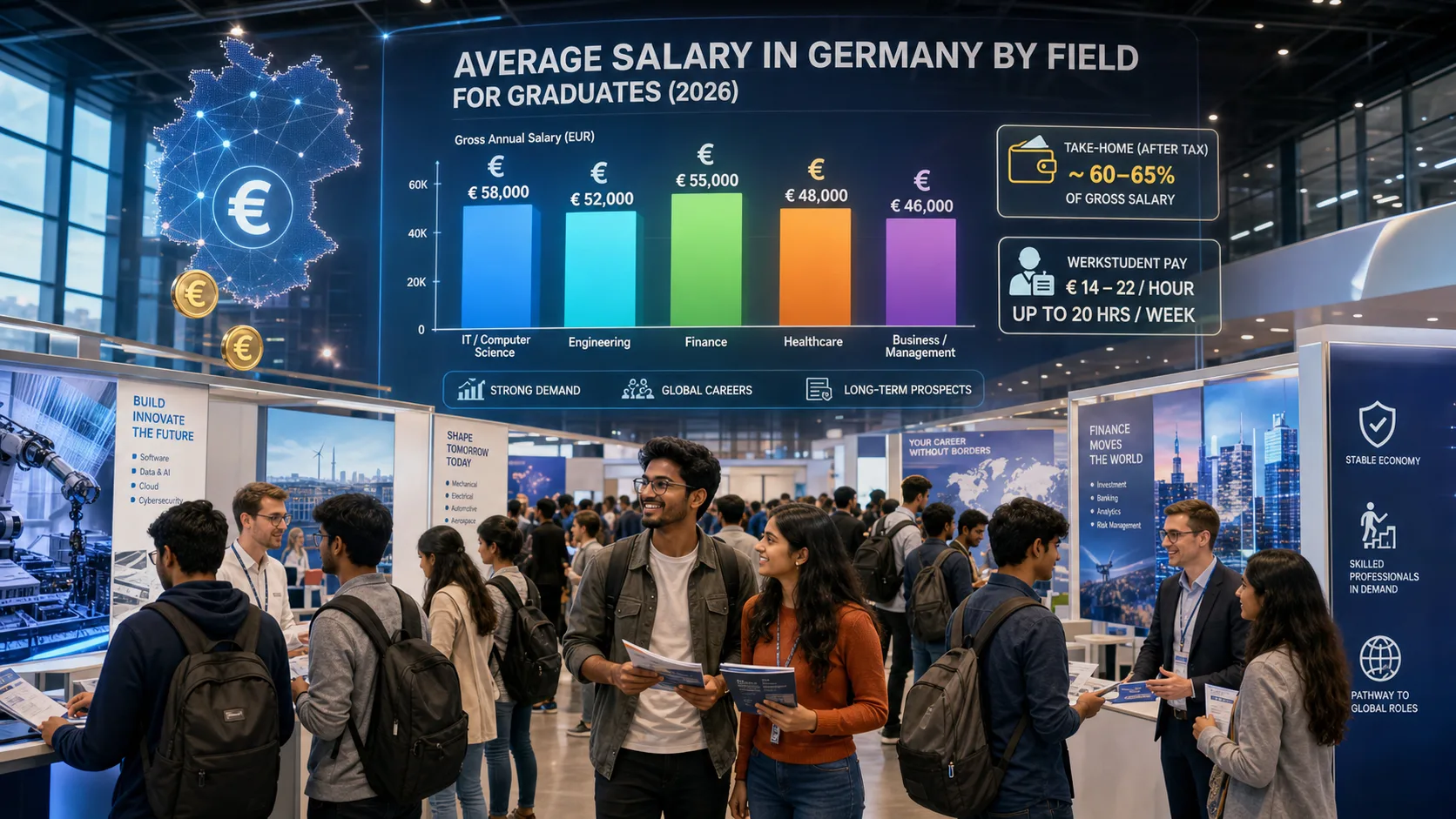
Werkstudent positions are the gold standard for international students. These are part-time jobs directly related to your field of study, for example, a computer science student working as a Werkstudent at SAP or Bosch. Werkstudent roles typically pay €14-20/hour, give you real industry experience for your CV, and are exempt from most social security contributions (you only pay pension insurance). Most students who find a Werkstudent job earn €700-1,000/month, which covers a significant portion of monthly expenses.
Realistically, most Indian students start earning within 3-6 months of arriving in Germany. With a part-time job earning even €500-600/month (₹45,000-54,000), your effective out-of-pocket monthly cost drops to just ₹20,000-40,000, comparable to living expenses in metro Indian cities.
Total 2-Year Master's Cost in INR: The Bottom Line
Here is the full picture, every expense from application to graduation for a 2-year (4-semester) master's programme in Germany.
| Expense | Total for 2 Years (EUR) | Total for 2 Years (INR) |
|---|---|---|
| Tuition | €0 | ₹0 |
| Semester fees (4 semesters) | €600-1,560 | ₹54,000-1,40,400 |
| Blocked account (2 years) | €22,416 | ₹20,17,440 |
| Health insurance (24 months) | €3,360 | ₹3,02,400 |
| Rent (24 months) | €7,200-14,400 | ₹6,48,000-12,96,000 |
| Food (24 months) | €4,800-7,200 | ₹4,32,000-6,48,000 |
| Transport, phone, books, leisure (24 months) | €2,640-6,240 | ₹2,37,600-5,61,600 |
| Visa fee | €75 | ₹6,750 |
| APS fee | , | ₹18,000 |
| uni-assist (3 applications) | €135 | ₹12,150 |
| Flight | , | ₹45,000 |
| Initial settlement | €450 | ₹40,500 |
| Scenario | 2-Year Total (EUR) | 2-Year Total (INR) |
|---|---|---|
| Budget (affordable city) | ~€24,500 | ~₹22,00,000 |
| Comfortable (mid-range city) | ~€29,000 | ~₹26,00,000 |
| Generous (expensive city) | ~€33,500 | ~₹30,00,000 |
Important: These totals include the blocked account amount, which you deposit upfront but withdraw and spend as living expenses in Germany, so it is not an additional cost on top of living expenses. The blocked account is effectively your first year's living expense money held in a special bank account. We include it here to show the total money you need to arrange from India. After accounting for part-time work earnings (₹5,00,000-10,00,000 over two years), your net out-of-pocket cost could be significantly lower.
Germany vs Other Countries: Cost Comparison in INR
How does Germany stack up against other popular destinations for Indian students? The answer is clear, Germany offers the best value for money by a wide margin, thanks to zero tuition at public universities and a lower cost of living than the US, UK, or Australia.
| Country | Tuition (2-Year Master's, INR) | Living Cost (2 Years, INR) | Total (INR) | Work Permit During Studies |
|---|---|---|---|---|
| Germany | ₹0-2,70,000 | ₹22,00,000-30,00,000 | ₹22,00,000-30,00,000 | 140 full days / 280 half days per year |
| USA | ₹30,00,000-60,00,000 | ₹20,00,000-35,00,000 | ₹50,00,000-95,00,000 | On-campus only (20 hrs/week) |
| UK | ₹20,00,000-40,00,000 | ₹18,00,000-28,00,000 | ₹38,00,000-68,00,000 | 20 hrs/week during term |
| Canada | ₹15,00,000-30,00,000 | ₹16,00,000-24,00,000 | ₹31,00,000-54,00,000 | 20 hrs/week (off-campus) |
| Australia | ₹22,00,000-45,00,000 | ₹18,00,000-26,00,000 | ₹40,00,000-71,00,000 | 48 hrs/fortnight |
Germany is the only major study destination where you can complete a full master's degree for under ₹25,00,000, and that includes all living expenses. Add in part-time earnings, and many students end up spending less on their entire German education than they would on tuition alone in the US or UK. Beyond cost, Germany also offers an 18-month post-study work visa and a clear path to permanent residency, making it a long-term investment, not just a degree.
How to Fund Your Studies: Scholarships and Financial Aid
While Germany is already affordable, several scholarships can reduce your costs further:
- DAAD Scholarships, The German Academic Exchange Service offers €992-1,200/month stipends plus health insurance and travel allowance. Highly competitive but fully funded.
- Deutschlandstipendium, €300/month merit-based scholarship available at most German universities. You apply through your university after enrolment.
- Heinrich Böll, Friedrich Ebert, Konrad Adenauer Foundations, Political foundation scholarships offering €992/month plus book allowance for master's students.
- University-specific waivers, Some universities in Baden-Württemberg waive the €1,500 tuition for high-achieving students.
Even without a scholarship, the combination of zero tuition and part-time work makes Germany accessible to students from middle-class Indian families who would struggle to fund a US or UK education.
Start Planning Your Budget Today
Now that you know the exact costs, the next step is to check whether your academic profile qualifies for admission to German universities. Our education consultants can review your grades, test scores, and preferences to recommend the best-fit programmes and create a personalised budget plan.
Ready to take the first step? Get a free profile evaluation from our Germany education experts. We will tell you which universities match your profile, what scholarships you can apply for, and exactly how much your specific plan will cost in Indian Rupees, no obligations, no fees.
Last updated: March 2026. Exchange rate used: 1 EUR = ₹90 INR. Figures sourced from the German Federal Foreign Office, DAAD, and statutory insurance providers. Verify current rates before making financial commitments.
Frequently Asked Questions
You probably qualify for more than you think.
Students who get evaluated find programmes they had no idea existed — at universities that charge nothing. 2 minutes, no cost. The only downside is not checking.
Want our guides higher up in Google?
Mark GradGermany as a preferred source and Google gives our pages more room when you search about studying in Germany. Takes one tap, and you can undo it any time from the same screen.
Living this, or on your way to it? Tell your story.
If you are already in Germany and finding it hard, or still fighting to get here, other students need to hear it from someone real. Share your honest journey. We help shape it, and nothing goes live until you approve it.
Free German Quiz · No Login
Can you score 10/10 on today's German challenge?
10 new words every day · 4,500+ words from A1 to C1 · takes about a minute.
Related Articles


Study in Germany
Public Health - Population and Professions, M.Sc.
Medizinische Hochschule Hannover (MHH)
Hannover
MBAInnovation & Leadership, MBA
Fachhochschule des Mittelstands (FHM)
Rostock, Berlin, Bielefeld, Köln, Bamberg, Hannover, Frechen, Schwerin
M.Eng.Intelligente und nachhaltige Fahrzeugtechnologien (Berufsbegleitendes Studienprogramm des Graduate Campus Hochschule Aalen), M.Eng.
Hochschule Aalen - Technik, Wirtschaft und Gesundheit
Aalen