TUM Germany Fees 2026: Tuition for International Students in EUR and INR
TL;DR: TUM Germany fees for newly enrolling non-EU/EEA students in 2026 are usually €2,000-€3,000 per semester for bachelor's and €4,000-€6,000 per semester for master's, plus the semester fee. At a June 2026 planning rate of about INR 111/EUR, that is roughly INR 2.2-3.3 lakh/semester for bachelor's and INR 4.4-6.7 lakh/semester for master's, before living costs and visa funds.
TUM Germany fees in Indian rupees: 2026 quick answer
For the query TUM Germany fees, the most important number is the non-EU/EEA tuition range. TUM states that tuition generally applies to international students from non-EU countries enrolling in a bachelor's or master's degree programme, with master's programmes usually charged at €4,000 or €6,000 per semester. Always confirm your exact programme amount on the official TUM page before paying.
| TUM fee item | EUR amount | Approx. INR at 111/EUR | Who should budget this? |
|---|---|---|---|
| Bachelor's tuition | €2,000-€3,000/semester | INR 2.22-3.33 lakh/semester | New non-EU/EEA bachelor applicants, unless exempt. |
| Master's tuition | €4,000-€6,000/semester | INR 4.44-6.66 lakh/semester | Most new non-EU/EEA master's applicants. |
| Two-year master's tuition | €16,000-€24,000 total | INR 17.8-26.6 lakh total | Four-semester master's estimate before waivers. |
| Blocked account for visa | €11,904/year | INR 13.2 lakh | Most Indian/non-EU student visa applicants. |
Bottom line: A non-EU Indian student planning a two-year TUM master's should budget tuition of about INR 17.8-26.6 lakh plus living costs, health insurance, semester fees and the first-year blocked account. If you qualify for an exemption or waiver, the tuition line may reduce sharply, but the visa/living budget still remains.
Browse TUM's profile and programmes in our free directory, compare tuition-free alternatives in the Programme Finder, or start with a free profile evaluation to see where your budget goes furthest.
Sources checked: official TUM tuition-fee page, Make it in Germany 2026 financial-proof page, DAAD cost guidance and current EUR/INR market references.
If you’re aiming for the Technical University of Munich in 2026, here’s the short answer: newly enrolling non‑EU/EEA international students now pay tuition fees at TUM, with clear exemptions and multiple waiver options. This guide explains the exact rules, fee ranges, deadlines, and smart ways to budget and apply confidently.
Why the Technical University of Munich in 2026?
The Technical University of Munich (TUM) is consistently ranked among Europe’s elite for engineering, computer science, AI, and life sciences. With strong industry ties in Bavaria and a research-driven learning model, TUM positions graduates for high-impact careers across technology, automotive, biotech, and consulting. While tuition has changed for some applicants, TUM remains far more affordable than many global peers when you factor in living costs, work opportunities, and scholarships.
What changed at TUM? New tuition rules explained
Beginning Winter Semester 2024/25, TUM introduced tuition fees for newly enrolling non‑EU/EEA international students in Bachelor’s and Master’s programs. If you’re applying for 2026 intakes, these rules apply to you. The fees are program-specific and paid in addition to the standard semester fee (roughly €150 for student services and basic transit access). MBA and executive programs follow separate, typically higher, totals.
Key figures at a glance (2026)
| Item | 2026 Amount / Rule | Notes |
|---|---|---|
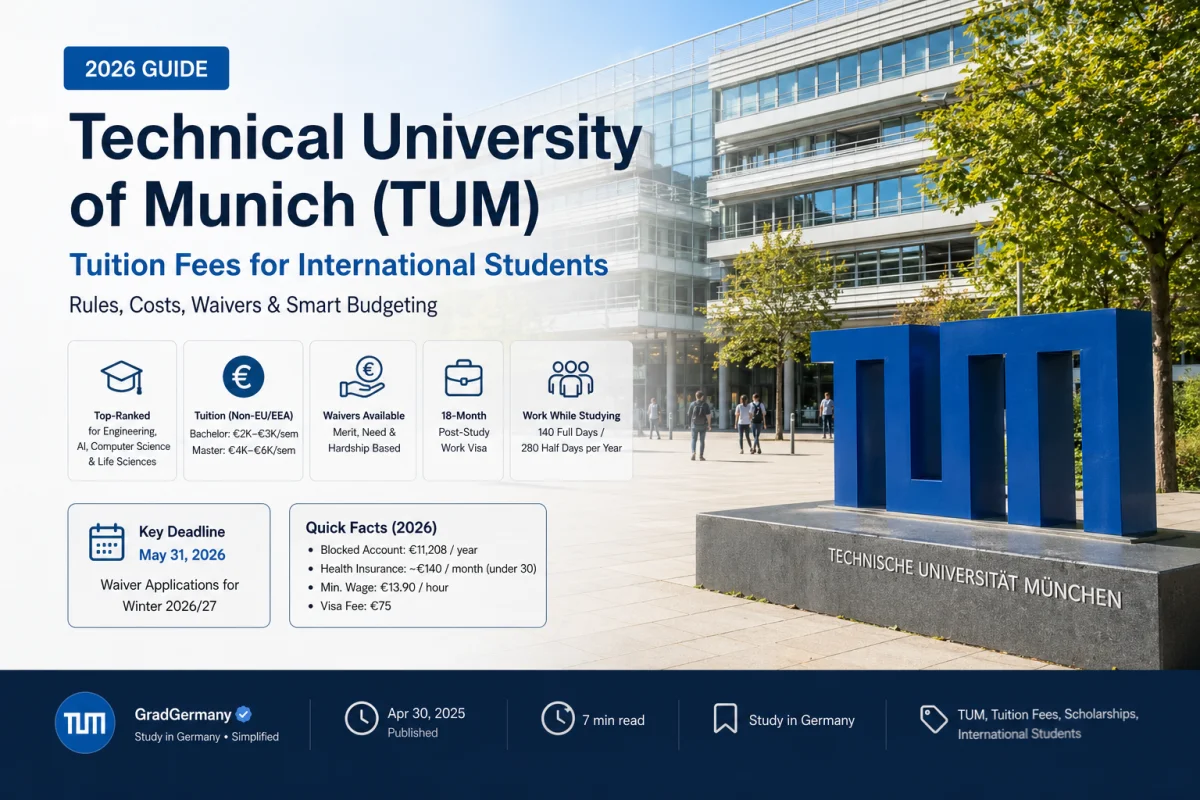
| TUM tuition (non‑EU/EEA) | Bachelor: €2,000-€3,000 per semester Master: €4,000-€6,000 per semester | Program-specific; in addition to semester fee (~€150) |
| MBA/Executive (indicative) | €16,000-€32,000+ total | Varies by track and duration |
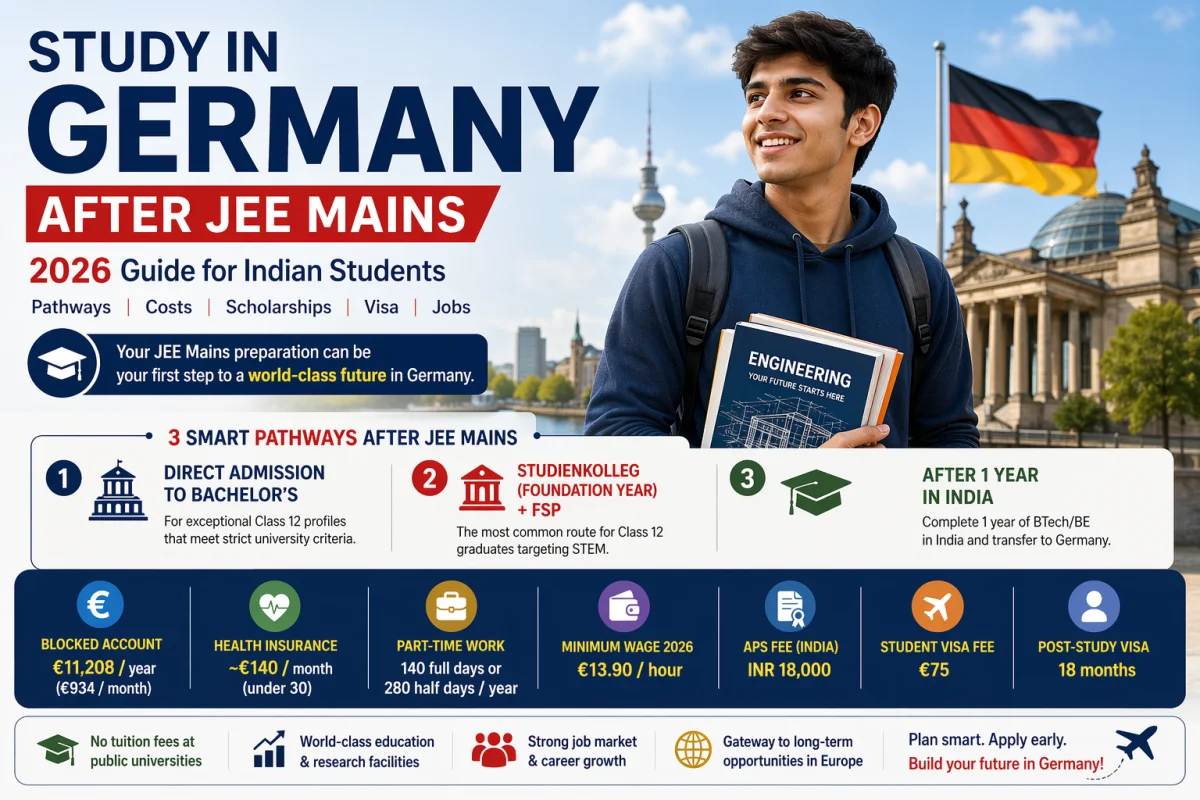
| Student work limit | 140 full days or 280 half days/year | For international students on a study visa |
| Minimum wage (Germany) | €13.90/hour | Helps estimate part-time earnings |
| Blocked account | €11,904/year (€992/month) | Financial proof for most student visas |
| Student health insurance | ~€140/month (under 30) | Public student tariff; private alternatives exist |
| Visa fee | €75 | Payable at visa application |
| APS fee (India) | INR 18,000 | Required for many India-origin applicants |
| Post-study work visa | 18 months | To find qualified employment after graduation |
| EU Blue Card thresholds | €45,934 (shortage) / €50,700 (general) | Annual gross salary requirements in 2026 |
Who pays tuition at TUM, and who is exempt?
The new structure targets newly enrolling non‑EU/EEA students in Bachelor’s and Master’s programs. However, several categories are exempt from the tuition component:
- EU/EEA citizens (including Iceland, Liechtenstein, Norway)
- Students with a German educational background (e.g., Abitur or a prior degree from within the German system)
- Strong domestic ties (e.g., 5+ years of residence in Germany prior to studies, or a parent who worked in Germany for at least 3 of the last 6 years)
- Recognized refugees/asylum seekers
- Doctoral candidates (PhD) for whom these specific tuition rules do not apply
- Continuing students enrolled before Winter 2024/25 (“grandfathered”)
If you’re unsure whether one of these applies to you, TUM will assess documentation during admission and enrollment. Always collect official proofs early (residence history, parental employment confirmations, prior education records).
How much are TUM tuition fees for international students?
For most non‑EU/EEA students starting a new Bachelor’s or Master’s in 2026, expect the following per-semester fee ranges:
- Bachelor’s programs: €2,000-€3,000 per semester
- Master’s programs: €4,000-€6,000 per semester
- MBA/Executive programs: often quoted as a total per program (indicatively €16,000-€32,000+)
These remain in addition to the semester fee (~€150). Exact tuition is program-specific, so always check the program page or TUM’s tuition navigator while planning your budget and scholarship strategy.
Scholarships and waivers: how to reduce or eliminate tuition
TUM operates multiple “financial lifelines” so that strong candidates aren’t excluded due to cost. These typically include:
- Merit-based waivers: For Master’s students, awards can start from the first semester if you rank among the top 5% of your graduating cohort at your home university. Bachelor’s students can usually apply from the second semester based on TUM grades.
- Need-based waivers: For students who can show that paying tuition would cause significant financial hardship. Expect to submit up to 18 months of bank statements and household income proofs.
- Social hardship waivers: For unexpected crises after enrollment (e.g., economic or political instability at home, medical or family emergencies) that impact your finances.
Key timing: For Winter Semester 2026/27, waiver scholarship applications typically close by May 31, 2026. Prepare documents early and have official translations ready.
Step-by-step: how to plan, apply, and secure funding
- Identify your TUM program and tuition amount. Use the program page and tuition navigator to confirm the exact fee per semester and any discipline-specific rules. Make a 2-year or 4-year cost projection.
- Check exemption criteria. If you have EU/EEA citizenship, German schooling, long-term residence, or parental employment in Germany, gather documents to prove your status.
- Decide your scholarship route. If you expect to be in the top 5% academically, prioritize a merit-based waiver. If finances are tight, plan for a need-based waiver and assemble bank/income evidence early.
- Translate and certify documents. All proofs (financials, rank letters) must be in German or English via a sworn translator.
- Prepare visa financials. Most applicants must open a blocked account for €11,904/year and budget for health insurance (~€140/month). Start early to avoid delays.
- Submit TUM application on time. Align your degree application deadlines with scholarship timelines. For Winter 2026/27, aim to have your waiver application submitted before May 31, 2026.
- Track status and plan backups. If a waiver is pending, prepare a backup funding plan (family support, education loan, or external scholarships) to keep your enrollment on track.
Budgeting for TUM: tuition plus living costs
Beyond tuition, Munich is one of Germany’s costlier cities, especially for housing. Plan holistically:
- Tuition (if applicable): Bachelor €2,000-€3,000; Master €4,000-€6,000 per semester
- Semester fee: ~€150 per semester
- Accommodation: Private rooms/studios in Munich are premium-priced; consider student housing waitlists early
Health insurance: ~€150/month under 30; budget more if over 30 or choosing private coverage
- Transportation: Semester ticket/basic transit often partly covered via the semester fee; check current regional offers
- Food and personal: Varies; student canteens and discounts help
For a complete Germany-wide picture and Munich-specific notes, see our detailed guide on the cost of studying.
Can international students work while studying at TUM?
Yes. In 2026, the federal rule allows up to 140 full days or 280 half days per year, with a minimum wage of €13.90/hour. Part-time roles include research assistantships, student jobs at TUM, or industry internships in Munich’s vibrant tech ecosystem. To plan your earning potential and compliance, read our guide to part-time jobs.
Comparison: TUM vs. typical international tuition
| Destination | Typical Annual Tuition (STEM Master) | Notes |
|---|---|---|
| Technical University of Munich (non‑EU/EEA) | €8,000-€12,000 | €4,000-€6,000 per semester; plus semester fee |
| United Kingdom (top universities) | £28,000-£40,000 | One-year Master’s common; living costs high in London |
| United States (top public/private) | $35,000-$65,000 | Excludes health insurance and campus fees |
| Other EU public universities (non‑EU fees) | €6,000-€18,000 | Varies by country and program |
Even with the new policy, TUM’s total cost remains competitive, especially when adding Germany’s robust work rights, affordable insurance, and strong post-study pathways.
Admissions and documents: avoid common pitfalls
- Application routes: Some programs may require applying via uni-assist; others accept direct TUM applications. Always check your program page.
- APS (India): Applicants educated in India often need an APS certificate before the visa. Book your slot early due to processing queues.
- Financial proof for visas: Most students will need a blocked account showing €11,904/year, plus liquidity for initial setup and rent deposits.
- Health insurance: Budget ~€140/month and decide between public student insurance and approved private options. Our primer on health insurance explains both.
- Translations: Use sworn translators for transcripts, rank letters, and financial proofs (German or English).
Timeline for Winter 2026/27 applicants
- Now-March 2026: Finalize program shortlist, check exact tuition per course, and confirm whether you’re subject to fees or exempt.
- By April 2026: Arrange APS (if applicable), standardized tests (if required), sworn translations, and open your blocked account.
- By May 31, 2026: Target deadline for TUM tuition waiver applications for Winter 2026/27.
- June-July 2026: Submit university application(s), track decisions, and prepare visa documents (visa fee €75, insurance proof, accommodation plan).
- August-September 2026: Receive enrollment instructions, pay semester fee and tuition (if applicable), finalize housing, and pre-register for student services.
Are TUM’s fee exemptions realistic for diaspora students?
Yes, many international diaspora candidates qualify via German schooling backgrounds, long-term residence, or parental employment. If you fall close to one of these criteria, document everything: residence registrations, social insurance records, school leaving certificates, and employment contracts. Clear records significantly improve your exemption review.
Maximizing your chance of a tuition waiver at TUM
- Academic excellence: If you’re a Master’s applicant, obtain an official letter stating you’re in the top 5% of your graduating class. For Bachelor’s, aim for strong first-year grades at TUM to qualify from semester two.
- Compelling need case: Build a consistent financial story with bank statements (up to 18 months), sponsor affidavits, and income proofs. Avoid unexplained large transfers.
- Program alignment: Showcase how your research interests and achievements fit TUM’s strengths (AI, robotics, mobility, energy, life sciences). Strong fit helps your overall profile.
- Apply early: Treat May 31, 2026 as a hard deadline. Late or incomplete files rarely receive favorable consideration.
Life after TUM: jobs and residence options
Germany offers an 18‑month post‑study work visa to find qualified employment. Graduates who secure roles meeting the EU Blue Card thresholds (€45,934 for shortage occupations; €50,700 general in 2026) gain a strong pathway to long-term residence. Munich’s tech and industrial base, automotive, robotics, chips, and biotech, offers high-quality roles aligned with TUM expertise.
Smart tips for your TUM application
- Use program pages and tuition navigator to confirm exact fees before applying.
- Gather exemption proofs early if you suspect you qualify, residence, parental employment, or German schooling.
- If you’re India-educated, initiate your APS certificate and keep buffer time.
- Map your funding: tuition/semester fee, blocked account, and insurance. Add a contingency for housing deposits.
- Practice concise, impact-focused statements about your research/industry fit with TUM labs and chairs.
Where does TUM fit among Germany’s top technical universities?
TUM is frequently cited alongside other leading technical institutions and is a headline member in discussions of Germany’s engineering excellence. If you are comparing options across the country, explore our deep-dive on TU9 universities to understand specialization strengths, locations, and industry clusters.
Final checklist for 2026 applicants
- Confirmed whether you are subject to tuition or exempt
- Projected your full study budget (tuition + living + insurance + visa)
- Chosen your waiver path (merit/need/hardship) and started documents
- Booked translations and, if needed, initiated APS
- Opened your blocked account and planned first-semester cash flow
- Aligned program and waiver timelines (target May 31, 2026 for waivers)
Ready to turn your TUM plan into an admit with a sustainable budget? Get a tailored shortlist, tuition and waiver strategy, and a document roadmap with GradGermany’s experts. Explore curated degrees on our programmes page or start with a free profile evaluation today.
Frequently Asked Questions
You probably qualify for more than you think.
Students who get evaluated find programmes they had no idea existed — at universities that charge nothing. 2 minutes, no cost. The only downside is not checking.
Want our guides higher up in Google?
Mark GradGermany as a preferred source and Google gives our pages more room when you search about studying in Germany. Takes one tap, and you can undo it any time from the same screen.
Get new guides as soon as they go live
Add our feed to Feedly, Inoreader or any RSS reader and every new guide on studying in Germany shows up there by itself. No email, no sign-up.
Living this, or on your way to it? Tell your story.
If you are already in Germany and finding it hard, or still fighting to get here, other students need to hear it from someone real. Share your honest journey. We help shape it, and nothing goes live until you approve it.
Related Guides
Free German Quiz · No Login
Can you score 10/10 on today's German challenge?
10 new words every day · 4,500+ words from A1 to C1 · takes about a minute.