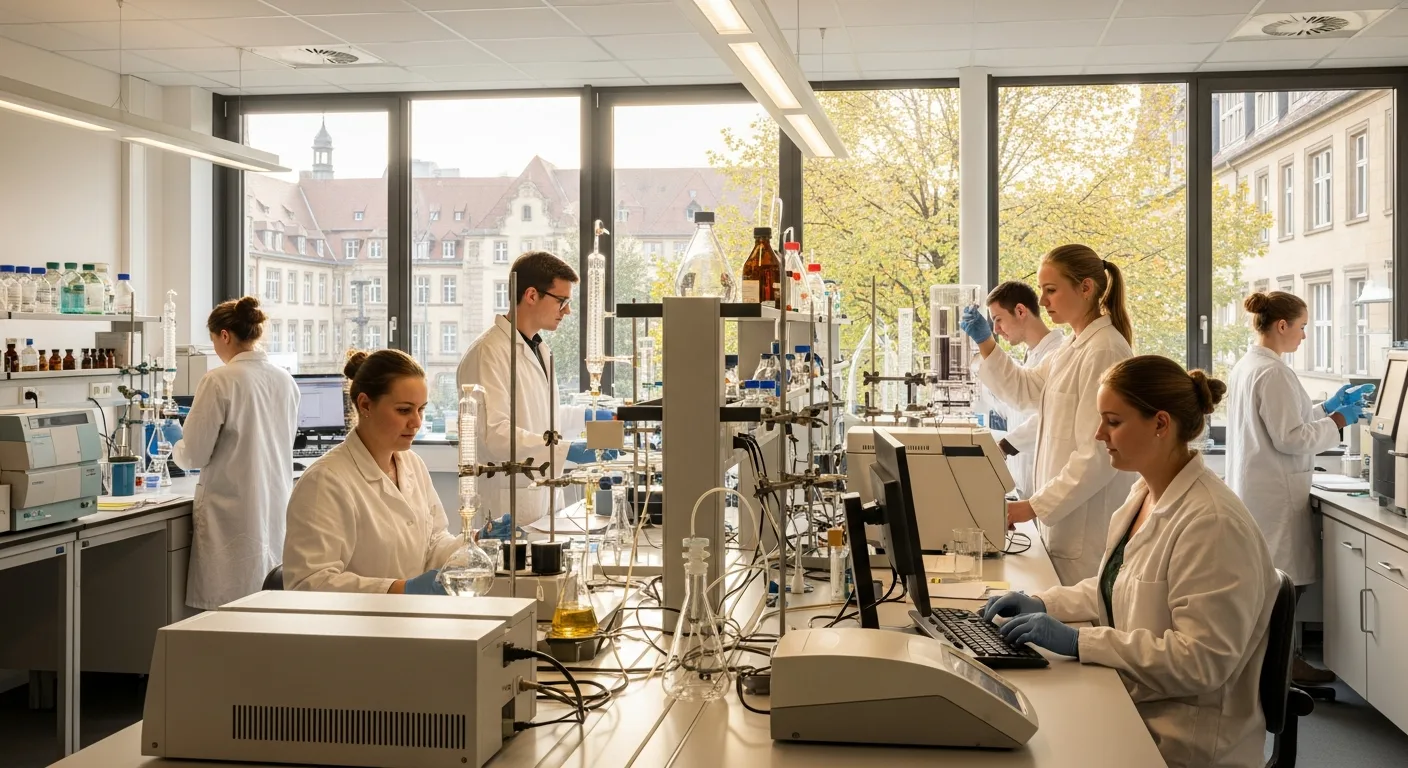
Chemistry
Programmes in Germany
Germany is the birthplace of modern chemistry and home to Nobel Prize-winning research institutions. Study organic chemistry, pharmaceutical chemistry, biochemistry, and more at tuition-free public universities — where groundbreaking science meets outstanding career prospects.
Chemistry Programmes
Tuition at Public Universities
Average Chemist Salary
Nobel Prizes in Chemistry
Showing 145–168 of 585 programmes
Chemie - Lehramt für das Gymnasium (auch Gesamtschulen) (Erstfach), B.A. / B.Sc.
Gottfried Wilhelm Leibniz Universität Hannover · Hannover
Chemie - Lehramt für das Gymnasium (auch Gesamtschulen) (Zweitfach), B.A. / B.Sc.
Gottfried Wilhelm Leibniz Universität Hannover · Hannover
Chemie - Lehramt für das Gymnasium (auch Gesamtschulen) (Zweitfach), M.Ed.
Gottfried Wilhelm Leibniz Universität Hannover · Hannover
Chemie - Lehramt für die allgemeinbildenden Fächer der Sekundarstufe II und das Gymnasium (auch Gesamtschulen), 2-Fach-Bachelor
Universität Münster · Münster
Apply by 9 Oct · 23d leftChemie - Lehramt für die allgemeinbildenden Fächer der Sekundarstufe II und das Gymnasium (auch Gesamtschulen), B.Sc.
Universität Ulm · Ulm
Apply by 15 Nov · 60d leftChemie - Lehramt für die allgemeinbildenden Fächer der Sekundarstufe II und das Gymnasium (auch Gesamtschulen), Lehramt für die beruflichen Fächer der Sekundarstufe II, M.Ed.
Gottfried Wilhelm Leibniz Universität Hannover · Hannover
Chemie - Lehramt für die allgemeinbildenden Fächer der Sekundarstufe II und das Gymnasium (auch Gesamtschulen), M.Ed.
Universität Ulm · Ulm
Apply by 15 Nov · 60d leftChemie - Lehramt für die allgemeinbildenden Fächer der Sekundarstufe II und das Gymnasium (auch Gesamtschulen), M.Ed.
Universität Münster · Münster
Apply by 9 Oct · 23d leftChemie - Lehramt für die allgemeinbildenden Fächer der Sekundarstufe II und das Gymnasium (auch Gesamtschulen), M.Ed.
Universität Duisburg-Essen · Essen
Chemie - Lehramt für die allgemeinbildenden Fächer der Sekundarstufe II und das Gymnasium (auch Gesamtschulen), M.Ed.
Freie Universität Berlin · Berlin
Chemie - Lehramt für die allgemeinbildenden Fächer der Sekundarstufe II und das Gymnasium (auch Gesamtschulen), M.Ed.
Bergische Universität Wuppertal · Wuppertal
Chemie - Lehramt für die beruflichen Fächer der Sekundarstufe II, B.A. / B.Sc.
Gottfried Wilhelm Leibniz Universität Hannover · Hannover
Apply by 30 Sep · 14d leftChemie - Lehramt für die beruflichen Fächer der Sekundarstufe II, B.Sc.
Universität Münster · Münster
Apply by 9 Oct · 23d leftChemie - Lehramt für die beruflichen Fächer der Sekundarstufe II, B.Sc.
Universität Siegen · Siegen
Apply by 15 Nov · 60d leftChemie - Lehramt für die beruflichen Fächer der Sekundarstufe II, M.Ed.
Universität Münster · Münster
Apply by 9 Oct · 23d leftChemie - Lehramt für die beruflichen Fächer der Sekundarstufe II, M.Ed.
Universität Duisburg-Essen · Essen
Chemie - Lehramt für die beruflichen Fächer der Sekundarstufe II, M.Ed.
Universität Siegen · Siegen
Apply by 15 Nov · 60d leftChemie - Lehramt für die beruflichen Fächer der Sekundarstufe II, M.Ed.
Bergische Universität Wuppertal · Wuppertal
Chemie - Lehramt für HRSGe, B.Sc.
Universität Bielefeld · Bielefeld
Apply by 15 Nov · 60d leftChemie - Lehramt für sonderpädagogische Förderung, B.A.
Universität Münster · Münster
Apply by 9 Oct · 23d leftChemie - Lehramt für sonderpädagogische Förderung, M.Ed.
Universität Münster · Münster
Apply by 9 Oct · 23d leftChemie - Lehramt Grundschule, M.Ed.
Universität Koblenz-Landau (jetzt: Universität Koblenz/RPTU) · Koblenz
Chemie - Lehramt Gymnasium, M.Ed.
Technische Universität Kaiserslautern (jetzt: RPTU) · Kaiserslautern
Chemie - Lehramt Gymnasium, M.Ed.
Universität Koblenz-Landau (jetzt: Universität Koblenz/RPTU) · Koblenz
Check My Fit
3 quick questions — every result gets a fit tag based on your budget and languages. Stored only on this device.
Tags are an indication based on tuition and teaching language — for a real assessment, get a free profile evaluation.
What You'll Study — Chemistry Specializations
A chemistry master's in Germany usually builds on a broad bachelor's foundation and then lets you specialise. Most programmes combine taught modules with substantial lab work and a research thesis. The exact structure varies by university, but the core areas below are common across German faculties.
Organic Chemistry
Synthesis, reaction mechanisms, catalysis and medicinal chemistry — the backbone of the pharmaceutical and fine-chemical industries.
Inorganic & Materials Chemistry
Coordination chemistry, solid-state materials, electrochemistry and energy storage — closely tied to Germany's materials-science strength.
Physical & Theoretical Chemistry
Spectroscopy, thermodynamics, kinetics and computational modelling that underpin modern instrumentation and simulation.
Analytical Chemistry
Separation science, mass spectrometry and quality control — central to environmental, food and quality-assurance roles.
Biochemistry & Chemical Biology
The chemistry of living systems, protein science and drug discovery, often shared with biotechnology and life-science faculties.
Pharmaceutical & Green Chemistry
Drug design, process chemistry and sustainable, low-waste synthesis — a growing focus across German research groups.
Not sure which track matches your background? A free profile evaluation can map your bachelor's coursework to the specialisations you're most likely to be admitted into.
Entry Requirements for Chemistry in Germany
Requirements differ by university and programme, so always check the individual programme page. The points below reflect what German chemistry faculties typically expect from international applicants.
Academic background
A recognised bachelor's degree in chemistry or a closely related field (biochemistry, chemical engineering, materials science), generally with a solid grade average. Many programmes look for sufficient coverage of organic, inorganic, physical and analytical chemistry plus laboratory experience.
Language proficiency
English-taught master's programmes typically ask for IELTS or TOEFL (often around IELTS 6.5). German-taught programmes generally require proof such as TestDaF or DSH. Even on English tracks, some everyday German helps with lab placements and daily life.
APS certificate & uni-assist
Applicants from India, China and Vietnam generally need an APS certificate verifying their academic documents before they apply. Many universities also process international applications through uni-assist, which pre-checks your credentials for a service fee.
GRE & other tests
The GRE is generally not required for chemistry master's programmes in Germany — a notable difference from many US applications. Some programmes may set additional subject prerequisites or a motivation letter instead.
Requirements and document rules change over time and vary by institution. Browse current options from the GradGermany homepage, and verify each programme's official admission page before applying.
Careers & Salaries for Chemists in Germany
Germany has one of the largest chemical and pharmaceutical industries in the world, anchored by major employers and a dense network of research institutes. Chemistry graduates work across R&D, production, quality control, regulatory affairs and academia. The salary ranges below are approximate and vary widely by role, region, employer and qualification level.
Typical roles
Lab and R&D chemist, analytical chemist, process & production chemist, quality-control specialist, regulatory affairs, and academic researcher. A PhD is common — and often expected — for senior research and industry leadership roles.
Entry-level pay
Master's-level graduates typically start at around €48,000–€58,000 per year, with figures depending heavily on industry, location and employer collective-bargaining agreements.
Experienced & PhD pay
With a PhD or several years of experience, salaries commonly move into roughly the €65,000–€90,000 range, and higher in management or specialised pharmaceutical roles.
Staying to work after graduation
International graduates of a German university can generally apply for a post-study job-seeker residence permit — commonly up to 18 months — to look for a position related to their degree. Once you secure a qualifying job, you can usually switch to a work residence permit or EU Blue Card. Germany's structural shortage of STEM professionals makes chemistry a strong field for long-term career prospects.
Frequently Asked Questions About Chemistry in Germany
Yes. Public universities in Germany charge no tuition fees for chemistry programmes at both Bachelor's and Master's level, regardless of your nationality. Students pay only a small semester contribution of €150–€350, which typically includes a public transport pass covering the entire city or region. The sole exception is Baden-Württemberg, where non-EU students pay €1,500 per semester — still far below the cost of comparable programmes in the US ($30,000–$60,000 per year), UK (£20,000–£35,000), or Australia (AUD 35,000–70,000). Monthly living costs average €934 according to the DAAD, meaning a two-year chemistry Master's can be completed for under €25,000 in total. Indian students must open a blocked account (Sperrkonto) of €11,904 for the student visa, which covers one year of living costs. Many chemistry students also earn €12–€15 per hour as research assistants (HiWi positions) in university labs, which helps offset expenses while providing invaluable hands-on research experience.
Germany is home to several world-leading chemistry departments. Ludwig-Maximilians-Universität München (LMU) and Technische Universität München (TUM) consistently rank among the global top 50 for chemistry, with exceptional strengths in catalysis, nanochemistry, and polymer science. Ruprecht-Karls-Universität Heidelberg houses the renowned Heidelberg Institute for Theoretical Studies and excels in molecular chemistry and spectroscopy. RWTH Aachen is a powerhouse in industrial and technical chemistry with strong ties to the chemical industry in the Rhine-Ruhr region. Georg-August-Universität Göttingen has a storied chemistry tradition, with multiple Nobel laureates. The Karlsruher Institut für Technologie (KIT) bridges fundamental chemistry research with materials science and nanotechnology applications. Freie Universität Berlin and Humboldt-Universität zu Berlin offer access to Berlin's vibrant research ecosystem, including the Helmholtz-Zentrum Berlin and the Fritz Haber Institute of the Max Planck Society.
Yes. A growing number of German universities offer chemistry programmes taught entirely in English, particularly at the Master's level. English-taught programmes are available in specialisations such as molecular chemistry, materials chemistry, pharmaceutical sciences, and chemical biology. Universities including TU Munich, RWTH Aachen, Heidelberg University, and Jacobs University Bremen offer English-medium chemistry Master's programmes. Admission typically requires IELTS 6.5+ or TOEFL 90+, along with a Bachelor's degree in chemistry or a closely related field with a strong foundation in organic, inorganic, physical, and analytical chemistry. At the Bachelor's level, most programmes are taught in German, requiring B2 or C1 proficiency. However, even in German-taught programmes, much of the advanced coursework, lab reports, and thesis research are conducted in English, as it is the international language of chemical research. Learning German to A2 or B1 level is recommended for daily life and will significantly expand your career opportunities in Germany's chemical industry after graduation.
Admission requirements vary by university and programme level. For Bachelor's programmes, you need a recognised secondary school qualification (such as the Indian 12th standard with strong marks in chemistry, physics, and mathematics), proof of German language proficiency (typically TestDaF 4x4 or DSH-2), and for some universities, subject-specific entrance requirements in mathematics and natural sciences. For Master's programmes, you need a Bachelor's degree in chemistry or a closely related discipline (biochemistry, chemical engineering, materials science) with a minimum GPA equivalent, typically 2.5 on the German scale or above 60% in the Indian system. Most Master's programmes require demonstrated knowledge in core chemistry areas: organic, inorganic, physical, and analytical chemistry, plus laboratory experience. English-taught Master's programmes require IELTS 6.5+ or TOEFL 90+. Some competitive programmes at TU Munich and Heidelberg may require GRE subject test scores or a motivation letter detailing your research interests. Prior lab experience and undergraduate research projects strengthen your application considerably.
Chemists in Germany enjoy strong earning potential across industry and academia. Entry-level chemists with a Master's degree typically earn between €45,000 and €55,000 per year, while those with a PhD start at €55,000–€70,000. The chemical and pharmaceutical industry in Germany is Europe's largest, with major employers including BASF (the world's largest chemical company, headquartered in Ludwigshafen), Bayer (pharmaceuticals and crop science), Merck (Darmstadt), Evonik, Henkel, and Covestro. Experienced chemists with 5–10 years in industry command salaries of €75,000–€100,000, and senior R&D managers or patent attorneys with a chemistry background can exceed €120,000. The German Chemical Industry Association (VCI) reports consistently strong demand for qualified chemists, particularly in pharmaceutical development, materials innovation, and sustainability-focused green chemistry. Regional salary variations exist: Munich, Frankfurt, and the Rhine-Neckar metropolitan area (Mannheim/Ludwigshafen/Heidelberg) offer the highest compensation packages.
Germany offers unparalleled chemistry research opportunities through its network of world-class institutions. The Max Planck Society operates dedicated chemistry institutes including the Max Planck Institute for Chemical Energy Conversion (Mülheim), Max Planck Institute for Polymer Research (Mainz), and the Fritz Haber Institute (Berlin), where students can pursue thesis projects and research assistantships alongside leading scientists. The Fraunhofer Society focuses on applied chemistry research, with institutes specialising in surface engineering, silicate research, and chemical technology. The Helmholtz Association funds large-scale research in materials science, energy storage, and catalysis across multiple centres. German universities maintain strong ties with the €230-billion German chemical industry, enabling students to participate in collaborative research projects with BASF, Bayer, Merck, and Evonik. Many programmes include mandatory research internships and thesis projects conducted in industry or research institute labs. The DAAD and DFG fund numerous scholarships and research grants specifically for international chemistry students, including the prestigious RISE programme for undergraduate research internships in German labs.
Explore More Programmes in Germany
Start Your Chemistry Career
in Germany
Get a free profile evaluation from our experts. We'll assess your academic background, recommend the best Chemistry programmes, and guide you through the entire application process.