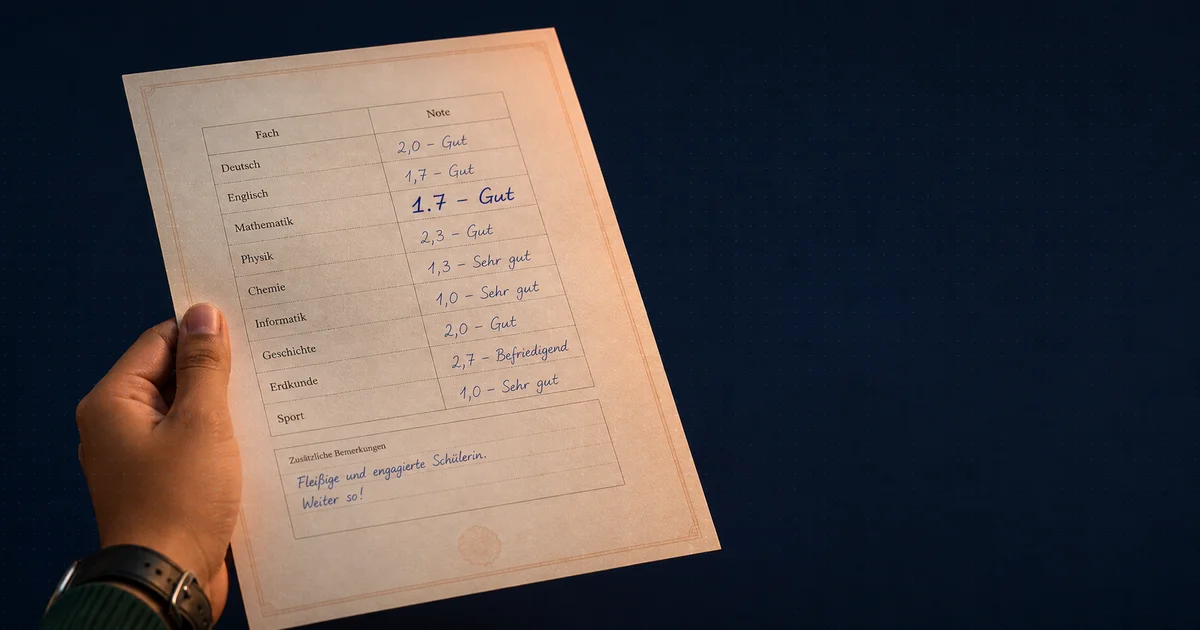
Quick answer: The German grading system runs from 1.0 (sehr gut, the best) to 5.0 (nicht ausreichend, fail), with 4.0 the minimum pass. Lower numbers are better: 1.0-1.5 is very good, 1.6-2.5 good, 2.6-3.5 satisfactory, 3.6-4.0 sufficient. Most Masters programmes expect 2.5 or better.
TL;DR: Germany grades from 1.0 (best) to 5.0 (fail), where 4.0 is the minimum to pass, the inverse of the US 4.0 GPA scale. The 1.0-1.5 band is sehr gut, 1.6-2.5 is gut, 2.6-3.5 is befriedigend, and 3.6-4.0 is ausreichend. Indian and other international grades are converted using the official Modified Bavarian Formula, standardised by Germany’s Conference of Education Ministers (KMK) in 2004.
The German Grade Scale, All Five Bands
The 1.0-5.0 scale is used at every German public university and most private ones. Grades are reported to one decimal place (e.g. 1.7, 2.3, 2.8), giving more granularity than a typical letter-grade system. Some faculties round to 0.3 increments (1.0, 1.3, 1.7, 2.0, 2.3, 2.7, 3.0, 3.3, 3.7, 4.0); others allow any decimal.
| Range | German term | English meaning | What it signals |
|---|---|---|---|
| 1.0-1.5 | Sehr gut | Very good, outstanding performance | Top of the cohort. Competitive for the most selective Master’s programmes (TUM, RWTH Aachen, LMU) and DAAD scholarships. |
| 1.6-2.5 | Gut | Good, substantially above average | A strong fit for almost all major German Master’s programmes. The most common band among accepted international applicants. |
| 2.6-3.5 | Befriedigend | Satisfactory, meets average requirements | Eligible for many programmes; you may need to focus on Universities of Applied Sciences (Fachhochschulen) for top picks. |
| 3.6-4.0 | Ausreichend | Sufficient, minimum to pass | A passing grade, but options for Master’s study narrow significantly. A profile evaluation is recommended. |
| 5.0 | Nicht ausreichend / Mangelhaft | Not sufficient, failed | Below the requirements. The course must be retaken. |
Two things worth noting up front. First, German universities do not use a 4.0 ceiling the way US universities do; the practical scale runs from 1.0 to 4.0 for passing work, with 5.0 reserved for failure. Second, the final grade you graduate with (your Gesamtnote) is a weighted average of your course grades plus your thesis, with the thesis often counting for 20-30% of the total, so a strong dissertation can meaningfully lift your overall mark.
Why German Grades Run Backward
The "lower is better" convention is one of the first things that surprises Indian applicants. The historical thread runs deep: Germany’s modern Notensystem was standardised nationwide in 1938 and continued by the Federal Republic of Germany after 1949, but the underlying logic of treating "1" as the highest mark inherits from the Prussian education system that began in 1763 with Frederick the Great’s Generallandschulreglement, one of Europe’s first compulsory primary-school decrees. The numerical 1-to-6 scale evolved from earlier verbal three-tier and five-tier school assessments around 1850, and remains in use across all 16 federal states today.
For internationals, the operative date is 2004. That’s when the Kultusministerkonferenz (KMK), the standing committee of education ministers from all German states, formally adopted the Modified Bavarian Formula as the standardised method for converting foreign grades to the German 1.0-4.0 scale. Every German public university and the central application service uni-assist uses this formula today. That single number, your converted German grade, is what admissions committees compare against German Abitur and Bachelor grades when ranking candidates for limited seats.
What Counts as a "Good" Grade in Germany?
This is the question every applicant actually wants answered, and the honest reply is "it depends on the use case." Below are realistic targets by application type, drawn from published cutoffs and 2026 admissions data.
For Bachelor’s (undergraduate) admission
Direct undergraduate admission with an Indian Class 12 transcript requires a minimum of 70% in board exams as of Winter Semester 2026/27, this is a recent change announced by APS India. Below 70%, the path is typically Studienkolleg (a one-year foundation programme) followed by undergraduate study, but the new 70% floor also applies to Studienkolleg eligibility. Read our full guide to the 70% rule for details.
For Master’s admission, the most common case
Most German Master’s programmes expect 2.5 or better (the gut band), that maps to roughly 7.0 CGPA or 70% on Indian transcripts.
- Top-tier programmes at Technical University of Munich (TUM), RWTH Aachen, LMU Munich, KIT Karlsruhe and Heidelberg typically want 2.0 or better for selective streams (CS, AI/ML, Engineering, Medicine). TUM’s overall acceptance rate runs 8-10%; RWTH around 23%; LMU around 18%.
- Mid-tier public universities generally accept 2.5-3.0.
- Universities of Applied Sciences (Fachhochschulen) are typically more flexible and often accept up to 3.0, with some accepting 3.3.
For DAAD scholarships
The DAAD does not publish a hard CGPA cutoff. In practice, successful Indian applicants typically have 8.0/10 CGPA or 75%+ (German equivalent ~2.0), and the strongest applicants come in at 8.5+/85%+. India’s overall DAAD success rate sits around 10%, and the DAAD itself emphasises that grades are necessary but not sufficient, your motivation letter, research alignment, references, and social engagement weigh as heavily as raw marks.
For PhD / research positions
Doctoral admission and DAAD doctoral funding generally expect 1.5 or better (top of gut, into sehr gut) for the Master’s degree on which you’re applying. Strong publications or thesis work can compensate for a slightly weaker grade, but unfunded direct-PhD offers below 2.0 are uncommon at top institutions.
How Your Indian Grade Converts to the German Scale
The official conversion uses the Modified Bavarian Formula:
German grade = 1 + 3 × (Nmax − Nd) / (Nmax − Nmin)
Where:
- Nmax = highest possible grade in your home system
- Nmin = minimum passing grade in your home system
- Nd = the grade you actually achieved
For a 10-point Indian CGPA: Nmax = 10, Nmin = 4 (the typical pass mark at most Indian universities). For Indian percentage transcripts: Nmax = 100, Nmin = 33.
Worked examples (Indian CGPA → German grade)
| Indian CGPA (out of 10) | German grade | Band |
|---|---|---|
| 9.5 | 1.3 | sehr gut |
| 9.0 | 1.5 | sehr gut |
| 8.5 | 1.8 | gut |
| 8.0 | 2.0 | gut |
| 7.5 | 2.3 | gut |
| 7.0 | 2.5 | gut |
| 6.5 | 2.8 | befriedigend |
| 6.0 | 3.0 | befriedigend |
Worked examples (Indian percentage → German grade)
| Indian percentage | German grade | Band |
|---|---|---|
| 90% | 1.4 | sehr gut |
| 85% | 1.7 | gut |
| 80% | 1.9 | gut |
| 75% | 2.1 | gut |
| 70% | 2.4 | gut |
| 65% | 2.6 | befriedigend |
| 60% | 2.8 | befriedigend |
Want your exact grade converted in one click? Use our German grade converter, it runs the official Modified Bavarian Formula in your browser, supports nine grading systems (Indian CGPA, percentage, Nepali, Chinese, Vietnamese, US 4.0, UK percentage, plus a custom mode), and returns your German grade with the band classification in real time.
What 1.0 Actually Means, And Why It’s Rarer Than You Think
A 1.0 in the German system is genuinely exceptional. It is not the equivalent of a 4.0 GPA in the US, where 4.0 is much more commonly achieved. A 1.0 at TU Munich or LMU Munich typically goes to less than 1% of a graduating cohort; a 1.0-1.5 (the full sehr gut band) is achieved by roughly 15-20% of graduates at top universities and lower at others.
The most common graduation bands at German universities are 2.0-2.5 (gut), which is what the majority of successful Master’s graduates earn. If your converted Indian transcript places you in the gut band, you are in excellent shape for a German Master’s application, not in the middle of the pack. Indian applicants regularly underestimate this and assume they need a 1.0 to be competitive, which is rarely true.
One more myth worth addressing: ausreichend (3.6-4.0) does not mean "you barely failed." It means "you passed at the minimum requirement." Students do graduate with an ausreichend Bachelor’s and successfully pursue a Master’s, especially at applied-science institutions.
The Modified Bavarian Formula in Detail
The full name is misleadingly specific, the formula is not just for Bavaria. It was developed in Bavaria but adopted by the KMK in 2004 as the federal standard, and is now applied uniformly across all 16 German states for international grade conversion.
The formula produces a single value between 1.0 and 4.0 by linearly mapping your home-country grade onto the German scale, anchored at the maximum and the pass mark of your home system. It rounds to one decimal place. Because it is a linear interpolation, your converted grade is determined by where you sit between your country’s pass mark and its highest grade, not by the absolute number on your transcript.
This is why an 8.0 CGPA on a 10-point Indian scale (Nmax = 10, Nmin = 4) and an 80% on a 100-point Indian scale (Nmax = 100, Nmin = 33) produce slightly different German grades (2.0 vs 1.9): they sit at different relative positions within their respective scales.
Each university applies the formula identically, but some apply small additional adjustments for known marking-leniency differences across countries or boards. In practice, the variation is small, almost always within ±0.2 of the standard formula result. The official KMK reference document is hosted by Heidelberg University and other institutions; the LMU Munich version is widely cited as the canonical text.
What to Do Next
If you’re actively preparing your German university application, the practical next steps are:
- Convert your CGPA or percentage to a German grade using our calculator, instant, no signup, runs the official KMK formula in your browser.
- Get a free profile evaluation from our admissions team. We review your full profile against our database of 20,000+ German programmes and recommend realistic options based on your actual converted grade, not just rough rules of thumb.
- Read our 70% rule guide if you’re an undergraduate Indian applicant, the new rule that takes effect on 15 March 2026 has changed what Class 12 percentage you need.
Whatever your converted grade turns out to be, the German higher education system is genuinely accessible to Indian students, with zero tuition at every public university and over 20,000 accredited programmes. The 1.0-5.0 scale is a tool for sorting candidates, not a barrier to entry.
Frequently Asked Questions
You probably qualify for more than you think.
Students who get evaluated find programmes they had no idea existed — at universities that charge nothing. 2 minutes, no cost. The only downside is not checking.
Want our guides higher up in Google?
Mark GradGermany as a preferred source and Google gives our pages more room when you search about studying in Germany. Takes one tap, and you can undo it any time from the same screen.
Living this, or on your way to it? Tell your story.
If you are already in Germany and finding it hard, or still fighting to get here, other students need to hear it from someone real. Share your honest journey. We help shape it, and nothing goes live until you approve it.
Related Guides
Free German Quiz · No Login
Can you score 10/10 on today's German challenge?
10 new words every day · 4,500+ words from A1 to C1 · takes about a minute.
Related Articles


Study in Germany
Griechische Philologie, B.A.
Universität Regensburg
Regensburg
M.Sc.Nachhaltiges landwirtschaftliches Produktionsmanagement, M.Sc.
Hochschule Neubrandenburg - University of Applied Sciences
Neubrandenburg
B.Ed.Geographie (Lehramt Berufsbildende Schulen), B.Ed.
Universität Koblenz-Landau (jetzt: Universität Koblenz/RPTU)
Koblenz