Germany Student Visa 2026: Blocked Account, Health Insurance & Step-by-Step Guide

To apply for a German student visa in 2026 after receiving your admission letter, you need three financial and insurance proofs: a blocked account (Sperrkonto) holding €11,904 for 12 months (€992 per month), valid health insurance - a travel/incoming policy with at least €30,000 coverage to bridge the gap before your semester starts, plus enrolment in a long-term student plan that is usually public/statutory insurance (TK, AOK or Barmer) at roughly €140-€160 per month - and a completed visa application submitted through the Consular Services Portal at digital.diplo.de. The German student visa is a National Visa (Type D), not a Schengen visa, the consular fee is around €75, and processing typically takes 4-12 weeks. This guide walks through each requirement and the exact step-by-step flow from admission letter to residence permit.
GradGermany is a paid consultancy that supports international students through this process. If you want a personalised read on your eligibility before you start, our free profile evaluation is a good first step. Numbers below reflect the official 2026 minimums published by the Auswärtiges Amt (German Federal Foreign Office); always re-check the official portal before paying any fee, as statutory amounts are revised annually.
How much money do you need in a blocked account for Germany in 2026?
A blocked account (Sperrkonto) is the German government's standard proof that you can cover your living costs. For 2026 you must deposit €11,904 for a 12-month visa - equal to €992 per month. The account is "blocked" because you can only withdraw a maximum of €992 each month after you arrive, which guarantees the money lasts the full year.
A practical tip: transfer slightly more than €11,904 (most students send €12,000-€12,100). Providers and intermediary banks deduct setup and transfer fees, and the consulate wants to see the full required balance after fees, not before. Sending a small buffer avoids a rejected Sperrbescheinigung over a €20-€50 shortfall.
Which blocked account providers are commonly used?
Several regulated fintech providers issue blocked accounts that German consulates accept. Below is a neutral comparison of the three most widely used. All are recognised by the Federal Foreign Office; many bundle the blocked account with health insurance in a single package, which can simplify your paperwork.
| Provider | Bundled insurance option | Typical setup time | Notes |
|---|---|---|---|
| Expatrio | Yes - blocked account + travel + public insurance "Value Package" | 1-3 business days after funds clear | Single dashboard for blocked account and insurance switch. |
| Fintiba | Yes - blocked account + insurance plans | 1-3 business days after funds clear | Long-established; partners with a German bank for the account. |
| Coracle | Yes - blocked account + insurance add-ons | 1-3 business days after funds clear | Often competitive on monthly account fees. |
We describe these neutrally and do not earn commission from naming them. Compare current fees, monthly account charges, and insurance terms on each provider's own site before deciding - the "best" one depends on your budget and whether you want a bundle.
How do you open a blocked account, step by step?
- Register online with your chosen provider and create an account.
- Upload your passport and complete identity verification (often a quick video or photo ID check).
- Receive your blocked-account IBAN and the exact amount to transfer (€11,904 plus a small buffer).
- Make a SWIFT transfer from your home-country bank to the German blocked account. International transfers can take 2-5 business days.
- Receive the Sperrbescheinigung (blocking confirmation) by email once funds clear. This PDF is the document you present at the visa appointment.
What health insurance do you need for a German student visa?
Health insurance is mandatory and works in two stages. You need both for a smooth application and enrolment.
Stage A - travel / incoming insurance
Your statutory student insurance usually only begins on the day your semester (or Studienkolleg/language course) officially starts. To cover the gap between arrival and that date - and to satisfy the visa requirement - you need travel or "incoming" insurance with a minimum of €30,000 coverage, valid Schengen-wide. This is inexpensive and is included in most provider bundles.
Stage B - long-term student insurance
For your actual studies you must hold a long-term plan, and most degree-seeking students are required to take public/statutory insurance:
| Type | Who it is for | Typical monthly cost (2026) | Providers |
|---|---|---|---|
| Public / statutory (gesetzliche) | Most enrolled degree students under 30 | ~€140-€160 | TK, AOK, Barmer |
| Private (private) | Students over 30, Studienkolleg students, or language-course students who cannot join the public scheme | Varies (often €80-€200+) | Various private insurers |
Public insurance with TK, AOK or Barmer is mandatory enrolment for most degree students and includes comprehensive coverage. Once you choose a public insurer, they issue a Versicherungsbescheinigung (certificate of insurance) that your university requires to complete enrolment. If you are over 30, in a Studienkolleg, or on a language course, you typically cannot join the public scheme and must take a private plan instead.
Do students from India, China or Vietnam need an APS certificate?
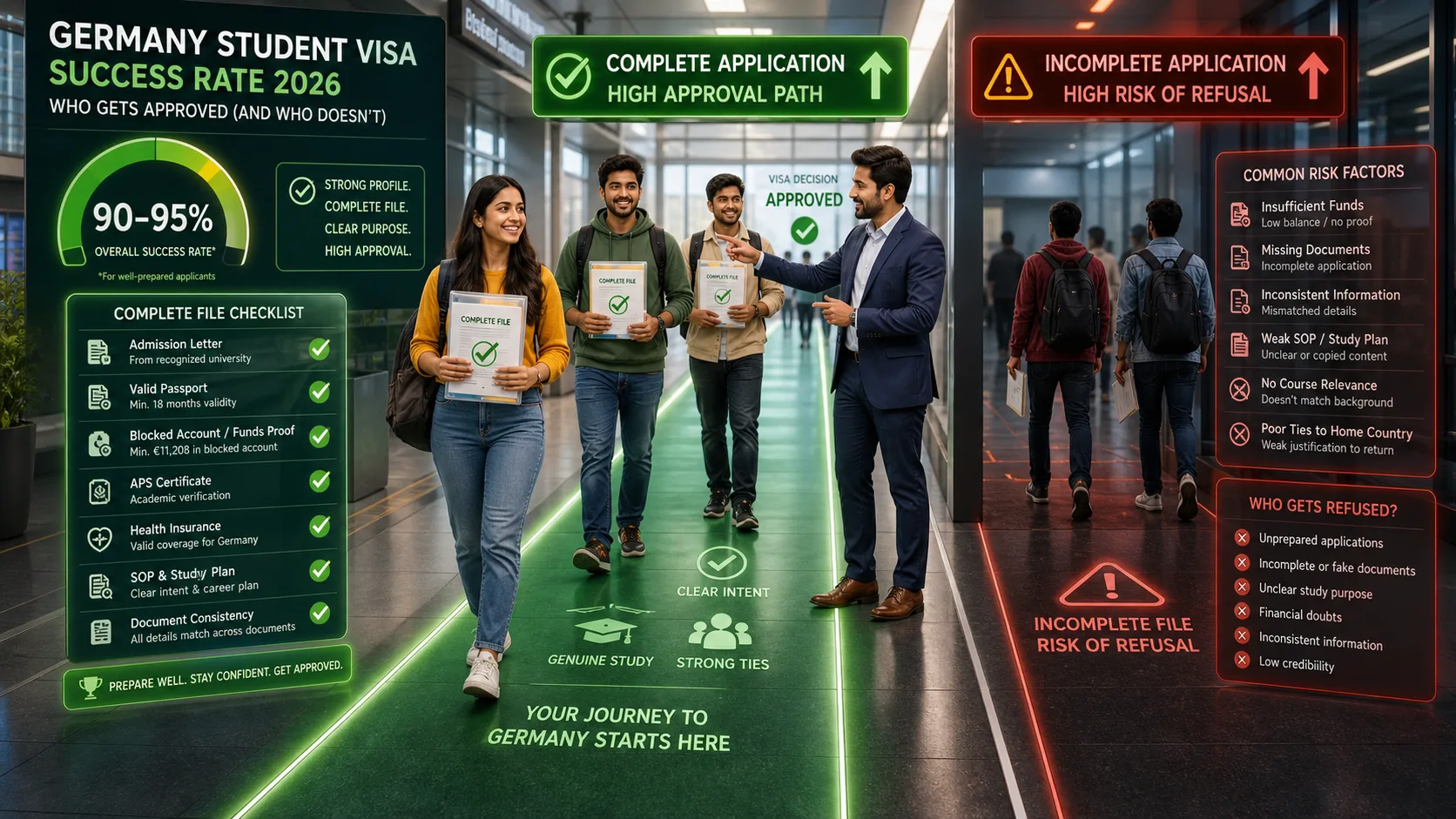
Yes. Applicants whose prior qualification is from India, China (including Hong Kong and Macau), or Vietnam must obtain an APS certificate (Akademische Prüfstelle) verifying their academic documents before the consulate will process the student visa. Without it, the visa is rejected. For Indian applicants the APS office at the German Embassy in New Delhi serves all states, and the certificate is valid indefinitely once issued - you reuse it for every application. Applicants from most other countries do not need APS.
Is the German student visa a Schengen or a national visa?
It is a National Visa (Type D), issued under German national law for stays longer than 90 days - not a short-stay Schengen (Type C) visa. You apply at the German mission in your home country, register through the Consular Services Portal at digital.diplo.de, pay a fee of around €75, and attend a biometrics appointment. After arrival the Type D visa is converted into a residence permit. Always book your appointment early: in high-demand countries the appointment slot, not the decision, is the real bottleneck.
Step-by-step: from admission letter to residence permit
Step 1 - Confirm your admission and Zulassungsbescheid
You need an official admission letter (Zulassungsbescheid) from a recognised German university. A conditional admission or Studienkolleg place can also support a visa, but check the exact wording - the consulate wants a clear statement of admission.
Step 2 - Open your blocked account and get the Sperrbescheinigung
Register with a provider (Expatrio, Fintiba, Coracle or a bank), transfer €11,904 plus a small buffer via SWIFT, and download your Sperrbescheinigung. Start this early - international transfers and confirmations take several business days.
Step 3 - Arrange health insurance
Take a travel/incoming policy (min €30,000) to cover your arrival gap, and set up public student insurance (TK, AOK or Barmer) - or a private plan if you are over 30 or in a Studienkolleg/language course. Keep both confirmations for the appointment.
Step 4 - Complete APS verification (India / China / Vietnam)
If your qualifications are from India, China or Vietnam, obtain your APS certificate before you book the visa appointment.
Step 5 - Register on digital.diplo.de and gather documents
Create your application on the Consular Services Portal and assemble the full document checklist (below).
Step 6 - Attend the visa appointment
Submit your documents and biometrics in person at the German mission. Pay the ~€75 fee. Processing typically takes 4-12 weeks.
Step 7 - Travel to Germany and complete Anmeldung
After arrival, register your address (Anmeldung) at the local Bürgeramt within the required window. You receive a Meldebescheinigung (registration confirmation) needed for almost everything else.
Step 8 - Activate your blocked account
Verify your German address with the blocked-account provider so the account is activated and starts paying out €992 per month to your new German current account.
Step 9 - Apply for your residence permit (Aufenthaltstitel)
Book an appointment at the local Ausländerbehörde (immigration office) to convert your Type D visa into a residence permit (Aufenthaltstitel) for the duration of your studies.
Full document checklist for the German student visa
- Valid passport (with sufficient validity and blank pages)
- Admission letter / Zulassungsbescheid from a recognised university
- Sperrbescheinigung (blocked-account blocking confirmation, €11,904)
- Proof of health insurance - travel/incoming (min €30,000) and student insurance Versicherungsbescheinigung
- Academic certificates and transcripts
- APS certificate (India, China, Vietnam applicants)
- Motivation letter / statement of purpose and CV
- Language proof (IELTS/TOEFL for English programmes; TestDaF/DSH/Goethe for German-taught)
- Biometric passport photos
- Completed visa application form from digital.diplo.de
Not sure your degree qualifies, or which programmes will accept you? Browse English-taught and German-taught options in our programme finder, or explore the paid-training route through our Ausbildung pathway if a vocational track suits you better.
Related guides
Frequently Asked Questions
You probably qualify for more than you think.
Students who get evaluated find programmes they had no idea existed — at universities that charge nothing. 2 minutes, no cost. The only downside is not checking.
Want our guides higher up in Google?
Mark GradGermany as a preferred source and Google gives our pages more room when you search about studying in Germany. Takes one tap, and you can undo it any time from the same screen.
Living this, or on your way to it? Tell your story.
If you are already in Germany and finding it hard, or still fighting to get here, other students need to hear it from someone real. Share your honest journey. We help shape it, and nothing goes live until you approve it.
Related Guides
Free German Quiz · No Login
Can you score 10/10 on today's German challenge?
10 new words every day · 4,500+ words from A1 to C1 · takes about a minute.
Related Articles


Study in Germany
Psychologie mit Schwerpunkt Klinische Psychologie, M.Sc.
Charlotte Fresenius Hochschule
München, Hamburg, Köln, Wiesbaden
M.Ed.Politische Bildung - Lehramt der Sekundarstufe II, M.Ed.
Universität Potsdam
Potsdam
M.A.Sozialwissenschaft im Zwei-Fächer-Masterstudiengang, M.A.
Ruhr-Universität Bochum
Bochum