How to Apply to German Universities: Step-by-Step

TL;DR: You'll research programmes and shortlist 3–5, start paperwork 18–12 months before an October intake, and get any required APS verification (Indian students). Prepare transcripts, a motivation letter, CV, language tests, and apply via uni-assist or directly. Note key deadlines (Winter intake: July 15) and fees (uni-assist: EUR 75 first application). Then accept offers, apply for a visa, and arrange housing.
Applying to German universities is different from applying to universities in the USA, UK, or Australia. There's no centralised application portal like UCAS or Common App. Instead, you'll navigate a mix of direct university applications, the uni-assist system, and country-specific requirements like the APS certificate for Indian students.
This guide walks you through the entire process, from first research to receiving your admission letter, with a realistic timeline and practical advice based on our experience helping hundreds of international students.
The Complete Application Timeline
Here's when to do what, working backwards from a Winter Semester (October) start:
| When | What to Do |
|---|---|
| 18–12 months before | Research universities and programmes. Start APS process (Indian students). Take IELTS/TOEFL if needed. |
| 12–9 months before | Shortlist 3–5 programmes. Check specific requirements (prerequisites, language, GPA). Get transcripts attested. |
| 9–6 months before | Prepare documents: motivation letter, CV, reference letters. Open blocked account. Collect all certificates. |
| 6–3 months before | Submit applications through uni-assist or directly. Pay application fees. Follow up on APS if pending. |
| 3–1 months before | Receive admission decisions. Accept offer. Apply for student visa at German Embassy. Arrange housing. |
| 1 month before | Book flights. Complete visa. Confirm accommodation. Arrange health insurance. |
Key deadlines for international students:
- Winter semester (October start): Apply by July 15 (many programmes have earlier deadlines in May or June)
- Summer semester (April start): Apply by January 15 (some programmes: November or December)
Step 1: Research and Shortlist Programmes
Germany has over 400 universities offering 20,000+ degree programmes. Narrowing down requires strategy:
Where to Search
- DAAD Programme Database (daad.de/en): The most comprehensive search tool. Filter by subject, degree type, language of instruction, and tuition.
- GradGermany Programme Finder (our programme search): Search 20,000+ programmes with filters for subject, city, university type, and English-taught options.
- Individual university websites: Once you've shortlisted universities, check their programme pages for specific requirements and curricula.
What to Check for Each Programme
- Language of instruction: Is it taught in English, German, or both? If German, what level is required?
- Prerequisite courses: Does your Bachelor's curriculum match the required modules? Some programmes reject applicants whose undergraduate coursework doesn't include specific subjects (e.g., a minimum number of credits in mathematics or programming).
- GPA requirement: German universities use their own grading scale (1.0 = best, 5.0 = fail). Your Indian marks are converted using the modified Bavarian formula. Aim for programmes where your converted GPA meets or exceeds the requirement.
- Application method: uni-assist or direct application? This determines your process and timeline.
- Tuition: Free at most public universities. Baden-Württemberg charges EUR 1,500/semester for non-EU students.
Step 2: Get Your APS Certificate (Indian Students)
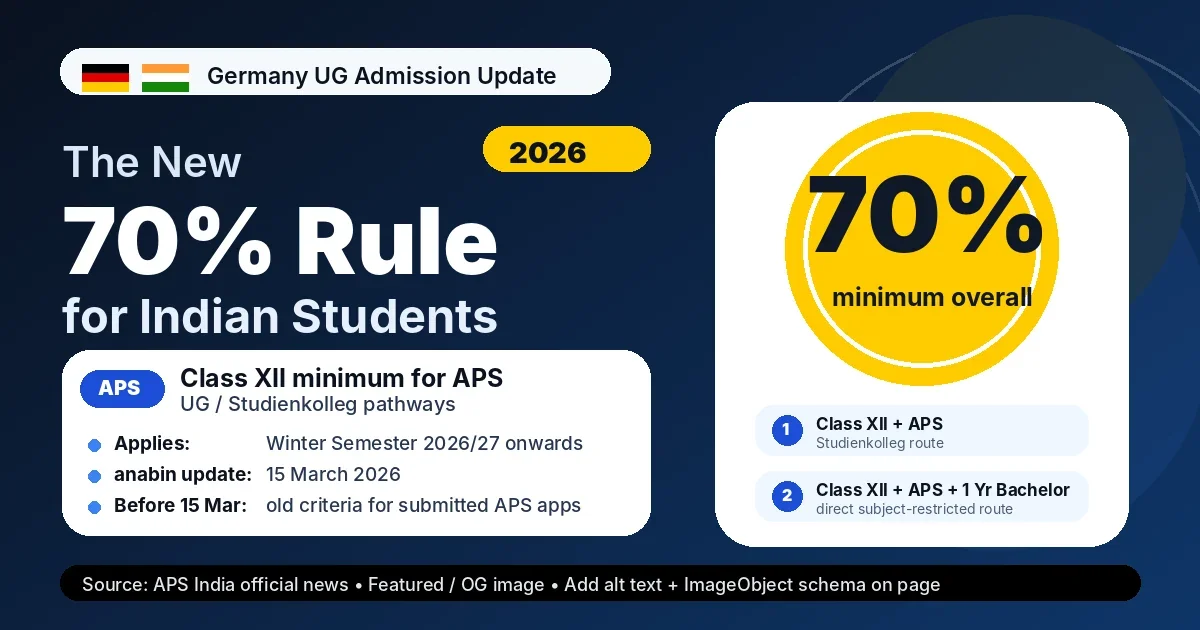
The Akademische Prüfstelle (APS) is a mandatory verification process for Indian students applying to German universities. It verifies the authenticity of your academic documents and ensures they meet German standards.
This is the most time-consuming step. Start it as early as possible, ideally 12+ months before your intended start date. For a complete walkthrough, see our APS Certificate India guide.
Quick summary:
- What it is: Document verification + in-person interview at the German Embassy in New Delhi
- Cost: INR 13,000 (~EUR 150)
- Processing time: 6–12 weeks (can be longer during peak season)
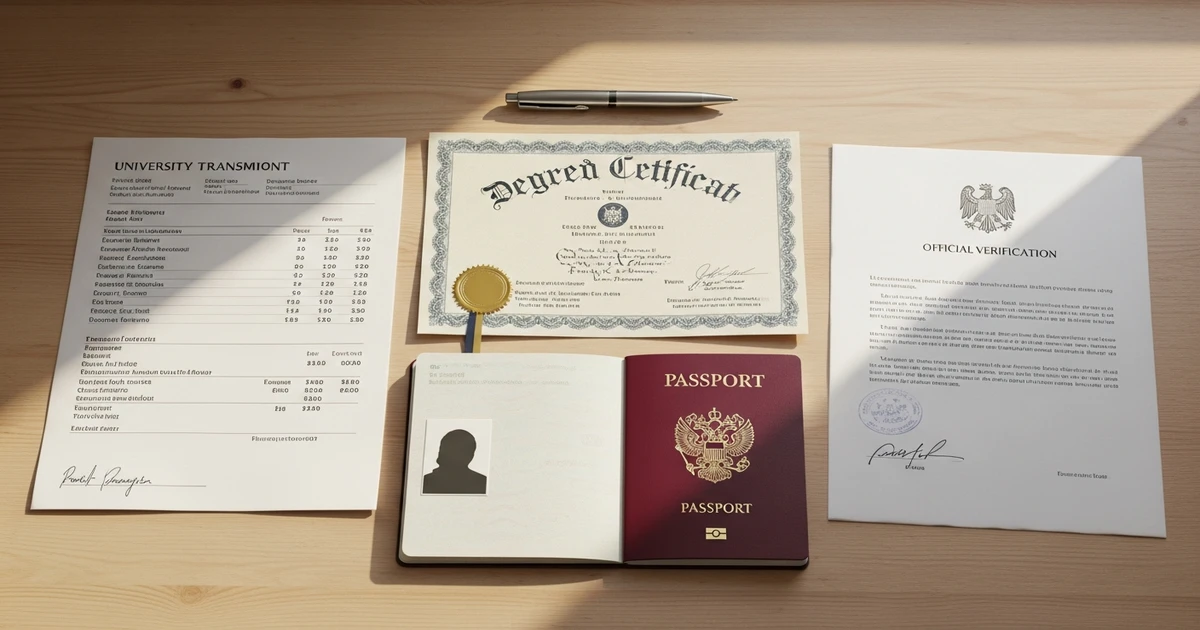
- Documents needed: Degree certificates, mark sheets, passport, 2 passport photos
- Valid for: All German university applications (you only do it once)
Step 3: Prepare Your Documents
Most German university applications require these documents:
Required Documents (Standard)
- APS certificate (Indian students), see Step 2
- Bachelor's degree certificate, attested/notarised copy. If you haven't graduated yet, submit a provisional certificate or transcript showing completed semesters.
- Academic transcripts (all semesters), attested copies with grading scale explanation
- Language proficiency certificate, IELTS (6.0–6.5), TOEFL iBT (80–95), or TestDaF (TDN 4) depending on programme language
- Motivation letter (1–2 pages), why this programme, why this university, your career goals. Be specific; avoid generic statements.
- CV / Resume, ideally in Europass format. Include education, work experience, projects, publications, skills, and languages.
- Passport copy, the photo/data page
- Passport-sized photographs, biometric format, as required by the specific university
Sometimes Required
- Reference letters (1–2), from professors or employers. Not all German programmes require these, unlike the USA.
- GRE scores, very rarely required in Germany. Some business or economics programmes at top universities may recommend it.
- Portfolio, for architecture, design, and art programmes
- Proof of internship/work experience, for some Master's programmes that require practical experience
- Statement of Purpose, some programmes use this term instead of "motivation letter"; same document, different name
Step 4: Apply Through uni-assist or Directly
German universities use two main application channels:
uni-assist Application
uni-assist is a centralised application processing centre used by about 180 German universities. It verifies your documents and converts your grades to the German scale before forwarding your application to the university.
- Cost: EUR 75 for the first application, EUR 30 for each additional application in the same semester
- Processing time: 4–6 weeks (submit well before the university deadline)
- You receive a VPD (Vorprüfungsdokumentation), a preliminary assessment of your eligibility that you send to the university
For a detailed walkthrough of uni-assist, see our uni-assist guide.
Direct Application
Some universities (including TU Munich, many universities in Bavaria, and several others) accept applications directly through their own online portals. This is often faster and free (no application fee).
Check each university's website to determine which method they use. Some accept both uni-assist and direct applications.
Step 5: Receive Your Admission Decision
After submitting, here's what to expect:
- Processing time: 4–8 weeks after the deadline (not after your submission). Universities review applications in batches after the deadline closes.
- Decision types:
- Zulassung (Admission): You're in! Follow the acceptance instructions.
- Zulassung unter Vorbehalt (Conditional Admission): Admitted conditionally, typically pending your final degree certificate or language test score.
- Ablehnung (Rejection): Not admitted. You can apply to other programmes or reapply next semester.
- Accept your offer by the stated deadline (usually 2–4 weeks). You may need to pay a deposit or submit additional documents.
Step 6: Apply for Your Student Visa
With your admission letter in hand, apply for a German student visa at the German Embassy or Consulate in India. You'll need:
- Admission letter from the German university
- Proof of financial resources (blocked account with EUR 11,208 or DAAD scholarship letter)
- Health insurance proof
- APS certificate
- Passport valid for at least 12 months
- Passport photographs (biometric)
- Filled visa application form
- Motivation letter (sometimes requested by the embassy)
Visa processing time: 4–8 weeks. Book your visa appointment as soon as you receive your admission letter. Appointments fill up quickly during peak season (May–August).
Common Mistakes That Lead to Rejection
- Missing the deadline. German deadlines are hard deadlines. There are no extensions. uni-assist needs 4–6 weeks to process, so if the university deadline is July 15, submit to uni-assist by June 1 at the latest.
- Insufficient prerequisite courses. If a programme requires 30 ECTS in mathematics and your Bachelor's only has 20 ECTS equivalent, you'll be rejected regardless of your GPA. Check module requirements carefully.
- Low GPA after conversion. Your Indian percentage or CGPA is converted to the German scale. A 65% from a top IIT may convert differently than a 65% from another university. Understand your converted grade before applying.
- Generic motivation letter. "I want to study in Germany because it has a strong economy" is not a motivation letter. Reference specific courses, professors, research groups, and career goals.
- Wrong language certificate. Submitting IELTS for a programme that only accepts TOEFL, or submitting a score below the minimum, wastes your time and application fee.
- Incomplete documents. Missing one page of your transcript, an unsigned form, or a low-resolution passport scan can delay or derail your application.
- Applying to only one university. German admissions can be unpredictable. Apply to at least 3–5 programmes to maximise your chances.
How Many Universities Should I Apply To?
We recommend 4–6 programmes across a mix of:
- 2 ambitious choices (top TU9 universities or Excellence universities where your profile is borderline)
- 2 realistic choices (universities where your profile comfortably meets requirements)
- 1–2 safe choices (programmes with lower GPA requirements or less competitive admissions)
With uni-assist, applying to 5 universities costs EUR 75 + (4 x EUR 30) = EUR 195. For direct applications, there's often no fee at all.
Need personalised guidance on your university selection and applications? Explore our admission services or contact us for a free initial consultation.
Frequently Asked Questions
You probably qualify for more than you think.
Students who get evaluated find programmes they had no idea existed — at universities that charge nothing. 2 minutes, no cost. The only downside is not checking.
Living this, or on your way to it? Tell your story.
If you are already in Germany and finding it hard, or still fighting to get here, other students need to hear it from someone real. Share your honest journey. We help shape it, and nothing goes live until you approve it.
Related Guides
Free German Quiz · No Login
Can you score 10/10 on today's German challenge?
10 new words every day · 4,500+ words from A1 to C1 · takes about a minute.
Related Articles
Study in Germany
Deutsch - Lehramt für die beruflichen Fächer der Sekundarstufe II, B.A./B.Sc.
Gottfried Wilhelm Leibniz Universität Hannover
Hannover
B.A.Berufspädagogik für Pflege- und Sozialberufe (vormals: Berufspädagogik für Gesundheits- und Sozialberufe), B.A.
APOLLON Hochschule der Gesundheitswirtschaft
Bremen
B.Sc.Medizintechnische Wissenschaften, B.Sc.
Duale Hochschule Baden-Württemberg
Heidenheim