Can I Switch Universities After My German Student Visa Is Approved? (2026 Guide)
How Often Does This Actually Happen?
You are not alone. According to DAAD's official statistics for 2024, the international Bachelor's dropout/change rate in Germany sits at 16 % in the first year (compared with 13 % for German students); the Master's figure is 9 %. With about 402,000 international students enrolled and 116,600 first-years (record high in 2024), that means roughly 40,000 international Bachelor students per year change their plan in some way during their first year, many of them by switching universities, not by leaving Germany.
The rules are designed for this reality. The Bundesministerium des Innern and the Auswärtiges Amt know that students arrive, find that programme A doesn't fit, and pivot to programme B. The DAAD SeSaBa research project (Success and Withdrawal of International Students) explicitly studies this transition. The legal scaffolding is in place.
The Legal Foundation: §16b AufenthG, Read in Plain English
Every part of the answer flows from one paragraph of German federal law. §16b of the Aufenthaltsgesetz (Residence Act) governs residence permits for studies, and section (6) is the part that protects you when things change.
§16b (6) AufenthG, in its operative clause, reads (translated):
"Before the residence permit issued under paragraph 1 is withdrawn, revoked, or shortened for reasons not attributable to the foreigner, the foreigner shall be given the opportunity to apply for admission at another educational institution for up to nine months."
Three things this clause does for you:
- It assumes you might lose admission at University A and need a substitute. That is a normal lifecycle event, not a violation.
- It gives you up to nine months to find that substitute, far longer than most students will ever need.
- It applies when the loss is "not attributable to the foreigner", meaning programme cancellation, language-test failure, late visa arrival missing the start of the semester, et cetera. A voluntary switch from A to B for personal preference is technically a different scenario, but in practice the same office handles both.
§16b (1) sets the precondition for any student permit: "a residence permit shall be issued for the purpose of full-time studies at a state or state-recognised higher-education institution if the foreigner has been admitted by the institution." The permit you eventually receive in Germany is anchored to your current admission, not the one named on your visa.
Three Switching Scenarios, and What to Do in Each
Before going further, locate yourself on this map. The right action depends entirely on which of the three states you are in.
| Scenario | Where you are | What to do | Risk level |
|---|---|---|---|
| (a) Before travel | Visa stamped in passport, still in home country, new admission letter received from University B. | Email the issuing consulate with the new admission letter. Request written acknowledgment. Carry both letters at the border. | Low-Medium |
| (b) After arrival, before residence permit issued | In Germany, did your Anmeldung, but residence permit (Aufenthaltserlaubnis) not yet issued. | Apply at the Ausländerbehörde of your new city using University B's documents. The permit is issued on current admission. | Lowest |
| (c) After residence permit issued | Already studying in Germany on a multi-year residence permit, want to change uni or programme. | Apply for Auflagenänderung or new permit at the Ausländerbehörde. Trigger Munich's 14-day rule; expect 8 weeks-11 months processing. | Medium |
Most readers of this article are in scenario (a) or (b). Scenario (c) is well-trodden ground that the German system handles dozens of times a day at every Ausländerbehörde, it is paperwork, not politics.
Myth-Busting: Is the German Student Visa "City-Bound"?
Short answer: no, but the myth has a real cause. The cause is the Vorabzustimmung (advance approval) procedure. When you apply for the student visa at a German consulate, the consulate routes the file to the Ausländerbehörde of the city where University A is located. That office gives advance approval; the visa is then issued on its strength. People conclude that the visa is "linked" to that city.
The truth is that German immigration jurisdiction follows your registered address (Anmeldung), not the visa stamp. Once you do your Anmeldung at the Bürgerbüro of the city where University B is, that city's Ausländerbehörde becomes responsible for your residence permit. The visa was a door, not a cage.
The Federal Government's Make-it-in-Germany portal states explicitly that the residence permit is issued in Germany by the local Ausländerbehörde once you are registered. There is no provision in the Aufenthaltsgesetz that voids the permit's eligibility because of a city change.
That said: do not enter Germany pretending to study at A if you have already abandoned A. Carry both admission letters. Border police can ask, and lying invalidates the visa under §95 AufenthG (false statements), that is a separate, serious legal problem. Honesty is free; it is also the law.
Notification Rules, Five Major Cities, Side by Side
This is where the rubber meets the road. Each Bundesland sets its own administrative practice, and the city-level Ausländerbehörde implements it. Here are the five offices most commonly involved with international students.
| City / Office | Reporting deadline | Approval required? | Fee & processing time |
|---|---|---|---|
| Munich (KVR, Kreisverwaltungsreferat) | 14 days after new immatriculation. Unverzüglich (without delay) is the operative word. | Yes, but not if change is within the same field (Fachrichtung). | €50 Auflagenänderung. Up to 11 months in worst case. |
| Berlin (LEA, Landesamt für Einwanderung) | Pre-approval recommended; report at next permit renewal at the latest. | Yes, change must be coordinated with LEA in advance per HU Berlin guidance. | ~€100. 8-14 weeks processing. |
| Hamburg (Einwohner-Zentralamt) | "Without delay" upon any change of programme or institution. | Yes, formal notification mandatory. | €50-€100. 6-12 weeks. |
| Frankfurt am Main | Within first 18 months of studies, change of subject is generally approved automatically. | Yes, but applicants in first 18 months get near-automatic approval. | €56-€96. After semester 3 (BA) / 2 (MA), university statement required. |
| Aachen / NRW (StädteRegion Aachen, branch on RWTH campus) | "Without delay"; no fixed day count published. | Yes; convenient on-campus office in RWTH SuperC building. | €56-€100. ~6 weeks at the RWTH branch. |
Sources for this table, with direct links to the official guidance:
- Munich KVR, Studienfachwechsel / Auflagenänderung
- FU Berlin, Aufenthaltserlaubnis & LEA process
- HU Berlin, change of university must be coordinated with LEA
- University of Hamburg, Aufenthaltstitel guidance
- StädteRegion Aachen, Ausländeramt for international students
Same Field vs Different Field, the Most Important Distinction
This is where many students panic without reason. Munich's KVR, usually the strictest office in Germany, states explicitly:
"Für einen Wechsel des Studiengangs oder Studienfachs innerhalb der selben Fachrichtung benötigen Sie keine besondere Genehmigung. Der Aufenthaltszweck wird hiervon nicht berührt."
Translation: For a change of programme or subject within the same field of study, you do not need special permission. The purpose of stay is not affected.
What this means in practice:
- Mechanical Engineering (TUM) → Mechatronics (RWTH Aachen), same Fachrichtung. No KVR/Ausländerbehörde approval needed. Just notify and update your address.
- M.Sc. Computer Science (KIT) → M.Sc. Data Science (TU Munich), same field. No special approval.
- M.Sc. Mechanical Engineering → M.Sc. Business Administration, different Fachrichtung. Approval required, and harder to obtain after semester 3.
Other Bavarian cities follow Munich's interpretation; most other Bundesländer are more permissive, not stricter. If you are switching within the same broad discipline, your administrative load is essentially: notify, register address, get new permit issued.
De-enrolment and What It Actually Triggers
One of the biggest fears is: "If I de-register from University A, will the foreigners' office know within 24 hours and revoke my visa?" The honest answer is: no, but you should not rely on the lag.
German universities do not have an automated, real-time data feed of Exmatrikulationen to the Ausländerbehörde. There is no such pipe. What happens instead:
- You de-register from University A. The university notes this on its records.
- Your residence permit's purpose of stay (study at a recognised institution) becomes endangered.
- Per §16b (6), you have up to 9 months to demonstrate that you have admission elsewhere, i.e. to fix the situation before any formal action.
- At your next renewal, you must produce a fresh Immatrikulationsbescheinigung. If by then you have University B's enrolment certificate, the renewal proceeds normally.
Universities will, on request from a foreigners' authority, confirm whether a student is currently enrolled. They do not volunteer this information at the moment of Exmatrikulation. HHU Düsseldorf's official guidance on de-registration confirms that the responsibility to inform the Ausländerbehörde rests with the student, not the university.
The practical rule is therefore: do not de-register from A until you have written admission/enrolment confirmation from B. Never leave a gap. The 9-month statutory grace is an emergency parachute, not a planning tool.
Sperrkonto: Do You Need a New One?
The Sperrkonto (blocked account) belongs to the student, not to a specific university. Switching universities does not require opening a new blocked account, the account follows you.
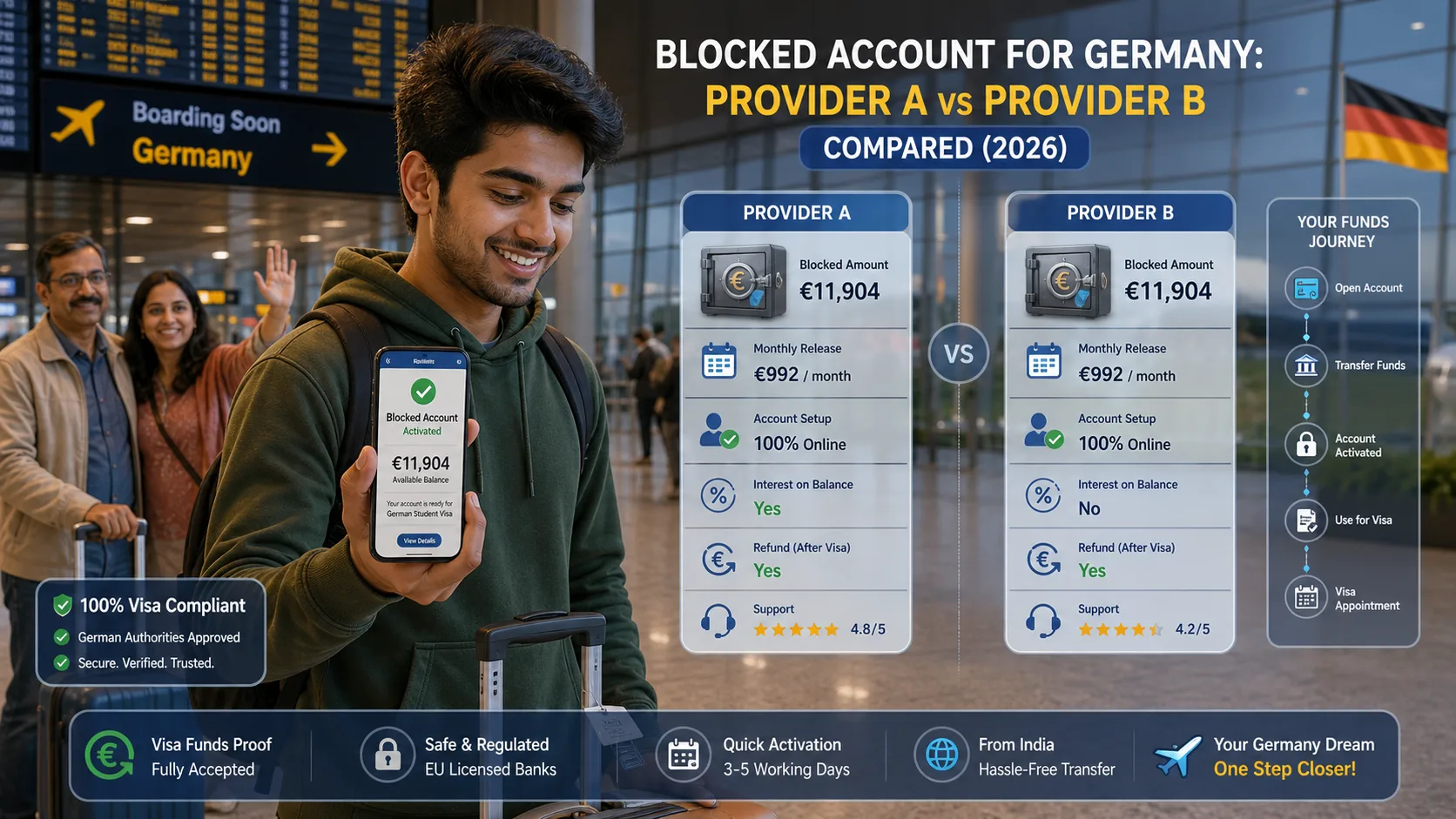
The 2026 minimum balance, per the Auswärtiges Amt, is €11,904 per year (€992 per month × 12). When you apply for the residence permit at the new city's Ausländerbehörde, expect them to ask for fresh proof that this annual minimum is funded for the next 12 months. That is a balance check, not a "new account" requirement.
Practical tip: if your blocked account is with Expatrio, Fintiba, Coracle, or Deutsche Bank, the monthly disbursement continues uninterrupted. You just produce the latest balance statement at the new appointment.
Step-by-Step Playbook: How to Switch Safely
Here is the exact sequence that has worked for hundreds of students we have advised. It works for scenarios (a), (b), and (c) with minor variations.
- Get University B's admission/enrolment confirmation in writing before doing anything else. An emailed PDF of the Immatrikulationsbescheinigung or formal admission letter is enough.
- Do not de-register from University A yet. Hold dual enrolment if possible, most German universities allow it. If A's tuition is zero (public university), the cost is also zero.
- Email the German consulate that issued your visa. Attach both admission letters. Ask in plain English whether the existing visa is acceptable for entry given the change. Keep the written reply.
- Travel with both admission letters in your hand luggage. If border police ask, show both. Tell the truth.
- Land in your new city, not the old one. Take the train from the airport directly to the city of University B. Do not register an address in the old city, that creates a paper trail you do not want.
- Do Anmeldung at the Bürgerbüro of the new city within 14 days of arrival (the federal deadline). This single act transfers Ausländerbehörde jurisdiction.
- Book the Ausländerbehörde appointment in the new city. Bring: passport, visa, both admission letters, new Immatrikulationsbescheinigung, Anmeldebestätigung, blocked-account proof, biometric photo, and the Munich/Berlin/Frankfurt-specific application form.
- De-register from University A only after you have University B's enrolment certificate in hand. Do this by email or via the student portal of A. Most universities process Exmatrikulation in 1-3 working days.
- If your residence permit was already issued for A's city and you are now in B's city: apply for Auflagenänderung or a new permit at the new Ausländerbehörde, citing §16b (1) and your current admission. Munich's 14-day reporting clock starts at new immatriculation.
If you are still in your home country (scenario a), steps 1-4 are the entire flow. If you are post-arrival pre-permit (scenario b), steps 5-7 are the active ones. If you have a permit already (scenario c), step 9 is critical.
Five Common Mistakes We See
- Cancelling University A before securing B. This creates the gap §16b (6) was designed to cover, but you should never need to use it. Always have B in writing before touching A.
- Lying at the border. "I'm here for University A" when you are not is a §95 AufenthG offence. Show both letters; tell the truth.
- Doing Anmeldung in the old city out of habit. If your visa was approved for Munich but you are moving to Berlin, do Anmeldung in Berlin, not Munich. Anmeldung defines jurisdiction.
- Missing Munich's 14-day reporting window. The KVR has staff who match enrolment data periodically; reporting late triggers a fine and can complicate the permit issuance.
- Not getting written confirmation from the embassy before flying. A single email exchange with the consulate, archived as PDF, defuses 90 % of border-control conversations.
Bottom Line
The German student-visa system is more flexible than its reputation suggests. §16b (6) AufenthG grants you up to nine months to find a new educational institution if your original plan falls through. Munich's 14-day reporting rule is the strictest; same-field changes need no special approval; the visa is not city-bound, your Anmeldung is.
The framework is designed for the reality that international students change their mind. The mistakes that cause real problems are administrative, de-registering too early, registering an address in the wrong city, or hiding the change from the embassy. Avoid those, and the German system will accommodate your switch without drama.
If you are weighing a switch and want a second pair of eyes on your specific timeline, our consultants review every case against the §16b checklist and the destination city's published practice. Get a free profile evaluation, we'll tell you within 48 hours whether your switch path is clean or whether it needs an extra step.
Sources cited in this article: §16b Aufenthaltsgesetz (Bundesamt für Justiz), Auswärtiges Amt visa portal, Make-it-in-Germany (Federal Government), KVR Munich, LEA Berlin, FU Berlin / HU Berlin international offices, University of Hamburg, StädteRegion Aachen, RWTH Aachen, Goethe-Universität Frankfurt, HHU Düsseldorf, Wissenschaft weltoffen 2024 (DAAD & DZHW), DAAD SeSaBa research project. All URLs verified live as of May 2026.
Frequently Asked Questions
You probably qualify for more than you think.
Students who get evaluated find programmes they had no idea existed — at universities that charge nothing. 2 minutes, no cost. The only downside is not checking.
Want our guides higher up in Google?
Mark GradGermany as a preferred source and Google gives our pages more room when you search about studying in Germany. Takes one tap, and you can undo it any time from the same screen.
Living this, or on your way to it? Tell your story.
If you are already in Germany and finding it hard, or still fighting to get here, other students need to hear it from someone real. Share your honest journey. We help shape it, and nothing goes live until you approve it.
Free German Quiz · No Login
Can you score 10/10 on today's German challenge?
10 new words every day · 4,500+ words from A1 to C1 · takes about a minute.