How to Apply to German Universities from India: Step-by-Step Guide (2026)

TL;DR: You'll need 8-12 months to apply, complete the mandatory APS check, collect language scores, and submit applications via uni‑assist or directly. Indians must open a blocked account with €11,208, secure health insurance and apply for a visa through VFS Global. Start 12 months before an October intake, target 5-8 programmes, and expect APS processing of 6-10 weeks (fee: INR 18,000).
Last updated: March 2026
Applying to German universities from India involves a structured, multi-step process that typically takes 8 to 12 months from start to enrolment. Indian applicants must first identify suitable programmes, verify that their Indian degree is recognised in Germany, and obtain the mandatory APS (Akademische Prüfstelle) certificate, a step unique to students from India and a few other countries. After gathering language test scores, academic transcripts, and a strong statement of purpose, candidates submit applications either directly to universities or through the uni-assist portal. Once an admission letter arrives, students must open a blocked account with €11,208, secure health insurance, and apply for a German student visa through VFS Global. This guide walks you through every step with exact costs, processing times, and deadlines so you can plan your timeline with confidence.
Timeline Overview: Month-by-Month Plan
Whether you are targeting the winter semester (October start) or the summer semester (April start), use this reverse-countdown timeline to stay on track. The table below assumes a winter semester intake.
| Months Before Start | Month (Winter Sem.) | Action Items |
|---|---|---|
| 12 months | October (prior year) | Research programmes on DAAD, shortlist 5-8 universities, check eligibility on anabin |
| 10-11 months | November, December | Register with APS India, gather transcripts & mark sheets, begin APS interview preparation |
| 8-9 months | January, February | Attend APS interview; take IELTS, TOEFL, or Duolingo English Test; draft statement of purpose |
| 6-7 months | March, April | Receive APS certificate; finalise SOP and CV; request letters of recommendation |
| 5 months | May | Create uni-assist account, upload documents, pay application fees |
| 4 months | June | Submit all applications before deadlines (many close June 1, July 15) |
| 3 months | July | Receive admission letters; accept offer; open blocked account via Expatrio or Fintiba |
| 2 months | August | Book VFS Global appointment; apply for student visa; arrange health insurance |
| 1 month | September | Receive visa; book flights; apply for Studentenwerk accommodation; pack essentials |
| 0 | October | Arrive in Germany, complete city registration (Anmeldung), attend orientation week |
Step 1: Choose Your Programme
Germany offers over 20,000 degree programmes across more than 400 universities, including roughly 1,800 programmes taught entirely in English. The best starting point is the DAAD Course Finder, which lets you filter by subject, degree type, language of instruction, and tuition status. You can also use GradGermany's own programme finder to browse and compare options tailored for Indian students.
When shortlisting programmes, consider these factors: the university's research focus, industry connections, city cost of living, and whether the programme is at a public university (tuition-free, except Baden-Württemberg which charges €1,500/semester for non-EU students) or a private institution. Also check the programme's specific admission requirements, some require a relevant bachelor's degree, GRE or GATE scores, or prior work experience. Shortlist 5 to 8 programmes across a mix of competitive and moderately selective universities to maximise your chances.
Step 2: Check Eligibility & Degree Recognition
German universities require your Indian degree to be formally recognised. The official tool is anabin, a database maintained by the KMK (Standing Conference of Education Ministers). Look up your Indian university and check its status:
- H+ (recognised), your degree is directly accepted by German universities
- H+/- (conditionally recognised), accepted for most programmes, but some universities may require additional assessment
- H- (not recognised), you may need to attend a Studienkolleg (foundation year) before applying
For Indian students, a four-year bachelor's degree from a NAAC-accredited or UGC-recognised university with H+ status typically qualifies you for direct master's admission. Three-year bachelor's degrees are also widely accepted for master's programmes, provided the university holds H+ status, though a few selective programmes may ask for additional qualifications. If your university is not listed on anabin, you can request an individual assessment through uni-assist, which adds 4-6 weeks to your processing time. Check your eligibility early, it determines your entire application strategy.
Step 3: Prepare for the APS Certificate
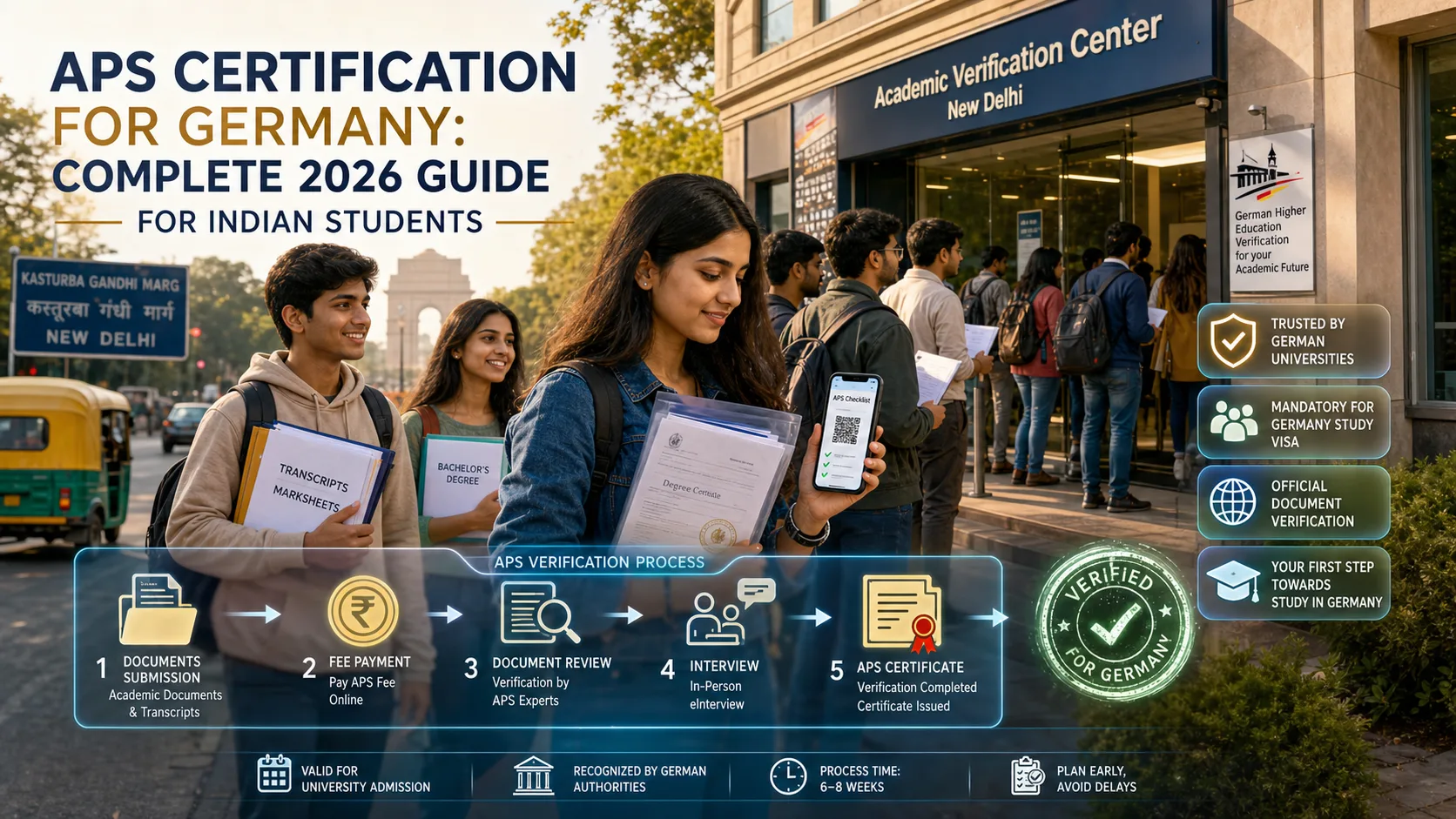
The Akademische Prüfstelle (APS) certificate is mandatory for all Indian applicants to German universities. Operated by the German Embassy in New Delhi, the APS verifies the authenticity of your academic documents and assesses your academic ability through a personal interview. Without this certificate, no German university will process your application.
Here is what you need to know:
- Fee: INR 18,000 (approximately €200)
- Processing time: 6 to 10 weeks from document submission to interview
- Interview format: 15-20 minute conversation covering your coursework, expect questions about your bachelor's thesis, major subjects, and project work
- Documents needed: 10th & 12th mark sheets, bachelor's transcripts (all semesters), degree certificate, passport copy
Tips for passing the APS interview: Review your university syllabus subject by subject. Be prepared to explain core concepts from your major in simple terms. The interviewer is checking whether you actually studied what your transcripts claim, not testing advanced knowledge. Practice explaining two or three projects or lab experiments in detail. If you have a thesis, know its methodology and conclusions. The pass rate is roughly 85-90% on the first attempt, and you can retake if needed (with an additional fee). Start this step early, it is the biggest bottleneck in the timeline for Indian applicants.
Step 4: Take Language Tests
Most English-taught master's programmes in Germany require one of the following test scores:
| Test | Typical Minimum Score | Cost (India) | Validity |
|---|---|---|---|
| IELTS Academic | 6.0, 6.5 overall | ~INR 16,250 | 2 years |
| TOEFL iBT | 80, 90 | ~INR 16,900 | 2 years |
| Duolingo English Test | 105, 115 | ~INR 5,300 ($49) | 2 years |
| Cambridge C1 Advanced | Grade C / 180+ | ~INR 17,000 | No expiry |
An increasing number of German universities now accept the Duolingo English Test as a budget-friendly alternative to IELTS or TOEFL, always verify acceptance on your target programme's website. If you are applying to a German-taught programme, you will need TestDaF (TDN 4 in all sections) or DSH-2. Some universities also accept Goethe-Zertifikat B2 or C1.
Book your test at least 3 months before application deadlines. IELTS results take 13 days, TOEFL results arrive in 4-8 days, and Duolingo gives results within 48 hours. If your score falls just short of the requirement, check whether your university offers conditional admission with a language preparation course.
Step 5: Prepare Your Documents
German universities expect a precise set of documents. Missing even one item can delay or void your application. Use this checklist:
| Document | Notes |
|---|---|
| 10th & 12th mark sheets | Notarised copies; some universities accept scanned originals |
| Bachelor's degree certificate | Provisional certificate if final degree not yet issued |
| All semester transcripts | Official transcripts from your university with grading scale |
| APS certificate | Original (universities accept digital verification code) |
| Language test scores | Official score report sent directly to university if required |
| Statement of Purpose (SOP) | Programme-specific, 500-750 words (see Step 6 below) |
| CV / Resume | Europass or academic format, 1-2 pages, reverse chronological |
| Letters of Recommendation (LOR) | 1-2 letters from professors or supervisors on university letterhead |
| Passport copy | Bio-data page, valid for at least 12 months |
| Passport-size photos | Biometric format per German visa specifications |
| GRE / GATE scores | Only if required by the specific programme |
Pro tip: Get all documents evaluated by an expert before submission. Notarise your academic documents at a local notary, German universities do not accept self-attested copies. Prepare certified English translations for any documents originally in Hindi or other regional languages. Keep both physical and high-resolution digital copies organised in clearly labelled folders.
Step 6: Write Your Statement of Purpose
Your Statement of Purpose (SOP) is your strongest tool for standing out among thousands of Indian applicants. German universities receive a high volume of applications from India, and a generic, copy-pasted SOP is the fastest way to get rejected. Each SOP must be tailored to the specific programme you are applying for.
Structure your SOP in 500-750 words:
- Opening hook (2-3 sentences): A specific experience or moment that sparked your interest in the field, avoid clichéd openings like "Since childhood, I have been passionate about..."
- Academic background (100-150 words): Highlight relevant coursework, projects, thesis work, and academic achievements that connect directly to the master's programme
- Professional/practical experience (80-120 words): Internships, research projects, industry exposure, or relevant extracurriculars
- Why this programme and university (100-150 words): Name specific modules, professors, research groups, or labs. Show you have researched the programme in detail
- Why Germany (50-80 words): Industry connections, research infrastructure, tuition-free education, career ecosystem
- Future goals (50-80 words): Clear career direction, how does this degree connect your past experience to your future ambitions?
Common mistakes to avoid: Do not write one SOP and send it to all universities, admissions committees notice immediately. Do not exceed the word limit. Do not repeat your CV, instead, explain the context and impact behind key experiences. Do not use AI-generated text verbatim; if you use AI tools to brainstorm, rewrite every sentence in your own voice with specific, personal details.
Step 7: Apply via uni-assist or Direct Portal
German universities accept applications through two channels, and the channel depends on the university:
| Channel | How It Works | Fee |
|---|---|---|
| uni-assist | Centralised portal for ~180 universities. Verifies and forwards your documents. | €75 first application + €30 each additional |
| Direct university portal | Apply on the university's own website (e.g., TUM, LMU, RWTH Aachen) | Varies: €0, €60 |
uni-assist processing time is typically 4 to 6 weeks from document receipt. During peak season (May-July), this can stretch to 8 weeks. Submit early, do not wait until the deadline. Upload all documents as PDFs under 2 MB each. After uni-assist verifies your credentials, they issue a VPD (Vorprüfungsdokumentation) and forward your application to the university.
For universities that accept direct applications, including many top-ranked institutions, apply through their online portal (often built on platforms like Campo, TUMonline, or HISinOne). Direct applications tend to have faster processing times because there is no intermediary. Check each university's website to confirm their application channel. If in doubt, GradGermany's programme finder lists the application method for every programme.
Step 8: Open a Blocked Account (Sperrkonto)
A blocked account is a mandatory financial proof required for your German student visa. You must deposit €11,208 for one year (equivalent to €934/month), which the German government considers the minimum amount needed to cover living expenses. After arriving in Germany, you can withdraw up to €934 per month.
The two most popular providers for Indian students are:
| Provider | Setup Fee | Monthly Fee | Processing Time |
|---|---|---|---|
| Expatrio | €0 | €5.90 | 1-3 business days |
| Fintiba | €0 | €4.90 | 1-5 business days |
When to open it: Open your blocked account immediately after receiving your admission letter, ideally 8-10 weeks before your visa appointment. The account setup itself is quick, but transferring €11,208 from India via international wire transfer can take 3-7 business days depending on your bank. You will need your passport, admission letter, and an Indian bank account with sufficient funds. Both Expatrio and Fintiba also offer bundled packages that include health insurance, which you will need for your visa application.
Step 9: Apply for Your Student Visa
Indian students need a German student visa (National Visa, Category D) to study in Germany. Applications are submitted through VFS Global centres in India (New Delhi, Mumbai, Bangalore, Chennai, Kolkata, Hyderabad, Pune, and Chandigarh).
Documents required for the visa appointment:
- Completed visa application form (Videx)
- Valid passport (at least two blank pages, valid beyond your intended stay)
- University admission letter / conditional admission letter
- APS certificate
- Blocked account confirmation (€11,208 deposited)
- Health insurance coverage letter (travel insurance for arrival + statutory insurance enrolment proof)
- Academic transcripts and degree certificates
- Language test score reports
- Passport-size biometric photos (3.5 x 4.5 cm)
- Visa fee: €75 (paid in INR equivalent at the appointment)
Processing time: 6 to 12 weeks. During peak season (July-September), processing can take the full 12 weeks or even longer. Book your VFS appointment as early as possible, slots fill up fast in summer. You can book an appointment up to 3 months before your programme start date.
Interview tips: The visa interview is brief (5-10 minutes). Know your programme name, university, city, and how you plan to finance your stay. Be clear and confident. Carry originals of every document you submitted as photocopies. If asked about your plans after graduation, mention the 18-month post-study residence permit and your career goals, but emphasise that your primary purpose is studying.
Step 10: Pre-Departure Preparation
Once your visa is approved, it is time to prepare for your move to Germany. Here is your pre-departure checklist:
Accommodation: Apply for a room at the local Studentenwerk (student services) dormitory as early as possible, these are the most affordable option at €250-400/month but have long waiting lists. Alternatives include WG-Gesucht.de for shared flats, or GradGermany's accommodation assistance service. Many universities also have an international office that helps incoming students find housing.
Health insurance: Germany requires all students to have health insurance. Students under 30 can enrol in statutory (public) health insurance with providers like TK (Techniker Krankenkasse) or AOK at approximately €140/month. You can begin the enrolment process online before arrival. You also need travel health insurance for your first few days until the statutory cover activates.
Flight booking: Book your flight 4-6 weeks in advance for the best fares. Popular routes from India land at Frankfurt, Munich, or Berlin. One-way tickets from Delhi to Frankfurt typically cost INR 25,000-45,000 depending on season and airline. Carry your admission letter, visa, and blocked account confirmation in your hand luggage.
What to pack: Bring formal documents (originals of all certificates, 10 passport photos, birth certificate), a power adapter (Type C/F plug), winter clothing if arriving for the winter semester, essential medications with prescriptions in English, and enough cash (€200-300) for the first few days before you can access your blocked account. Do not over-pack, you can buy most things locally at reasonable prices.
Key Application Deadlines
| Intake | General Deadline | Classes Begin |
|---|---|---|
| Winter Semester | July 15 | October |
| Summer Semester | January 15 | April |
Important: These are the standard uni-assist deadlines. Many universities, especially competitive programmes at TU Munich, RWTH Aachen, KIT, and TU Berlin, set earlier deadlines (often May 31 or June 1 for the winter semester). Always check the specific deadline on the programme's own website. Some programmes also have rolling admissions, meaning they close applications once all seats are filled, regardless of the official deadline.
5 Common Mistakes Indian Students Make (and How to Avoid Them)
- Starting the APS process too late. The APS certificate takes 6-10 weeks, and delays are common during peak season. If you start in April for a July 15 deadline, you will almost certainly miss it. Fix: Begin your APS application at least 6 months before the application deadline, ideally in November or December for the following winter semester.
- Sending the same SOP to every university. Admissions committees at German universities are experienced enough to recognise generic statements. A non-specific SOP signals low effort and low genuine interest. Fix: Write a new SOP for every programme. Reference specific modules, professors, and research areas at each university.
- Ignoring uni-assist processing time. Students often submit their uni-assist application on the deadline day, not realising that uni-assist needs 4-6 weeks to process and forward documents to the university. By the time uni-assist is done, the university's internal deadline may have passed. Fix: Submit uni-assist applications at least 6 weeks before the published deadline.
- Not checking anabin before applying. Some students apply to 5-8 programmes, pay all the fees, and then discover their Indian university's degree is not recognised (H- status). Fix: Check anabin before you invest any money or time. If your university is H-, explore Studienkolleg options or apply only to programmes that accept individual credential evaluations.
- Underestimating visa processing time. The German student visa can take up to 12 weeks during peak season. Students who apply in August for an October start sometimes receive their visa after the semester has already begun. Fix: Book your VFS Global appointment the moment you receive your admission letter and blocked account confirmation. Aim to apply for the visa no later than early August for a winter semester start.
Start Your Germany Application Today
The process of applying to German universities from India is detailed, but entirely manageable when you follow a structured timeline. Every year, thousands of Indian students successfully navigate these steps and begin their studies at world-class German universities, with zero tuition fees.
Not sure where to start? Use GradGermany's programme finder to explore 20,000+ programmes, or get a free profile evaluation from our team of Germany education experts. We will assess your eligibility, suggest matching programmes, and help you build a realistic application timeline.
Last updated: March 2026
Frequently Asked Questions
You probably qualify for more than you think.
Students who get evaluated find programmes they had no idea existed — at universities that charge nothing. 2 minutes, no cost. The only downside is not checking.
Want our guides higher up in Google?
Mark GradGermany as a preferred source and Google gives our pages more room when you search about studying in Germany. Takes one tap, and you can undo it any time from the same screen.
Living this, or on your way to it? Tell your story.
If you are already in Germany and finding it hard, or still fighting to get here, other students need to hear it from someone real. Share your honest journey. We help shape it, and nothing goes live until you approve it.
Free German Quiz · No Login
Can you score 10/10 on today's German challenge?
10 new words every day · 4,500+ words from A1 to C1 · takes about a minute.