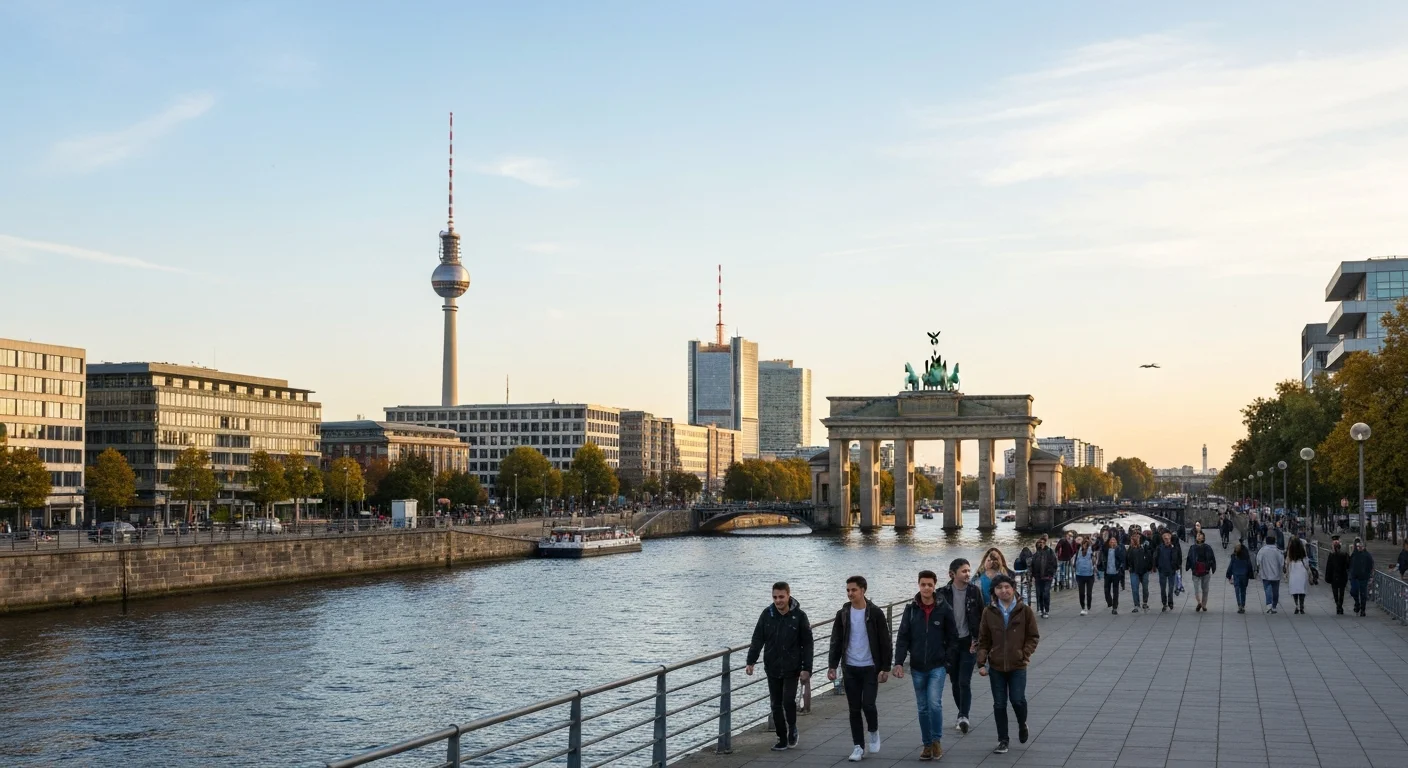
Study in Berlin
Germany's Most International Student City
Berlin is Germany's largest city with over 40 universities and 200,000 students. World-class education at near-zero tuition with an unmatched quality of life.
40+
Universities
200,000+
Students
€0
Tuition at Public Unis
€950–1,200
Monthly Cost
Top Universities in Berlin
Berlin has one of Germany's densest concentrations of higher education. The main public institutions include:
- Technische Universitaet Berlin (TU Berlin) - a member of the TU9 group, strong in engineering, computer science and applied sciences.
- Humboldt-Universitaet zu Berlin (HU Berlin) - a research university with deep strengths in the humanities, social sciences and natural sciences.
- Freie Universitaet Berlin (FU Berlin) - broad research university, well known for humanities, political science and life sciences.
- Charite - Universitaetsmedizin Berlin - one of Europe's largest university hospitals, run jointly by HU and FU, for medicine.
- Universitaet der Kuenste (UdK Berlin) - leading arts, design and music school.
Universities of applied sciences (Hochschulen) include HTW Berlin, the Berliner Hochschule fuer Technik (BHT) and HWR Berlin, which tend to be more industry-practical.
Cost of Living in Berlin
Berlin was long seen as a cheaper capital, but rents have risen sharply and it is now closer to the more expensive end among German cities, though still typically below Munich.
- Rent (room in a shared flat / WG): roughly EUR 450-700 per month, depending heavily on neighbourhood and timing.
- Food and groceries: around EUR 200-300 per month.
- Transport: a semester contribution usually includes a transit ticket; otherwise budget for the discounted student travel options.
- Total: a realistic student budget is roughly EUR 1,000-1,400 per month, in line with the blocked-account guideline.
Finding affordable housing is the hardest part - start your search early.
Student Life in Berlin
Berlin is one of Europe's most international and diverse cities, with a very large student and expat community, so you will rarely feel isolated as a newcomer.
Each district has its own character: Mitte is central and historic, while areas like Kreuzberg, Neukoelln and Friedrichshain are popular with younger and international residents for their cafes, markets and nightlife. Charlottenburg is quieter and leafier.
The U-Bahn, S-Bahn, trams and buses make getting around easy and largely car-free. English is widely spoken in everyday and startup settings, but learning German (at least B1) helps a lot with bureaucracy, housing and daily life, and is essential for German-taught programmes.
Careers & Industry in Berlin
Berlin is Germany's leading startup and tech hub, alongside established industry, media, biotech and a large public sector as the national capital.
Well-known employers headquartered or with major sites in Berlin include Zalando, Delivery Hero, HelloFresh, N26, Siemens, Bayer and Deutsche Bahn, plus many smaller startups and research institutes. This breadth helps graduates in tech, engineering, life sciences and business find internships and entry-level roles.
After finishing a recognised degree, international graduates can generally apply for a post-study job-seeker residence permit (commonly up to 18 months) to look for qualified work, and can later switch to a work permit or EU Blue Card once employed.
Showing 721–744 of 1,007 programmes
Physik, M.Sc.
Humboldt-Universität zu Berlin · Berlin
Physikalische Ingenieurwissenschaft, B.Sc.
Technische Universität Berlin · Berlin
Physikalische Ingenieurwissenschaft, M.Sc.
Technische Universität Berlin · Berlin
Physikalische Technik - Medizinphysik, B.Eng.
Berliner Hochschule für Technik · Berlin
Apply by 15 DecPhysikalische Technik - Medizinphysik, M.Eng.
Berliner Hochschule für Technik · Berlin
Apply by 15 DecPhysiotherapie/ Ergotherapie, B.Sc.
Alice Salomon Hochschule Berlin · Berlin
Planetary Sciences and Space Exploration, M.Sc.
Freie Universität Berlin · Berlin
Planung nachhaltiger Gebäude, M.Sc.
Berliner Hochschule für Technik · Berlin
Apply by 15 DecPolitical Economy of European Integration, M.A.
Hochschule für Wirtschaft und Recht Berlin · Berlin
Politik/Politische Bildung - Lehramt für die allgemeinbildenden Fächer der Sekundarstufe II und das Gymnasium (auch Gesamtschulen), M.Ed.
Freie Universität Berlin · Berlin
Politikwissenschaft - Affaires Internationales/ Affaires Européennes, M.A.
Freie Universität Berlin · Berlin
Politikwissenschaft - Sciences Sociales, B.A.
Freie Universität Berlin · Berlin
Politikwissenschaft für das Lehramt (Kernfach) - Lehramt für die allgemeinbildenden Fächer der Sekundarstufe II und das Gymnasium (auch Gesamtsch, B.A.
Freie Universität Berlin · Berlin
Politikwissenschaft für das Lehramt (Modulangebot) - Lehramt für die allgemeinbildenden Fächer der Sekundarstufe II und das Gymnasium (auch Gesamtschulen), B.A.
Freie Universität Berlin · Berlin
Politikwissenschaft, B.A.
Freie Universität Berlin · Berlin
Politikwissenschaft, M.A.
Freie Universität Berlin · Berlin
Polymer Science, M.Sc.
Freie Universität Berlin · Berlin
Positive Psychologie und Coaching, Master of Arts, M.A.
Deutsche Hochschule für Gesundheit und Sport · Berlin, Hamburg +4
Prähistorische Archäologie, M.A.
Freie Universität Berlin · Berlin
Präventive Soziale Arbeit, M.A.
Katholische Hochschule für Sozialwesen Berlin (KHSB) - Staatlich anerkannte Fachhochschule für Sozialwesen · Berlin
Praxisforschung in Sozialer Arbeit und Pädagogik, M.A.
Alice Salomon Hochschule Berlin · Berlin
Process Energy and Environmental Systems Engineering / Prozess-, Energie- und Umweltsystemtechnik, M.Sc.
Technische Universität Berlin · Berlin
Produkt-Design, B.A.
weißensee kunsthochschule berlin · Berlin
Produkt-Design, M.A.
weißensee kunsthochschule berlin · Berlin
Apply by 30 Nov · 50d leftCheck My Fit
3 quick questions — every result gets a fit tag based on your budget and languages. Stored only on this device.
Tags are an indication based on tuition and teaching language — for a real assessment, get a free profile evaluation.
Frequently Asked Questions About Studying in Berlin
Yes. Public universities in Berlin charge no tuition fees for all students, regardless of nationality. You only pay a semester contribution of approximately €310–€330, which includes a Semesterticket covering all Berlin public transport — buses, trams, U-Bahn, S-Bahn, and regional trains within the AB zone. This makes Berlin one of the most affordable capital cities in the world for higher education. By comparison, a comparable Master's programme in London or New York would cost €20,000–€50,000 per year in tuition alone. International students must open a blocked account with €11,904 (approximately €992/month) to obtain a German student visa. With monthly living costs of €950–€1,200 and zero tuition, a two-year Master's in Berlin costs a fraction of what English-speaking countries charge, making it an outstanding value proposition for international students.
Berlin is home to several world-renowned universities forming the Berlin University Alliance, an Excellence Cluster: Freie Universität Berlin (FU), strong in humanities, social sciences, and natural sciences; Humboldt-Universität zu Berlin (HU), one of Germany's oldest universities, founded in 1810; and Technische Universität Berlin (TU), a TU9 member excelling in engineering and computer science. Charité – Universitätsmedizin Berlin is Europe's largest university hospital with over 100 clinics. Other notable institutions include the University of the Arts Berlin (UdK), HTW Berlin (applied sciences), Berliner Hochschule für Technik (BHT), and private universities like ESMT Berlin and Hertie School. Together these institutions serve over 200,000 students, making Berlin Germany's largest university city and one of Europe's top study destinations.
Yes. Berlin offers one of Germany's widest selections of English-taught programmes, particularly at the Master's level. TU Berlin offers English-medium Master's degrees in Computer Science, Data Science, and Innovation Management. HU Berlin has English-taught tracks in Social Sciences and British Studies. FU Berlin offers Master's programmes in Intellectual Encounters of the Islamicate World and North American Studies in English. Private universities like ESMT Berlin (ranked among Europe's top business schools) and Hertie School (public policy) offer their entire curricula in English. SRH Berlin and Bard College Berlin provide English-taught Bachelor's degrees. Across public and private institutions, Berlin offers over 100 English-taught programmes spanning engineering, business, social sciences, arts, and technology. Admission typically requires IELTS 6.5 or TOEFL 90+.
The average monthly cost of living for students in Berlin ranges from €950 to €1,200. Rent is the largest expense: expect €400–€600 for a room in a shared flat (WG) or Studierendenwerk student housing. Groceries and eating at the Mensa (university canteen, meals from €2–€4) cost roughly €200–€250 per month. Statutory health insurance for students under 30 is approximately €110/month. The Semesterticket is included in your semester fee, saving you €50+/month on transport. Personal expenses, mobile phone, and leisure add €100–€150. International students must prove €11,904 in a blocked account for the student visa (€992/month). Berlin remains one of the most affordable major European capitals, though rents have been rising. Applying early for Studierendenwerk housing significantly reduces costs.
Berlin has Europe's largest startup ecosystem, with over 500 venture-backed startups and established tech companies including Zalando, Delivery Hero, N26, HelloFresh, and Siemens. The city is also home to major offices of Google, Amazon, Microsoft, and SAP. Germany offers an 18-month post-study work visa for graduates, giving you ample time to find employment and transition to an EU Blue Card for long-term residency. Berlin's international and English-friendly work environment makes it particularly attractive for international graduates in tech, business, and creative industries. Starting salaries for tech roles range from €45,000–€55,000, while business and consulting positions start at €42,000–€50,000. Students are allowed to work 120 full days or 240 half days per year alongside their studies, gaining valuable work experience and income.
Most Berlin universities accept applications through uni-assist or their own portals. TU Berlin and HU Berlin primarily use uni-assist, while FU Berlin has its own online application system for many programmes. For the winter semester (October start), deadlines are typically July 15 for international applicants, though some competitive programmes close as early as May 31. Required documents include certified academic transcripts, language certificates (IELTS/TOEFL for English programmes or TestDaF/DSH for German programmes), a motivation letter, and a CV. Indian applicants must obtain an APS certificate from the German Embassy in New Delhi — this process takes 4–8 weeks. Start your preparation at least 6–8 months before the deadline. The uni-assist processing fee is approximately €75 for the first application and €30 for each additional university.
Explore More Programmes in Germany
Ready to Study
in Berlin?
Get a free profile evaluation from our Germany education experts. We will assess your eligibility, recommend the best universities in Berlin, and guide you through every step of the application process.