Study in Germany: The Complete Guide for International Students

Why study in Germany in 2026?
Germany has quietly become the #1 destination for Indian students who want a globally respected degree without taking on ₹20L+ in student debt. The numbers tell the story: per the DAAD's 2025 Wissenschaft weltoffen report, 59,419 Indian students were enrolled at German universities in 2024 - more than double the 28,905 figure from 2020. Germany overtook the UK for Indian Master's enrolments in 2023 and continues to widen the gap.
Six reasons it's worth considering seriously:
- Tuition is essentially free. All 16 federal states abolished tuition fees for Bachelor's and most Master's between 2007 and 2014. A non-EU Master's student in Leipzig or Berlin pays €0 in tuition, plus a semester fee of roughly €150 that usually includes a public-transit pass. Bavaria is now the exception: TU Munich charges new non-EU students, so read the fee page of every university on your list.
- English-taught programmes have exploded. 1,700+ Master's programmes are fully in English - covering CS, data science, mechanical and electrical engineering, automotive, business, and even some MBAs. You don't need German to get the degree; you need it for daily life.
- Real graduate outcomes. Germany's skilled-worker shortage hit 400,000+ open positions in 2025. STEM graduates typically land €45,000-€55,000 starting salaries, with engineering and IT well above that.
- 18 months to find a job after graduation. The post-study job-seeker visa (Aufenthaltserlaubnis zur Arbeitsplatzsuche) gives you 18 months in Germany to find a role that matches your qualification - no employer sponsorship required upfront.
- Path to permanent residency. After 2 years of skilled work on the EU Blue Card, you can apply for a Niederlassungserlaubnis (permanent residence). After 8 years total you qualify for citizenship - the new 2024 citizenship law lets you keep your Indian passport.
- Quality of life and safety. Munich, Hamburg, and Berlin routinely rank in the top 10 of Mercer's Quality of Living index. Public transport, healthcare (covered by your student insurance), and campus infrastructure are world-class.
Quick facts: Germany at a glance
Before we go deeper, here's the cheat sheet for Indian applicants. All numbers are 2026 figures and have been cross-checked against DAAD and the German Federal Foreign Office.
| Item | What it means for you |
|---|---|
| Capital | Berlin (population 3.7M); financial centre Frankfurt; tech hub Munich |
| Language | German. English widely spoken in universities and big cities; daily life outside university is easier with B1 German |
| Currency | Euro (€). 1 € ≈ ₹93 (June 2026) |
| Climate | Temperate. Cold winters (-5 to 5°C) in the north and east; milder in the southwest. Indian students usually adapt in 2-3 months |
| Public universities | Spread across all 16 federal states, offering tuition-free Bachelor's and most Master's |
| English programmes | 1,700+ Master's, 200+ Bachelor's |
| Intakes | Winter (October start) is the main intake; Summer (April start) has limited programmes |
| Application portal | Most use uni-assist (uni-assist.de) as a central service; some universities apply direct |
| Visa | National Visa (D-Visa) for >90 days. Apply at the German Embassy New Delhi or consulate in Chennai, Bangalore, Mumbai, Kolkata |
| Work allowance | 140 full days or 280 half days per year. Werkstudent roles exempt from the cap |
| Post-study visa | 18 months to find a skilled job |
| PR eligibility | 2 years on EU Blue Card or 5 years on a standard work permit |
Admission intakes in Germany (with 2026 deadlines)
Germany runs on two academic intakes per year, and which one you can apply to depends on the programme.
| Intake | Starts | Application window (international) | Where to apply |
|---|---|---|---|
| Winter (Wintersemester) | 1 October | 15 January - 15 March (most unis); some close 15 July | uni-assist or direct |
| Summer (Sommersemester) | 1 April | 1 July - 15 January of the prior year | uni-assist or direct |
Source: DAAD India - Application Deadlines
Practical tip: if you want a Winter 2026 start, your deadline is mostly already past (March 2026). For most students, the realistic plan is Winter 2027 (apply July-November 2026) or Summer 2027 (apply September 2026-January 2027). Start your APS process 6-9 months before the application deadline - APS interviews at the German Embassy New Delhi are booked out 8+ weeks ahead.
Top universities international students pick in 2026
These are not the "best" German universities (that would take a separate page) - these are the universities that combine English-taught programmes, strong Indian-student communities, and reliable admission rates. Tuition is €0 at every one of them; the only mandatory fees are the semester contribution (€150-€350).
| University | City | Strongest for Indian applicants | Semester fee |
|---|---|---|---|
| TU Munich (TUM) | Munich | CS, Data Science, Mechanical, Electrical, Management | €162 (~₹15K) |
| RWTH Aachen | Aachen | Mechanical, Automotive, Computer Science | €300 (~₹28K) |
| KIT - Karlsruhe | Karlsruhe | Mechanical, Electrical, CS, Economics | €1,650 (€0 tuition + €1,500 non-EU admin fee from 2026 - verify) |
| TU Berlin | Berlin | CS, Data Science, Business, Electrical | €300 (~₹28K) |
| LMU Munich | Munich | Management, Economics, Physics, Life Sciences | €84 (~₹7.8K) |
| Heidelberg University | Heidelberg | Medicine (separate rules below), Physics, Biosciences | €171 (~₹16K) |
| TU Darmstadt | Darmstadt | CS, IT Security, Electrical, Mechanical | €280 (~₹26K) |
| University of Stuttgart | Stuttgart | Automotive, Aerospace, Production, Electrical | €290 (~₹27K) |
| FAU Erlangen-Nürnberg | Erlangen | Engineering, Materials, AI, Medical Engineering | €127 (~₹12K) |
| Humboldt-Universität zu Berlin | Berlin | Economics, Agricultural Sciences, Philosophy | €315 (~₹29K) |
Sources: DAAD university database and each university's official semester-fee page, accessed June 2026.
Top courses international students pick in 2026
These are the highest-enrolment subjects among Indian students at German public universities, with realistic starting salary ranges. All are available as English-taught Master's programmes at multiple universities.
| Course | Duration | Tuition | Avg. starting salary (€/yr) | Avg. starting salary (₹/yr) |
|---|---|---|---|---|
| MS Computer Science / Data Science | 2 years | €0 | €52,000 - €68,000 | ₹48L - ₹63L |
| MS Mechanical / Automotive Engineering | 2 years | €0 | €48,000 - €62,000 | ₹45L - ₹58L |
| MS Electrical / Information Engineering | 2 years | €0 | €50,000 - €65,000 | ₹47L - ₹60L |
| MS Business / Management / Industrial Eng. | 2 years | €0 | €45,000 - €60,000 | ₹42L - ₹56L |
| MS Economics / Finance / Data Analytics | 2 years | €0 | €46,000 - €58,000 | ₹43L - ₹54L |
| MS AI / Robotics / Mechatronics | 2 years | €0 | €54,000 - €72,000 | ₹50L - ₹67L |
| MS Biotechnology / Life Sciences | 2 years | €0 | €42,000 - €55,000 | ₹39L - ₹51L |
| MS Physics / Materials Science | 2 years | €0 | €44,000 - €56,000 | ₹41L - ₹52L |
| MS Architecture / Urban Planning | 2 years | €0 (portfolio req.) | €40,000 - €52,000 | ₹37L - ₹48L |
| MBA (English, top schools) | 1-1.5 years | €6,000 - €49,000 (mostly private) | €55,000 - €85,000 | ₹51L - ₹79L |
Salary figures: StepStone Gehaltsreport 2025 and Hochschulkompass for tuition. All figures pre-tax and pre-social-security.
Eligibility & admission requirements for international students
Every German public university sets its own admission criteria, but the items below are the ones 95% of Indian applicants need. If you don't tick these boxes, the rest of the application is moot.
| Requirement | What you actually need | Common mistake to avoid |
|---|---|---|
| Recognised bachelor's degree | 4-year Bachelor's (B.Tech/B.E./B.Sc./BA) from a UGC/AICTE-recognised university. 3-year degrees accepted only if followed by a 1-2 year Master's, per Anabin | Applying with a 3-year B.Com/BBA without checking Anabin first |
| Minimum marks | Usually 60-70% aggregate, or CGPA 7.0+ on a 10-point scale. Some CS programmes want 75% | Ignoring programme-specific cut-offs (TUM CS is higher than RWTH CS) |
| English proficiency | IELTS 6.0-6.5 (most ask 6.5, no band below 6.0) or TOEFL iBT 80-90. Duolingo 115+ accepted by some unis | Booking IELTS too late - sit it 2 months before your target intake |
| German proficiency (German-taught) | TestDaF 4×4, DSH-2, or Goethe C1. Not required for English-taught programmes | Skipping A1-B1 even for English programmes - daily life is much easier with B1 German |
| APS Certificate | Mandatory for Indian applicants. Issued by the German Embassy New Delhi after document verification + interview. 4-8 weeks. Cost ~₹18,000 | Not starting APS early - slots fill up, and you can't submit a visa application without it |
| GRE / GMAT | Rarely required at German public universities. TUM, RWTH, TU Berlin don't ask GRE for CS/Engineering. MBAs may ask GMAT 600+ | Paying for a GRE you don't need |
| Motivation Letter (SOP) | 1-2 pages, specific to the programme and university. Generic SOPs get rejected | Copy-pasting a single SOP across 5 applications |
How much does it actually cost to study in Germany?
For 95% of Indian students, the cost question has three parts: tuition, blocked account, and monthly living expenses.
1. Tuition
Public universities in Germany charge €0 tuition for Bachelor's and most Master's programmes - including for Indian students. The exceptions are:
- Baden-Württemberg charges €1,500/semester for non-EU Master's students (€3,000/year). This applies to universities in Stuttgart, Heidelberg, Karlsruhe (KIT), Freiburg, Tübingen, Konstanz, Mannheim, Ulm.
- Bavaria charges new non-EU students at TU Munich: usually 2,000 or 3,000 euros per semester for a Bachelor's and 4,000 or 6,000 for a Master's, in place since winter 2024/25. Anyone already enrolled before that, or holding a degree earned inside the German system, is exempt. Our TUM fees guide has the bands and the waivers.
- Some private universities and a handful of specialised programmes (Executive MBAs, some media/art schools).
- Free tuition at public universities has been the norm since 2014 and most states still hold to it. Two have stepped away, so read the fee page rather than the reputation.
2. Semester contribution
Every university charges a semester fee (Semesterbeitrag) covering student services and (usually) a public-transport pass. This ranges from €80 to €350 depending on the university.
3. The blocked account (Sperrkonto) - €11,904/year
To get a German student visa, you must prove you can support yourself for one year. The standard is €11,904 for 12 months (€992/month), deposited into a blocked account at Fintiba, Expatrio, or Coracle. You withdraw a monthly allowance once you're in Germany.
4. Real monthly living costs (city-by-city)
Germany is not one price - Munich is roughly 2× Leipzig. Here's what Indian students actually report spending in 2025-2026:
| Expense | Munich / Frankfurt | Berlin / Hamburg | Leipzig / Dresden |
|---|---|---|---|
| Rent (dorm / shared flat) | €550 - €800 | €450 - €650 | €280 - €420 |
| Food (self-cook + canteen) | €250 - €320 | €220 - €280 | €180 - €240 |
| Health insurance (mandatory) | €110 - €120 | €110 - €120 | €110 - €120 |
| Public transport (often in fee) | €0 (covered) | €0 (covered) | €0 (covered) |
| Phone + Internet | €25 - €35 | €25 - €35 | €25 - €35 |
| Books + Misc | €50 - €80 | €50 - €80 | €40 - €70 |
| Total / month | €985 - €1,355 (₹92K - ₹1.26L) | €855 - €1,165 (₹80K - ₹1.08L) | €635 - €885 (₹59K - ₹82K) |
| Total / year | €11,820 - €16,260 (₹11L - ₹15.1L) | €10,260 - €13,980 (₹9.5L - ₹13L) | €7,620 - €10,620 (₹7.1L - ₹9.9L) |
Compiled from the DAAD Cost of Living calculator and German Student Union (Deutsches Studentenwerk) 2025 rent data. Actual student spend varies ±20% based on lifestyle.
The blocked account, explained
The Sperrkonto is the single biggest upfront cost for an Indian student. You must open it before your visa appointment, transfer €11,904 (about ₹10.5L at June 2026 rates), and the German embassy verifies the deposit before stamping your visa.
Three providers dominate:
- Fintiba - most popular with Indian students. Account opening ₹3,000-₹5,000. €11,904 deposit required.
- Expatrio - bundles a blocked account with a German health-insurance plan. Often cheaper overall.
- Coracle - newer, fully digital, often has the fastest verification.
Once you're in Germany, you can withdraw up to €992/month. The balance is yours to keep - if you finish your Master's early, you withdraw the remainder as a final payout.
The APS certificate: the step most Indian students underestimate
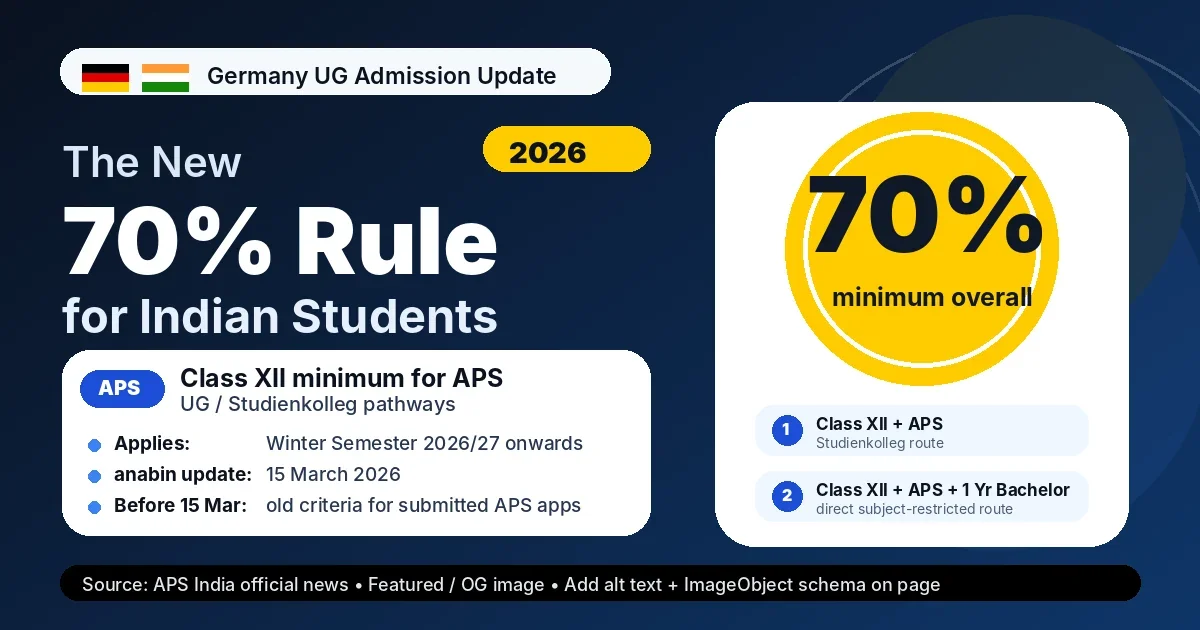
The Akademische Prüfstelle (APS) is a verification process run by the German Embassy in New Delhi. Every Indian applicant needs it before they can apply to a German public university.
What it actually involves:
- Register online at india.diplo.de, upload transcripts and degree certificates.
- Pay the fee (~€200 / ₹18,000).
- Attend an in-person interview (20-30 minutes) at the embassy or a consulate. They ask about your academic background, intended programme, and career goals in English or German.
- Receive the APS certificate (4-8 weeks after the interview). It is then attached to every university application and to your visa file.
Two practical points Indian students often miss:
- You can apply to universities before receiving APS, but you cannot be issued an admission letter without it. Start the APS process 6 months before your target application deadline.
- APS is not required for doctoral applications or for short-term study (under 90 days). It's specific to Bachelor's and Master's applicants from India, China, and Vietnam.
Scholarships Indian students actually get in 2026
Most Indian students don't apply for scholarships because they assume they're for "exceptional" students. Wrong - the DAAD scholarship programme is open to anyone with a 7.0+ CGPA and a clear study plan. Here's the real list of scholarships Indian students are getting:
| Scholarship | Coverage | Who it's for | Deadline (typical) |
|---|---|---|---|
| DAAD Study Scholarship | €934/mo + insurance + flight + tuition (if any) | Master's/PhD applicants from India with 2+ years work experience | Oct-Nov annually |
| DAAD EPOS | Full funding + travel + insurance | Mid-career professionals in development-related Master's | Sep-Oct annually |
| Deutschlandstipendium | €300/mo for 2 semesters (renewable) | Any enrolled student, merit + need based | After first semester |
| Heinrich Böll Foundation | €934/mo + extras | Master's/PhD; socially/politically engaged students | Mar 1 / Sep 1 |
| Konrad Adenauer Foundation | €934/mo | Master's/PhD; strong academics + community involvement | Jan 15 / Jul 15 |
| Friedrich Ebert Foundation | €934/mo + insurance | Master's/PhD; demonstrated social/political commitment | Oct 31 / May 31 |
| Rosa Luxemburg Foundation | €934/mo | Master's/PhD; critical-thinking, often humanities/social sciences | Apr 1 / Oct 1 |
| Hans Böckler Foundation | €934/mo | Master's/PhD; working-class or first-generation students | Jan 31 / Jul 31 |
| Erasmus Mundus Joint Master's | €1,400/mo + travel + tuition | Selected joint programmes across EU; highly competitive | Oct-Jan (per programme) |
| SBW Berlin Scholarship | €500-€1,000/mo | Students from developing countries; tuition, living, travel | Aug 31 / Feb 28 |
| Friedrich Naumann Foundation | €934/mo | Master's/PhD; liberal-arts focus | Oct 31 / Apr 30 |
| KAAD Scholarship | €934-€1,200/mo | Students from developing countries; Christian background preferred | Rolling; 4-6 months ahead |
Source: DAAD India - Scholarships and individual foundation websites. Stipends are pre-tax for non-EU students.
Realistic expectation: foundation scholarships are highly competitive - 3-8% acceptance rates. Apply to 5+ and don't pin your financial plan on a single award. The DAAD Study Scholarship is the most generous and has the most spots for Indian students (~120 per year). Browse our full Germany scholarships list for current deadlines.
The German student visa, step by step
For a course of study longer than 90 days, you need a National Visa (D-Visa) for "Studium" (study). You apply at the German Embassy in New Delhi or the consulates in Mumbai, Bangalore, Chennai, or Kolkata.
Documents checklist (the embassy will not process without all of these):
- Valid passport (issued within last 10 years, validity >12 months beyond visa)
- Two recent biometric photos (45×35mm, white background)
- University admission letter (Zulassungsbescheid) - original + 2 copies
- APS certificate - original + 2 copies
- Blocked account confirmation showing €11,904 deposit
- Academic transcripts and degree certificates (10th, 12th, Bachelor's) - originals + 2 copies
- IELTS / TOEFL / TestDaF score report
- Motivation letter (the same one you sent to the university)
- CV (German format, table-style preferred)
- Health insurance confirmation (travel policy for entry, switch to a German public plan once there)
- Proof of accommodation in Germany (dorm confirmation or rental agreement)
- Financial guarantee - blocked account OR scholarship letter OR parent's income proof
Visa processing: 4-6 weeks from the date of your appointment. Book your appointment 3 months before your programme start date. New Delhi embassy slots fill up fastest.
Once issued, the visa is valid for 3 months. You must register at the local Einwohnermeldeamt (city registration) within 14 days of arrival and convert the entry visa to a residence permit (Aufenthaltstitel) - this gives you the right to work and the path to the 18-month job-seeker visa after graduation.
Working while you study
Indian students are allowed to work 140 full days or 280 half days per calendar year without needing a separate work permit. A "full day" is anything over 4.5 hours; a "half day" is up to 4.5 hours. During semester breaks, you can work more freely.
Two exceptions to the 140/280 cap:
- Werkstudent roles (working student) - if your job is related to your field of study and you work ≤20 hours/week during semester, you don't count against the 140/280-day cap. Most Indian students in tech land these.
- HiWi (Hilfswissenschaftler) - research-assistant roles at your university, paid hourly, no cap.
Realistic earnings: €13.90/hr minimum in 2026. Most Indian students earn €450-€700/month from a part-time job - enough to cover food, phone, and transport, but not rent.
After graduation: 18-month job-seeker visa, then EU Blue Card
Once you finish your Master's, you don't have to leave. Germany gives you 18 months on an Aufenthaltserlaubnis zur Arbeitsplatzsuche (residence permit for job seeking) to find a role that matches your qualification. Requirements:
- Completed degree at a German public university
- Proof of financial self-sufficiency (blocked account or savings of ~€11,904)
- Health insurance
- Valid passport
Once you secure a job offer that matches your qualification, you switch to a work permit. After 2 years on the EU Blue Card (salary threshold €48,300/year in 2026, or €43,759 in shortage occupations like IT, engineering, medicine), you can apply for a Niederlassungserlaubnis (permanent residence). After 5-8 years of legal residence you can apply for German citizenship - the 2024 reform allows dual citizenship, so you can keep your Indian passport.
How to apply: the GradGermany 4-step process
We guide Indian students through this end-to-end. The first step is the most important: an honest evaluation of where you stand before you spend ₹20K on IELTS and €200 on APS.
- Free profile evaluation - share your academics, target programme, and timeline. We tell you honestly whether Germany is the right fit and which universities match your profile.
- University shortlist + APS support - we match you against 21,777 programmes and shortlist 5-8 realistic options. We help you prepare for the APS interview.
- Applications, SOP, blocked account, visa - we write your motivation letter per programme, submit applications via uni-assist, set up the Fintiba/Expatrio blocked account, prepare the visa file, and book your embassy appointment.
- Land in Germany - airport pickup, dorm/apartment handover, Anmeldung (city registration), health-insurance activation, and a WhatsApp group of recent grads from your university.
Not sure where you stand? Get a free, honest profile evaluation - we tell you which universities you have a realistic shot at, in 48 hours.
Free Profile Evaluation →Chat on WhatsApp
Common mistakes that get international applications rejected
After 1,000+ applications, here are the recurring reasons Indian students miss out:
- Applying to programmes that need German with an English-only profile (or vice versa). Always check the language-of-instruction page on the university's site before applying.
- Submitting a generic motivation letter. German admissions officers read every SOP. If your "Why RWTH Aachen?" paragraph could apply to any university, you're filtered out.
- Missing the APS certificate at admission stage. Some unis issue conditional admission; many don't. Check the portal for "APS required at application" vs "APS required at enrolment".
- Choosing a university only by ranking. TU Munich is not always the right choice - if your CGPA is 7.2 and you want Industrial Engineering, TU Darmstadt or FAU Erlangen will take you seriously while TUM might not.
- Not checking Anabin for 3-year degrees. A 3-year B.Com from a non-flagship college is sometimes not recognised for direct Master's entry. Verify before you start.
- Booking IELTS too late. If your target is Winter 2027, you should have IELTS in hand by March 2026 so you can shortlist and apply by May 2026.
- Underestimating the blocked-account transfer time. An ₹10.5L international transfer via Fintiba takes 3-7 working days. Don't start it one week before your visa appointment.
Studienkolleg and TestAS: who actually needs them
This is the step that surprises Bachelor's applicants. A German university admits you on the strength of a school-leaving certificate it treats as equivalent to the Abitur, and an Indian Higher Secondary certificate on its own usually is not. Three routes get you past it: one completed year of a recognised Bachelor's at home, a qualifying JEE result at some universities, or a Studienkolleg year that ends in the Feststellungsprüfung.
TestAS sits beside that decision rather than inside it. It is an aptitude test, not a language test, and universities use it differently: some ask for it outright, some read a strong score as a tie-breaker in a crowded round, and Studienkollegs use it for entry. You can sit it in German or English, and the certificate has no expiry date, so an early attempt costs you nothing but the fee. The TestAS guide covers the modules, the two formats and how the score is read.
Master's applicants skip both. Your Bachelor's is the entry qualification, which is why the APS certificate and uni-assist matter far more at that level.
Turning your marks into a German grade
German admissions think in grades from 1.0 at the top to 4.0 at the pass line, and uni-assist converts your transcript with the Modified Bavarian Formula. The arithmetic decides more than people expect. A 2.0 clears most cut-offs. A 3.0 quietly closes the technical universities.
Run your numbers through our German grade converter before you shortlist: an 8.0 CGPA on a 10-point scale with a pass mark of 4 comes out at 2.0. If you want the scale explained rather than calculated, how German grading works walks through the 1.0 to 5.0 range and what counts as a good grade.
Where to go next
If you are at the shortlist stage, browse German universities and accredited programmes by subject, or start from the money with scholarships. Applying for a Master's? Start at Masters in Germany. Coming straight from school? Bachelors in Germany is the better entry point. Indian applicants have a country guide of their own: studying in Germany from India.
Why we built this guide
Most "study in Germany" guides on the internet are either written by content mills that have never set foot in Germany, or by consultancies trying to sell you something on every line. We tried to make this one different - every fact is sourced (DAAD, German Foreign Office, Anabin, the universities' own pages), every number is 2026, and every recommendation is something we'd give our own younger sibling.
If something is wrong or out of date, tell us - we update this page regularly. If you'd like a free, honest profile evaluation, the button below doesn't ask for your credit card or your phone number.
Frequently Asked Questions
You probably qualify for more than you think.
Students who get evaluated find programmes they had no idea existed — at universities that charge nothing. 2 minutes, no cost. The only downside is not checking.
Want our guides higher up in Google?
Mark GradGermany as a preferred source and Google gives our pages more room when you search about studying in Germany. Takes one tap, and you can undo it any time from the same screen.
Living this, or on your way to it? Tell your story.
If you are already in Germany and finding it hard, or still fighting to get here, other students need to hear it from someone real. Share your honest journey. We help shape it, and nothing goes live until you approve it.
Free German Quiz · No Login
Can you score 10/10 on today's German challenge?
10 new words every day · 4,500+ words from A1 to C1 · takes about a minute.