Average Salary in Germany by Field for Graduates (2026)
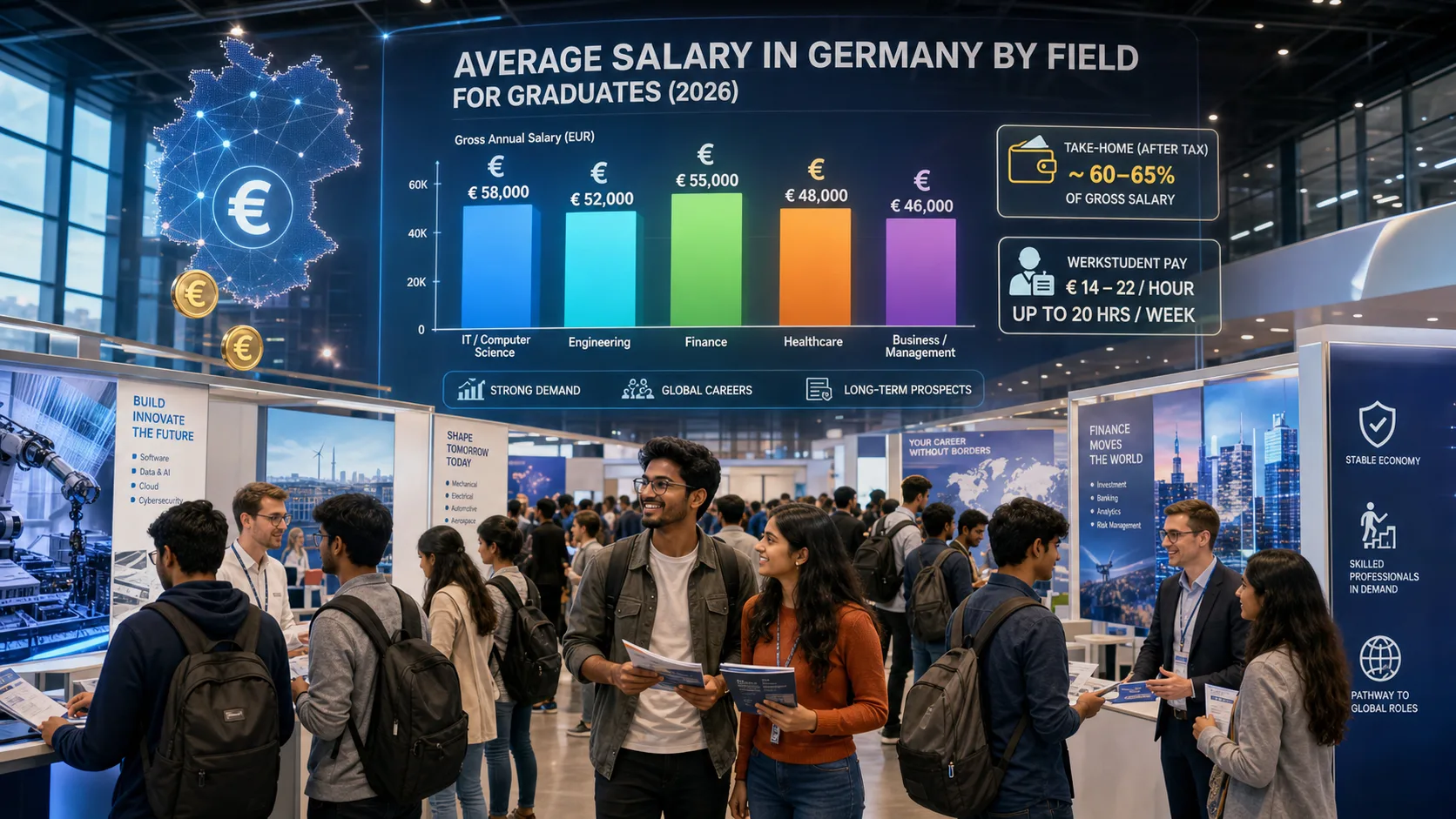
TL;DR: Master's graduates in Germany typically start at €45,000-€55,000 per year, with engineering and IT/CS often at the higher end. As a student you can work 140 full days / 280 half days a year, earning roughly €12-€15/hour (€13-€20 in Werkstudent roles). Salary also matters for your EU Blue Card and PR timeline.
Key facts at a glance
| Item | Detail |
|---|---|
| Master's starting salary | €45,000-€55,000/year |
| Highest-paying fields | Engineering, IT/CS, finance |
| Student work limit | 140 full / 280 half days per year |
| Typical part-time pay | €12-€15/hour |
| Werkstudent pay | €13-€20/hour |
Here's where the whole Germany decision starts to add up financially. You go in paying little or no tuition, and you come out into a job market that pays graduates well, a combination very few study destinations can offer. This guide breaks down what graduates actually earn in Germany in 2026 by field, what you can make part-time as a student, and how your salary quietly shapes how fast you can settle for good.
The headline number
Master's graduates typically start at €45,000-€55,000/year, varying by field, employer, and city. Combined with tuition-free public education (see Free Universities in Germany), that's a return on investment few destinations match, and it underpins the post-study work and PR pathway.
Graduate salaries by field
| Field | Outlook | Notes |
|---|---|---|
| Engineering | Very strong | Mechanical, electrical, automotive in high demand |
| IT / Computer Science | Very strong, growing | Often at/above the range; see MS CS guide |
| Healthcare / nursing | Steady, secure | Nursing via Ausbildung starts as paid training |
| Business / finance | Wide range | Finance/consulting can start high |
| Natural sciences | Solid | Strong progression in research and pharma |
Germany faces shortages in engineering, IT, healthcare, and the sciences, which strengthens both salaries and job security in those fields.
What affects your salary
- Field, the single biggest factor
- City, Munich, Frankfurt, Stuttgart pay more but cost more to live in
- German language, fluency widens options and lifts pay
- Experience, internships and Werkstudent roles give a head start
- Employer, large corporations vs startups vs public sector differ
Earning while you study
International students can work 140 full days or 280 half days per year. Typical part-time pay is around €12-€15/hour, while Werkstudent positions in your field often pay €13-€20/hour and double as career experience. These earnings help with living costs alongside your blocked account.
How salary connects to permanent residence
Your salary isn't just take-home pay, it's a lever on your immigration timeline, which most students don't connect until later. The EU Blue Card requires earnings above a set threshold, and clearing it (especially alongside decent German) noticeably speeds up your route to permanent residency. In other words, picking a well-paid, in-demand field doesn't only pay your bills, it gets you settled in Germany sooner.
Tax and take-home: a quick note
German gross salaries are subject to income tax and social contributions (pension, health, etc.), so take-home pay is lower than gross, but those pension contributions also count toward your settlement timeline. Treat the figures here as gross starting salaries.
Choose a field that pays off
Your field shapes your salary, your job security, and how fast you can settle in Germany. GradGermany helps you pick programmes with strong outcomes for your goals.
Get a free profile evaluation or browse programmes by subject.
Frequently Asked Questions
You probably qualify for more than you think.
Students who get evaluated find programmes they had no idea existed — at universities that charge nothing. 2 minutes, no cost. The only downside is not checking.
Want our guides higher up in Google?
Mark GradGermany as a preferred source and Google gives our pages more room when you search about studying in Germany. Takes one tap, and you can undo it any time from the same screen.
Living this, or on your way to it? Tell your story.
If you are already in Germany and finding it hard, or still fighting to get here, other students need to hear it from someone real. Share your honest journey. We help shape it, and nothing goes live until you approve it.
Free German Quiz · No Login
Can you score 10/10 on today's German challenge?
10 new words every day · 4,500+ words from A1 to C1 · takes about a minute.