Best Universities in Germany for MS in Computer Science (2026)
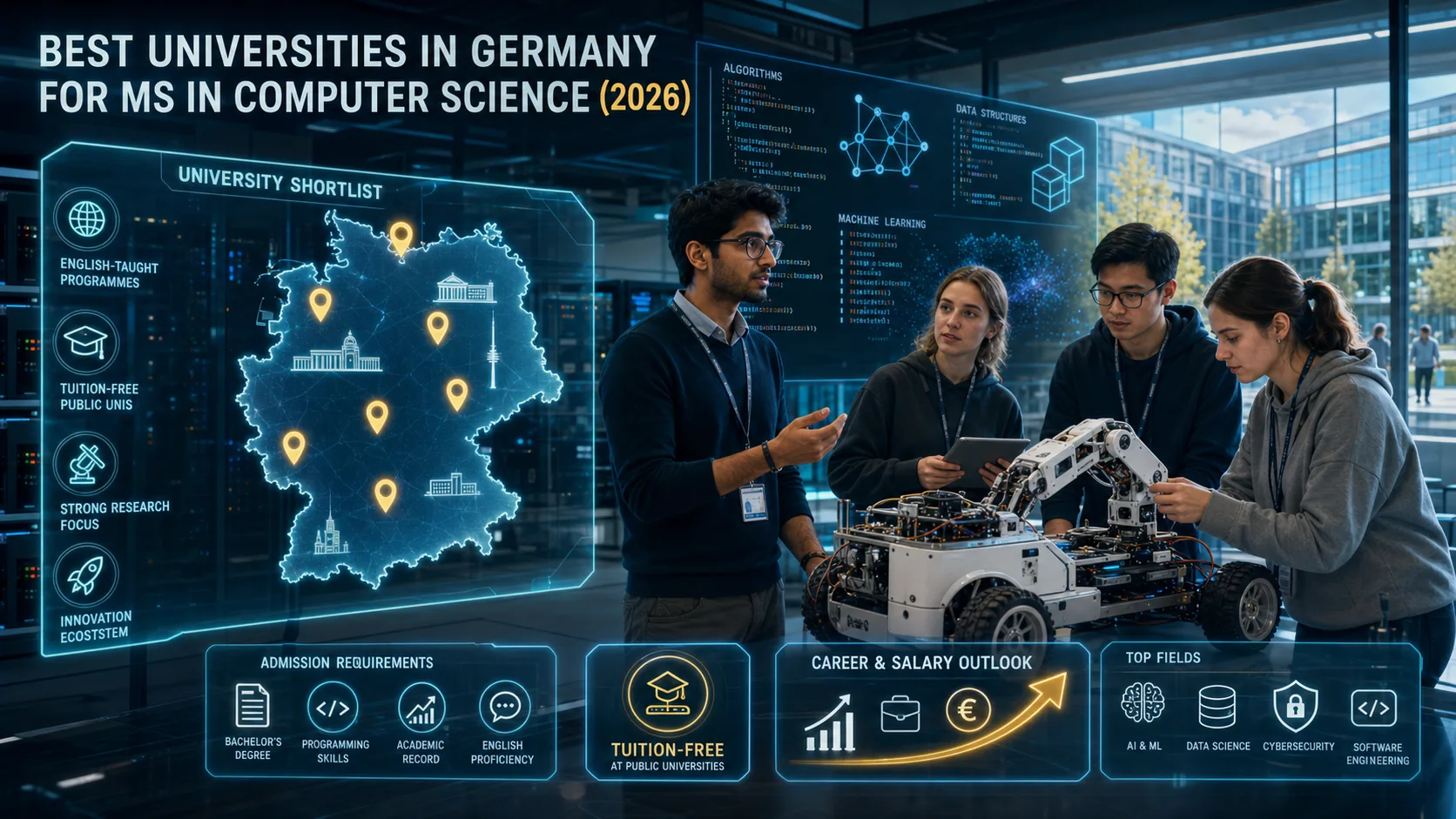
TL;DR: Germany is one of the best-value places in the world for an MS in Computer Science, tuition-free at most public universities, no GRE required, and strong job prospects in a country short of tech talent. Top choices include TUM, RWTH Aachen, TU Berlin, KIT, and TU Darmstadt, many with fully English-taught programmes.
Key facts at a glance
| Item | Detail |
|---|---|
| Tuition | Free at most public universities |
| GRE | Generally not required |
| Language | Many English-taught options |
| Starting salary | ~€45,000-€55,000+ (often higher in tech) |
| Mandatory for Indians | APS certificate |
For an Indian student weighing where to do a Master's in Computer Science, Germany is hard to beat on pure value: you typically pay no tuition, you don't need the GRE, and you graduate into a country actively short of tech talent. Low cost going in, strong earnings coming out. Below are the universities worth your shortlist for 2026, plus how to decide between them.
Why study MS Computer Science in Germany?
Three reasons. Cost: most public universities charge no tuition, see Free Universities in Germany. Quality and industry: a world-class tech sector, strong university-industry links, and Werkstudent (working-student) roles. Career outcomes: CS graduates are in high demand, supporting the post-study work and PR pathway.
Top universities for MS in Computer Science
| University | Strength | Fee note |
|---|---|---|
| TU Munich (TUM) | Top-ranked CS | Fees for new non-EU from WS 2024/25 |
| RWTH Aachen | Elite engineering + computing (TU9) | Free |
| TU Berlin | CS + startup city | Free |
| KIT Karlsruhe | Leading technical uni | Baden-Württemberg non-EU fee |
| TU Darmstadt | IT security, CS | Free |
| University of Stuttgart | Engineering + computing | Baden-Württemberg non-EU fee |
| TU Dresden | Technical programmes | Free |
| LMU Munich | Research-intensive | Free |
| University of Freiburg | AI / ML | Baden-Württemberg non-EU fee |
| FAU Erlangen-Nuremberg | Engineering + CS | Free |
Rankings and fee policies shift between intakes, confirm the current status of your specific programme. RWTH and TUM belong to the TU9, Germany's alliance of leading technical universities (the German equivalent of the IITs).
English-taught vs German-taught
Many CS Master's are taught fully in English, browse English-taught programmes. German-taught options widen choices and improve daily life and job-hunting; keep both doors open by building German via our A1-C1 courses. See Study Without IELTS.
Admission requirements for MS in CS
- A relevant Bachelor's (CS, IT, or related) with strong grades
- APS certificate, mandatory
- CGPA converted via the German Grade Converter
- English proof (IELTS/TOEFL) or an accepted alternative
- A strong SOP and letters of recommendation
- Some programmes expect specific coursework (maths, algorithms, programming)
The top CS programmes are genuinely competitive, so don't lean on grades alone, a sharp, specific application can be the difference between an offer and a polite rejection.
How to choose the right university
- Specialisation, AI/ML, security, systems, data
- Tuition status, most free; mind the Baden-Württemberg and TUM exceptions
- Language of instruction, English availability for your exact programme
- Location and industry, Munich, Berlin, Stuttgart offer strong tech job markets
- Admission realism, apply to a balanced shortlist
After your MS: jobs and PR
CS sits squarely in Germany's skilled-shortage list, strengthening your post-study work visa prospects and your route to the EU Blue Card and permanent residency. Master's graduates commonly start around €45,000-€55,000, with tech salaries often higher, see Average Salary by Field.
Build your CS shortlist with experts
Balancing specialisation, fees, language, and admission odds is where most applicants go wrong. GradGermany builds a strategic shortlist for your profile.
Get a free profile evaluation or explore MS Computer Science programmes.
Frequently Asked Questions
You probably qualify for more than you think.
Students who get evaluated find programmes they had no idea existed — at universities that charge nothing. 2 minutes, no cost. The only downside is not checking.
Want our guides higher up in Google?
Mark GradGermany as a preferred source and Google gives our pages more room when you search about studying in Germany. Takes one tap, and you can undo it any time from the same screen.
Living this, or on your way to it? Tell your story.
If you are already in Germany and finding it hard, or still fighting to get here, other students need to hear it from someone real. Share your honest journey. We help shape it, and nothing goes live until you approve it.
Free German Quiz · No Login
Can you score 10/10 on today's German challenge?
10 new words every day · 4,500+ words from A1 to C1 · takes about a minute.
Related Articles
Study in Germany
Sexualwissenschaft, M.A.
MSH Medical School Hamburg - University of Applied Sciences and Medical University
Hamburg
M.Sc.Psychologie mit dem Schwerpunkt Arbeits- und Organisationspsychologie oder Kognition und Verhalten, M.Sc.
Universität Potsdam
Potsdam
B.Ed.Deutsch, B.Ed.
Universität Paderborn
Paderborn