PR in Germany After Studies: Blue Card & Settlement Pathway (2026)
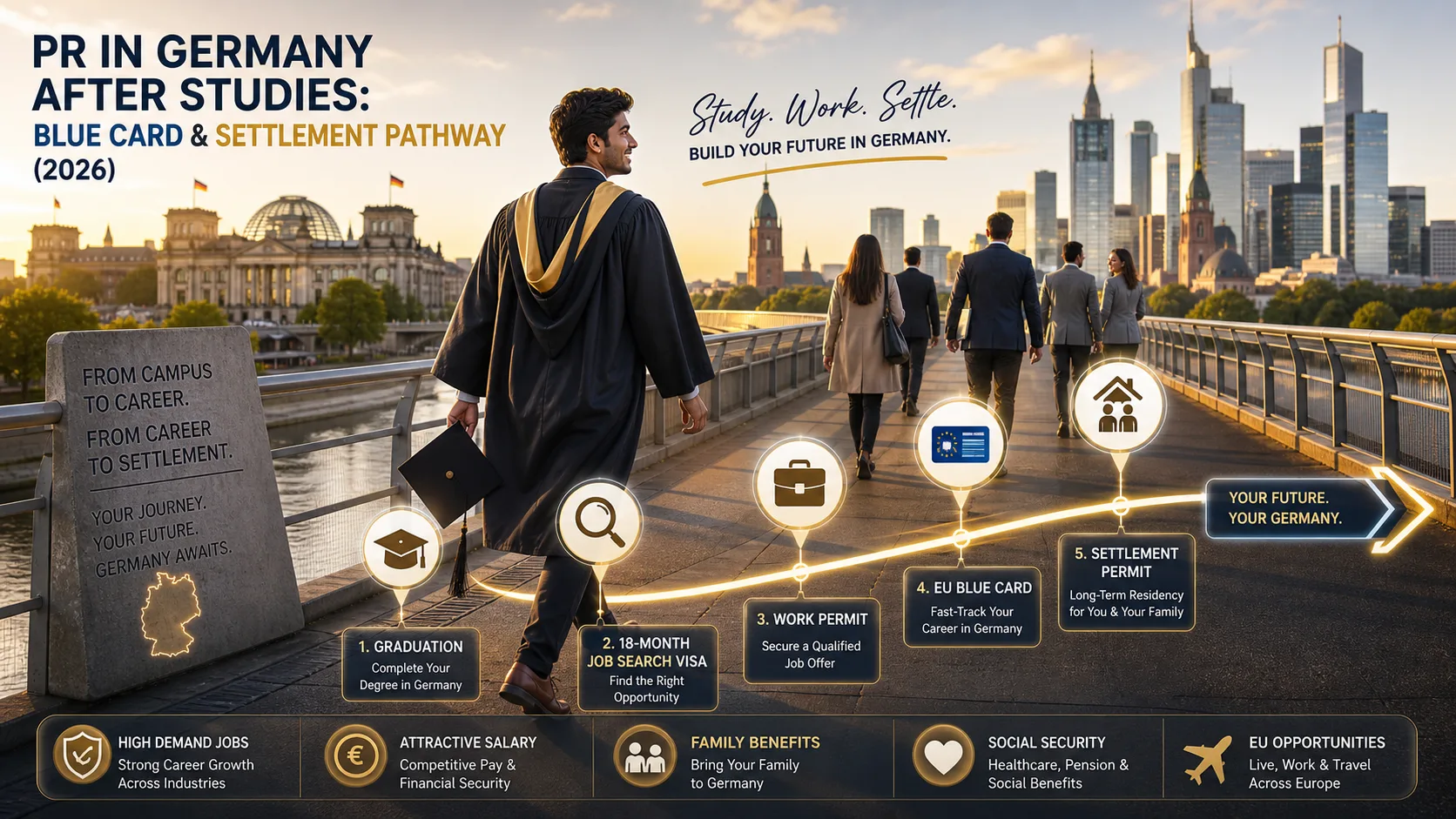
TL;DR: Germany has one of the clearest study-to-settlement pipelines in the world. After graduating you get an 18-month post-study work visa to find a job, move to a work permit or EU Blue Card once employed, and then qualify for permanent residency, a timeline that's significantly shorter for Blue Card holders with good German.
The pathway at a glance
| Stage | What it is |
|---|---|
| 1. Post-study work visa | 18 months to find a relevant job |
| 2. Work permit / Blue Card | Once employed in your field |
| 3. EU Blue Card | Faster PR for graduates above salary threshold |
| 4. Settlement permit | Permanent residence (Niederlassungserlaubnis) |
Talk to enough Indian students and you realise the German degree is often just the entry ticket: what they're really after is a future in Europe. Germany happens to offer one of the clearest paths from "international student" to "permanent resident" anywhere in the world, and the steps are surprisingly logical once you lay them out. Here's the route in 2026, stage by stage.
The big picture: study to settlement
Finish your studies get an 18-month post-study work visa move to a work permit or EU Blue Card once employed qualify for permanent residency after a qualifying period of work and contributions. Each stage builds on the last, and a German degree shortens the whole timeline.
Stage 1: The 18-month post-study work visa
After graduating, you automatically qualify for an 18-month residence permit to look for a job in your field, working without restriction while you search. This is a major advantage over many other destinations.
Stage 2: Getting a job and a work permit
Germany faces a skilled-worker shortage in engineering, IT, healthcare, and the sciences. The average starting salary for Master's graduates is around €45,000-€55,000/year (see Average Salary by Field). With a qualifying job offer, you move to a work residence permit or an EU Blue Card.
Stage 3: The EU Blue Card
The EU Blue Card is a residence permit for graduates with a qualifying job and a salary above a set threshold. Its advantage is speed, Blue Card holders reach permanent residency faster, especially with German language skills. Thresholds and timelines are set annually, so confirm current figures when you apply.
Stage 4: Permanent residency (settlement permit)
After a qualifying period of skilled work and pension contributions, shortened significantly for Blue Card holders, particularly with good German, you can apply for a settlement permit (Niederlassungserlaubnis), Germany's permanent residence, granting indefinite rights to live and work. Exact periods depend on permit type, language level, and contributions, so confirm current rules.
How language accelerates everything
If there's one thing that quietly determines how fast you settle, it's your German. Better German means a shorter road to permanent residency, an easier job hunt, and access to roles that simply aren't open to English-only candidates. Even if your career runs entirely in English, getting to B1-B2 measurably shortens your path, which is why we tell students to start learning the language long before they think they need it. Our German courses from A1 to C1 are built for exactly this.
The Ausbildung route to residence
University isn't the only path. The Ausbildung route, including nursing, is often the fastest legal route to long-term residence, because trainees are usually hired permanently and build work history immediately.
How students plan for PR from day one
- Choose a field with strong German demand (engineering, IT, healthcare).
- Build German alongside your degree.
- Use the 18-month window decisively.
- Move to a Blue Card where eligible.
- Track contribution and language milestones toward settlement.
Plan your study-to-settlement path
The choices you make before you even apply, field, university, language plan, shape how quickly you can settle. GradGermany helps Indian students plan with the long game in mind.
Frequently Asked Questions
You probably qualify for more than you think.
Students who get evaluated find programmes they had no idea existed — at universities that charge nothing. 2 minutes, no cost. The only downside is not checking.
Want our guides higher up in Google?
Mark GradGermany as a preferred source and Google gives our pages more room when you search about studying in Germany. Takes one tap, and you can undo it any time from the same screen.
Living this, or on your way to it? Tell your story.
If you are already in Germany and finding it hard, or still fighting to get here, other students need to hear it from someone real. Share your honest journey. We help shape it, and nothing goes live until you approve it.
Related Guides
Free German Quiz · No Login
Can you score 10/10 on today's German challenge?
10 new words every day · 4,500+ words from A1 to C1 · takes about a minute.
Related Articles
Study in Germany
Pflege- und Gesundheitswissenschaften, M.A.
Steinbeis Hochschule GmbH
Magdeburg
M.Ed.Spanisch (Lehramt an Gymnasien), M.Ed.
Georg-August-Universität Göttingen
Göttingen
B.Ed.Lehramtsbezogener Bachelorstudiengang (Landau) - Studiengangsmodell, B.Ed.
Universität Koblenz-Landau (jetzt: Universität Koblenz/RPTU)
Landau