Health Insurance in Germany for Students: Public vs Private (2026)
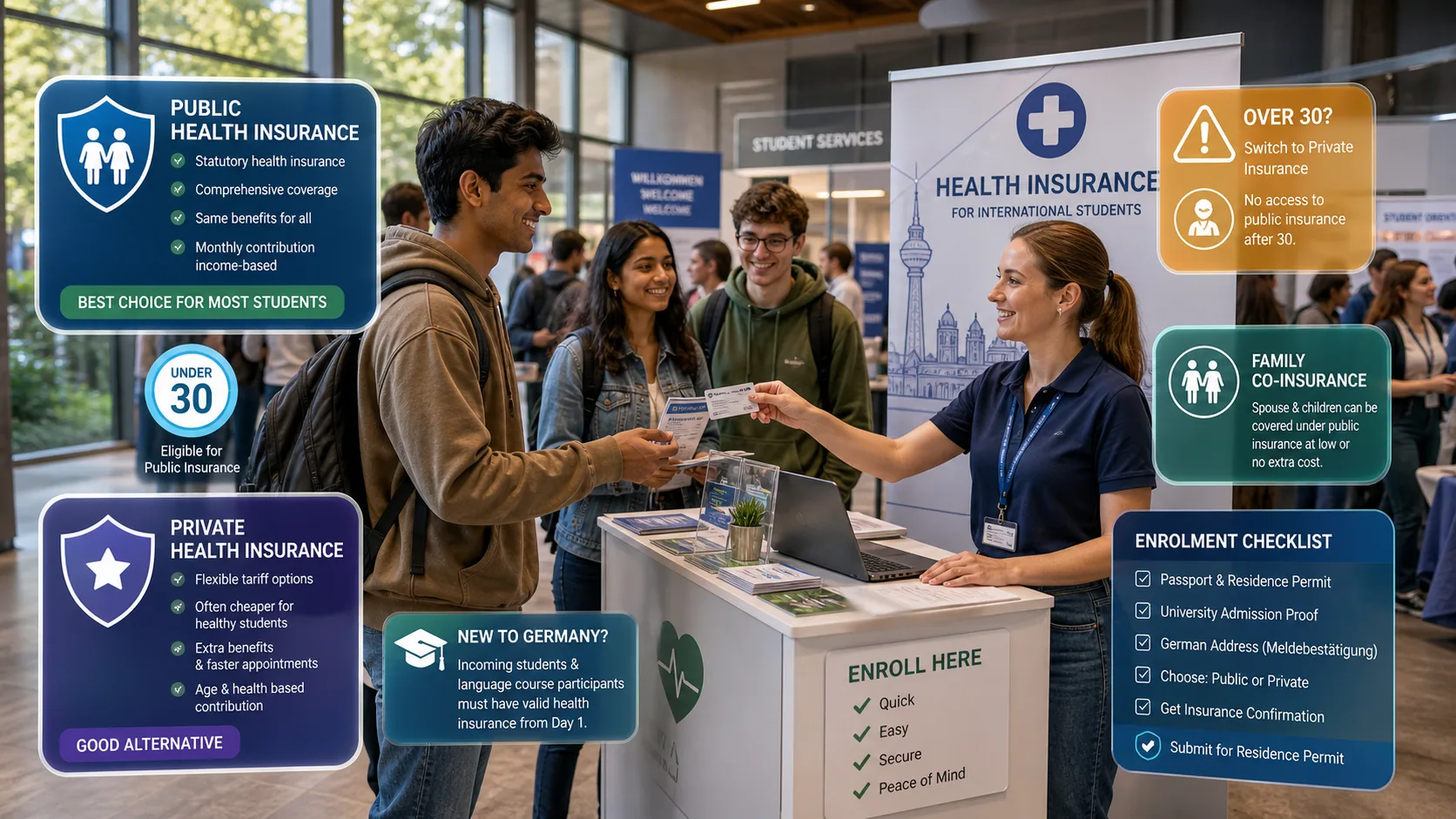
TL;DR: Health insurance is mandatory to enrol and to get your visa. Students under 30 qualify for discounted public insurance (the student rate through TK, AOK, Barmer, and others) at roughly €120 to €150 per month in 2026. From age 30 you lose the student rate and pay more. Public is the standard choice for most degree students; private suits specific cases.
Key facts at a glance
| Item | Detail (2026) |
|---|---|
| Mandatory? | Yes, for enrolment and visa |
| Under 30 (public student rate) | ~€120 to €150/month |
| Over 30 | Higher; usually no student rate |
| Main public insurers | TK, AOK, Barmer, DAK |
| Language/course students | Often need private/incoming cover |
| Family co-insurance | Possible for dependents (conditions) |
Health insurance is not optional in Germany; you literally cannot enrol or finalise your visa without it. The good news is that for most students it is affordable and straightforward, as long as you pick the right type.
Why it is mandatory
Germany runs a mandatory health insurance system, and universities require proof of valid cover from a German-regulated provider before they will enrol you. It is also part of your visa file. So this is one box you must tick early, not an afterthought.
Public insurance: the standard choice under 30
If you are under 30 and enrolled in a degree programme, you qualify for the discounted public student rate (Krankenversicherung der Studenten) through any public insurer, such as TK, AOK, Barmer, or DAK. In 2026 this runs roughly €120 to €150 per month (the base contribution plus long-term care insurance). All public insurers offer essentially the same core coverage at a similar price, so people often choose based on English-language support and app quality.
The age-30 cliff
Here is the catch worth planning around: the discounted student rate applies only until you turn 30 (or the 14th semester, whichever comes first). After 30, you lose the student rate and must move to standard voluntary public cover or private insurance, which can be considerably more expensive in 2026. If you are starting a Master's at 28 or a PhD in your early 30s, factor this in from the start.
Private insurance: when it fits
Private (and "incoming") insurance suits specific situations: students over 30, those in language or preparatory courses (who often cannot get the public student rate), and some PhD candidates. Private plans can start cheaper monthly, but be careful, as some incoming/travel plans are not accepted for enrolment because they are not GKV or PKV under German law. Always confirm a plan is university-acceptable before buying.
A common, costly mistake
Students sometimes arrive on a cheap travel or "incoming" plan bought online, then discover the student office will not accept it for enrolment, losing precious time. Avoid this by arranging proper German-regulated cover before you arrive, or switching immediately on arrival.
Family co-insurance
If you bring dependents, public student insurance can offer family co-insurance (Familienversicherung), covering a spouse or children at no extra premium provided they live in Germany and earn under the set threshold. This is a real advantage of the public route; see Bringing Your Spouse to Germany.
How to enrol, step by step
- Confirm whether you qualify for public (under 30, degree programme) or need private.
- Choose a public insurer (TK and others offer English support) or an accepted private plan.
- Apply online with your admission letter and passport.
- Get your proof of insurance for enrolment and your residence permit.
- Register with a local doctor (Hausarzt) once you arrive.
Get your insurance sorted before it delays you
Picking the wrong plan can stall your enrolment. GradGermany guides Indian students to accepted, cost-effective cover as part of pre-departure and post-arrival support.
See our post-arrival support or get a free profile evaluation.
Frequently Asked Questions
You probably qualify for more than you think.
Students who get evaluated find programmes they had no idea existed — at universities that charge nothing. 2 minutes, no cost. The only downside is not checking.
Want our guides higher up in Google?
Mark GradGermany as a preferred source and Google gives our pages more room when you search about studying in Germany. Takes one tap, and you can undo it any time from the same screen.
Get new guides as soon as they go live
Add our feed to Feedly, Inoreader or any RSS reader and every new guide on studying in Germany shows up there by itself. No email, no sign-up.
Living this, or on your way to it? Tell your story.
If you are already in Germany and finding it hard, or still fighting to get here, other students need to hear it from someone real. Share your honest journey. We help shape it, and nothing goes live until you approve it.
Related Guides
Free German Quiz · No Login
Can you score 10/10 on today's German challenge?
10 new words every day · 4,500+ words from A1 to C1 · takes about a minute.
Related Articles



Study in Germany
Mechanical Engineering, M.Sc.
Hochschule Rhein-Waal - University of Applied Sciences
Kleve
M.A.Slavische Philologie, M.A.
Georg-August-Universität Göttingen
Göttingen
M.Ed.Bildungswissenschaftliches Studium im Masterstudiengang für das Lehramt an Berufskollegs, M.Ed.
Universität Duisburg-Essen
Essen