Germany vs Canada for Indian Students 2026: Cost, Visa & PR Compared
TL;DR: Germany wins on tuition (free at most public universities vs paid in Canada) and upfront cost, with a €75 visa fee and an €11,904 living-cost proof. Canada offers a well-known PR pathway but a higher living-funds requirement and PGWP rules that vary by programme. The right pick depends on cost sensitivity, field, and how you weigh each PR route.
At a glance
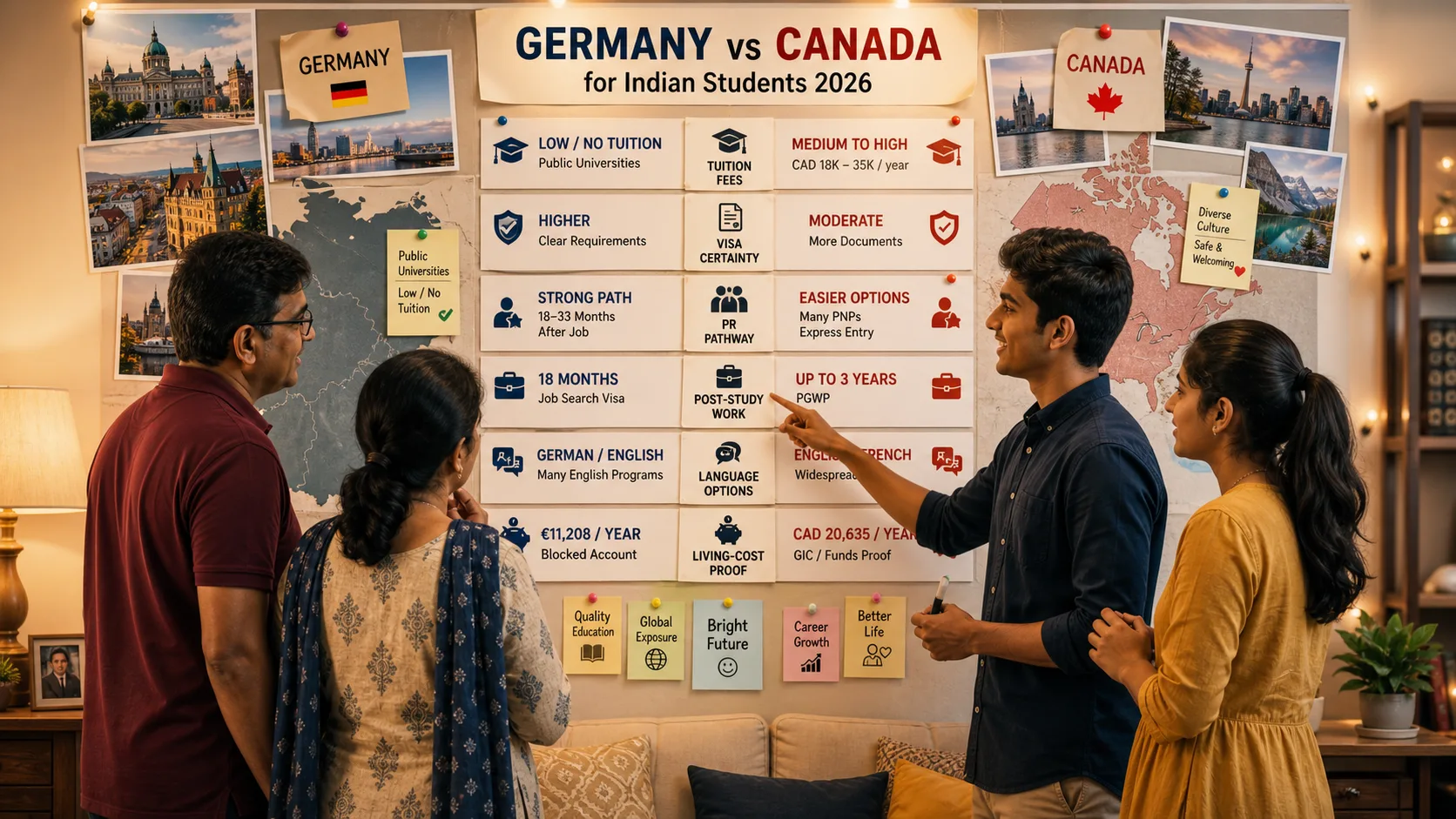
| Factor | Germany | Canada |
|---|---|---|
| Tuition (public) | Free at most public unis | Paid, varies |
| Living-cost proof | €11,904 blocked account | CAD ~22,895 (varies) |
| Visa fee | ~€75 | Higher |
| Post-study work | 18 months | PGWP (programme-dependent) |
| Language | English options + German | English / French |
Germany and Canada are the two destinations Indian students most often weigh against each other in 2026, now that both are seen as more welcoming than some traditional choices. Here is an honest, like-for-like comparison.
Cost: Germany's clearest edge
At German public universities, tuition is free even for international students; your main expense is living costs, proven via a blocked account of €11,904 per year. Canada charges tuition, and its living-funds requirement for the study permit has risen to around CAD 22,895, on top of fees. For families watching the total bill, Germany usually comes out materially cheaper.
Visa and approval
Germany's visa fee is roughly €75, and the country approves a high share of complete applications from Indian students. Canada's process is well established but has seen tightening and higher cost. Both are more predictable than some other destinations, but Germany's combination of low fee and high approval is hard to beat on cost-certainty.
Post-study work
Germany gives graduates an 18-month post-study work visa to find a job in their field. Canada's Post-Graduation Work Permit (PGWP) can be generous, but eligibility now depends on your programme being on the current eligible list, so you must check before you commit. Confirm the latest PGWP rules for your exact course.
The PR pathway
Both lead to permanent residence, by different logic. Canada's Express Entry is a mature, points-based system many Indian students know well. Germany routes you through the post-study work visa to the EU Blue Card and then a settlement permit, with German language a major accelerator. Neither is universally "faster"; it depends on your field, language, and how each system scores your profile.
Language
Canada operates in English (and French). Germany has thousands of English-taught programmes, but German pays off enormously for jobs and residence. If you are willing to learn German, that effort compounds; if you want to stay strictly in English, Canada has the edge on day-to-day ease.
How to choose
Decide on what you weight most: lowest cost (Germany), a familiar English-only PR system (Canada), your field's strength in each country, and your appetite for learning German. Run the full cost calculation including living-funds requirements and fees, not just tuition.
Get a side-by-side built around your profile
Cost, field, language, and PR goals all pull differently. GradGermany maps Germany against your Canada plans so you can decide on facts, not generic rankings.
Frequently Asked Questions
You probably qualify for more than you think.
Students who get evaluated find programmes they had no idea existed — at universities that charge nothing. 2 minutes, no cost. The only downside is not checking.
Want our guides higher up in Google?
Mark GradGermany as a preferred source and Google gives our pages more room when you search about studying in Germany. Takes one tap, and you can undo it any time from the same screen.
Living this, or on your way to it? Tell your story.
If you are already in Germany and finding it hard, or still fighting to get here, other students need to hear it from someone real. Share your honest journey. We help shape it, and nothing goes live until you approve it.
Free German Quiz · No Login
Can you score 10/10 on today's German challenge?
10 new words every day · 4,500+ words from A1 to C1 · takes about a minute.