The Anmeldung: How to Register Your Address in Germany (and Why It's Critical)
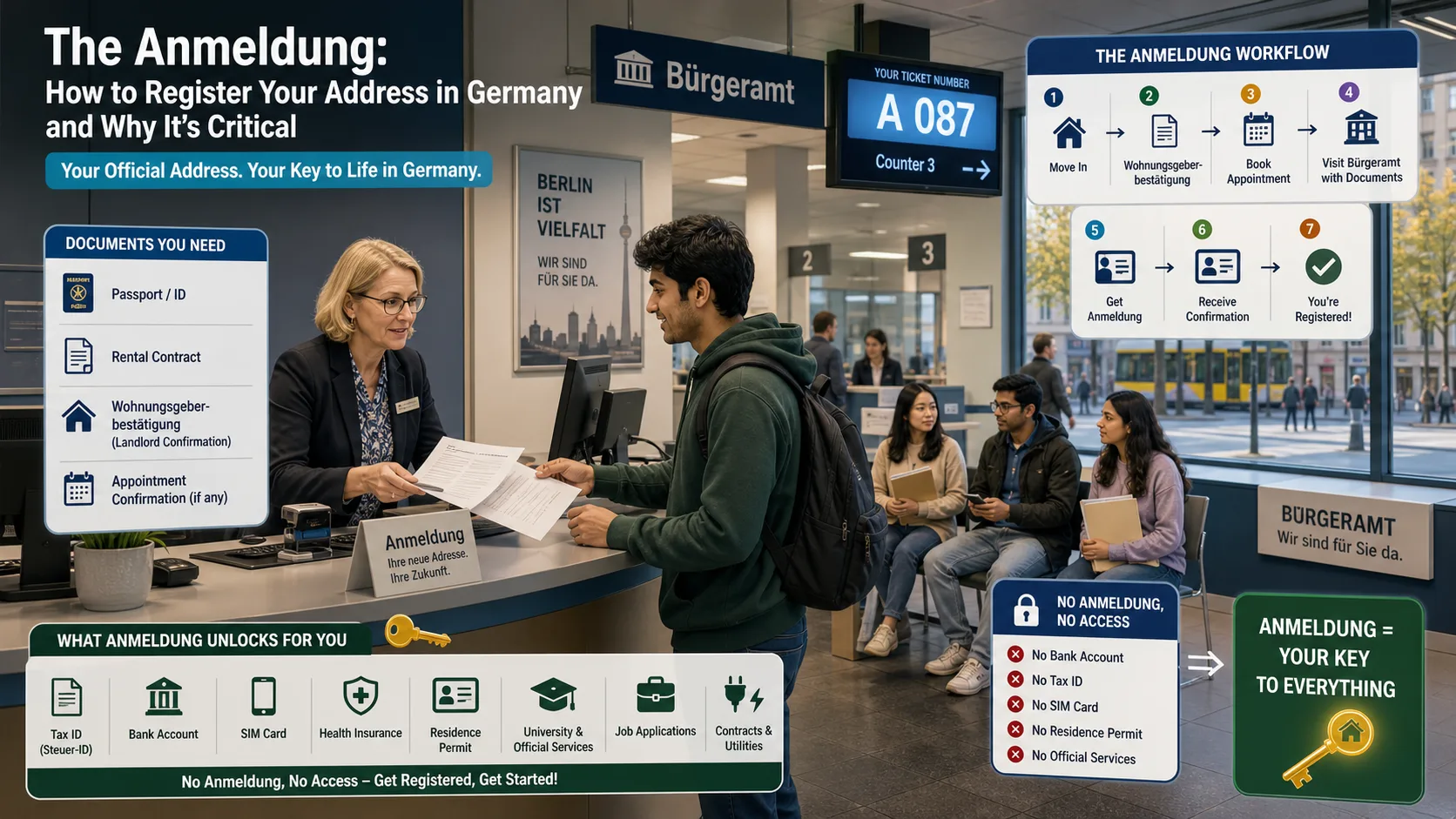
TL;DR: The Anmeldung is the mandatory registration of your home address at the local citizens' office (Bürgeramt), usually within two weeks of moving in. You need it for almost everything that follows: your residence permit, a traditional bank account, a tax ID, and more. You will need your passport, visa, and a landlord confirmation (Wohnungsgeberbestätigung).
Key facts at a glance
| Item | Detail |
|---|---|
| What it is | Address registration at the Bürgeramt |
| When | Usually within ~2 weeks of moving in |
| Key document | Wohnungsgeberbestätigung (landlord confirmation) |
| Also need | Passport, visa/residence permit |
| You receive | Meldebescheinigung (registration certificate) |
| Unlocks | Residence permit, tax ID, traditional bank, more |
The Anmeldung is one of those German bureaucratic steps that sounds trivial and turns out to be foundational. Skip it or delay it, and a surprising number of other things stall. Here is how to get it right.
What is the Anmeldung?
The Anmeldung is the official registration of your residential address with the local authority (the Bürgeramt or Einwohnermeldeamt). Germany requires residents to register where they live, and as a student you are no exception. You typically must do it within about two weeks of moving into your accommodation.
Why it is so important
The Anmeldung is the key that unlocks the rest of your administrative life in Germany. You generally need it (and the registration certificate, the Meldebescheinigung) for:
- Your residence permit (converting your visa)
- A traditional bank account and your tax ID (Steuer-ID)
- Many contracts and services
In short, almost every other step depends on having done your Anmeldung first.
What you need
- Your passport
- Your visa or residence permit
- The Wohnungsgeberbestätigung, a confirmation from your landlord that you live at the address
- The completed registration form
The landlord confirmation is the document students most often forget to arrange, so request it from your landlord as soon as you move in.
How to do it, step by step
- Secure your accommodation and move in.
- Ask your landlord for the Wohnungsgeberbestätigung.
- Book an appointment at your local Bürgeramt (appointments can be scarce in big cities, so book early).
- Attend with your passport, visa, landlord confirmation, and form.
- Receive your Meldebescheinigung (registration certificate). Keep it safe; you will need copies.
Common pitfalls
- Leaving it too late (you risk missing the registration window)
- Not arranging the landlord confirmation in advance
- Struggling to find a Bürgeramt appointment in big cities; book the moment you have housing
- Losing the Meldebescheinigung; make copies
How it connects to everything else
Your Anmeldung feeds directly into your residence permit application and your ability to set up a traditional bank account and receive your blocked-account release smoothly. Treat it as one of your very first tasks on arrival.
Arrive ready to register
The Anmeldung is simple if you arrive prepared and chaotic if you do not. GradGermany's post-arrival support walks Indian students through registration and the steps that follow.
See our post-arrival support or get a free profile evaluation.
Frequently Asked Questions
You probably qualify for more than you think.
Students who get evaluated find programmes they had no idea existed — at universities that charge nothing. 2 minutes, no cost. The only downside is not checking.
Want our guides higher up in Google?
Mark GradGermany as a preferred source and Google gives our pages more room when you search about studying in Germany. Takes one tap, and you can undo it any time from the same screen.
Get new guides as soon as they go live
Add our feed to Feedly, Inoreader or any RSS reader and every new guide on studying in Germany shows up there by itself. No email, no sign-up.
Living this, or on your way to it? Tell your story.
If you are already in Germany and finding it hard, or still fighting to get here, other students need to hear it from someone real. Share your honest journey. We help shape it, and nothing goes live until you approve it.
Free German Quiz · No Login
Can you score 10/10 on today's German challenge?
10 new words every day · 4,500+ words from A1 to C1 · takes about a minute.