Finding Student Accommodation in Germany: Dorms, WGs and How to Avoid the Crunch (2026)
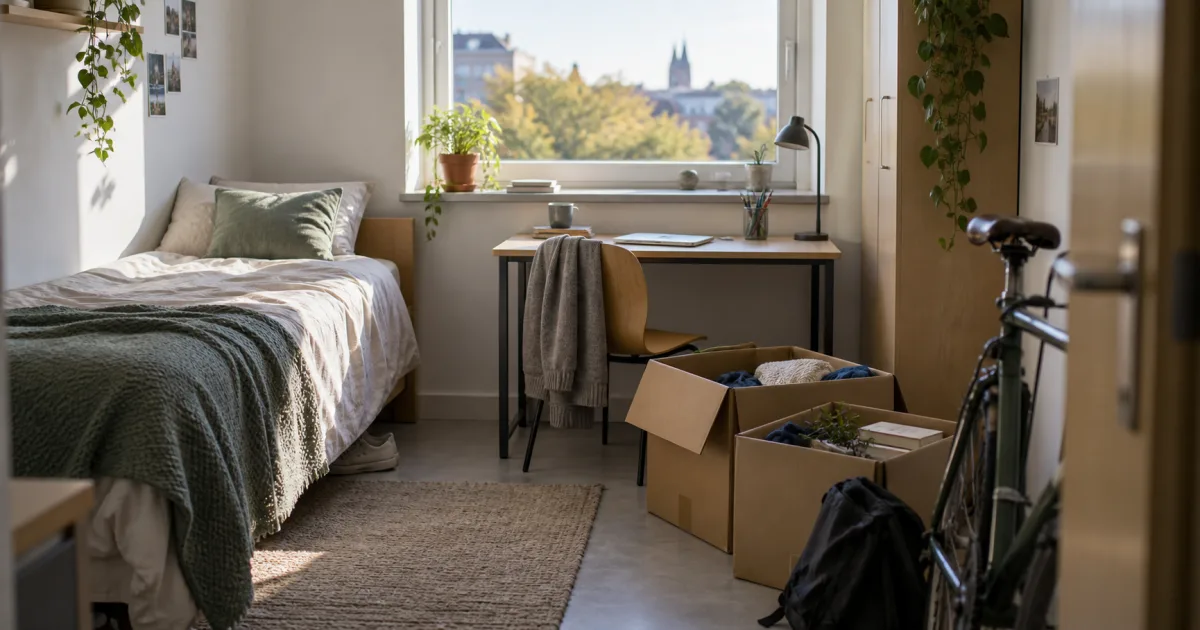
TL;DR: A room in a hall of residence averages a good 250 euros a month, which is well under the private market. Places are limited and international students get a quota rather than a guarantee, so apply through the local Studierendenwerk as soon as your acceptance letter arrives.
The three ways students live in Germany
Halls of residence, a shared flat, or your own place. In that order of price, and in reverse order of how easy they are to get.
| Option | Typical cost | The catch |
|---|---|---|
| Hall of residence (Studierendenwerk) | A good 250 euros a month on average | Limited places, waiting lists, quotas for international students |
| WG, a room in a shared flat | Varies by city, usually well above hall prices | You audition for it, often in German |
| Own flat | Highest, plus deposit and often a Schufa check | Hard without a German income history |
City matters more than category. Munich runs roughly double Leipzig for the same room, which is why our complete guide breaks living costs down city by city.
How halls actually work
Halls are run by the local Studierendenwerk or Studentenwerk, the student services organisation, not by the university itself. You apply directly to them, online, for the city where you will study.
Three details decide whether you get a room:
- Timing. Apply as soon as your letter of acceptance arrives. Not after the visa, not after you book flights.
- The quota. A fixed share of places that become available is set aside for exchange and international students. It is a quota, not a guarantee, and the international office cannot promise you a room.
- Duration. Contracts typically renew by the semester up to a maximum period, so a hall room is not automatically yours for the whole degree.
Many halls also have resident assistants, international students living in the building whose job is helping new arrivals settle. It is a real advantage in your first month.
If you do not get a hall place
Have the fallback ready before you need it. The WG market moves fast and rewards preparation:
- Write a short self-introduction in German and English, with your course, your start date and one sentence of personality.
- Collect the documents people ask for: admission letter, proof of funding such as your blocked account confirmation, passport copy.
- Expect video viewings. Flatmates choose people, not applications.
- Budget for a deposit of up to three months of cold rent, which comes back when you leave.
Be alert to the standard scam: a landlord who cannot meet, insists on a transfer before viewing, and writes beautiful English. Never send money for a room nobody has shown you.
What the rent covers, and what it does not
German listings separate cold rent from warm rent. Kaltmiete is the room. Warmmiete adds heating and some service charges, and electricity or internet may still sit outside both. When you compare two rooms, compare warm rent and ask what is missing.
Budget separately for health insurance, which is mandatory and is not part of any rent.
The timeline that works
- Offer arrives: apply to the Studierendenwerk the same week.
- Visa stage: line up your blocked account and keep the confirmation handy for landlords.
- Six weeks out: start WG applications in parallel, assuming no hall place.
- On arrival: register your address, which you need for a bank account and your residence permit.
Sources
Frequently Asked Questions
You probably qualify for more than you think.
Students who get evaluated find programmes they had no idea existed — at universities that charge nothing. 2 minutes, no cost. The only downside is not checking.
Want our guides higher up in Google?
Mark GradGermany as a preferred source and Google gives our pages more room when you search about studying in Germany. Takes one tap, and you can undo it any time from the same screen.
Get new guides as soon as they go live
Add our feed to Feedly, Inoreader or any RSS reader and every new guide on studying in Germany shows up there by itself. No email, no sign-up.
Living this, or on your way to it? Tell your story.
If you are already in Germany and finding it hard, or still fighting to get here, other students need to hear it from someone real. Share your honest journey. We help shape it, and nothing goes live until you approve it.
Related Guides
Free German Quiz · No Login
Can you score 10/10 on today's German challenge?
10 new words every day · 4,500+ words from A1 to C1 · takes about a minute.