How to Apply to German Universities from Nepal: The Full Route for 2027

To study in Germany from Nepal, start with what your certificate allows: the NEB school certificate alone leads to a Studienkolleg, while the longer Nepali bachelor is the normal basis for a master's application. Then come the applications, proof of money and the visa queue at the Embassy in Kathmandu, and the order matters. You can miss a German intake without ever being rejected. It happens when the IELTS result lands after the deadline, uni-assist is still checking documents when the university portal closes, or the Embassy queue is joined a month too late. This guide is the order of operations, from the first look at your certificates to the day you register your address in a German town.
If you only need dates, they are in our deadlines calendar. Here the focus is what to do at each stage and why it comes where it does.
Step 1: Work out what your Nepali qualification opens
A German university does not start by asking where you studied. It asks what your certificate entitles you to study. The DAAD admission database, which is based on anabin, gives these answers for Nepal:
| What you hold | What it opens in Germany |
|---|---|
| Class 12 (NEB) with no university study | A Studienkolleg and its final exam, the Feststellungspruefung, in the focus course that matches your last two school years |
| Class 12 plus at least one successful year at a university | Direct admission to a bachelor in the same or a related subject |
| A Nepali bachelor of 4 to 5 years | Direct admission to undergraduate study in any subject, and the normal basis for a master's application |
For a master's, the length of your bachelor matters. anabin rates the 4-year Nepali bachelor (for example a Bachelor of Engineering or a BBA) as equivalent to a German bachelor, but the 3-year bachelor only as conditionally comparable. Whether a given master's accepts a 3-year degree is decided by that university, usually by counting credits. Our anabin guide explains how to read these ratings, and the Studienkolleg guide covers the foundation-year route for +2 holders.
Step 2: Shortlist programmes and read the small print
Start with our programme finder and keep only courses whose entry rules you meet today, not the ones you hope to meet after a retake. For every programme on the list, copy five things from its official page into one sheet:
- The language of instruction, and the exact certificate and score it asks for.
- The subject background and minimum credits it expects from your bachelor.
- Where you apply: uni-assist, a VPD followed by the university portal, or the university portal alone.
- The deadline for non-EU applicants, which can be earlier than the one for EU applicants.
- Any tuition fee. Most state universities charge none, but Baden-Wuerttemberg charges non-EU students EUR 1,500 per semester and TUM sets its own fees.
Around six serious options is a workable list. With fewer, one rejection hurts. With many more, you will not have time to write a proper statement of purpose for each.
Step 3: Have the language certificate before you apply
English-taught programmes want proof of English such as IELTS or TOEFL, and each university sets its own minimum, so copy the score from the programme page rather than from a forum. Most German-taught programmes ask for German at level B2 or higher.
Book the test so the result is in your hands at least a month before your earliest deadline. If you are taking a German exam, choose a provider the German Embassy in Kathmandu accepts, because the Embassy recognises certificates from only a short list of centres when you apply for the visa later.
Step 4: Submit the applications
Many universities route international applications through uni-assist, which checks your documents before the university sees them. For Nepal, uni-assist asks for your Class XII certificate with subjects and grades and, if you have one, your university degree with subjects and grades. The process is digital, so you upload clear scans of the official documents.
Plan around its clock. uni-assist currently needs 4 to 5 weeks for applications from Asia and recommends applying at least 8 weeks before the university deadline. Some universities want a VPD instead, a preliminary review from uni-assist that you then send to the university yourself. Fees, the VPD and common document problems are in our uni-assist guide.
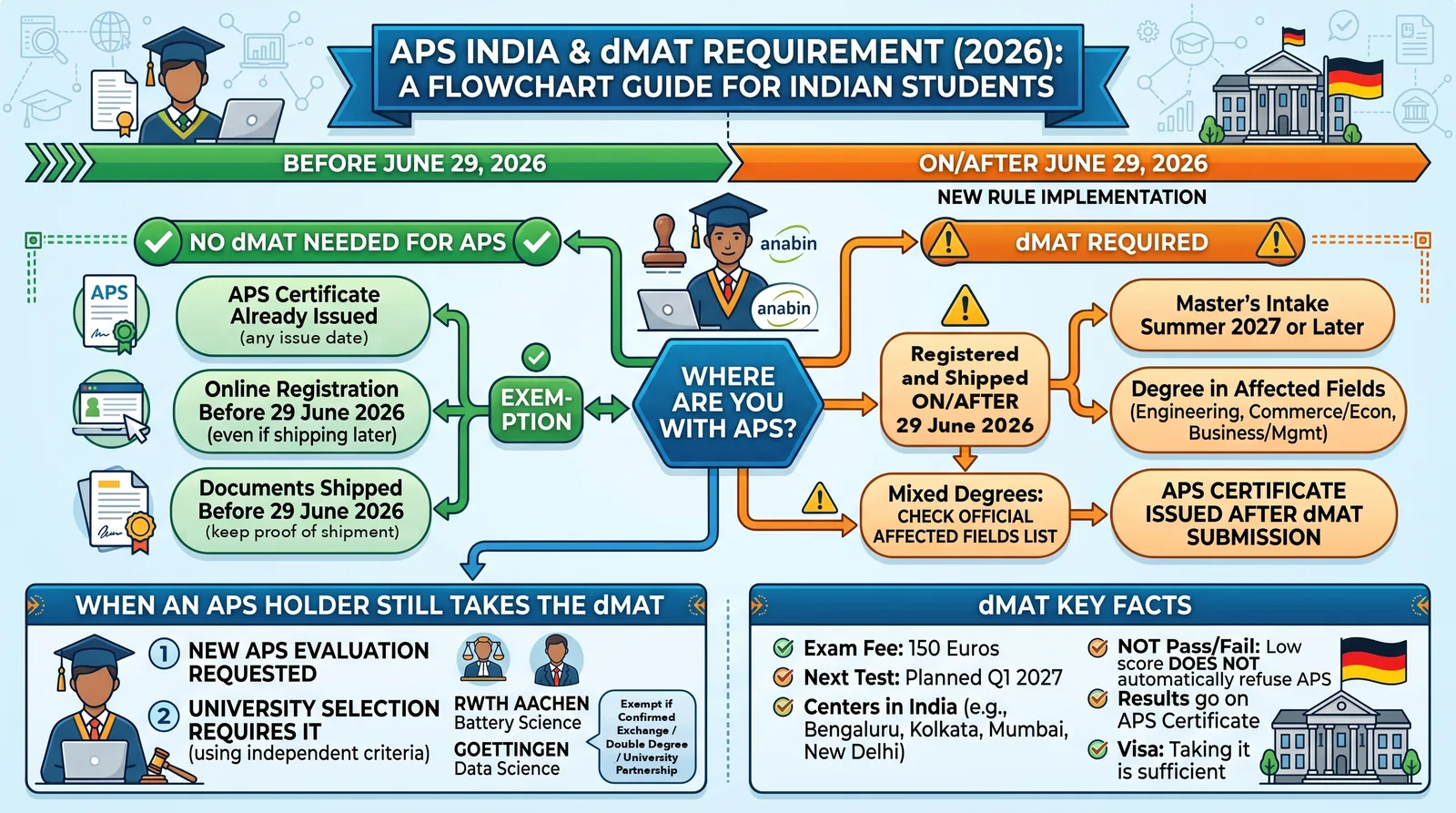
Each application usually needs a CV and a statement of purpose written for that programme. One thing Nepali applicants are often told wrongly: you do not need an APS certificate for Nepali school or university qualifications. The Embassy requires APS only for Chinese and Indian degrees, which does mean it applies to you if your bachelor is from an Indian university.
Step 5: From admission letter to visa
An admission letter sets three processes going at once, and each of them takes weeks.
- Proof of money. Germany's benchmark for students is EUR 992 a month, or EUR 11,904 for a year. The Embassy in Kathmandu does not insist on a blocked account up front and also accepts a scholarship, a formal sponsorship letter from someone living in Germany, or proof of your family's financial status, though it may ask for a blocked account during processing. Amounts and providers are in our blocked account guide.
- The visa queue. Since 1 December 2025 the Embassy allocates appointments from a waiting list in order of registration. You can submit no earlier than three months before your planned trip, and processing takes from about 3 to 4 weeks to several months. Documents and the interview are covered in our student visa guide.
- Foreign exchange. Under Nepal Rastra Bank rules, banks need a No Objection Letter from the Ministry of Education, Science and Technology before they exchange money for study abroad.
Step 6: Your first weeks in Germany
The national visa is usually issued for 90 days. It gets you into the country; it is not your permit for the whole degree, so the clock is running from the day you land.
- Health insurance before enrolment. German law requires you to prove your health insurance status to the university before it enrols you, and the insurer reports it electronically.
- Register your address. Anyone moving into a flat must register within two weeks at the local registration office.
- Enrol and pay the semester contribution. DAAD puts it at roughly EUR 70 to EUR 430 per semester, often including a local transport ticket.
- Apply for the residence permit. Book the foreigners authority (Auslaenderbehoerde) early; you need the permit before your visa runs out.
Not sure which route fits your marks and degree? Our profile evaluation checks your documents against these rules before you spend money on applications.
Frequently Asked Questions
You probably qualify for more than you think.
Students who get evaluated find programmes they had no idea existed — at universities that charge nothing. 2 minutes, no cost. The only downside is not checking.
Want our guides higher up in Google?
Mark GradGermany as a preferred source and Google gives our pages more room when you search about studying in Germany. Takes one tap, and you can undo it any time from the same screen.
Get new guides as soon as they go live
Add our feed to Feedly, Inoreader or any RSS reader and every new guide on studying in Germany shows up there by itself. No email, no sign-up.
Living this, or on your way to it? Tell your story.
If you are already in Germany and finding it hard, or still fighting to get here, other students need to hear it from someone real. Share your honest journey. We help shape it, and nothing goes live until you approve it.
Free German Quiz · No Login
Can you score 10/10 on today's German challenge?
10 new words every day · 4,500+ words from A1 to C1 · takes about a minute.