Degree Recognition for Germany: Anabin and ZAB Explained (2026)
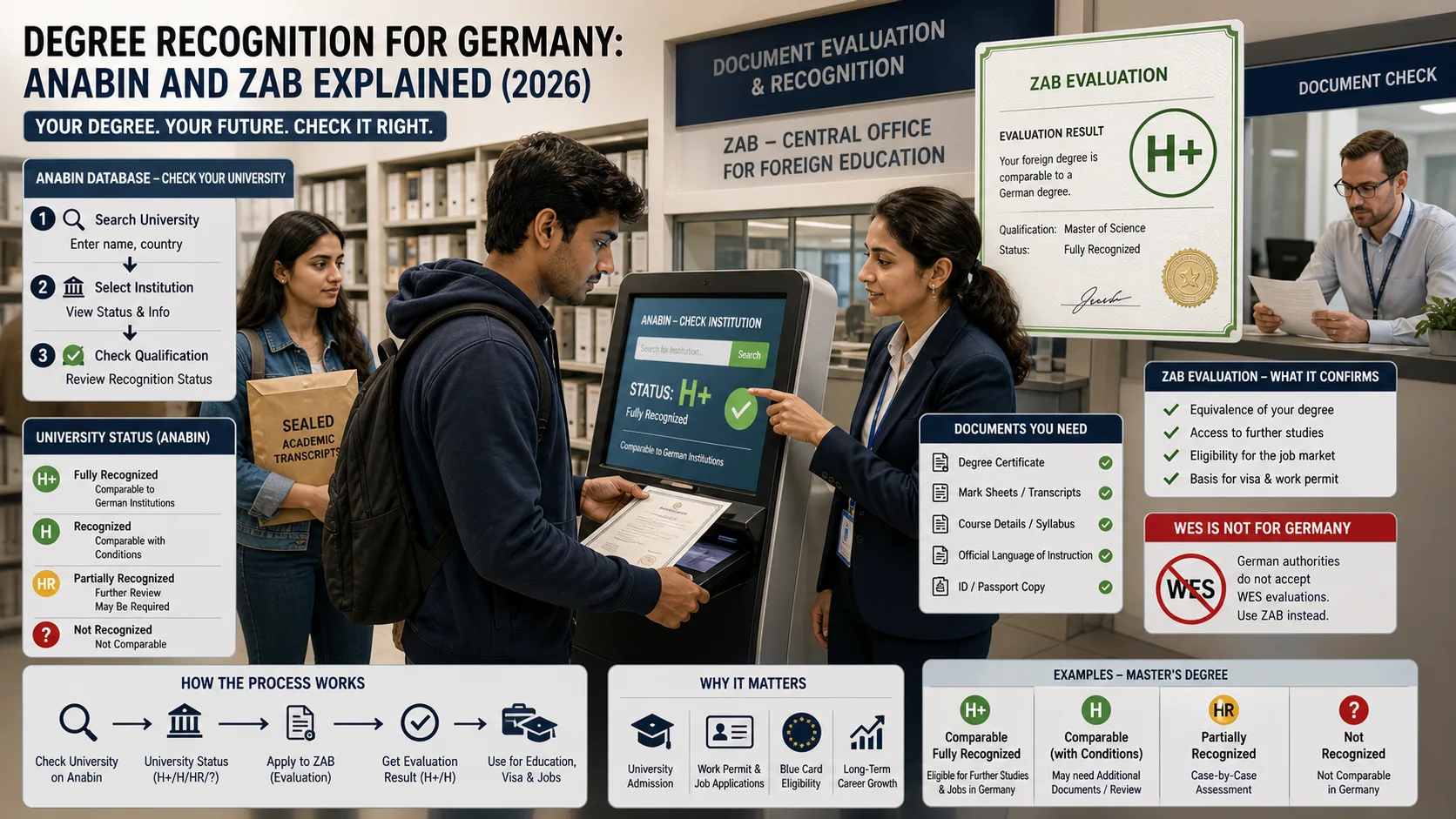
TL;DR: Germany checks foreign qualifications through the Anabin database and, where formal recognition is needed, the ZAB (Central Office for Foreign Education). Germany does not use WES, so do not buy a WES report for Germany. Most IIT, NIT, and UGC-recognised Indian degrees are already listed in Anabin, often rated "H+" (fully equivalent).
Key facts at a glance
| Item | Detail |
|---|---|
| Database | Anabin (check your degree first) |
| Formal recognition body | ZAB |
| WES | Not used for Germany |
| Best rating | "H+" (fully equivalent) |
| Most IIT/NIT/UGC degrees | Generally listed/recognised |
| Recognition timeline | Often ~1 to 4 months when needed |
Degree recognition sounds intimidating, but for most Indian students it is more straightforward than the jargon suggests. Here is how Germany actually checks your qualifications, and the one mistake to avoid.
How Germany checks your degree
Germany uses two main tools. Anabin is an online database that classifies foreign institutions and qualifications and their German equivalence; it is your first stop. ZAB (the Zentralstelle für ausländisches Bildungswesen) provides formal recognition statements where they are required, for example for some regulated professions or certain visa routes.
The mistake to avoid: WES
Many Indian students assume the recognition process is the same everywhere. It is not. Germany does not use WES (which is for Canada and the US). Do not pay for a WES report if Germany is your target; it will not help your German application.
How Indian degrees are treated
The good news for most Indian applicants: degrees from IITs, NITs, and UGC-recognised universities are generally already listed in Anabin, frequently with the top "H+" rating, meaning fully equivalent. Check the database first; in many cases your institution and degree are already classified, and no separate evaluation is needed.
Understanding the ratings
In Anabin, institutions and degrees carry equivalence ratings. "H+" means recognised as equivalent. Some qualifications are rated partially equivalent, in which case you may need additional steps or formal ZAB recognition. Knowing your rating early tells you exactly what (if anything) you need to do.
When you need formal recognition
For unregulated roles (most IT and engineering jobs), formal recognition is often not mandatory, though it strengthens applications. For regulated professions (such as healthcare; see Volume 1's nursing guide), formal recognition is usually required before you can practise. When recognition is needed, the process often takes around one to four months, so start before your job search, not after an offer.
Step-by-step
- Search the Anabin database for your institution and degree.
- Note your equivalence rating (aim for "H+").
- If fully equivalent and unregulated, you likely need no separate evaluation.
- If partially equivalent or in a regulated field, pursue ZAB recognition.
- Do not waste money on a WES report for Germany.
Check your recognition the right way
Knowing your Anabin rating early saves time and money (and stops you wasting cash on the wrong report). GradGermany helps Indian students verify recognition and plan accordingly.
Frequently Asked Questions
You probably qualify for more than you think.
Students who get evaluated find programmes they had no idea existed — at universities that charge nothing. 2 minutes, no cost. The only downside is not checking.
Want our guides higher up in Google?
Mark GradGermany as a preferred source and Google gives our pages more room when you search about studying in Germany. Takes one tap, and you can undo it any time from the same screen.
Get new guides as soon as they go live
Add our feed to Feedly, Inoreader or any RSS reader and every new guide on studying in Germany shows up there by itself. No email, no sign-up.
Living this, or on your way to it? Tell your story.
If you are already in Germany and finding it hard, or still fighting to get here, other students need to hear it from someone real. Share your honest journey. We help shape it, and nothing goes live until you approve it.
Free German Quiz · No Login
Can you score 10/10 on today's German challenge?
10 new words every day · 4,500+ words from A1 to C1 · takes about a minute.