Do Mini-Job Days Count Toward Germany's 140-Day Student Work Limit?
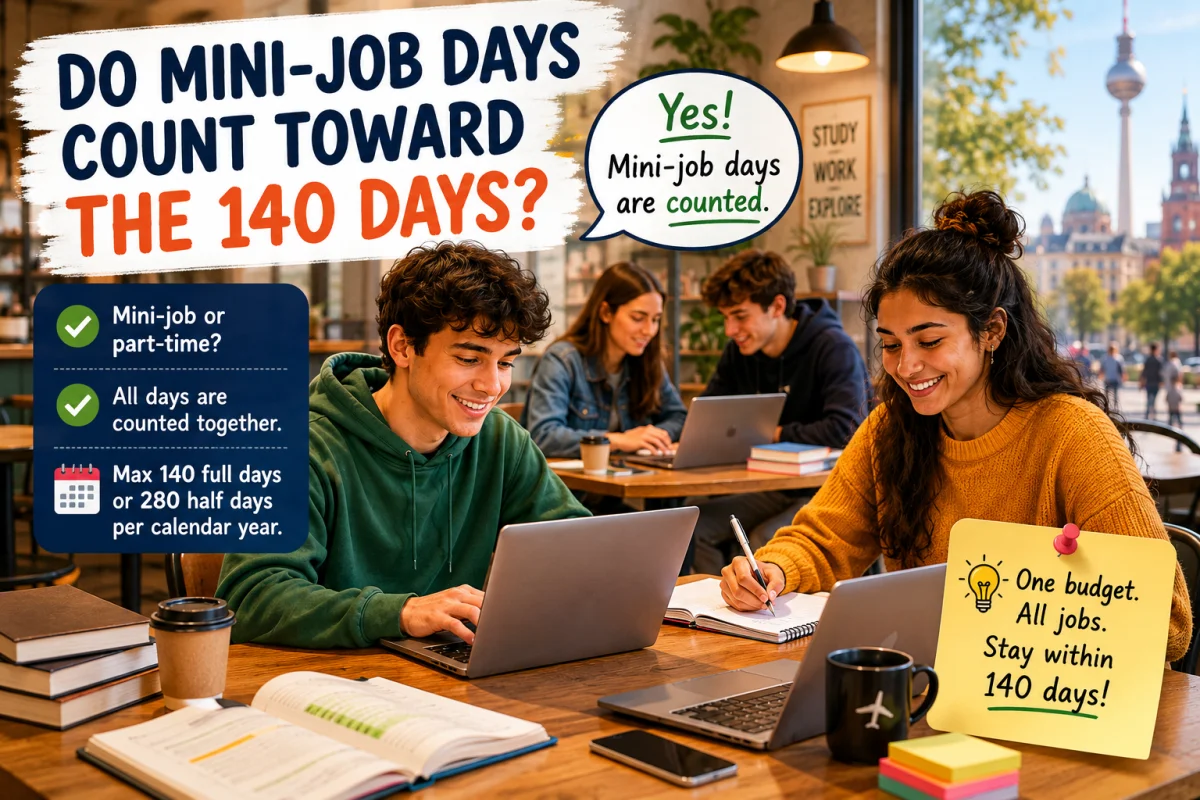
TL;DR: Yes, your mini-job days count toward Germany's 140-day student work limit. As a non-EU international student you may work 140 full days (or 280 half days) per calendar year without a separate work permit, and that allowance is one shared budget. It does not matter whether you do a mini-job only, a part-time job only, or both at once, every day you work on a regular job is counted against the same 140-day cap. Only on-campus academic jobs and mandatory curriculum internships are exempt.
"Do the days from my €556 mini-job get counted in the 140 days, or is that separate?" It is one of the most common questions we get from students after they arrive in Germany, and getting the answer wrong can put your residence permit at risk. The short version: mini-job days are absolutely counted. This guide explains exactly how the limit works in 2026, how mini-job and part-time days combine, and how to stay compliant.
Short answer: do mini-job days count?
Yes. Under §16b of the German Residence Act (Aufenthaltsgesetz), an international student's permission to work is written into the residence permit as "Beschäftigung erlaubt. 140 Tage oder 280 halbe Tage pro Jahr", employment permitted, 140 days or 280 half-days per year. The wording says employment, not "part-time employment" or "jobs above the mini-job threshold". A mini-job (geringfügige Beschäftigung) is employment in the eyes of the law, so every day you work in a mini-job is a day off your 140-day allowance.
The mini-job earnings ceiling, €556/month in 2025, rising to €603/month from 1 January 2026, only affects your tax and social-insurance status. It has no effect on the immigration day-count. A low-paid mini-job day and a higher-paid part-time day are counted exactly the same way: as one working day.
What the 140-day rule actually is
Since March 2024, non-EU/EEA students in Germany may work 140 full days or 280 half days per calendar year without needing approval from the Federal Employment Agency (this was raised from the old 120/240-day limit). The allowance:
- Resets every calendar year, January to December, not your academic or semester year.
- Applies to the whole year, including semester breaks. (Germany no longer uses the old "20 hours during term, unlimited in the holidays" framing for the immigration cap, it is now a flat annual day-budget.)
- Covers all regular employment regardless of pay level, employer, or job type.
EU/EEA and Swiss students are not bound by the 140-day rule and can work like any local resident. This guide is for non-EU international students on a §16b study residence permit.
Full days vs half days, how a day is counted
This is where most students miscount. The 140/280 figure is two ways of expressing the same budget:
- A full day = working more than 4 hours on that calendar day (up to the standard 8-hour day).
- A half day = working 4 hours or less on that calendar day.
So you have either 140 full days or 280 half days, or any mix that stays within the equivalent budget (one full day "costs" the same as two half days). Working 3 hours after class still uses a half day; it is not free just because it was short. This matters a lot for mini-jobbers, who often work short shifts: a mini-job built from many 3-4 hour shifts can burn through your 280 half-days faster than you expect.
Why mini-job days are included
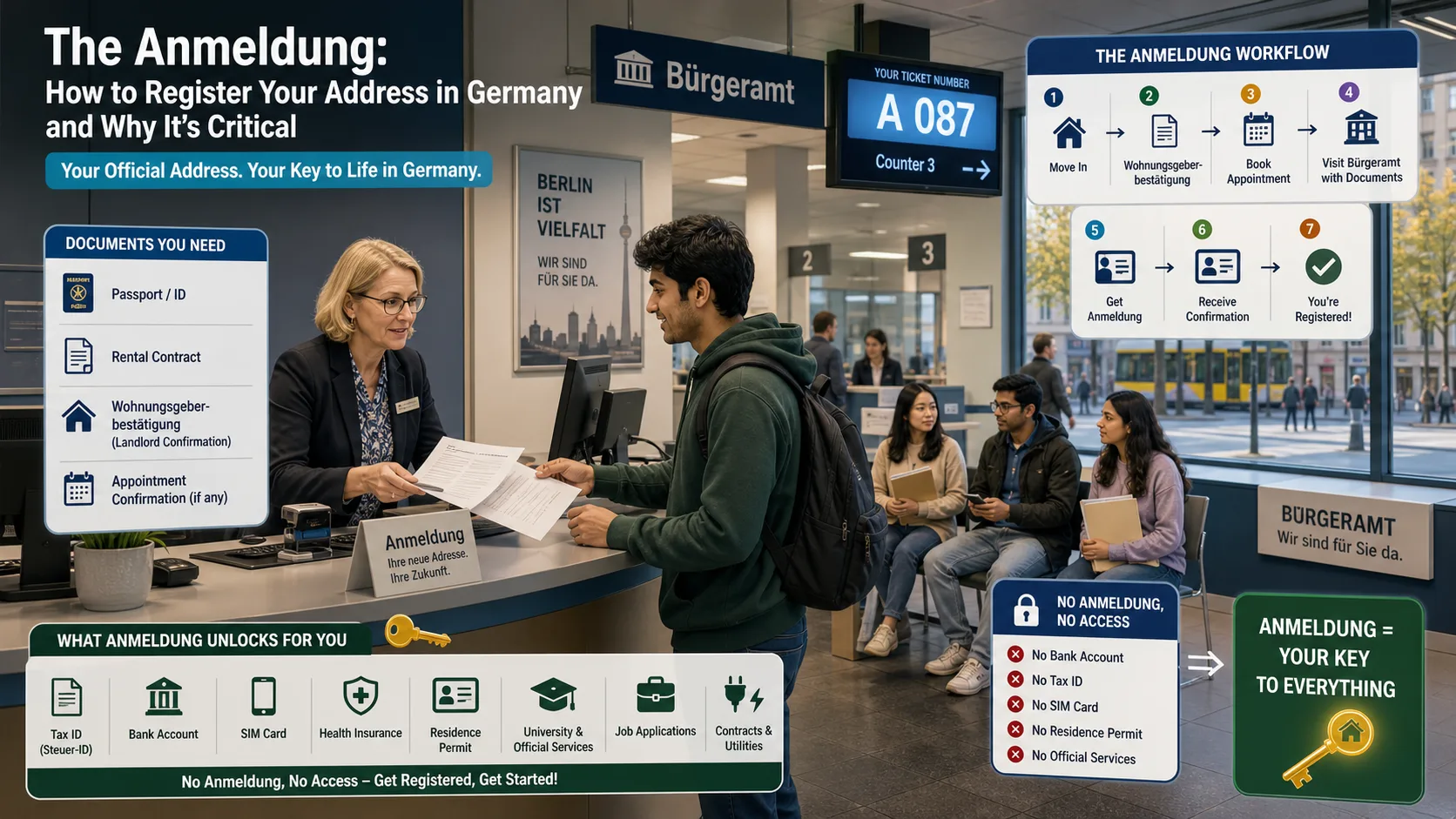
Read Also: The Anmeldung: How to Register Your Address in Germany (and Why It's Critical)
A mini-job is simply a job with capped monthly earnings (€603 in 2026). German labour law treats it as a proper employment relationship, you sign a contract, you are registered with the Minijob-Zentrale, and you accrue the same legal status as any other employee. Because it is employment, it falls squarely inside the residence-permit wording "Beschäftigung erlaubt … 140 Tage". There is no carve-out for mini-jobs in the day-count.
Students sometimes assume that because a mini-job is "small" or tax-free, it does not register. It does. The Ausländerbehörde (Foreigners' Office) can and does check your employment history when you renew your permit, and your employer reports your mini-job to the authorities. Treat every mini-job shift as a day (or half-day) spent from your annual budget.
One combined budget: mini-job + part-time
The single most important point: 140 days is your total across every job you hold. It is not 140 days per job and not a separate allowance for mini-jobs. Whether you work one job or three, the days are added together against the same cap. Here is how the three common setups land against the limit:
| Your setup | How days are counted | Annual limit |
|---|---|---|
| Mini-job only (e.g. café, retail, delivery) | Each calendar day you work = 1 full day (>4h) or ½ day (≤4h) | 140 full / 280 half days |
| Part-time only (regular job above the mini-job threshold) | Each calendar day you work = 1 full day or ½ day | 140 full / 280 half days |
| Mini-job + part-time together | Days from both jobs are added up. A single calendar day worked across two jobs still counts once (as one day, full or half by total hours) | 140 full / 280 half days combined |
In other words, you cannot "reset" the clock by switching from a mini-job to a part-time role, or by adding a second job. The combined total of all days worked across all regular jobs must stay at or under 140 full days (280 half days) in the calendar year. If you work both jobs on the same day, count that day once, based on the total hours worked that day (so two 3-hour shifts at two employers = 6 hours = one full day).
A note on the 20-hour "Werkstudent" rule: Separately from the immigration 140-day cap, there is a social-insurance rule (the Werkstudentenprivileg) that limits you to about 20 working hours per week during the semester to keep your reduced student insurance contributions. Crucially, the hours from a mini-job and a working-student job are added together for that 20-hour test too. These are two different rules with two different purposes, but both treat your jobs as a combined whole.
What does NOT count toward your 140 days
A few specific activities are exempt from the 140/280-day budget:
- On-campus academic jobs, student/research assistant roles (studentische Hilfskraft / HiWi / wissenschaftliche Hilfskraft) at your own university or an affiliated academic institution. These do not count against the 140 days, although you should still notify the Ausländerbehörde.
- Mandatory internships that are a compulsory, credited part of your study programme (a Pflichtpraktikum). Voluntary internships, however, do count.
Everything else, cafés, supermarkets, warehouses, tutoring through an agency, delivery apps, office part-time work, voluntary internships, counts. When in doubt, assume it counts and keep a record.
Mini-job, part-time or Werkstudent, which is right for you?
Because the day-budget is the same for all of them, the real differences are about money, insurance, and relevance to your degree:
- Mini-job, capped at €603/month (2026), no income tax, minimal social contributions. Best if you want light, flexible income and to protect your study time.
- Regular part-time job, higher earnings, but income above the mini-job threshold means tax and social-insurance deductions kick in. Watch the 20-hour/week semester rule.
- Werkstudent (working student) role, a part-time job in a company that is relevant to your field; great for your CV and often better paid. Still bound by both the 140-day immigration cap and the 20-hour social-insurance rule during term.
For a deeper comparison, see our guides on the 140-day work limit explained and part-time jobs for students in Germany. Planning ahead for after graduation? Read about the 18-month post-study job seeker visa.
How to track your days and stay compliant
- Keep a simple day log. A spreadsheet with the date and hours worked (across all jobs) is enough. Mark each working day as full (>4h) or half (≤4h).
- Count by calendar day, not by shift. Two shifts on the same day = one day.
- Add every job together. Your mini-job and any other job share the budget.
- Leave a buffer. Don't plan to hit exactly 140, aim for ~120 to absorb miscounting and exam-period work.
- Keep payslips and contracts. You may need them when renewing your residence permit.
Exceeding 140 full days is a breach of your residence-permit conditions and can lead to fines or problems with your visa renewal, so the few minutes of tracking are well worth it. Rules can also differ slightly between cities, so always confirm the exact wording printed on your residence permit with your local Ausländerbehörde.
Frequently Asked Questions
You probably qualify for more than you think.
Students who get evaluated find programmes they had no idea existed — at universities that charge nothing. 2 minutes, no cost. The only downside is not checking.
Want our guides higher up in Google?
Mark GradGermany as a preferred source and Google gives our pages more room when you search about studying in Germany. Takes one tap, and you can undo it any time from the same screen.
Living this, or on your way to it? Tell your story.
If you are already in Germany and finding it hard, or still fighting to get here, other students need to hear it from someone real. Share your honest journey. We help shape it, and nothing goes live until you approve it.
Free German Quiz · No Login
Can you score 10/10 on today's German challenge?
10 new words every day · 4,500+ words from A1 to C1 · takes about a minute.