Your Chances of a Job After a Master's in Germany: Placement Data by Field (2026)
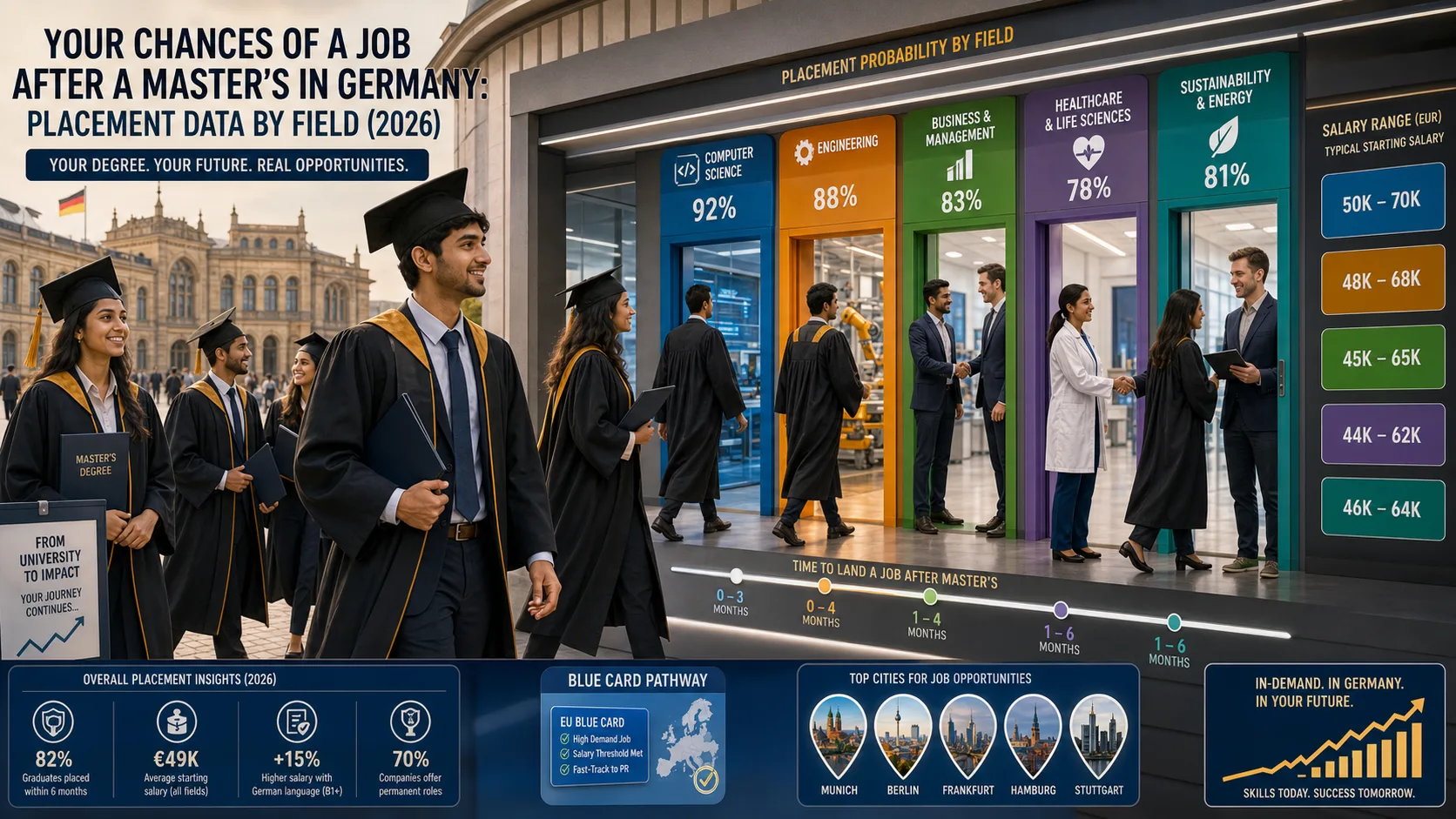
TL;DR: Roughly 70 to 75% of international Master's graduates find employment in Germany, and higher in shortage fields: IT/CS around 80 to 85%, healthcare around 85 to 90%, engineering 75 to 80%, business 55 to 65%. Your odds hinge on three things: your field, your German level (B2 is a big boost), and practical experience like Werkstudent roles.
Placement by field at a glance
| Field | Approx. placement |
|---|---|
| Healthcare | 85 to 90% |
| IT / Computer Science | 80 to 85% |
| Engineering | 75 to 80% |
| Business | 55 to 65% |
| Overall | 70 to 75% |
"Will I actually get a job?" is the question behind every decision to study abroad. For Germany in 2026, the data is genuinely encouraging, as long as you understand what drives the numbers.
The headline numbers
Around 70 to 75% of international Master's graduates find employment in Germany. That is strong, and it reflects a simple supply-and-demand reality: Germany has a very large number of unfilled positions and a relatively small pool of international graduates each year, so the balance favours graduates.
Placement by field
The averages hide big differences by field:
- Healthcare: ~85 to 90%, reflecting an acute shortage
- IT / Computer Science: ~80 to 85%
- Engineering: ~75 to 80%
- Business: ~55 to 65%
The pattern is clear: STEM and healthcare fields, which sit on Germany's shortage lists, place far more reliably than general business.
The three factors that decide your outcome
Placement is not luck; it tracks three things you can influence:
- Field of study. STEM and healthcare lead; align your degree with demand.
- German level. Reaching B2 materially improves placement; in some estimates it boosts outcomes substantially. Build it via our German courses.
- Practical experience. Werkstudent roles and internships during your studies significantly improve your odds.
How the job feeds your future
A job after your Master's is not just income; it is the gateway to the EU Blue Card and permanent residence. Shortage-field roles even have lower Blue Card salary thresholds and a faster PR timeline, so your field choice compounds over years.
How to maximise your chances
- Pick a STEM or healthcare field where you can.
- Treat German as a career investment, not an afterthought.
- Land at least one Werkstudent role or internship during your studies.
- Build a German-style CV and application (see Volume 1's CV guide).
- Use the 18-month post-study window with focus, not as a holiday.
Plan your studies around the job at the end
The students who place best plan backwards from employment. GradGermany helps Indian students choose fields and build the profile that German employers hire.
Get a free profile evaluation or explore our German courses.
Frequently Asked Questions
You probably qualify for more than you think.
Students who get evaluated find programmes they had no idea existed — at universities that charge nothing. 2 minutes, no cost. The only downside is not checking.
Want our guides higher up in Google?
Mark GradGermany as a preferred source and Google gives our pages more room when you search about studying in Germany. Takes one tap, and you can undo it any time from the same screen.
Get new guides as soon as they go live
Add our feed to Feedly, Inoreader or any RSS reader and every new guide on studying in Germany shows up there by itself. No email, no sign-up.
Living this, or on your way to it? Tell your story.
If you are already in Germany and finding it hard, or still fighting to get here, other students need to hear it from someone real. Share your honest journey. We help shape it, and nothing goes live until you approve it.
Free German Quiz · No Login
Can you score 10/10 on today's German challenge?
10 new words every day · 4,500+ words from A1 to C1 · takes about a minute.