In-Demand Jobs in Germany 2026: Where the Vacancies Are
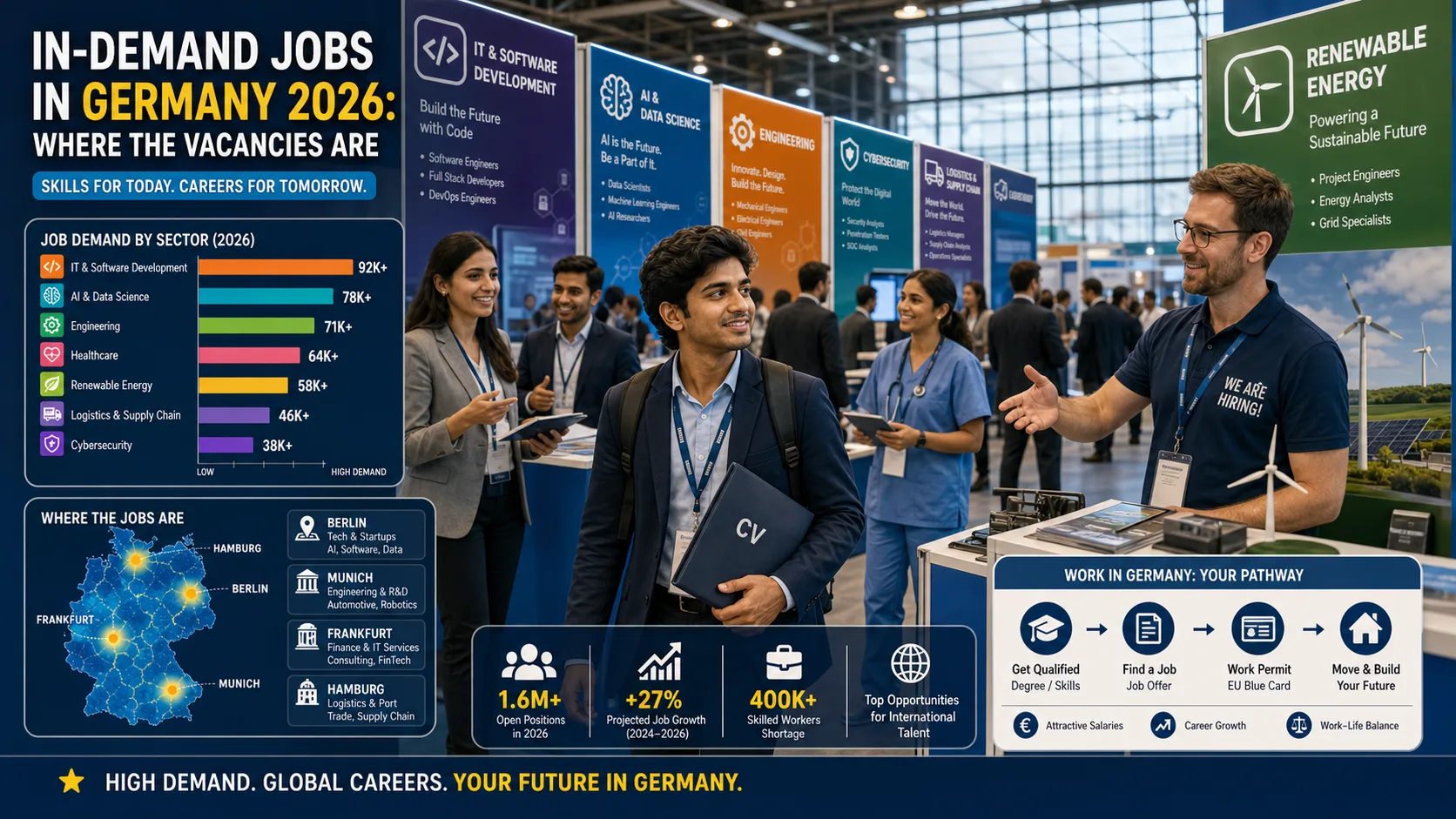
TL;DR: Germany has hundreds of thousands of unfilled skilled positions in 2026, concentrated in IT/software, AI and data science, engineering, healthcare/nursing, and renewable energy. Roles on the official shortage list get faster visas and lower salary thresholds for the EU Blue Card. For Indian graduates, aligning your degree with these fields is the highest-leverage career move.
Top in-demand fields at a glance
| Field | Example roles |
|---|---|
| IT / software | Developers (Java, Python, cloud), sysadmins |
| AI / data | Data scientists, ML engineers |
| Engineering | Mechanical, electrical, automotive, civil |
| Healthcare | Nurses, care workers, doctors |
| Renewable energy | Solar, wind, hydrogen specialists |
| Cybersecurity | Security analysts |
Germany's biggest economic story is also its biggest opportunity for Indian students: a severe, sustained shortage of skilled workers. Studying in a field Germany needs turns your degree into a near-guaranteed career runway.
Why the shortage exists
Germany has an ageing population and not enough younger workers entering the labour force, leaving a structural, multi-decade gap. The country is short hundreds of thousands of skilled professionals each year, which is precisely why it reformed its immigration laws (the Opportunity Card, expanded EU Blue Card) to attract talent from countries like India.
The most in-demand fields
IT and software development. Tens of thousands of open roles; developers in Java, Python, and cloud are in constant demand, often in English-speaking international firms. See Studying Data Science & AI in Germany.
AI and data science. Among the fastest-growing fields, with strong salaries and demand across automotive, fintech, and manufacturing.
Engineering. Mechanical, electrical, automotive, and civil engineers are perennially short, reflecting Germany's industrial backbone and infrastructure needs.
Healthcare and nursing. A critical, well-documented shortage; see Volume 1's nursing guide.
Renewable energy. The energy transition drives demand for solar, wind, and hydrogen specialists; see Studying Renewable Energy in Germany.
Cybersecurity. Rising digital-security needs have created a sustained shortage of specialists.
How shortage status helps you
Roles on Germany's official shortage list (Engpassberufe) get tangible advantages: faster visa processing and lower salary thresholds for the EU Blue Card. That means easier entry and a quicker route to permanent residence for graduates in these fields.
Salaries to expect
Demand pushes pay up. In-demand graduate roles commonly start in the €45,000 to €55,000 range, with data science, AI, and senior tech roles often higher. For the full picture, see Volume 1's salary-by-field guide.
How Indian graduates should target these fields
- Choose a degree aligned to a shortage field (IT, AI/data, engineering, healthcare, energy).
- Build German to at least B2; it widens options and lifts pay, and it earns points on the Opportunity Card.
- Gain experience through Werkstudent roles during your studies.
- Get your degree recognised where needed; see Degree Recognition.
- Use the post-study work visa decisively to convert into a role.
Choose a degree that leads to a job
The smartest career decision happens before you enrol: picking a field Germany actually needs. GradGermany helps Indian students align programme choice with the German job market.
Get a free profile evaluation or browse programmes by subject.
Frequently Asked Questions
You probably qualify for more than you think.
Students who get evaluated find programmes they had no idea existed — at universities that charge nothing. 2 minutes, no cost. The only downside is not checking.
Want our guides higher up in Google?
Mark GradGermany as a preferred source and Google gives our pages more room when you search about studying in Germany. Takes one tap, and you can undo it any time from the same screen.
Get new guides as soon as they go live
Add our feed to Feedly, Inoreader or any RSS reader and every new guide on studying in Germany shows up there by itself. No email, no sign-up.
Living this, or on your way to it? Tell your story.
If you are already in Germany and finding it hard, or still fighting to get here, other students need to hear it from someone real. Share your honest journey. We help shape it, and nothing goes live until you approve it.
Free German Quiz · No Login
Can you score 10/10 on today's German challenge?
10 new words every day · 4,500+ words from A1 to C1 · takes about a minute.