Opportunity Card vs Student Blocked Account: Why Chancenkarte Needs More Money
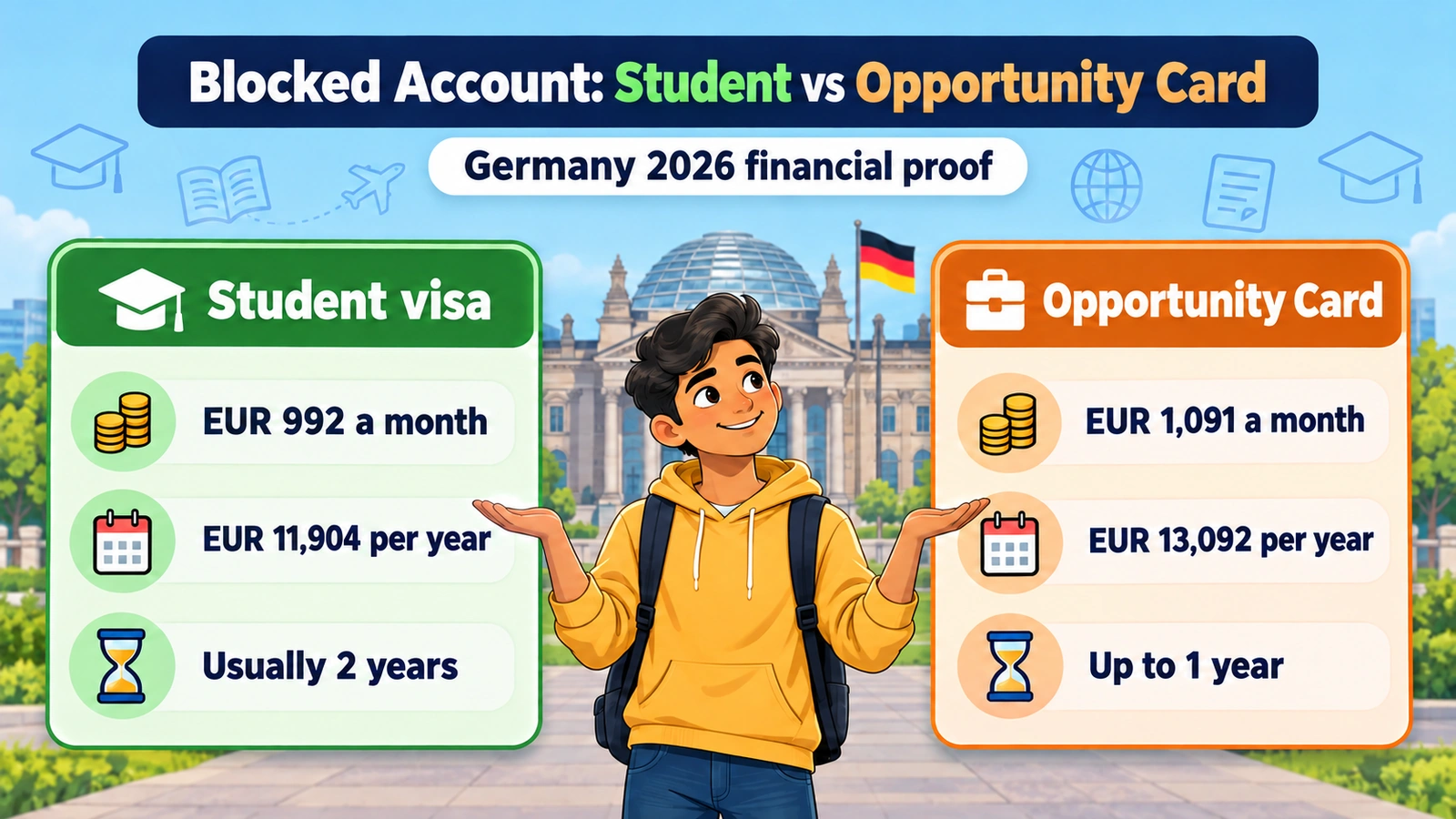
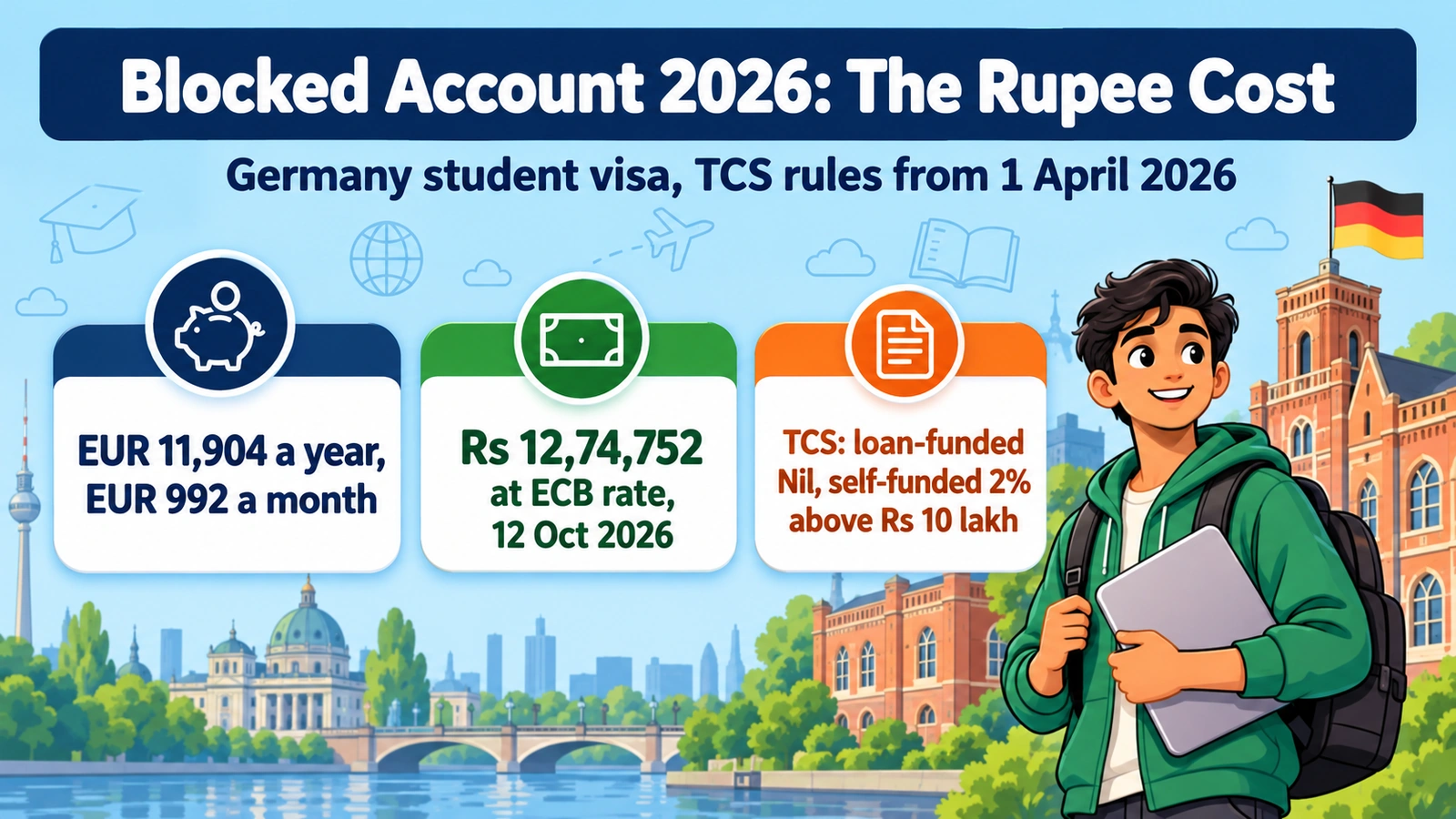
TL;DR: The Opportunity Card blocked account amount for 2026 is EUR 1,091 a month, or EUR 13,092 for a full 12 months, while a student blocked account in Germany needs EUR 992 a month (EUR 11,904 a year). Both figures come from the same BAfoeG student-aid rate, and the Chancenkarte adds 10 percent on top. In return, the Opportunity Card accepts net pay from a signed part-time job as proof, so your blocked account only has to cover the gap.
Opportunity Card blocked account vs student account: the two numbers
For a student visa, the German missions in India want a blocked account holding EUR 11,904 for the first year of study, with a confirmation that no more than EUR 992 can be withdrawn per month. For the Opportunity Card, they ask for proof of "currently at least" EUR 1,091 per month, so a full 12-month card means EUR 13,092. The gap is EUR 99 a month, or EUR 1,188 a year, and it comes from one rule.
Where the student figure comes from
The study permit sits in Section 16b of the Residence Act, but the money rule is Section 2(3) sentence 5. It ties a student's funds to the monthly need under the BAfoeG, Germany's student-aid law, and the Interior Ministry announces the figure in the Federal Gazette (Bundesanzeiger) by 31 August for the next calendar year. The notice of 13 August 2025 set EUR 992 for 2026. The notice of 19 August 2026 keeps EUR 992 for 2027.
Where the Chancenkarte financial proof comes from
Section 20a, the Opportunity Card rule, only says your living costs must be covered. It names no amount. The figure comes from the Federal Foreign Office's visa handbook (Visumhandbuch, status 21 August 2026). It tells missions they can use the flat rate in Section 2(3) sentence 6 as a guide: the BAfoeG maximum plus 10 percent. The Act sets that surcharge for some language courses, qualification recognition measures and people searching for a training or study place. Citing the Interior Ministry's application notes (point 20a.4.1), the handbook says EUR 1,091 a month has been required for a single person since 1 January 2025.
The maths: EUR 992 plus 10 percent is EUR 1,091.20, rounded to full euros. Make it in Germany gives the same EUR 1,091 net per month and labels it the amount for 2026. So the Opportunity Card isn't pegged to a different benchmark. It's the student benchmark with a surcharge.
Why online guides show different amounts
When the card launched on 1 June 2024, the requirement was EUR 1,027 a month, according to the Expert Council on Integration and Migration (SVR). Guides still quoting that are out of date. Also, the handbook calls EUR 1,091 the usual amount, not a fixed one: if your actual rent is higher, for example in a big city, the mission can work from that.
Student visa vs Opportunity Card: side by side
| Item | Student visa | Opportunity Card |
|---|---|---|
| Permit | Section 16b Residence Act | Section 20a Residence Act |
| Monthly amount (2026) | EUR 992 | EUR 1,091 (usual amount) |
| Full-year deposit | EUR 11,904 for the first year | EUR 13,092 for a 12-month card |
| How the figure is set | BAfoeG monthly need, announced yearly in the Federal Gazette | Same BAfoeG figure plus 10 percent, used as a guide |
| Other proof accepted | Declaration of commitment or scholarship | Declaration of commitment, net pay from a part-time or trial job, own funds |
| Work allowed | 140 full or 280 half days a year, or up to 20 hours a week | Average of 20 hours a week, plus trial work of up to two weeks per employer |
| Permit length | Usually two years at first, renewable | Up to one year; follow-up card of up to two years with a job contract or offer |
| Monthly release | Up to EUR 992 | EUR 1,091 on a full-year deposit |
Can a part-time job replace the Opportunity Card blocked account?
Partly, and here the Chancenkarte is more flexible. Make it in Germany says a signed contract for a side job of up to 20 hours a week counts. If it pays at least EUR 1,091 net a month, you've met the requirement. If it pays less, a blocked account covers the difference. The handbook also accepts agreed pay from a trial job, your own savings, or a declaration of commitment (Verpflichtungserklaerung): a formal promise by someone living in Germany, filed in person at their local foreigners authority with proof of income.
You don't have to fund all 12 months either. If you can't prove living costs for the full year, the card may be issued for a shorter period and extended later, up to 12 months in total.
What happens to the money each month
Both permits use the same mechanism. You pay in the full sum before your visa appointment. After you arrive and activate the account, the provider releases a fixed monthly amount to your current account: EUR 992 at most for students, EUR 1,091 on a full Opportunity Card deposit.
Can you use the same provider? Yes. Fintiba, for example, lists EUR 11,904 for students and EUR 13,092 for the Opportunity Card. The Foreign Office publishes no provider list and recommends none, so compare fees in our provider comparison. Check the monthly figure on your blocking confirmation: an account set up at EUR 992 a month falls short for a Chancenkarte.
If plans change: an account opened without a visa application needs a paid consular certificate before the bank releases the money. After a refusal, the refusal letter is normally enough. Once you're in Germany, the foreigners authority must agree to any early closure.
Which route costs you less?
On paper, the student route needs EUR 1,188 less per year and gives a longer permit. In practice they're rarely alternatives: you need a university admission for one, and a recognised degree or vocational qualification for the other. Our Opportunity Card guide covers points and eligibility, and Nepali applicants should read our guide for Nepali graduates.
Already graduated in Germany? Read our post-study work visa guide and the job seeker visa vs Opportunity Card comparison first. You'd normally use the Section 20 job seeker permit instead, which runs for up to 18 months and lets you work in any job while you search.
Get the amount right before you deposit
Unsure which route fits? Book a free profile evaluation and we'll check your profile and the right amount before you transfer a rupee. For the deposit's own costs, see our blocked account cost breakdown. The number that trips people up: a full-year Chancenkarte needs EUR 13,092, not EUR 11,904 and not the old 2024 figure.
Sources
- Federal Foreign Office: Visumhandbuch, entries Chancenkarte and Lebensunterhalt bei nationalen Visa (status 21 August 2026)
- German Missions in India: Opportunity Card (accessed 12 October 2026)
- German Missions in India: Studies, including preparatory college and language courses (accessed 12 October 2026)
- Make it in Germany: Job search opportunity card (accessed 12 October 2026)
- Make it in Germany: Questions and answers regarding the opportunity card (accessed 12 October 2026)
- Make it in Germany: Visa for studying (accessed 12 October 2026)
- Federal Ministry of the Interior: Notice on the minimum amount under Section 2(3) Residence Act for 2026 (BAnz AT 29.08.2025 B1)
- Federal Ministry of the Interior: Notice on the minimum amount under Section 2(3) Residence Act for 2027 (BAnz AT 31.08.2026 B1)
- Gesetze im Internet: Section 2 Residence Act (accessed 12 October 2026)
- Gesetze im Internet: Section 16b Residence Act (accessed 12 October 2026)
- Gesetze im Internet: Section 20a Residence Act (accessed 12 October 2026)
- Federal Foreign Office: Opening and closing a blocked bank account (accessed 12 October 2026)
- Bundesrat: Statement on the 30th BAfoeG amendment, Drucksache 457/26 (25 September 2026)
- SVR Expert Council on Integration and Migration: Kurzinformation Chancenkarte (February 2025)
- Fintiba: Blocked account Germany product page (accessed 12 October 2026)
Frequently Asked Questions
You probably qualify for more than you think.
Students who get evaluated find programmes they had no idea existed — at universities that charge nothing. 2 minutes, no cost. The only downside is not checking.
Want our guides higher up in Google?
Mark GradGermany as a preferred source and Google gives our pages more room when you search about studying in Germany. Takes one tap, and you can undo it any time from the same screen.
Living this, or on your way to it? Tell your story.
If you are already in Germany and finding it hard, or still fighting to get here, other students need to hear it from someone real. Share your honest journey. We help shape it, and nothing goes live until you approve it.
Related Guides
Free German Quiz · No Login
Can you score 10/10 on today's German challenge?
10 new words every day · 4,500+ words from A1 to C1 · takes about a minute.