Study in Hamburg
Germany's Maritime Metropolis
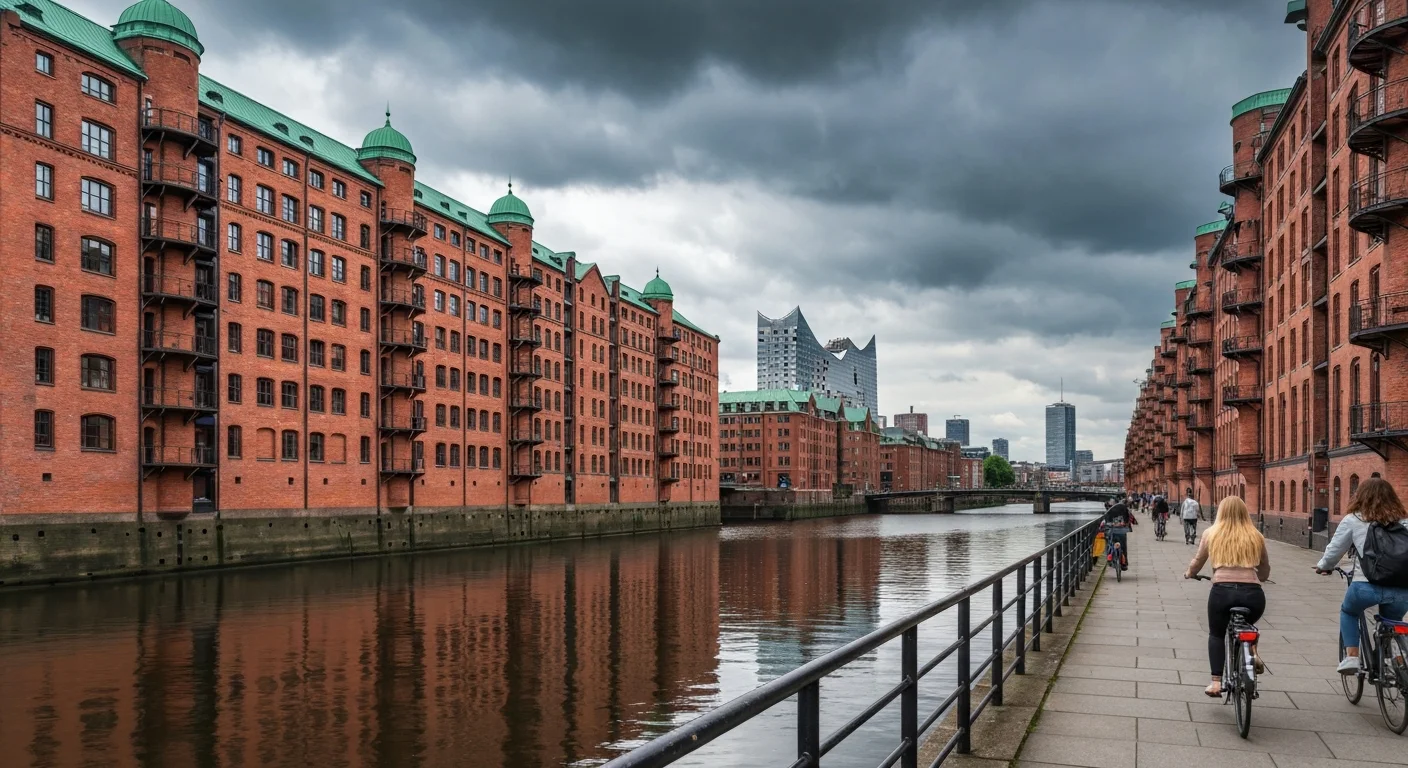
Hamburg is Germany's second-largest city and home to Europe's third-largest port. With 20+ universities and 110,000 students, it combines academic excellence with a vibrant international culture.
20+
Universities
110,000+
Students
€0
Tuition at Public Unis
€1,000–1,250
Monthly Cost
Top Universities in Hamburg
Hamburg has a broad mix of public research universities and applied-sciences institutions:
- Universität Hamburg (UHH) — the city's largest comprehensive research university, strong in physics, climate and earth sciences, law, economics and the humanities.
- Hamburg University of Technology (TUHH) — a focused technical university in the Harburg district, known for engineering and many English-taught master's programmes.
- HAW Hamburg — a large university of applied sciences with practical, industry-linked programmes in engineering, IT, life sciences, design and media.
- HafenCity University (HCU) — specialises in architecture, civil engineering, urban planning and geomatics.
Hamburg also hosts respected private institutions such as Bucerius Law School and Kühne Logistics University, plus arts schools like the HFBK and the HfMT.
Cost of Living in Hamburg
Hamburg is one of Germany's more expensive cities, broadly comparable to Frankfurt and below Munich, but still cheaper than many Western capitals. Budget carefully, especially for housing.
- Rent (room in a shared flat/WG): typically around EUR 450-700 per month, higher for a small studio.
- Food and groceries: roughly EUR 200-300 per month if you mostly cook at home.
- Transport: a semester contribution usually includes public transport across the HVV network; check current pricing.
Overall, a realistic monthly student budget is roughly EUR 1,100-1,500, which also reflects the proof-of-funds level Germany expects for a student visa.
Student Life in Hamburg
Hamburg is a green, water-laced port city built around the Alster lakes and the river Elbe, giving students plenty of parks, waterfronts and outdoor space. Lively student-friendly neighbourhoods include the Schanzenviertel, St. Pauli, Altona, Ottensen and Eimsbüttel, with cafes, markets and a famous nightlife around the Reeperbahn.
As an international, trade-oriented metropolis, Hamburg has a sizeable international community and English is widely understood in everyday and academic settings. Many master's programmes are taught in English. Still, learning German noticeably improves daily life, part-time job options and longer-term career prospects, so most students aim for at least basic conversational German alongside their studies.
Careers & Industry in Hamburg
Hamburg is a major economic hub with diverse industries, which helps graduates find relevant work and internships:
- Aviation: one of the world's leading aerospace clusters, with large sites for Airbus and Lufthansa Technik.
- Logistics and trade: the Port of Hamburg is among Europe's largest, anchoring firms like Hapag-Lloyd and Kühne+Nagel.
- Media: a national media centre, home to publishers and broadcasters such as NDR and major magazine houses.
- Consumer goods and e-commerce: employers like Beiersdorf (Nivea) and the Otto Group.
After graduating, non-EU students can generally apply for a post-study residence permit (commonly up to 18 months) to seek qualified employment in Germany.
Showing 193–216 of 656 programmes
Evangelische Religion, B.A.
Universität Hamburg · Hamburg
Evangelische Religion, B.Ed.
Universität Hamburg · Hamburg
Evangelische Religion, B.Ed.
Universität Hamburg · Hamburg
Evangelische Religion, M.Ed.
Universität Hamburg · Hamburg
Evangelische Religion, M.Ed.
Universität Hamburg · Hamburg
Evangelische Religion, M.Ed.
Universität Hamburg · Hamburg
Eventmanagement, B.A.
Europäische Fernhochschule Hamburg · Hamburg
Exercise in Neurological Science, M.Sc.
MSH Medical School Hamburg - University of Applied Sciences and Medical University · Hamburg
Expressive Arts in Social Transformation, B.A.
MSH Medical School Hamburg - University of Applied Sciences and Medical University · Hamburg
Fahrzeugbau, B.Eng.
HAW Hamburg · Hamburg
Fahrzeugbau, M.Sc.
HAW Hamburg · Hamburg
Fahrzeugtechnik, M.Sc.
Helmut-Schmidt-Universität/Universität der Bundeswehr Hamburg · Hamburg
Film & Motion Design, B.A.
University of Europe for Applied Sciences · Berlin, Hamburg
Film, M.A.
Hochschule für Bildende Künste Hamburg · Hamburg
Finance und Management, B.Sc.
Europäische Fernhochschule Hamburg · Hamburg
Finance, M.Sc.
Europäische Fernhochschule Hamburg · Hamburg
Flugzeug-Systemtechnik, M.Sc.
Technische Universität Hamburg · Hamburg
Flugzeugbau, B.Eng.
HAW Hamburg · Hamburg
Flugzeugbau, M.Sc.
HAW Hamburg · Hamburg
Food Science, M.Sc.
HAW Hamburg · Hamburg
Fotografie & Neue Medien, B.A.
University of Europe for Applied Sciences · Hamburg
Französisch (Hauptfach), B.A.
Universität Hamburg · Hamburg
Französisch (Nebenfach), B.A.
Universität Hamburg · Hamburg
Führung in der Medizin, M.A./M.Sc.
Helmut-Schmidt-Universität/Universität der Bundeswehr Hamburg · Hamburg
Check My Fit
3 quick questions — every result gets a fit tag based on your budget and languages. Stored only on this device.
Tags are an indication based on tuition and teaching language — for a real assessment, get a free profile evaluation.
Frequently Asked Questions About Studying in Hamburg
Yes. Public universities in Hamburg charge no tuition fees for any student, regardless of nationality. You only pay a semester contribution of approximately €330–€350, which includes a Semesterticket covering Hamburg's entire HVV public transport network — buses, U-Bahn, S-Bahn, regional trains, and even Elbe ferries. This makes Hamburg one of Europe's most affordable major cities for higher education. By comparison, a Master's programme at a UK university would cost €15,000–€35,000 per year in tuition alone. International students must open a blocked account with €11,904 for the German student visa, proving they can cover living expenses of approximately €992 per month. With monthly living costs of €1,000–€1,250 and zero tuition, a two-year Master's in Hamburg is a highly cost-effective choice for international students.
The University of Hamburg (UHH) is one of Germany's largest universities with over 43,000 students and a strong reputation in natural sciences, humanities, and economics. It was awarded Excellence University status in 2019. Hamburg University of Technology (TUHH) is a leading technical university with around 8,000 students, known for engineering, computer science, and green technologies. HafenCity University (HCU) is Europe's only university dedicated entirely to architecture, urban planning, and metropolitan development. HAW Hamburg is one of Germany's largest universities of applied sciences, offering practice-oriented programmes in engineering, design, and life sciences. Bucerius Law School is Germany's top-ranked private law school. Other institutions include the Hochschule für Musik und Theater and Hamburg School of Business Administration (HSBA).
Yes. Hamburg universities offer a growing number of English-taught programmes, especially at the Master's level. TUHH offers English-medium Master's degrees in Computer Science, Environmental Engineering, Microelectronics and Microsystems, and International Management & Engineering. UHH has English-taught tracks in Economics, Integrated Climate System Sciences, and several natural science fields. HSBA offers a fully English-taught MBA and Bachelor in Business Administration. Kühne Logistics University (KLU) — a private university specialising in logistics and supply chain management — delivers its programmes entirely in English. Maritime Studies and Port Management programmes benefit from Hamburg's position as Europe's third-largest port. Admission typically requires a relevant Bachelor's degree, IELTS 6.5 or TOEFL 90+, and an APS certificate for Indian applicants.
The average monthly cost for students in Hamburg ranges from €1,000 to €1,250. Rent is the main expense: €400–€600 for a room in a shared flat (WG) in popular student neighbourhoods like Eimsbüttel, Altona, or Barmbek. Studierendenwerk Hamburg offers subsidised dormitory rooms from €250–€380, but demand is high, so apply as early as possible. Groceries and Mensa meals cost roughly €200–€250 per month. Statutory health insurance for students under 30 is approximately €110/month. The Semesterticket is included in your semester fee, covering all HVV public transport and saving you €60+/month. International students must prove €11,904 in a blocked account for the student visa. Hamburg is more affordable than Munich but slightly pricier than Berlin, offering an excellent quality of life with its waterfront setting and vibrant cultural scene.
Hamburg offers outstanding career prospects across several thriving industries. The city is home to Airbus (civil aircraft assembly), Lufthansa Technik (MRO), Beiersdorf (Nivea), Otto Group (e-commerce), and Hapag-Lloyd (global shipping). Hamburg hosts Europe's third-largest container port, making it a hub for logistics, supply chain management, and international trade. The city also leads in media (Gruner + Jahr, Spiegel, Zeit), renewable energy (Vattenfall, Nordex, Siemens Gamesa), and gaming (InnoGames, Goodgame Studios). International graduates benefit from Germany's 18-month post-study work visa and can transition to an EU Blue Card. Starting salaries range from €42,000–€52,000 depending on the field, with engineering and logistics roles at the higher end. Students can work 120 full days or 240 half days per year alongside their studies.
Most Hamburg universities accept applications through uni-assist or their own portals. The University of Hamburg uses its STiNE portal and also accepts applications via uni-assist for most international programmes. TUHH has its own online application system with separate deadlines per programme. HAW Hamburg uses a direct application portal. Winter semester deadlines are typically July 15 for international applicants, though some programmes may close earlier. Required documents include certified academic transcripts, degree certificates, language certificates (IELTS/TOEFL for English programmes or TestDaF/DSH for German programmes), a motivation letter, and a CV. Indian applicants must obtain an APS certificate from the German Embassy in New Delhi, which takes 4–8 weeks. The uni-assist fee is approximately €75 for the first application and €30 for each additional university. Start preparation at least 6–8 months before your deadline.
Explore More Programmes in Germany
Ready to Study
in Hamburg?
Get a free profile evaluation from our Germany education experts. We will assess your eligibility, recommend the best universities in Hamburg, and guide you through every step of the application process.