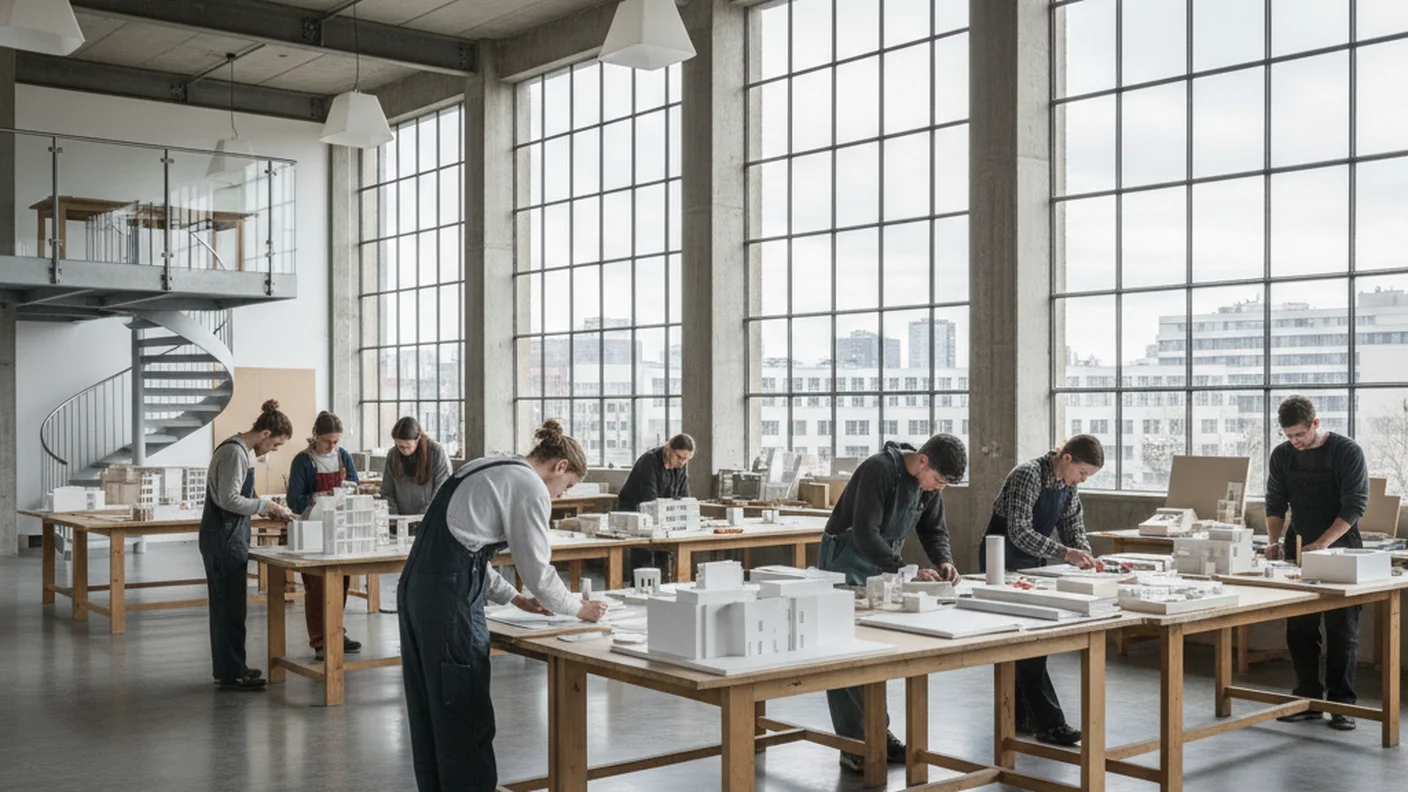
Architecture Programmes
in Germany
From the Bauhaus movement to cutting-edge sustainable design, Germany has shaped modern architecture. Study at universities where engineering precision meets creative vision — tuition-free at public institutions.
Architecture Programmes
Tuition at Public Universities
Years Bauhaus Heritage
Sustainability Focus
Showing 745–768 of 785 programmes
Vermessung - Kooperative Ingenieurausbildung, B.Eng.
Hochschule Bochum · Bochum
Apply by 30 Sep · 14d leftVermessung und Geoinformatik - dual, B.Eng.
Hochschule Anhalt - Anhalt University of Applied Sciences · Dessau
Vermessung und Geoinformatik, B.Eng.
Hochschule für Technik Stuttgart · Stuttgart
Vermessung und Geoinformatik, B.Eng.
Technische Hochschule Würzburg-Schweinfurt · Würzburg
Vermessung und Geoinformatik, B.Eng.
Hochschule Anhalt - Anhalt University of Applied Sciences · Dessau
Vermessung und Geoinformatik, M.Eng.
Hochschule Anhalt - Anhalt University of Applied Sciences · Dessau
Vermessung, B.Eng.
Hochschule Bochum · Bochum
Apply by 30 Sep · 14d leftVermessung, B.Eng.
Hochschule Bochum · Bochum
Apply by 30 Sep · 14d leftVermessung, M.Eng.
Hochschule für Technik Stuttgart · Stuttgart
Apply by 1 Nov · 46d leftVermessungstechnik, B.Sc.
RWTH Aachen · Aachen
Vermessungstechnik, M.Ed.
RWTH Aachen · Aachen
Vermessungswesen, B.Eng.
Technische Hochschule Georg Agricola · Bochum
Versorgungstechnik (dual), M.Ed.
Bergische Universität Wuppertal · Wuppertal
Versorgungstechnik, M.Ed.
Bergische Universität Wuppertal · Wuppertal
Wasserbau/Bauingenieurwesen dual, B.Eng.
Hochschule Koblenz · Koblenz
Apply by 30 Sep · 14d leftWater Engineering (vormals Environmental Engineering), M.Sc.
Technische Hochschule Lübeck · Lübeck
Water Engineering, M.Eng.
Hochschule Magdeburg-Stendal · Magdeburg
Wirtschaftsingenieurwesen - technische Fachrichtung Bauingenieurwesen, B.Sc.
Technische Universität Darmstadt · Darmstadt
Wirtschaftsingenieurwesen - technische Fachrichtung Bauingenieurwesen, M.Sc.
Technische Universität Darmstadt · Darmstadt
Wirtschaftsingenieurwesen - Technisches Facility Management, B.Sc.
Westfälische Hochschule Gelsenkirchen, Bocholt, Recklinghausen · Gelsenkirchen
Wirtschaftsingenieurwesen (Bau und Immobilien), B.Eng.
Hochschule für Technik Stuttgart · Stuttgart
Apply by 1 Nov · 46d leftWirtschaftsingenieurwesen / Bauingenieurwesen, B.Sc.
RWTH Aachen · Aachen
Wirtschaftsingenieurwesen / Bauingenieurwesen, M.Sc.
RWTH Aachen · Aachen
Wirtschaftsingenieurwesen / Bautechnik und -management, M.Sc.
Berliner Hochschule für Technik · Berlin
Apply by 15 DecCheck My Fit
3 quick questions — every result gets a fit tag based on your budget and languages. Stored only on this device.
Tags are an indication based on tuition and teaching language — for a real assessment, get a free profile evaluation.
What You'll Study in a German Architecture Programme
German architecture education is known for pairing creative design with engineering rigour. A typical curriculum is built around the design studio — where you develop projects from concept to detail — supported by technical, historical, and theoretical modules. Most programmes combine the following core areas.
Design Studio & Studio Culture
The heart of the degree — iterative project work, crits, and reviews where you translate ideas into spatial, buildable proposals.
Building Construction & Technology
Materials, structural principles, building physics, and construction detailing — the engineering side German schools are respected for.
History & Theory of Architecture
From the Bauhaus legacy to contemporary discourse, situating your work within architectural thought and precedent.
Sustainable & Energy-Efficient Design
A strong focus area in Germany — low-energy buildings, retrofitting, and climate-responsive design driven by strict efficiency standards.
Urban Design & Planning
Working at the scale of neighbourhoods and cities — public space, density, mobility, and the urban fabric.
Digital Tools & Representation
CAD, BIM, parametric modelling, and visualisation — alongside traditional drawing and physical model-making.
Common specialization tracks
At Master's level, many universities let you focus your studies. Common tracks include Architectural Design, Sustainable Architecture, Urban Design & Planning, Landscape Architecture, Interior Architecture, Building Technology, and Historic Preservation & Monument Conservation. Exact tracks and module names vary by university — browse the listings above to compare specializations programme by programme.
What You Need to Apply
Requirements differ between universities and between Bachelor's and Master's entry, but most architecture applicants from outside the EU should plan for the following. Exact thresholds change, so always confirm against the specific programme page — or let us check your eligibility with a free profile evaluation.
Academic background
For a Master's, a recognised Bachelor's in architecture (or a closely related field) is typically expected. Recognition of your degree is assessed via the anabin database — many international qualifications also route through uni-assist for pre-evaluation.
Design portfolio
Architecture is portfolio-driven. Most programmes require a curated portfolio showing creative and spatial thinking. Some accept digital submissions; others expect a specific format — check each university's brief carefully.
Language proof
English-taught programmes generally ask for IELTS (commonly around 6.5) or TOEFL. German-taught programmes require German at roughly B2–C1 (TestDaF or DSH). Even in English tracks, some German is valuable for studio culture and everyday life.
APS certificate
Applicants whose prior degree is from India, China, or Vietnam generally need an APS certificate before applying and for the student visa. Process it early — it is reusable across multiple applications once issued.
A few notes that often surprise applicants: a GRE is usually not required for architecture in Germany. Public universities generally charge no tuition for consecutive Master's, though a modest per-semester contribution and proof of funds still apply, and a handful of states or non-consecutive programmes do charge fees. Always verify the current details on the official programme page before you apply.
Working as an Architect in Germany
Germany has a large, active construction and design sector, with steady demand driven by urban development, infrastructure renewal, and tightening energy-efficiency regulations. Graduates work in architecture and design firms, urban planning agencies, construction and engineering companies, real estate development, and public-sector building authorities.
Typical roles
Design architect, project architect, urban designer, sustainability/energy consultant, BIM specialist, and roles in planning authorities or development firms.
Indicative salary ranges
Entry-level roles typically pay around €40,000–€50,000 per year. With several years of experience this generally rises into roughly the €55,000–€70,000+ range. Figures are approximate and vary by city, employer, and role.
Becoming a licensed architect
Using the protected title "Architekt" requires registration with a state Architects' Chamber (Architektenkammer), which generally involves a qualifying degree plus a period of supervised professional practice.
Staying on after you graduate
International graduates of German universities can generally apply for a post-study job-seeker residence permit of up to 18 months to find qualified work in their field. Once employed in a suitable role, you can typically move on to a work residence permit or, where salary conditions are met, an EU Blue Card — which can also open a faster route toward long-term residence. Exact conditions and thresholds change over time, so confirm the current rules before you rely on them.
Not sure which programmes fit your profile and career goals? Start with a free profile evaluation, or learn how GradGermany supports your application end to end.
Frequently Asked Questions About Architecture Studies in Germany
Germany is the birthplace of Bauhaus — the movement that defined modern architecture and design globally. Founded by Walter Gropius in Weimar in 1919, the Bauhaus school revolutionized how we think about form, function, and aesthetics, and its influence can be seen in buildings worldwide. German architecture education uniquely emphasizes both creative design and engineering rigour, producing graduates who can envision and realize ambitious projects with technical precision and sustainability awareness. World-class studios equipped with CNC fabrication, 3D printing, laser cutting, and parametric design tools provide hands-on experience from early semesters. Germany’s strong sustainability focus, driven by the Energiewende (energy transition) and the Gebäudeenergiegesetz (Building Energy Act), makes it a global leader in green architecture education. Free tuition at public universities means students pay only a semester contribution of €150–€350, making it far more affordable than architecture schools in the UK, USA, or Australia.
German universities offer an extensive range of architecture specialisations at both Bachelor’s and Master’s levels across their network of technical universities and art academies. These include Architectural Design (conceptual and spatial design), Sustainable Architecture (energy-efficient buildings, passive house standards, and net-zero design — an area where Germany leads globally), Urban Design & Planning (city development, public spaces, and smart city concepts), Landscape Architecture (parks, green infrastructure, ecological planning), Interior Architecture (spatial design and furnishing), Building Technology (construction engineering, materials science, BIM and digital fabrication), and Historic Preservation (Denkmalpflege — restoration and conservation of heritage buildings, a field of particular importance in Germany with its vast architectural heritage spanning Romanesque churches and Gothic cathedrals to Jugendstil villas and Bauhaus icons). Application deadlines for most programmes fall between May and July 15 for winter semester, so early research and preparation is strongly recommended.
Yes. Several universities offer English-taught Architecture Master’s programmes, attracting international students from around the world. Many design studios accept project work and critiques in English even within German-taught programmes, creating a bilingual studio environment that mirrors international practice. Institutions like TU Berlin (Urban Design MSc, Habitat Unit), TU Munich, Bauhaus-Universität Weimar, and the Anhalt University of Applied Sciences in Dessau (located next to the original Bauhaus buildings) have strong international profiles and English-taught options. English-taught programmes typically require IELTS 6.5+ or TOEFL 90+. At the Bachelor’s level, most programmes are in German, typically requiring B2 proficiency via TestDaF or DSH. However, most universities offer free German language courses for enrolled international students, and developing German skills is highly beneficial for studio critiques, building code compliance, client communication, and professional architectural practice in Germany’s competitive design market.
Most architecture programmes require a design portfolio (Mappe) demonstrating creative and spatial thinking, technical drawing skills, and conceptual depth. Typical requirements include 15–30 works showing sketches, freehand drawings, architectural models, photography, and completed design projects. Quality and conceptual originality matter more than sheer quantity. Requirements vary by university — some accept digital portfolios (PDF format, typically 20–40 pages), while others require physical submission in A3 or A2 format. Prestigious institutions like TU Munich and UdK Berlin may also include an aptitude test (Eignungsprüfung), a design task completed under supervised conditions, or a personal interview as part of the admission process. For Master’s programmes, your Bachelor’s thesis project, academic transcripts, and professional work samples carry significant weight. Indian students should also obtain an APS certificate (Akademische Prüfungsstelle) before applying to ensure their qualifications are recognised.
Architecture graduates find opportunities at architecture firms (including internationally renowned German studios like Behnisch Architekten, GMP Architekten, Henn, and Sauerbruch Hutton), urban planning agencies, construction companies, real estate development firms, and public sector planning departments. Germany's ongoing construction boom — driven by acute housing demand in cities like Berlin, Munich, and Hamburg, with hundreds of thousands of new apartments needed annually — and increasingly strict sustainability regulations (Gebäudeenergiegesetz) create strong demand for qualified architects across the country. Starting salaries range from €38,000–€48,000, with experienced architects, project managers, and partners at established firms earning €60,000–€90,000+. Germany's 18-month post-study work visa enables international graduates to establish their careers, with a clear pathway to permanent residency via the EU Blue Card. The freelancer visa (Freiberufler) also allows qualified architects to establish independent practices and work with clients across Europe.
For German-taught programmes, yes — typically B2 to C1 level (verified via TestDaF 4×4 or DSH-2) is required for admission. Some Master’s programmes are offered entirely in English, particularly those focused on urban design, international architecture, or sustainable building technology. Understanding German architectural terminology is beneficial regardless of your programme language, as studio culture, building codes (DIN standards and Bauordnung), client communication during design projects, and professional practice in Germany frequently involve German. Knowledge of terms like Bebauungsplan (development plan), Baugenehmigung (building permit), and Flächennutzungsplan (land-use plan) is essential for professional practice. Membership in the Architektenkammer (Chamber of Architects), which is required to use the protected title “Architekt” in Germany, also assumes working German proficiency. Many universities offer free German language courses alongside your studies, and most international students reach working proficiency within one to two years.
Explore More Programmes in Germany
Design Your Future
in Germany
Get a free profile evaluation from our experts. We'll review your portfolio, recommend the best Architecture programmes for your profile, and guide you through the entire application and visa process.