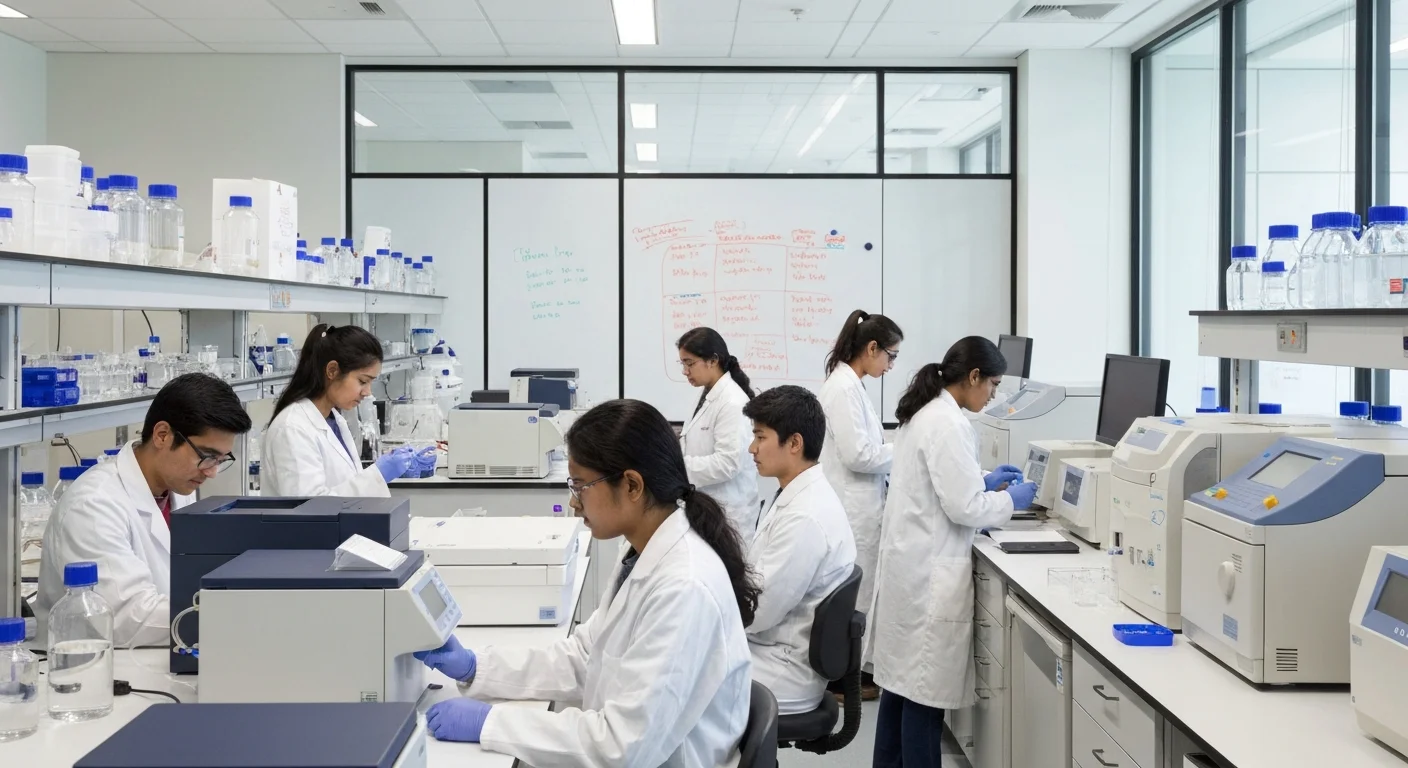
Biotechnology Programmes
in Germany
Germany is Europe's largest biotechnology market, home to BioNTech, CureVac, and 700+ biotech companies. Study at the forefront of pharmaceutical, medical, and industrial biotechnology.
Biotech Programmes
Tuition at Public Universities
Biotech Companies
Homeland
Showing 25–48 of 327 programmes
Bio- und Prozess-Ingenieurwesen / Verfahrenstechnik (vormals: Bio-, Umwelt und Prozess-Verfahrenstechnik), B.Eng.
Hochschule Trier - Trier University of Applied Sciences · Birkenfeld
Bio- und Prozessverfahrenstechnik, M.Sc.
Hochschule Trier - Trier University of Applied Sciences · Birkenfeld
Bio- und Umwelttechnik / Bio- and Environmental Engineering im Praxisverbund, B.Eng.
Hochschule Braunschweig/Wolfenbüttel, Ostfalia Hochschule für angewandte Wissenschaften · Wolfenbüttel
Bio- und Umwelttechnik / Bio- and Environmental Engineering, B.Eng.
Hochschule Braunschweig/Wolfenbüttel, Ostfalia Hochschule für angewandte Wissenschaften · Wolfenbüttel
Bioanalytik, B.Sc.
Hochschule Albstadt-Sigmaringen · Sigmaringen
Biochemistry, M.Sc.
Rheinische Friedrich-Wilhelms-Universität Bonn · Bonn
Biodiversity Sciences, M.Sc.
Martin-Luther-Universität Halle-Wittenberg · Halle
Bioelectrical Engineering, B.Eng.
Technische Hochschule Ingolstadt · Ingolstadt
Apply by 1 Oct · 15d leftBioengineering, B.Sc.
Hochschule Rhein-Waal - University of Applied Sciences · Kleve
Biofabrikation, M.Sc.
Julius-Maximilians-Universität Würzburg · Würzburg
Bioinformatics, M.Sc.
Universität Potsdam · Potsdam
Bioinformatik und Genomforschung, M.Sc.
Universität Bielefeld · Bielefeld
Apply by 15 Nov · 60d leftBioinformatik und Systembiologie, M.Sc.
Justus-Liebig-Universität Gießen · Gießen
Bioinformatik, B.Sc.
Technische Hochschule Mittelhessen - THM · Gießen
Bioinformatik, B.Sc.
Freie Universität Berlin · Berlin
Bioinformatik, B.Sc.
Johann Wolfgang Goethe-Universität, Frankfurt am Main · Frankfurt am Main
Bioinformatik, B.Sc.
Technische Hochschule Deggendorf · Deggendorf
Bioinformatik, B.Sc.
Hochschule Fresenius · Idstein
Bioinformatik, B.Sc.
Universität des Saarlandes · Saarbrücken
Bioinformatik, B.Sc.
Martin-Luther-Universität Halle-Wittenberg · Halle
Apply by 30 Sep · 14d leftBioinformatik, B.Sc.
Friedrich-Schiller-Universität Jena · Jena
Bioinformatik, B.Sc.
Technische Universität München · München
Bioinformatik, M.Sc.
Technische Universität München · München
Bioinformatik, M.Sc.
Johann Wolfgang Goethe-Universität, Frankfurt am Main · Frankfurt am Main
Apply by 1 DecCheck My Fit
3 quick questions — every result gets a fit tag based on your budget and languages. Stored only on this device.
Tags are an indication based on tuition and teaching language — for a real assessment, get a free profile evaluation.
Core Subjects & Specialization Tracks
A biotechnology degree in Germany generally blends laboratory science with engineering and data skills. Most Master's programmes build on a shared core — molecular biology, biochemistry, microbiology, cell biology, genetics and analytical chemistry — before letting you specialise in your final semesters and thesis project. Many curricula also include bioprocess engineering, statistics and a growing amount of computational biology.
Pharmaceutical Biotechnology
Drug discovery, biologics, vaccines and the development of biopharmaceuticals — closely tied to Germany's strong pharma sector.
Industrial & Bioprocess Engineering
Fermentation, bioreactor design and scale-up of biological processes for chemicals, enzymes, biofuels and sustainable materials.
Bioinformatics & Computational Biology
Genomics, sequence analysis, structural biology and the programming and statistics skills increasingly expected across the field.
Molecular & Cell Biology
Gene expression, genetic engineering, CRISPR-based methods and cell-culture techniques that underpin modern research labs.
Biomedical & Medical Biotechnology
Diagnostics, tissue engineering, immunology and the interface between biotechnology and clinical applications.
Agricultural & Environmental Biotech
Plant biotechnology, bioremediation and green technologies — a smaller but growing track at several universities.
Exact track names and availability vary by university and by whether the programme is research-oriented (typically at a university) or more applied (often at a Fachhochschule / university of applied sciences). Use our free profile evaluation to match your background to the right specialisation.
What You Typically Need to Apply
Requirements differ between universities, but most Master's-level biotechnology programmes in Germany look for a recognised Bachelor's degree in a related discipline plus proof of language ability. The points below are general guidance — always confirm the exact criteria on each programme's official page.
Academic background
A Bachelor's in biotechnology, biology, biochemistry, chemistry, molecular life sciences, bioengineering or a closely related field. Programmes usually expect solid foundations in molecular biology, chemistry and mathematics, and may check for specific credit points in core subjects.
Language proficiency
For English-taught programmes you'll typically need IELTS (often around 6.5) or an equivalent TOEFL score. German-taught programmes generally require TestDaF or DSH at an advanced level. Requirements vary, so check each programme.
APS certificate
Applicants with qualifications from India, China and Vietnam generally need an APS certificate verifying their academic documents before applying or applying for a student visa. It is issued once and can be reused for multiple applications.
Applications & GRE
Some universities take applications directly; others route them through uni-assist, which checks foreign qualifications for a fee. The GRE is generally not required for biotechnology programmes in Germany, though a few may request it — verify per programme.
Not sure whether your degree is recognised or whether you'll need a Studienkolleg foundation year? Start with a free profile evaluation and we'll review your eligibility.
Career Paths & Earning Potential
Germany's biotechnology and life-sciences sector spans pharmaceutical giants, contract research organisations, diagnostics firms, public research institutes and a vibrant startup scene. Graduates commonly move into roles such as research scientist, bioprocess or production engineer, quality assurance and regulatory affairs specialist, clinical research associate, bioinformatician, or product and application specialist.
Entry-level roles
Fresh Master's graduates typically earn around €45,000–€55,000 per year, varying by region, employer and specialisation. Figures are approximate.
With experience
After a few years, experienced specialists and team leads often see salaries roughly in the €60,000–€80,000+ range, with industry roles generally paying more than academia.
Where graduates work
Pharma and biotech companies, Max Planck and Fraunhofer institutes, diagnostics and medical-device firms, CROs and fast-growing startups across hubs like Munich, Heidelberg, Berlin and the Rhine-Main region.
Staying to work after graduation
International graduates of German universities can generally apply for an 18-month post-study residence permit to look for a job related to their qualification. Once you secure a suitable role, you can usually switch to a work residence permit or, if you meet the salary threshold, an EU Blue Card — a common route for biotech graduates toward long-term residence in Germany. Exact thresholds and conditions are set by the authorities and change over time, so check the current rules.
Ready to plan your path? Explore programmes via the GradGermany platform or get a free profile evaluation to start your application.
Frequently Asked Questions About Biotechnology in Germany
Germany is Europe's largest biotech market with over 700 companies and the continent's highest biotech R&D expenditure. BioNTech (developer of the first approved COVID-19 mRNA vaccine), CureVac, and major pharmaceutical firms like Bayer (Leverkusen), Merck (Darmstadt), and Boehringer Ingelheim are headquartered here. World-class research at Max Planck Institutes (86 institutes nationwide) and Fraunhofer Institutes (76 centres) drives innovation in pharmaceutical, medical, and industrial biotechnology. Germany's biotech hubs are concentrated in Munich/Martinsried (Bavaria's BioTech cluster), Berlin-Brandenburg (Health Capital), the Rhine-Neckar region (Heidelberg, Mannheim), and the Rhine-Main area (Frankfurt, Darmstadt). The German government invests over €3 billion annually in life sciences research, making it an ideal environment for biotech students and researchers.
Yes, at public universities. There are no tuition fees for Biotechnology programmes at public institutions, even for international students from non-EU countries. The only cost is a semester contribution of approximately €150–€350, which typically includes a Semesterticket for public transport in your region. Public universities offering excellent Biotech programmes include TU Munich, Heidelberg University, RWTH Aachen, TU Berlin, University of Freiburg, and LMU Munich. The sole exception is Baden-Württemberg, which charges €1,500/semester for non-EU students. For your student visa, you need a blocked account (Sperrkonto) with €11,904 per year. Private universities like Jacobs University charge €20,000+ per year, but public alternatives offer equal or superior quality at no tuition cost.
German universities offer deep specializations including Pharmaceutical Biotechnology (drug development and clinical trials), Biomedical Engineering (medical devices and tissue engineering), Bioinformatics (computational biology and genomics), Industrial Biotechnology (biofuels and enzyme technology), Molecular Biology (gene expression and protein engineering), Bioprocess Engineering (fermentation and scale-up technology), and Genetic Engineering (CRISPR and gene therapy). Many programmes are directly linked to leading research institutes — for example, Heidelberg University collaborates with the German Cancer Research Center (DKFZ) and the European Molecular Biology Laboratory (EMBL). TU Munich partners with the Helmholtz Centre Munich for environmental health research. University of Göttingen and University of Würzburg offer specialized molecular bioscience tracks with hands-on lab training from the first semester.
Yes. Several universities offer English-taught Biotech programmes, especially at Master's level. TU Munich offers MSc Molecular Biotechnology and MSc Biomedical Engineering in English. Heidelberg University provides an internationally renowned MSc in Molecular Biosciences with research tracks at DKFZ and EMBL. Jacobs University Bremen (now Constructor University) offers a full English-taught BSc and MSc in Biochemistry and Cell Biology. RWTH Aachen offers MSc Biomedical Engineering in English. University of Freiburg provides MSc Biochemistry and Biophysics with English instruction. The DAAD lists over 50 English-taught life science programmes across Germany. Most require IELTS 6.0–6.5 or TOEFL 80–90 for admission. Indian students should obtain their APS certificate early, as biotech programmes are competitive with limited seats.
Germany's biotech sector is booming, with the industry growing at 8–10% annually. Graduates find roles in pharmaceutical companies (Bayer, Merck, Boehringer Ingelheim, Roche Germany), research institutes (Max Planck, Fraunhofer, Helmholtz), clinical laboratories, regulatory agencies, and biotech startups (BioNTech, CureVac, Evotec, MorphoSys). Starting salaries typically range €45,000–€55,000, with pharmaceutical industry positions reaching €55,000–€65,000 for Master's graduates. PhD holders in biotech can earn €60,000–€75,000 at entry level. The 18-month post-study work visa allows international graduates to job-search without employer sponsorship. Germany's EU Blue Card programme offers a favourable salary threshold of €41,042 for life science professionals classified as shortage occupations. The BioRegions initiative in Munich, Berlin, Heidelberg, and Hamburg actively supports biotech career development.
A Bachelor's in Biology, Chemistry, Biochemistry, Biotechnology, Biomedical Sciences, or related fields is typically required, with a minimum GPA of 2.5 on the German scale (approximately 65%+ for Indian students). Strong foundations in molecular biology, organic chemistry, biochemistry, and mathematics/statistics are expected across most programmes. Competitive programmes at TU Munich, Heidelberg, and LMU Munich may require 70–75% or higher. Some programmes require documented lab experience (at least 6–12 weeks) or research internships as part of your Bachelor's. English-taught programmes need IELTS 6.0–6.5 or TOEFL 80–90. Indian applicants must obtain an APS certificate (€150) from the German Embassy in New Delhi. Letters of recommendation from professors or research supervisors significantly strengthen your application for competitive biotech Master's programmes.
Explore More Programmes in Germany
Launch Your Biotech Career
in Germany
Get a free profile evaluation from our experts. We'll assess your academic background, recommend the best Biotechnology programmes, and guide you through the entire application process.