Ausbildung in Germany: A Guide for Nepali Students
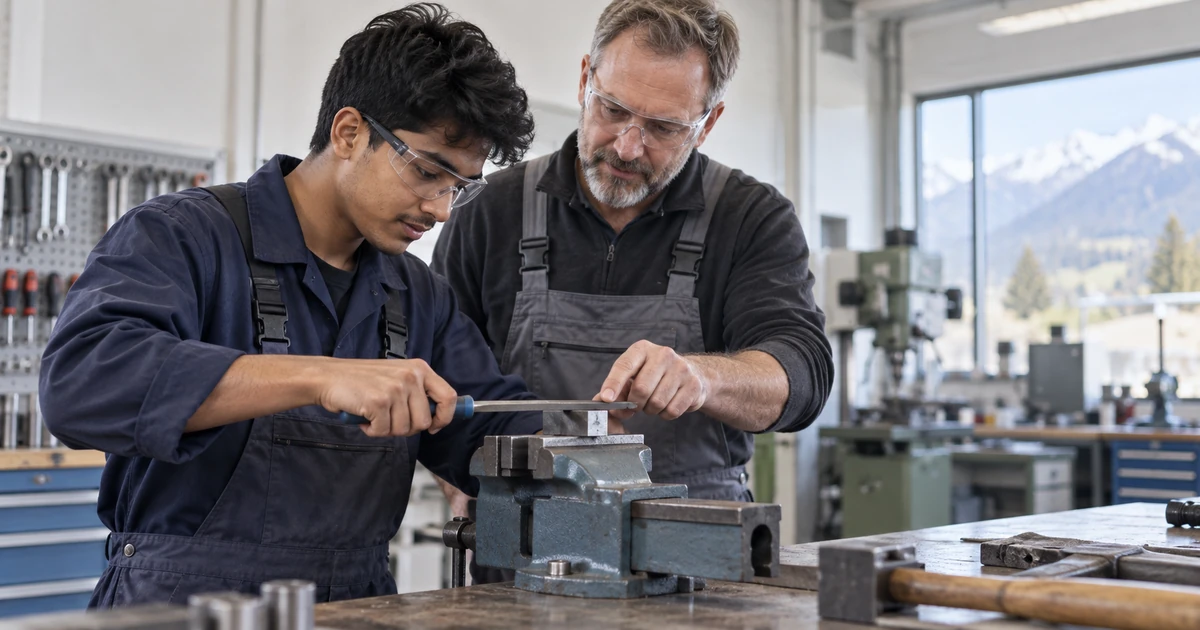
An Ausbildung is vocational training in Germany. You sign a contract with an employer, learn an occupation at work and at a vocational school, and get paid while you train. To start one from Nepal you need a signed training contract and a visa from the Embassy in Kathmandu. For a Nepali applicant who does not want a university route, or cannot fund one, it is a real alternative. It also asks for German from day one, at B1 at least, which changes how you prepare.
How Ausbildung differs from a degree
Germany has 327 recognised training occupations under its vocational training laws, according to the BIBB directory for 2025. Dual training splits your time between a company and a vocational school. School-based training takes place at a school, and the Residence Act accepts it for a visa only if it leads to a state-recognised qualification. Both are covered by Section 16a.
The biggest difference from studying is who picks you. In dual training an employer chooses you, not an admissions office, and there is no university application or uni-assist step. What you need is a signed training contract, and for company-based training the Federal Employment Agency has to approve it unless an exemption applies.
What it pays
Training pay has a legal floor. For training that starts in 2026, the minimum monthly allowance is EUR 724 in the first year, EUR 854 in the second, EUR 977 in the third and EUR 1,014 in the fourth (official notice for 2026). The minimums for training starting in 2027 had not been published when we checked on 9 October 2026.
Many employers pay more. BIBB reports that trainees at companies covered by collective agreements earned EUR 1,133 gross a month on average in 2024. It works the other way too: a collective agreement may set pay below the legal minimum, and employers bound by it may follow it (BIBB press release). Read the pay line in your contract year by year.
Training pay and the visa money rule
Section 2(3) of the Residence Act measures Ausbildung permits against the same monthly benchmark used for students, EUR 992 in 2026. A first-year allowance at the legal minimum sits well below that. If your offer pays near the floor, ask the employer early how the gap is covered, for example through subsidised accommodation, and be ready to show savings. How the Kathmandu embassy treats proof of funds in general is in our blocked account guide.
What the Embassy in Kathmandu asks for
The Embassy now points applicants to the Consular Services Portal: you upload your documents online, get feedback on whether the file is complete, and use the appointment only to show originals, give fingerprints and pay. Its vocational training page still carries the document list from the old paper procedure, which shows what the file has to contain. Beyond the usual passport, photo, application form, citizenship and birth certificates, it lists:
- A self-written motivation letter and a CV (bio data sheet)
- The contract from your German employer, stating pay, accommodation if provided, and health insurance
- The training plan (Ausbildungsplan)
- The form Erklaerung zum Beschaeftigungsverhaeltnis
- Proof of qualifications: your school leaving and Higher Secondary certificates and mark sheets, plus earlier studies or internships in the field where you have them
- German at B1, accepted only from Goethe-Zentrum Kathmandu in Thapathali, VHS (Bhaktapur, Kathmandu or Pokhara) or telc
- The Federal Employment Agency's pre-approval (Vorabzustimmung), where applicable
The fee is the rupee equivalent of EUR 75, and the page gives about three to four weeks as the minimum processing time. Health insurance and the flight booking are only due after approval. Booking an appointment works as for other national visas; our Kathmandu embassy guide explains the waiting list.
Getting to B1, and past it
Read Also: MS in Computer Science in Germany for Nepali Students: How TUM, TU Berlin and Saarland Select
B1 is the line for the visa, not the level at which life gets comfortable. Your vocational school teaches in German and your colleagues speak it all day. If you can reach B2 before you fly, do. Our guides to learning German before you move and to the Goethe-Zentrum in Kathmandu cover courses and exam dates.
Finding a training place from Nepal
The Federal Employment Agency's job board lists vocational training places alongside jobs. Apply to companies directly, in German, with a German-style CV and a short cover letter for each one.
Be wary of anyone who promises a contract or a visa for a fee. The Embassy says plainly that agents have no say in its decisions and cannot make them faster.
Your rights during and after training
- You may hold a side job unrelated to your training for up to 20 hours a week (Section 16a(3)).
- If your training ends for reasons outside your control, you get up to six months to find another training place before the authorities can end your permit (Section 16a(4)).
- After completing a qualified vocational training in Germany, you can get a permit of up to 18 months to look for a job (Section 20). The route from there runs to a skilled-worker permit; see our skilled worker visa guide.
Nursing follows its own recognition rules and has a separate guide on nursing in Germany for Nepali students.
Frequently Asked Questions
You probably qualify for more than you think.
Students who get evaluated find programmes they had no idea existed — at universities that charge nothing. 2 minutes, no cost. The only downside is not checking.
Want our guides higher up in Google?
Mark GradGermany as a preferred source and Google gives our pages more room when you search about studying in Germany. Takes one tap, and you can undo it any time from the same screen.
Get new guides as soon as they go live
Add our feed to Feedly, Inoreader or any RSS reader and every new guide on studying in Germany shows up there by itself. No email, no sign-up.
Living this, or on your way to it? Tell your story.
If you are already in Germany and finding it hard, or still fighting to get here, other students need to hear it from someone real. Share your honest journey. We help shape it, and nothing goes live until you approve it.
Free German Quiz · No Login
Can you score 10/10 on today's German challenge?
10 new words every day · 4,500+ words from A1 to C1 · takes about a minute.