Dresden: TU's Affordable Tech Hub - EUR 800-950/Month
TL;DR: Dresden offers TU Dresden (TU9 elite) with rent EUR 380-480/month and total budget EUR 800-950/month. The blocked account (EUR 992/month) covers it comfortably. The Semesterbeitrag is EUR 361.00, most of it a national transport ticket. Baroque architecture meets modern tech in a compact, bike-friendly city.
Europe's largest microelectronics cluster is a tram ride from a baroque opera house. If you are doing a master in chips, materials or embedded systems, that is the reason to look at Dresden before you look at anywhere else.
Silicon Saxony is the reason to come here
Dresden is the centre of Silicon Saxony, the biggest microelectronics cluster in Europe. GlobalFoundries, Infineon, X-FAB and Bosch all operate on or near the campus, with a startup layer around them. For a student that translates into thesis projects, internships and Werkstudent contracts at EUR 14-18. All of it without leaving the city, which is unusual in a place this cheap to live in. The national picture on student pay is in what Werkstudent jobs pay and how to find one.
TU Dresden, in its own numbers
TU Dresden is a TU9 member with 29,000 students, of whom about 21 percent are international, drawn from 128 countries. It employs 8,400 people, 5,500 of them academic staff, and more than 600 professors.
One figure deserves a caveat you will not get from a rankings page. TU Dresden runs 121 degree programmes, and 28 of them are taught in English, alongside 26 double-degree programmes. That is a real English-taught catalogue but not an unlimited one, so check that your specific field is on it rather than assuming the university as a whole runs in English. Its strengths sit in microelectronics, materials science, bioengineering and computer science, which is exactly where the English-taught master's cluster. Worth knowing before you arrive: at 21 percent international, TU Dresden is a markedly more German-speaking campus than, say, TUM at 45 percent. That is an argument for the place if you want the language to stick, and an argument against it if you were hoping to get through two years without it. If engineering is your field, English-taught engineering master's in Germany lists what is on offer here and elsewhere.
What a month costs
| Expense | Monthly Budget |
|---|---|
| Rent (WG room) | EUR 380-480 |
| Food & groceries | EUR 190-240 |
| Transport (semester ticket) | About EUR 39, from the EUR 234.18 charged each semester |
| Health insurance | EUR 120-135 |
| Phone, internet, leisure | EUR 70-100 |
| Total | EUR 810-995 |
The blocked account releases EUR 992/month, so a normal Dresden month lands inside it with EUR 50-100 to spare. No part-time job is required to make the numbers work, which changes how much of your week belongs to the degree. Compare the other cities in where the blocked account covers the month.
The Semesterbeitrag, itemised
The one bill that does not spread across the month. For the winter semester 2026/27 TU Dresden charges EUR 361.00, and the split explains where it goes: EUR 112.73 to the Studentenwerk and EUR 248.27 to the student body, of which EUR 234.18 is the Deutschlandticket and the bike-share schemes and EUR 14.09 is the student representation itself.
Read that ratio once and the fee stops looking like a charge. Nearly two thirds of it is a national rail and transport pass. Divided over six months it is the roughly EUR 39 in the table above, for unlimited local, regional and national regional-train travel. Bought as an adult ticket, that is not a price you would find. The comparison across states is in what the Semesterbeitrag pays for.
Budget it twice a year, not once. Two payments of EUR 361.00 come to EUR 722.00 across a full academic year, and they land in the weeks you are also paying a deposit and a first month's rent. Set the money aside rather than taking it out of that month's blocked-account release.
Miss the re-registration date and you are out
This is the one administrative deadline in Dresden with teeth, and international students are the ones it catches. Re-registration for the winter semester runs from July 1 to September 5, with the Medical Faculty closing earlier, on August 15.
The consequence of missing it is not a late fee. TU Dresden's own guidance points at its enrolment regulations: a student who has neither properly re-registered nor taken formal leave by the end of the period is exmatriculated by the university as a matter of course. The notice lands in your student portal with an email pointing you to it, and you have one month to object in writing if you had a genuine reason for the delay.
Two practical points follow. Watch the portal, not just your inbox, over the summer. And remember that your student residence permit depends on being enrolled, so an exmatriculation is an immigration problem before it is an academic one. Your first month in Germany covers how the two are linked.
Rent by district
A room in a shared flat costs EUR 380-480/month. Altstadt and Neustadt, the two central districts, run EUR 420-520. Prohlis and Gorbitz on the edges are EUR 330-420.
Studentenwerk dorms are cheapest at EUR 280-380 a month, and the supply is real rather than token: the Studentenwerk lists 28 halls of residence in Dresden with 5,730 places between them. That is a meaningful share of a 29,000-student university, which is part of why Dresden rents stay where they are. It still comes with the waiting list you would expect, so apply as soon as you accept your offer rather than when you book a flight.
Two cities in one
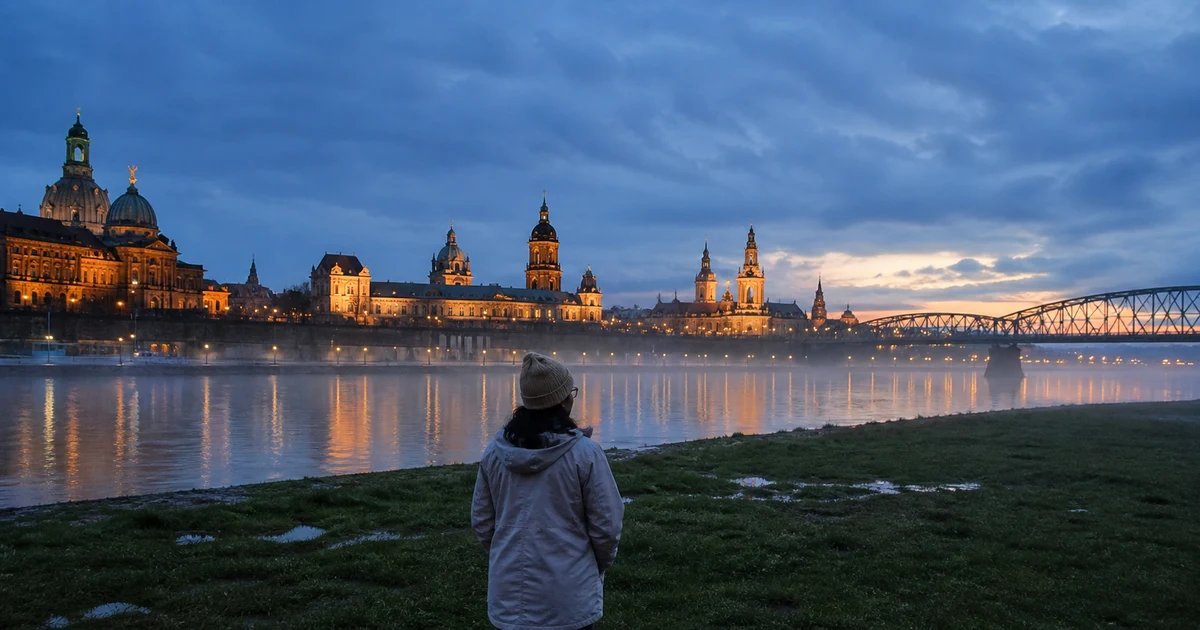
The Altstadt is the postcard version: the Zwinger, the Frauenkirche, the Semperoper. Cross the Elbe into the Neustadt and it is bars, street art and a distinctly alternative scene, which is where most students end up. The tech campus in Dresden-Nord is a third register again. The river itself does a lot of work: cycling and swimming along the Elbe is most people's summer here. Against the other affordable options, see Leipzig, Dresden and Aachen on cost, or the bigger comparison in Munich, Berlin and Leipzig side by side.
Getting around, and out
The transport ticket comes inside the Semesterbeitrag and, at EUR 234.18 a semester, it is the Deutschlandticket rather than a city pass. That covers the whole VVO network in Dresden, trams, buses and the S-Bahn, and it keeps working on regional trains beyond Saxony, so Meissen, Pirna and the Saxon Switzerland hills are included and so is most of the rest of the country at weekends. The city itself is compact enough that most students cycle and never think about transport again.
Sources
- TU Dresden, facts and figures
- TU Dresden, re-registration and Semesterbeitrag
- Studentenwerk Dresden, halls of residence
- DAAD
Looking at TU Dresden? Our application support will tell you which of its programmes your profile can reach, and what the year costs.
Frequently Asked Questions
You probably qualify for more than you think.
Students who get evaluated find programmes they had no idea existed — at universities that charge nothing. 2 minutes, no cost. The only downside is not checking.
Want our guides higher up in Google?
Mark GradGermany as a preferred source and Google gives our pages more room when you search about studying in Germany. Takes one tap, and you can undo it any time from the same screen.
Living this, or on your way to it? Tell your story.
If you are already in Germany and finding it hard, or still fighting to get here, other students need to hear it from someone real. Share your honest journey. We help shape it, and nothing goes live until you approve it.
Free German Quiz · No Login
Can you score 10/10 on today's German challenge?
10 new words every day · 4,500+ words from A1 to C1 · takes about a minute.