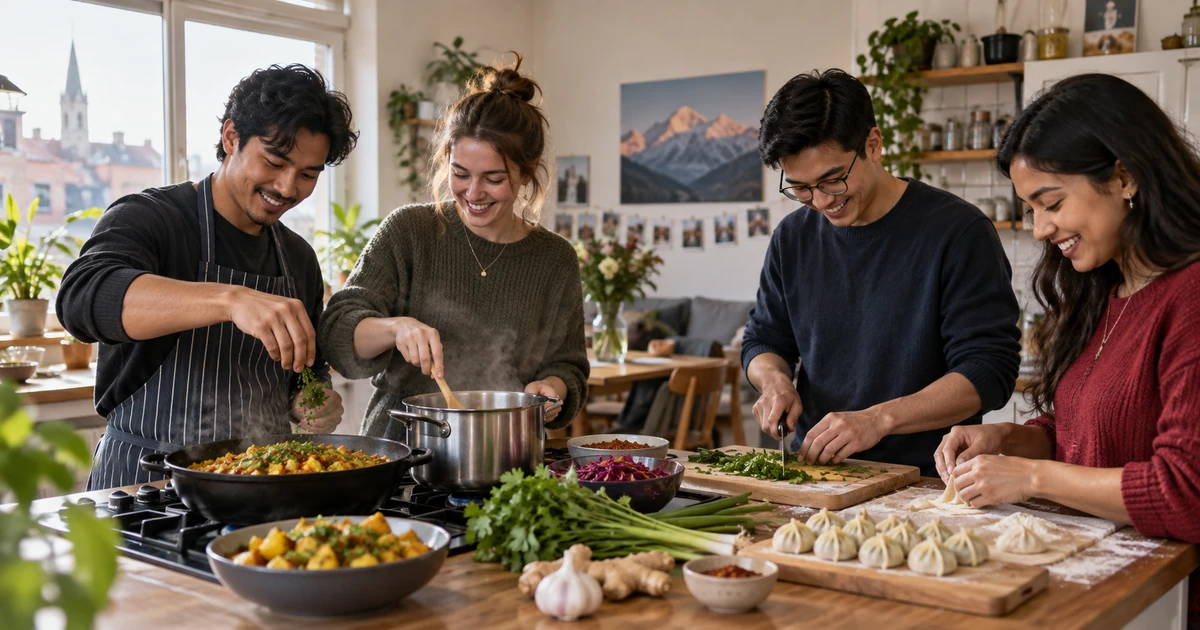
Students in Germany spent an average of EUR 198 a month on food in the most recent national student survey (DZHW, 2023, as reported by DAAD). At Nepal Rastra Bank's selling rate on 9 October 2026 that is about NPR 34,000. Whether you land above or below that number depends mostly on two habits: how often you eat at the university canteen, and whether you can cook dal-bhat for the week on a Sunday evening. This guide is about both, plus what you can and cannot bring from home.
The Mensa: your cheapest hot meal
Almost every university has a Mensa, the canteen run by the local student services organisation (Studierendenwerk). Students pay subsidised prices; staff and guests pay more. Two current examples:
- In Munich, most canteens charge students by weight: EUR 0.90 per 100 g, with soup and the "StudiTopf" stew at EUR 0.33 per 100 g. At the fixed-price canteens in Weihenstephan and Lothstrasse, dishes run from EUR 1.00 to EUR 5.25 (Studierendenwerk Muenchen Oberbayern).
- In Lower Saxony, the "Niedersachsen-Menue" costs students EUR 2.50, from 5 January 2026 and for 2026 only (Studentenwerk Hannover).
In Munich you can pay by bank card, mobile payment or student card. A filling lunch for two or three euros is hard to beat even with home cooking, once you count the gas, oil and spices.
The menu will not taste like home. Expect potatoes, pasta, schnitzel and stews, usually with one or two vegetarian lines. If you avoid beef or pork, learn three words before your first visit: Rind (beef), Schwein (pork) and Haehnchen (chicken).
Cooking dal-bhat in a German kitchen
In a shared flat or student hall the kitchen is shared too, and cooking Nepali food there is mostly a matter of finding ingredients and managing the smell.
Where the ingredients are
Rice, red lentils, onions, garlic, ginger, tomatoes, chillies and chicken are in every ordinary supermarket. For the rest, such as mustard oil, masoor and mas dal in bulk, chana, beaten rice (chiura), basmati in 5 kg bags, jeera, methi and garam masala, go to an Asian or Indian grocery. Most larger university cities have at least one. Timur and jimbu are harder to find; that is what the packing list is for.
Equipment
A small pressure cooker makes dal and meat curry in a fraction of the time and saves energy in a shared kitchen. If your kitchen has an induction hob, check that the cooker's base works on induction before you buy or pack one. A cheap rice cooker is worth it if your flatmates also cook rice.
Shared-kitchen manners
Tempering spices in hot oil (the jhanne step) fills a corridor fast. Open the window, switch on the extractor if there is one, and keep the kitchen door shut. Label your shelf, clean the hob the same evening, and you will have far fewer arguments about food than about rubbish separation.
What you can and cannot bring from Nepal
German customs is strict about food from outside the EU. Meat and meat products, milk and dairy products, and eggs are restricted for animal-health reasons. Plants, plant parts, fruits and seeds need a phytosanitary certificate; only pineapple, coconut, durian, banana and date are exempt (German Customs, food and feed).
In Nepali terms:
- Leave at home: sukuti (dried meat), ghee, chhurpi and other cheese, homemade achar with meat.
- Risky: fresh chillies, fresh herbs, gundruk and anything else homemade from leaves or seeds. When in doubt, buy it in Germany.
- Usually fine: factory-sealed spice mixes, tea and packaged snacks with no meat or dairy. Keep them in their original packaging.
Our packing list for Nepali students covers the rest of the suitcase.
Supermarket basics that surprise new arrivals
- Sundays are dead. Shop-hours law keeps stores closed on Sundays and public holidays (Section 3 Shop Closing Act). Do the big shop on Saturday.
- Bottles have a deposit (Pfand). Single-use plastic bottles and cans always carry EUR 0.25; reusable bottles usually EUR 0.08 or 0.15 (Federal Environment Ministry). Return them to the machine in a shop that sells that kind of packaging to get the deposit back.
- Discount chains are your friend. Store-brand rice, lentils, oil and frozen vegetables are what keep a food budget near the survey average.
A week that stays near the average
One pattern that keeps costs down: Mensa at lunch on weekdays, one big pot of dal and a curry cooked on Sunday, rice made fresh each evening, and breakfast of bread, eggs or oats. Buy spices once a month at the Asian shop and everything else at a discount supermarket. Cooking with flatmates and splitting the bill helps too, and it softens the first winter away from home; our guide to homesickness has more on that side of things.
For the rest of the monthly budget, including rent and insurance, see our budget living guide and the cost breakdown in rupees. For a proper Dashain or Tihar meal, ask the Nepali community in your city; start with our list of Nepali community groups in Germany.
Frequently Asked Questions
You probably qualify for more than you think.
Students who get evaluated find programmes they had no idea existed — at universities that charge nothing. 2 minutes, no cost. The only downside is not checking.
Want our guides higher up in Google?
Mark GradGermany as a preferred source and Google gives our pages more room when you search about studying in Germany. Takes one tap, and you can undo it any time from the same screen.
Get new guides as soon as they go live
Add our feed to Feedly, Inoreader or any RSS reader and every new guide on studying in Germany shows up there by itself. No email, no sign-up.
Living this, or on your way to it? Tell your story.
If you are already in Germany and finding it hard, or still fighting to get here, other students need to hear it from someone real. Share your honest journey. We help shape it, and nothing goes live until you approve it.
Free German Quiz · No Login
Can you score 10/10 on today's German challenge?
10 new words every day · 4,500+ words from A1 to C1 · takes about a minute.