Living in Germany on a Budget: A Monthly Plan for Nepali Students
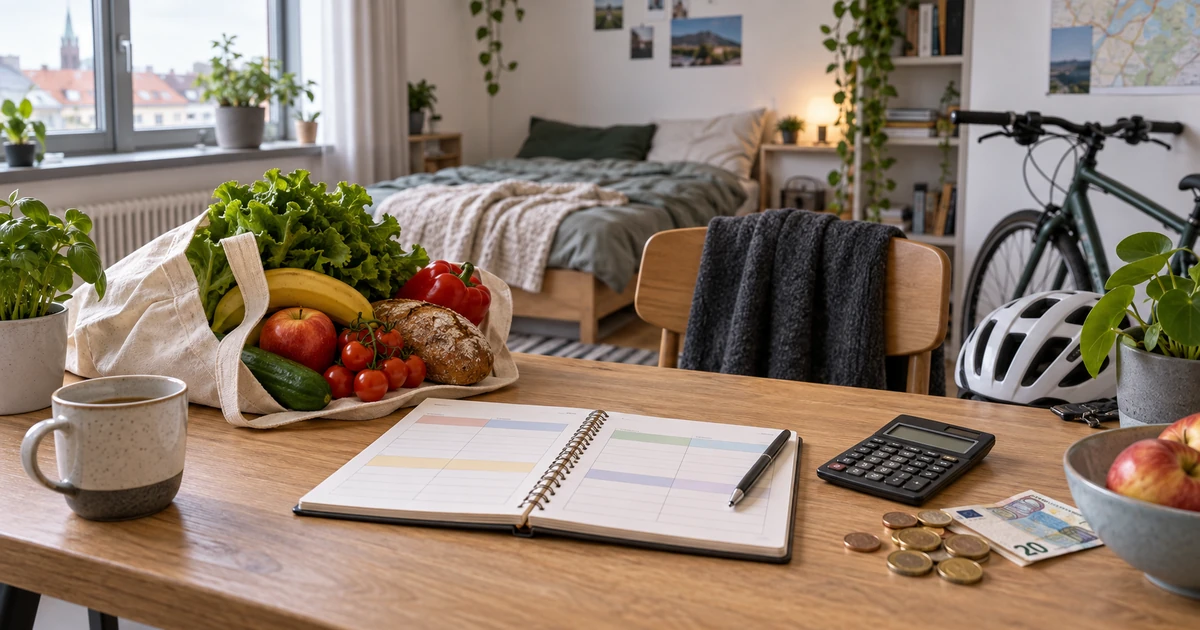
Here is the number to plan around: EUR 992 a month. It is what the Federal Foreign Office's Consular Services Portal says a student must have available, and a 12-month blocked account holding EUR 11,904 works out to exactly that. DAAD puts real student needs at EUR 900 to EUR 1,200 a month depending on the city. So EUR 992 is not generous. It works if you control three costs and avoid a handful of avoidable ones.
This page is about running a month. For the full cost of a degree, see our guide to the cost of studying in Germany, and for the same figures converted to rupees, the NPR cost breakdown.
Where a student's money actually goes
The national student survey run in summer semester 2021 (the 22nd Sozialerhebung) found that students' three biggest monthly costs were rent at EUR 410, food at EUR 198 and health at EUR 100 (Sozialerhebung executive summary). Those are self-reported averages for all students in Germany, and rents have risen since, so treat them as a floor.
As an international student you also carry fixed costs that do not bend much:
- Health insurance. At TK, the 2026 public student rate is EUR 146.29 a month if you are 23 or older and childless, EUR 141.16 if you are younger.
- Semester contribution. Roughly EUR 70 to EUR 430 per semester, paid in one go, often including a transport ticket.
- Broadcasting fee (Rundfunkbeitrag). EUR 18.36 a month per dwelling, whether or not you own a TV.
A worked example
Take a student aged 24 who rents a WG room for EUR 400 warm, pays a EUR 300 semester contribution and shares a flat with two others. These are illustrative numbers, not a quote for any city.
| Item | Per month |
|---|---|
| WG room, warm rent | EUR 400.00 |
| Health and care insurance (TK, 23+) | EUR 146.29 |
| Semester contribution (EUR 300 over 6 months) | EUR 50.00 |
| Broadcasting fee, split three ways | EUR 6.12 |
| Fixed costs | EUR 602.41 |
| Left from EUR 992 for food, phone, books, clothes and everything else | EUR 389.59 |
Under EUR 390 for food and the rest of life is tight but workable if you cook. Push the rent to EUR 600 and you are left with under EUR 190, which is not. Rent is the lever that matters most.
Rent: the decision that sets your budget
A room in a shared flat (WG) or a Studierendenwerk hall is almost always cheaper than a studio. Our student housing guide covers how to find either from Nepal. Two money details people miss:
- The deposit. German law caps a rental deposit at three months' rent excluding utilities, and you are entitled to pay it in three monthly instalments, the first at the start of the tenancy. Plan for it in your first month anyway.
- The broadcasting fee in halls. In a hall of residence, each room that opens onto a shared corridor counts as its own dwelling and pays the full EUR 18.36. Only rooms that share their own front door count as one WG and can split it.
Health insurance: compare the add-on, not the whole price
The statutory part of the student rate is set by law and is the same at every public insurer; only the insurer's add-on differs. At TK the add-on is EUR 23.00 of the total. So shopping around saves a few euros at most. What does not save money in the long run is switching to private cover to shave the monthly bill: the exemption from public insurance cannot be revoked once granted. Our health insurance guide explains the choice in full.
Transport: never pay twice
Many universities include a semester ticket in the semester contribution. Where it is the Deutschlandsemesterticket, the tariff rules set its price at 60 percent of the regular Deutschlandticket, which costs EUR 63 a month from January 2026. That works out to EUR 37.80 a month for buses, trams and regional trains across Germany, though not long-distance trains such as the ICE. If your semester ticket already does that, do not buy a separate Deutschlandticket. If your university has no such ticket, the EUR 63 subscription is usually the cheapest way to move around.
Food: cook in batches
Dal, rice and tarkari cooked for three or four days at a time is about the cheapest way to eat well in Germany. Buy rice and lentils in large bags from Asian or Indian grocers rather than small packets at the supermarket, and use the university canteen (Mensa) on long lab days. One small habit adds up: most single-use bottles and cans carry a deposit of at least 25 cents, which you get back at any shop that sells that kind of packaging. Our food and cooking guide has shopping and recipe ideas.
One-off costs to keep aside
- Residence permit. Issuing one costs EUR 100; extending one for more than three months costs EUR 93.
- Winter clothing. Budget for a proper winter jacket and waterproof shoes before November arrives.
- Laptop repair. Keep a small reserve, because a dead laptop in exam season has to be fixed at once.
Filling the gap with work
Part-time work helps, but do not build your first semester's budget on it. A mini-job pays at most EUR 603 a month in 2026, and your residence permit caps you at 140 full working days a year. Finding the first job takes time, especially with little German. Our part-time jobs guide explains what is realistic.
Frequently Asked Questions
You probably qualify for more than you think.
Students who get evaluated find programmes they had no idea existed — at universities that charge nothing. 2 minutes, no cost. The only downside is not checking.
Want our guides higher up in Google?
Mark GradGermany as a preferred source and Google gives our pages more room when you search about studying in Germany. Takes one tap, and you can undo it any time from the same screen.
Get new guides as soon as they go live
Add our feed to Feedly, Inoreader or any RSS reader and every new guide on studying in Germany shows up there by itself. No email, no sign-up.
Living this, or on your way to it? Tell your story.
If you are already in Germany and finding it hard, or still fighting to get here, other students need to hear it from someone real. Share your honest journey. We help shape it, and nothing goes live until you approve it.
Free German Quiz · No Login
Can you score 10/10 on today's German challenge?
10 new words every day · 4,500+ words from A1 to C1 · takes about a minute.
Related Articles



Study in Germany
Gesundheitswissenschaften, M.Sc.
Hochschule Neubrandenburg - University of Applied Sciences
Neubrandenburg
M.Sc.Elektrotechnik und Informationstechnik, M.Sc.
Technische Universität Ilmenau
Ilmenau
M.A.Formen der Rationalität / Forme della razionalità, M.A.
Martin-Luther-Universität Halle-Wittenberg
Halle