Food Science Master's in Germany in English: Requirements & Careers
TL;DR: A handful of German universities teach food science master's in English, and most of them charge no tuition. Hohenheim is the exception that catches people out: as a Baden-Wuerttemberg university it bills non-EU students 1,500 euros a semester. You need a food science, chemistry, biology or engineering bachelor's with the specific subject credits each programme names, and the English bar swings from B2 to C1 depending on where you apply.
Food science is really three careers wearing one name, and picking the wrong one costs you a year. Food technology is processing and engineering. Microbiology and quality control lead to lab and regulatory work. Nutrition points at R&D and public health. Decide which of those you want before you shortlist programs, then read the curriculum and the thesis options to check the program actually delivers it.
Choose the specialisation before the university
Program titles blur the distinction. Two courses both called Food Science can have almost no modules in common, one built around plant engineering and the other around metabolic chemistry. The module list is the honest description of the degree; the title is marketing.
The English-taught options in DAAD's database make the split visible in their names. Hohenheim runs Food Science and Technology, which sits on the process engineering side. Bayreuth's campus in Kulmbach runs three separate degrees, Food Quality and Safety, Food System Sciences and Global Food, Nutrition and Health, which are three different answers to the same question. Fulda offers International Food Business and Consumer Studies and Nutrition, Health and Food Systems, Kassel runs its own version of the food business degree in Witzenhausen, and Bonn's Agricultural and Food Economics is economics rather than laboratory work. Pick the column you want to work in first.
| Programme | Where | Tuition per semester | Intake |
|---|---|---|---|
| Food Science and Technology | Hohenheim, Stuttgart | 1,500 euros (non-EU) | Winter |
| Food Quality and Safety | Bayreuth, Kulmbach | No tuition | Winter |
| Food System Sciences | Bayreuth, Kulmbach | No tuition | Winter |
| Nutrition, Health and Food Systems | Fulda | No tuition | Winter and summer |
| Agricultural and Food Economics | Bonn | No tuition | Winter and summer |
Which universities teach it in English
Only a limited set, and most of them take a single winter intake, which means one missed deadline is a full year. The cohorts are small and tied to the agro-food industry, which is good for placements and bad for your odds if you apply to only one. Confirm the teaching language on the program page itself, not on an aggregator, because "English" in a database entry sometimes means an English track inside a German-taught degree. See which English-taught master's in Germany charge no tuition.
What you need to apply
The generic answer is a bachelor's in food science, food technology, chemistry, biology or a close relative, with solid chemistry and microbiology on the transcript rather than one introductory course. The useful answer is that each programme writes its bar down, and the two bars below are as different as they look.
- Hohenheim, Food Science and Technology. A completed bachelor's in natural sciences or engineering, plus subject-specific knowledge worth at least 70 points across physics, mathematics, organic chemistry, food chemistry, microbiology and process engineering. English at B2, which UNIcert II or IELTS Academic 6.5 satisfies. Applications for winter run 1 April to 15 June.
- Bayreuth, Food Quality and Safety. A degree in biology, biochemistry or a comparable life science with a final grade of 2.5 or better on the German scale, plus an aptitude test. English at C1, which means IELTS Academic 7 or Cambridge C1 Advanced or UNIcert III. International applicants go through uni-assist rather than applying direct, and the winter window is 1 March to 15 June.
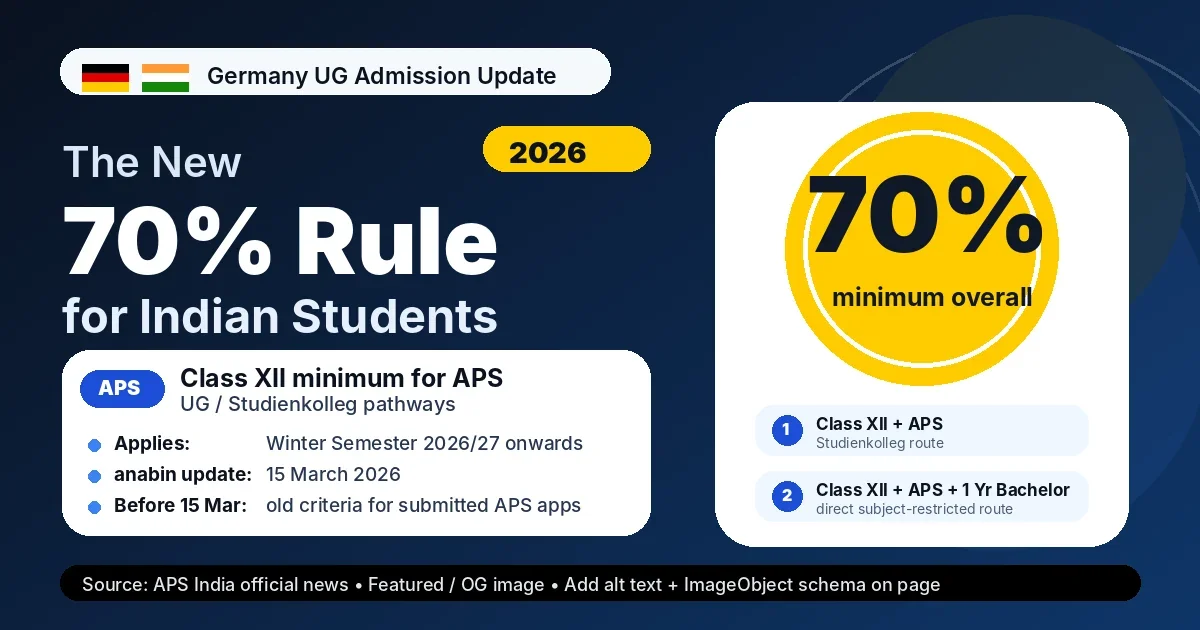
- An APS certificate for India, China, Vietnam and Mongolia: see how the APS certificate works for Indian applicants.
Two things follow from that pair. First, IELTS 6.0 is below both bars, so a test result that clears an engineering master's elsewhere may not clear a food science one. Second, if uni-assist is in the chain, add its handling fee and several weeks of processing to your plan; it charges 75 euros for your first chosen course of study in a semester and 30 euros for each further one, payable whatever the outcome.
The gap that gets applicants rejected
Missing modules, almost every time. A biology graduate turns up without food processing or food chemistry. A food-technology graduate turns up with a thin science base. Hohenheim's points system makes this literal: you are counting credits in six named subject areas, and an application that leaves one of them empty is short before anyone reads your motivation. Fix it before you apply, with extra coursework or an industry internship that puts the missing subject on paper. See how competitive German master's admission really is.
What it costs
At most of these universities there is no tuition and you pay only the semester contribution. Bayreuth's is 165.84 euros and it includes access to regional public transport, which is a real saving rather than an administrative charge. Hohenheim's semester fee is 174.50 euros, and on top of it non-EU students pay Baden-Wuerttemberg's 1,500 euros per semester, or 650 euros if you already hold a degree at the same level. Over a four-semester master's that is 6,000 euros of tuition at Hohenheim and nothing at Bayreuth or Fulda for the same field.
Hohenheim advises transferring the tuition and the enrolment fee together from your home country before you travel, which is worth doing while you still have a favourable window on the exchange rate. Add living costs of 900 to 1,100 euros a month and the 11,904 euros you must show in a blocked account for the visa. Full numbers in what a year in Germany actually costs an Indian student.
Where graduates work
Quality, production, R&D and regulatory roles across the food and beverage industry, plus a growing number of agri-food startups. A Werkstudent job or an internship during the degree does most of the work of getting hired. After you finish, the 18-month job-seeker visa gives you time to convert that into a work permit and later permanent residence. See the rules on working during your studies and what the 18-month job-seeker visa lets you do.
German is not optional in this industry
Plant floors and regulatory bodies work in German. R&D departments and international companies are more relaxed about it. If you graduate with English only, you have cut yourself out of most production and quality jobs in the country, which is where the volume of hiring is. Start the language early: how much German you actually need.
Sources
- DAAD: Hohenheim Food Science and Technology M.Sc.
- DAAD: Bayreuth Food Quality and Safety M.Sc.
- University of Hohenheim: costs of studying
- uni-assist: handling fees
- DAAD
- Hochschulkompass
Not sure which specialisation fits your degree? A free profile evaluation will map your transcript to the programs that would take you.
Frequently Asked Questions
You probably qualify for more than you think.
Students who get evaluated find programmes they had no idea existed — at universities that charge nothing. 2 minutes, no cost. The only downside is not checking.
Want our guides higher up in Google?
Mark GradGermany as a preferred source and Google gives our pages more room when you search about studying in Germany. Takes one tap, and you can undo it any time from the same screen.
Living this, or on your way to it? Tell your story.
If you are already in Germany and finding it hard, or still fighting to get here, other students need to hear it from someone real. Share your honest journey. We help shape it, and nothing goes live until you approve it.
Free German Quiz · No Login
Can you score 10/10 on today's German challenge?
10 new words every day · 4,500+ words from A1 to C1 · takes about a minute.