German Student Visa from India: Documents, Process & Timeline (2026)
TL;DR: Indian students need a national visa (D-Visa) for any course longer than 90 days. You must already have an APS certificate and a university admission letter, plus proof of funds (a blocked account of €11,904), health insurance, and language proof. The visa fee is about €75, and you should start the whole process 6-8 months before your course begins.
Key facts at a glance
| Item | Detail (2026) |
|---|---|
| Visa type | National visa (D-Visa) for study |
| Apply via | VFS Global / German Mission in India |
| Prerequisites | APS certificate + university admission |
| Proof of funds | Blocked account €11,904 (€992/month) |
| Visa fee | ~€75 + VFS charges |
| When to start | 6-8 months before course start |
The German student visa is the last gate between your admission letter and your flight out, and it's the stage where good plans most often come undone. Not because the process is mysterious; it's actually well laid out. It comes undone because it's strict about two things students tend to underestimate: complete documents and early timing. Here's the full picture for Indian students in 2026, in the order you'll actually need it.
Which visa do you need?
If your course lasts longer than 90 days, which covers every Bachelor's, Master's, and MBA programme, you need a national visa (D-Visa) for study, applied through VFS Global on behalf of the German Mission in India.
Prerequisites before you apply
Two things must already be in place before you book an appointment:
- APS certificate, mandatory for Indian students. If you don't have it, start with APS Certification for Germany.
- University admission, an offer or admission letter.
Documents required for the German student visa
Missing even one item can waste an appointment. Prepare:
- Valid passport (with at least two blank pages)
- Completed, signed visa application form
- Biometric passport photographs (German specification)
- University admission letter
- APS certificate
- Proof of funds, a blocked account with €11,904 (€992/month), or a recognised alternative (scholarship, Letter of Commitment)
- Proof of health insurance valid in Germany
- Academic certificates and transcripts (Class 10, 12, Bachelor's)
- Language proof, IELTS/TOEFL for English-taught programmes, or German B2/C1 for German-taught ones (see Study Without IELTS)
- Motivation letter / statement of purpose
- CV in German or English
Always cross-check the current checklist on the official German Mission and VFS websites.
The financial requirement explained
For most students, the blocked account is how you prove you can support yourself. In 2026 that means depositing €11,904 upfront, after which the bank releases up to €992 per month once you've landed. One detail trips up Indian applicants constantly: the money has to come from your own account or a close family member's, transfers from friends or business accounts get rejected, and that rejection can sink the whole application. We break down which provider to choose in Blocked Account: Fintiba vs Expatrio.
Step-by-step visa process
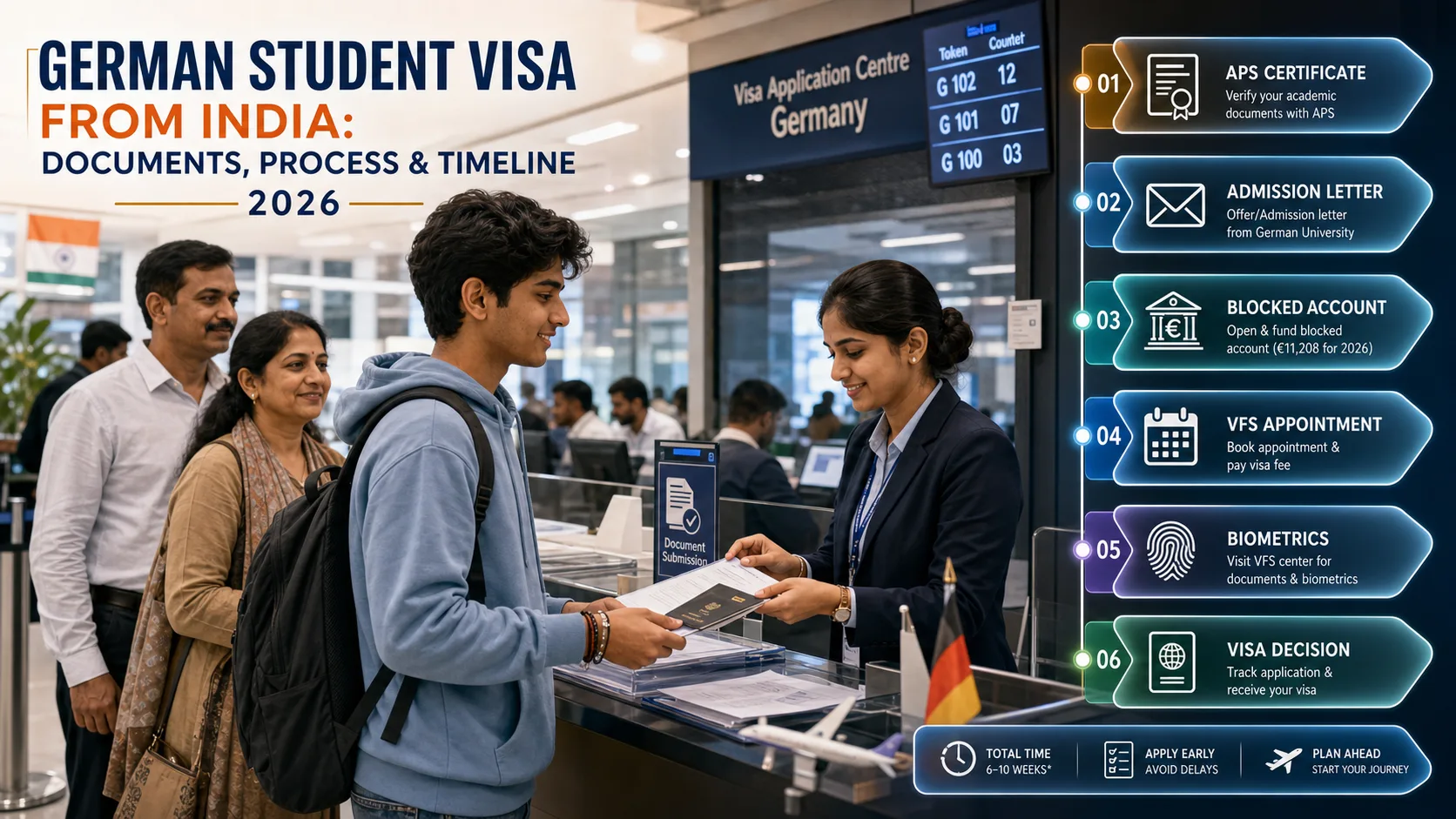
- Open your blocked account 8-12 weeks before your appointment.
- Gather all documents and make the required copies.
- Book your VFS/embassy appointment, slots vanish before Winter Semester, so book early.
- Attend the appointment, submit documents, give biometrics.
- Attend the interview if scheduled (see Visa Interview Questions).
- Wait for processing, typically several weeks.
- Collect your visa and plan travel.
German student visa fees in 2026
The student visa fee is approximately €75 (paid in INR equivalent), plus VFS service charges. Confirm the exact figure on VFS when you apply.
Visa timeline: when to start
| Months before course start | What to do |
|---|---|
| 6-8 months | APS certificate + university applications |
| 3-4 months | Admission received, open blocked account |
| 2-3 months | Book and attend visa appointment |
| Buffer | Allow several weeks for processing |
If there's one place students consistently run out of road, it's the APS and appointment-booking stages. Almost every "I missed my intake" story we hear traces back to starting these too late, not to a document being wrong, but to time simply running out.
Why student visas get rejected
The frequent causes: incomplete or inconsistent documents, insufficient proof of funds, weak interview answers, and doubts about genuine student intent. A rejection isn't always final, see Visa Rejection: Reasons & How to Reapply.
After you arrive: residence permit
The D-Visa gets you through the airport, but it's not the end of the paperwork. Within your first few weeks in Germany you'll need to register your address (the Anmeldung) and apply for a residence permit at the local immigration office. It sounds bureaucratic because it is, and doing it in a new country in a new language is where a lot of students feel lost. GradGermany's post-arrival support covers the Anmeldung, opening a bank account, and health insurance enrolment.
Get your visa application right the first time
A rejected appointment can cost an entire intake. GradGermany handles the full journey, blocked account, documents, appointment scheduling, and interview coaching.
Start with a free profile evaluation or explore visa processing.
Frequently Asked Questions
You probably qualify for more than you think.
Students who get evaluated find programmes they had no idea existed — at universities that charge nothing. 2 minutes, no cost. The only downside is not checking.
Want our guides higher up in Google?
Mark GradGermany as a preferred source and Google gives our pages more room when you search about studying in Germany. Takes one tap, and you can undo it any time from the same screen.
Living this, or on your way to it? Tell your story.
If you are already in Germany and finding it hard, or still fighting to get here, other students need to hear it from someone real. Share your honest journey. We help shape it, and nothing goes live until you approve it.
Free German Quiz · No Login
Can you score 10/10 on today's German challenge?
10 new words every day · 4,500+ words from A1 to C1 · takes about a minute.