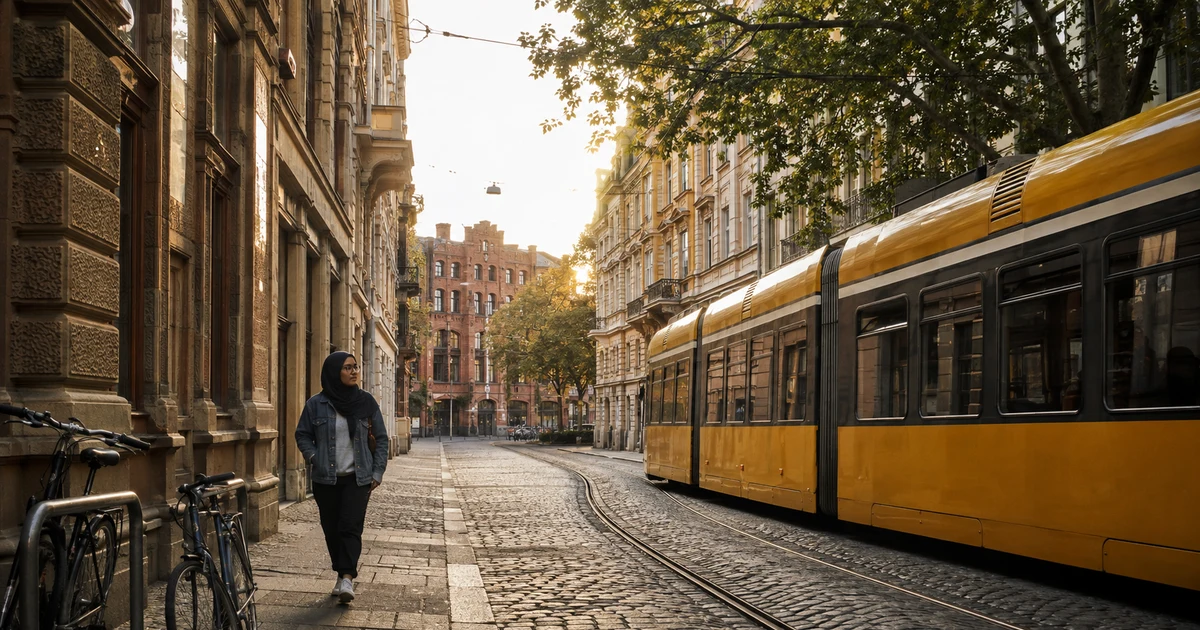
TL;DR: Leipzig is Germany's most affordable major student city. A private WG room costs EUR 350-450/month and a Studentenwerk room starts at EUR 215 with every bill and the furniture included. Total budget EUR 784-964 privately, or EUR 649-839 in a hall. The blocked account (EUR 992/month) covers it with room to spare. The semester contribution is EUR 320.80 plus the student council share.
In most German student cities the question is how to make the blocked account stretch. In Leipzig the question is what to do with what is left. A month here costs EUR 784-964 all in on the private rental market, against EUR 992 released from the account, which means an ordinary student month ends level or ahead without a job. Get a hall room and the gap widens further. That single fact shapes everything else about studying here.
The city where the blocked account leaves change
Live in an outer district like Gruenau or Paunsdorf and commute in by S-Bahn and you can hold the month under EUR 750, leaving EUR 150-200 spare. Over a two-year master that is an emergency fund, or a lot of weekends elsewhere in Europe. Nowhere else on the list of big German university cities does the arithmetic work out that way: see where the blocked account actually covers the month.
What a Studentenwerk room actually costs
Studentenwerk Leipzig runs 15 halls of residence across the city, and its published prices are the number that should anchor your budget rather than any private listing.
- Single room in a shared flat: EUR 215 to 325 a month.
- Apartment: EUR 295 to 435 a month.
Those are all-inclusive figures, and the inclusion list is longer than most students expect. It covers the base rent, heating, water, electricity, every other running cost, furnishings down to the bed, wardrobe, shelving, table and chair, cable or satellite television, 24-hour internet, minor repairs with an on-site caretaker, and free use of the common rooms. There is no annual utilities reckoning, and there is no furniture to buy in your first week, which quietly saves several hundred euros nobody budgets for.
The deposit is EUR 450.00, taken with the first rent or transferred in advance, and returned six to eight weeks after you move out. Note the shape of that: a flat sum rather than a multiple of the rent, so on a EUR 215 room it is more than two months and on a EUR 435 apartment it is barely one.
One condition worth reading before you sign. The minimum tenancy is one academic year, meaning two full semesters. Exchange students such as Erasmus participants can take three months instead. If you plan to move out to a WG after a semester, a hall contract is not the flexible option it looks like.
The queue is the constraint, not the price
Allocation for the winter semester usually begins in August, and Studentenwerk Leipzig works strictly through the queue rather than answering questions about your position in it. To put a real date on it: in early September 2026 the offers going out for winter semester 2026/27 were reaching applicants who had applied before 19 August 2026. Apply the week your admission arrives, not the week you book a flight.
Rent, district by district
On the private market a room in a shared flat costs EUR 350-450/month, the lowest of any major German university city. Zentrum and Suedvorstadt, the central and most wanted areas, run EUR 400-500. Gruenau and Paunsdorf on the edges are EUR 300-400. A private room at EUR 400 with bills on top lands close to EUR 500 all in, which is why a EUR 325 hall room with everything included is not the compromise it appears to be.
The month, line by line
Read Also: Aachen: RWTH's Affordable Life - EUR 800-950/Month
| Expense | Studentenwerk room | Private WG room |
|---|---|---|
| Rent | EUR 215-325, bills included | EUR 350-450 |
| Food and groceries | EUR 180-230 | EUR 180-230 |
| Transport (semester ticket) | EUR 37.80 | EUR 37.80 |
| Health insurance | EUR 146.29 | EUR 146.29 |
| Phone, internet, leisure | EUR 70-100 | EUR 70-100 |
| Total | EUR 649-839 | EUR 784-964 |
The health insurance line is the same in every German city, because statutory student cover is priced from a fixed base rather than from your income. It works out at EUR 87.38 for health at the student rate, plus your fund's additional contribution, plus EUR 35.91 for long-term care insurance if you are over 23 and have no children.
The semester contribution, itemised
Saxony publishes the Studentenwerk side of the fee in the official gazette, so there is no guesswork. From winter semester 2026/27 it is EUR 90.00 to Studentenwerk Leipzig, split as EUR 11.20 for social services and the national student services body and EUR 78.80 to finance the student restaurants and cafeterias, plus EUR 4.00 to the mobility fund and EUR 226.80 for the solidarity-based semester Deutschlandticket. That is EUR 320.80, before each university adds its own student council contribution.
The ticket is the line that repays itself. EUR 226.80 a semester is EUR 37.80 a month against the EUR 63 a member of the public pays for the same national travel pass, and it is nationwide rather than local. Two things follow: your daily tram ride costs nothing extra, and so does the train to Berlin.
Be aware the contribution cannot be waived, reduced or deferred. Students who spend a whole semester away from Leipzig can apply for an exemption in writing, but the request has to reach Studentenwerk by the last working day before the semester begins.
The two universities
University of Leipzig was founded in 1409, which makes it one of the oldest in Germany, and it is strongest in humanities, law, medicine and the sciences. HTWK Leipzig is the applied counterpart, built around engineering and media. Both run English-taught master's programmes, so the low cost of living is not paid for with a German-only catalogue. How competitive entry is varies by subject: admission difficulty across German universities.
A cheap base for the rest of Central Europe
Because the semester ticket is now a full Deutschlandticket rather than a regional pass, it covers every regional train in the country, not just the MDV network of trams, buses and S-Bahn out to Halle and Dessau. What that turns into is a travel habit. Berlin is 1 hour by train, Dresden 1 hour, the Erzgebirge 45 minutes. Students here take weekends away that would be unaffordable from Munich, and the marginal cost of most of them is zero.
The catch: wages are lower too
Werkstudent roles in Leipzig pay EUR 12-14 an hour. That is below Munich or Aachen, so the cheap rent is not pure profit. The employer base is growing, with BMW, Porsche, DHL and Amazon logistics operations plus a startup scene around SpinLab, and some students commute to Halle or Dresden for better-paid work, which the semester ticket makes free.
Run the whole sum rather than the rent line. A Leipzig student paying EUR 250 for a hall room and earning EUR 13 an hour is usually ahead of a Munich student earning EUR 18 and paying EUR 700, and the gap is bigger than the hourly rates suggest: what Werkstudent jobs pay across Germany.
Where students actually live
Roughly 40,000 students live in a city of 600,000. They concentrate in Suedvorstadt and Connewitz, which is where the bars, cafes and venues are. The Spinnerei, an old cotton mill turned gallery complex, is the centre of the art scene. The city is flat, walkable and built for bikes. Anyone still calling Leipzig boring has not been there recently. If you are weighing it against the other cheap options, compare it with Dresden and Aachen on cost, or against the expensive ones in Munich, Berlin and Leipzig side by side.
Sources
- Studentenwerk Leipzig, rents and what is included
- Studentenwerk Leipzig housing FAQ
- Semester contribution regulations, Saxon Official Gazette
- Section 245 SGB V, student health contribution rate
- Deutschlandticket price
Thinking about Leipzig? Our application support will tell you which programmes there fit your profile and what the year will really cost.
Frequently Asked Questions
You probably qualify for more than you think.
Students who get evaluated find programmes they had no idea existed — at universities that charge nothing. 2 minutes, no cost. The only downside is not checking.
Want our guides higher up in Google?
Mark GradGermany as a preferred source and Google gives our pages more room when you search about studying in Germany. Takes one tap, and you can undo it any time from the same screen.
Get new guides as soon as they go live
Add our feed to Feedly, Inoreader or any RSS reader and every new guide on studying in Germany shows up there by itself. No email, no sign-up.
Living this, or on your way to it? Tell your story.
If you are already in Germany and finding it hard, or still fighting to get here, other students need to hear it from someone real. Share your honest journey. We help shape it, and nothing goes live until you approve it.
Free German Quiz · No Login
Can you score 10/10 on today's German challenge?
10 new words every day · 4,500+ words from A1 to C1 · takes about a minute.
Related Articles


Study in Germany
B.A. Rechtswissenschaft (Nebenfach), B.A.
Universität Konstanz
Konstanz
B.A.Tourismuszukunft: Innovation, Transformation und nachhaltige Entwicklung, B.A.
Hochschule für angewandte Wissenschaften Kempten
Kempten
MasterSimulation Based Engineering, Master
Technische Hochschule Ingolstadt
Ingolstadt