Public vs Private Universities in Germany: Which Is Right for Indian Students? (2026)
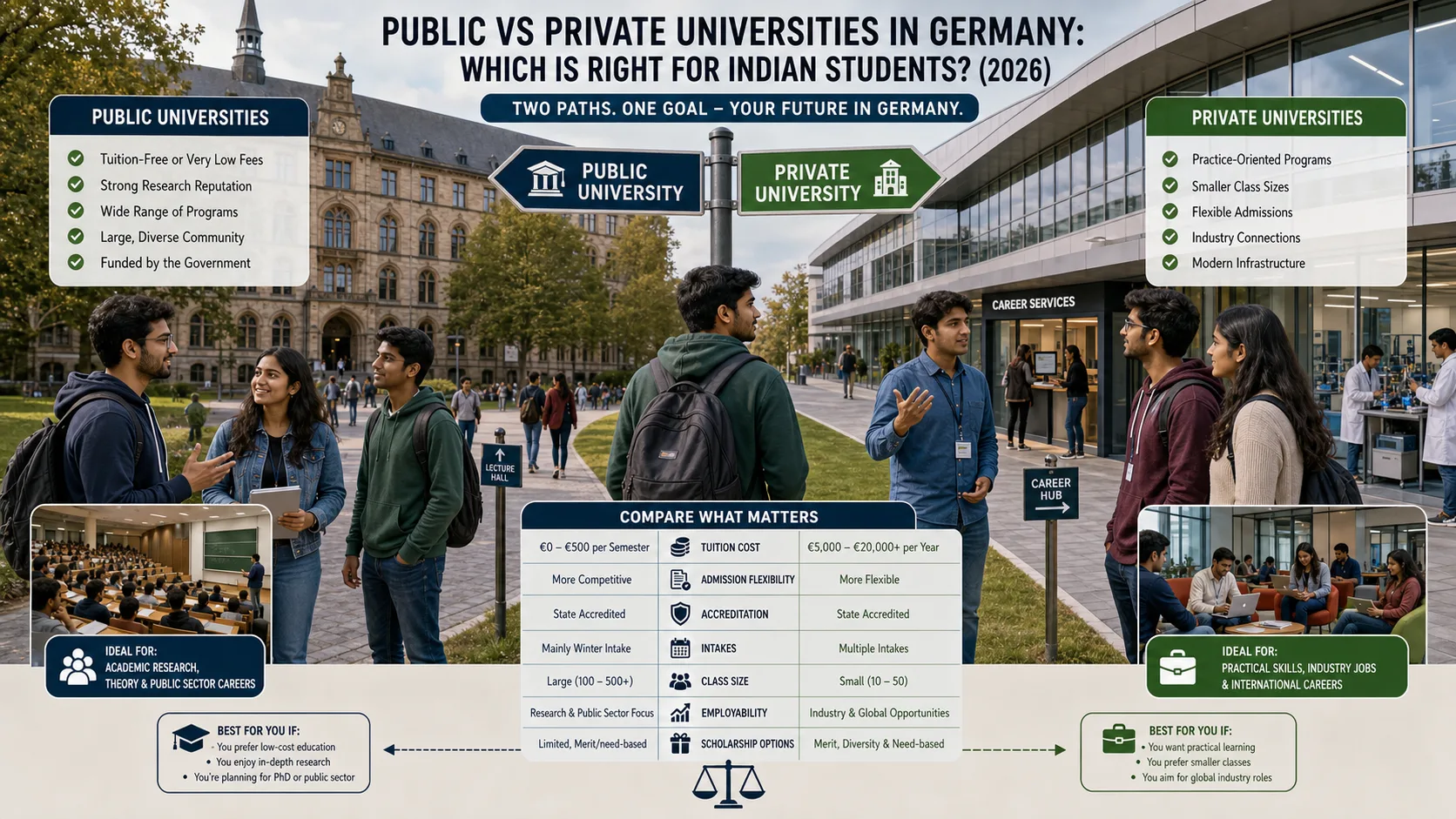
TL;DR: Public universities are free (or near-free) and highly respected, and they are GradGermany's focus. Private universities charge €5,000 to €20,000+ per year but may offer easier admission, more English-taught programmes, smaller classes, and flexible intakes. For most Indian students the public route wins on value; private can suit specific needs, as long as the university and programme are properly recognised.
Public vs private at a glance
| Factor | Public | Private |
|---|---|---|
| Tuition | Free or near-free | €5,000 to €20,000+/year |
| Reputation | Generally high | Varies; check recognition |
| Admission | Competitive | Often easier |
| English programmes | Many | Often more |
| Class size | Larger | Often smaller |
| Intakes | Standard | Often flexible |
"Should I go public or private in Germany?" is a fair question, and the honest answer is: usually public, but not always. Here is how to decide for your situation.
The core difference: cost
Germany's public universities charge no tuition for most programmes (the main exceptions being Baden-Württemberg's non-EU fee and TUM's new fees), which is the headline reason Germany is such good value. Private universities charge full tuition, typically €5,000 to €20,000 or more per year. Over a degree, that is a very large difference.
Where private universities can make sense
Public is not automatically right for everyone. Private universities may offer:
- Easier or more flexible admission, useful for some profiles
- More English-taught programmes and international cohorts
- Smaller classes and more individual attention
- Flexible intakes beyond the standard Winter/Summer cycle
- Industry-focused or niche programmes not widely offered at public universities
If these factors matter more to you than tuition cost, a private university can be a legitimate choice.
The recognition warning
This is the crucial caveat. GradGermany focuses on public universities and Ausbildung, and says no to private universities as a matter of policy, partly because quality and recognition vary. If you do consider private, verify the university and programme are officially recognised (see Degree Recognition and the Anabin database) before committing a rupee. An unrecognised qualification can undermine your visa, your career, and your PR path.
How to decide
Weigh these against your situation:
- Budget: can you justify €5,000 to €20,000+/year over free?
- Admission: is your profile competitive for public universities? (See Volume 2's pathway posts.)
- Programme fit: does a private university offer something public ones don't?
- Recognition: is the specific university and programme properly recognised?
- Goals: does the choice support your job and PR plans?
For most Indian students, a recognised public university delivers the best combination of cost, reputation, and outcomes.
Choose a university that serves your goals
The public-vs-private decision shapes your cost and your outcomes. GradGermany helps Indian students target recognised public universities that fit their profile and budget.
Frequently Asked Questions
You probably qualify for more than you think.
Students who get evaluated find programmes they had no idea existed — at universities that charge nothing. 2 minutes, no cost. The only downside is not checking.
Want our guides higher up in Google?
Mark GradGermany as a preferred source and Google gives our pages more room when you search about studying in Germany. Takes one tap, and you can undo it any time from the same screen.
Get new guides as soon as they go live
Add our feed to Feedly, Inoreader or any RSS reader and every new guide on studying in Germany shows up there by itself. No email, no sign-up.
Living this, or on your way to it? Tell your story.
If you are already in Germany and finding it hard, or still fighting to get here, other students need to hear it from someone real. Share your honest journey. We help shape it, and nothing goes live until you approve it.
Related Guides
Free German Quiz · No Login
Can you score 10/10 on today's German challenge?
10 new words every day · 4,500+ words from A1 to C1 · takes about a minute.
Related Articles



Study in Germany
Gesellschafts- und Wirtschaftskommunikation, M.A.
Universität der Künste Berlin
Berlin
B.Ed.Chemie (Lehramt Grundschulen), B.Ed.
Universität Koblenz-Landau (jetzt: Universität Koblenz/RPTU)
Koblenz
B.Sc.Wirtschaftspädagogik, B.Sc.
Johann Wolfgang Goethe-Universität, Frankfurt am Main
Frankfurt am Main