Study in Germany after JEE Mains (2026 Guide)
Yes, you can study in Germany after JEE Mains, but JEE Mains alone usually isn’t enough for direct bachelor’s admission. Most Indian 12th pass students need either a Studienkolleg year (foundation) with the FSP exam or one completed year of a recognized Indian bachelor’s. This 2026 guide explains your options, how JEE Mains can still strengthen your profile, and the exact steps, costs, timelines, and documents.
Can you study in Germany after JEE Mains?
Short answer: JEE Mains by itself does not grant direct entry to German bachelor’s degrees. However, your JEE Mains attempt is valuable, it demonstrates STEM aptitude and can support applications to Studienkolleg, English-taught foundation programs, or even help you stand out after completing one year of undergraduate study in India. If you clear JEE Advanced with a strong rank, selected universities may consider direct subject-restricted entry, but that is not common with JEE Mains alone.
Quick overview: Your pathways after JEE Mains
Depending on your Class 12 subjects, board (CBSE/ICSE/State), and JEE track, you typically have three practical routes:
- Studienkolleg (1 year) + Feststellungsprüfung (FSP) → Enter a bachelor’s in the matched subject area.
- Complete 1 full academic year of a relevant Indian bachelor’s with strong grades → Apply for direct subject-restricted admission to year 1 in Germany.
- Consider bachelor’s later: finish a full bachelor’s in India → Apply for German master’s (your JEE Mains background can still help for STEM credibility).
For engineering aspirants targeting TU and applied sciences universities, the Studienkolleg T-Kurs is the most common route post-12th if you only have JEE Mains.
Key facts for 2026 applicants (India to Germany)
| Item | 2026 Figure / Note |
|---|---|
| Blocked account requirement | €11,208 per year (€934/month) |
| Student health insurance (under 30) | ~€140/month |
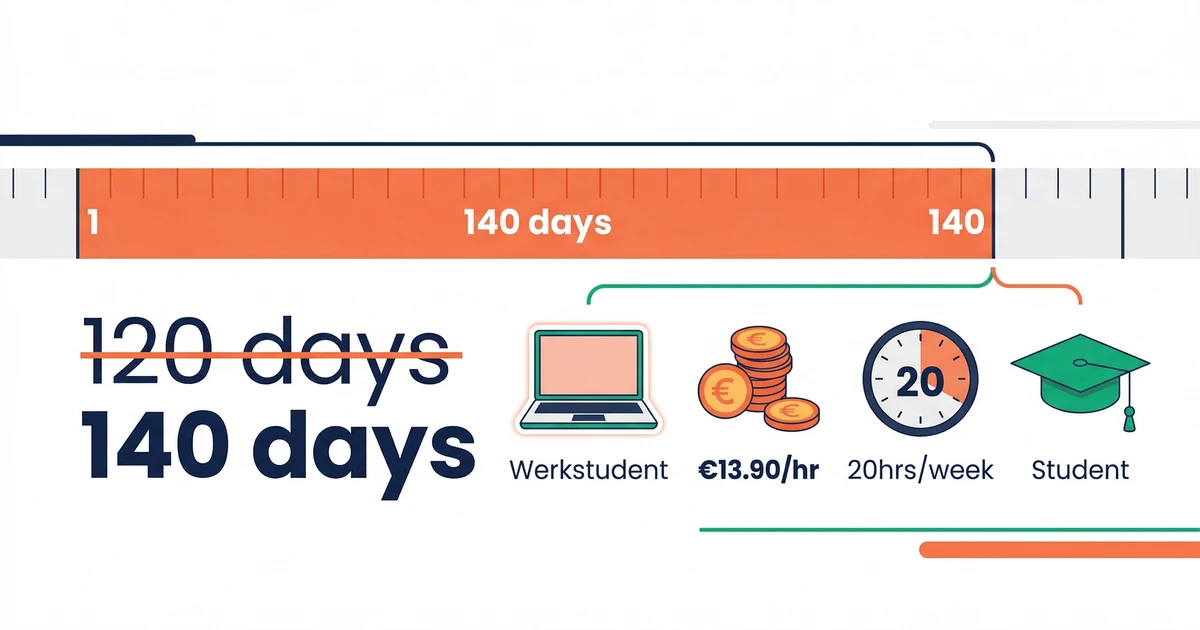
| Student part-time work limit | 140 full days or 280 half days per year |
| Minimum wage (student jobs) | €13.90/hour |
| National visa (D) fee | €75 |
| APS fee (India) | INR 18,000 |
| Post-study work visa (job-seeker) | 18 months after graduation |
| EU Blue Card threshold | €45,934 (shortage) / €50,700 (general) |
How JEE Mains fits into German university admissions
German universities base bachelor’s eligibility on your school-leaving qualification (Class 12) and its equivalence. For most Indian boards, Class 12 alone is not equivalent to the German Abitur. Therefore:
- JEE Mains is not a substitute for Abitur equivalence.
- It can, however, strengthen your profile, especially for STEM-oriented Studienkolleg intake or when you apply after completing your first bachelor’s year in India.
- JEE Advanced (with a competitive rank) may open limited direct-entry possibilities at select universities and only for subject-restricted fields. Check each university’s page and the anabin/uni-assist notes carefully.
If your plan is “Germany after JEE Mains,” map yourself to either Studienkolleg or the 1-year-in-India route. Both are proven, realistic, and lead to the same end goal: a bachelor’s in Germany.
Pathways after JEE Mains: Which one is right for you?
| Pathway | Who should choose | Duration | Language | Pros | Cons |
|---|---|---|---|---|---|
| Studienkolleg (T-Kurs for engineering) | 12th pass (PCM), strong STEM interest; JEE Mains attempt adds weight | ~1 year + FSP | Mostly German (B1-B2 entry; C1 by FSP) | Direct bridge to German bachelor’s; strong fundamentals | Extra year; must learn German to high level; entrance tests |
| 1 year of Indian bachelor’s, then apply | Students already enrolled in B.Tech/B.Sc. in India | 1 year in India + 3-3.5 years in Germany | German or English, depending on program | No Studienkolleg; can target English-taught programs | Must maintain strong CGPA; credit transfer not guaranteed |
| Finish bachelor’s in India → Master’s in Germany | Those open to a later move; want maximum program choice | 3-4 years India + 2 years Germany | Mostly English-taught master’s options | Largest pool of programmes; strong employability | Later start in Germany; not immediate post-12th |
Step-by-step: Studienkolleg route after JEE Mains
- Confirm eligibility and course type
With Class 12 (PCM) and JEE Mains, your likely Studienkolleg track is T-Kurs (engineering/CS). Review target universities and whether they use uni-assist for processing.
- Build language fundamentals
Most public Studienkollegs need German at B1-B2 on entry, and you’ll reach C1 by the FSP exam. Start intensive German early. Some private foundation courses offer English instruction, but public options are primarily German.
- Prepare for entrance tests (Aufnahmeprüfung)
Expect math, logical reasoning, and sometimes physics/German. Your JEE Mains prep helps for quant. Check sample papers of your chosen Studienkolleg.
- Collect application documents
Class 10/12 mark sheets, passport, German language certificate, motivation letter, CV, recommendation (optional), and where required, the APS certificate for India.
- Apply via uni-assist or directly
Submit before deadlines (typically Jan-Mar for summer, May-Jul for winter). Verify whether your Studienkolleg takes centralized or direct applications.
- Receive admission and apply for the student visa
Arrange finances via a blocked account (€11,208/year) and proof of funds. Book your visa appointment and consider our assisted student visa support.
- Arrive, clear FSP, and start your bachelor’s
After passing the Feststellungsprüfung, you apply to subject-aligned bachelor’s programs. Keep your grades competitive for top universities.
Step-by-step: 1-year-in-India route after JEE Mains
Read Also: The Study Shift: What You’ll Pay in 2026
- Enroll in a relevant Indian bachelor’s
Choose B.Tech/B.E./B.Sc. aligned with your intended German major. Maintain strong first-year grades; competitive CGPA boosts direct subject-restricted admission chances.
Advertisement - Shortlist German universities and languages
Decide between German-taught or English-taught programs. Many UAS (Fachhochschule) programs are in German; some universities offer English options in CS, EE, Mechanical, etc.
- Check application platforms
Confirm if your targets use uni-assist and note document legalization, transcripts, and evaluation timelines.
- Take language/proficiency tests
German-taught: TestDaF or DSH (C1 level typical). English-taught: IELTS/TOEFL (university-specific). Your JEE Mains background isn’t a language waiver.
- Secure APS and finances
APS verification (INR 18,000) is mandatory for India. Prepare a blocked account, living-cost plan, and insurance estimates.
- Apply and manage deadlines
Winter intake (Oct) deadlines commonly May-Jul; Summer intake (Apr) Jan-Mar. Always confirm on program pages.
- Get admission, apply for visa, fly
Pay the €75 visa fee, submit insurance proof (~€140/month for students under 30), book flights, and arrange temporary housing.
What scores matter for Germany if you took JEE Mains?
Universities will focus on your Class 12 core subjects (Maths/Physics/Chemistry) and, for the 1-year route, your first-year CGPA. JEE Mains can be a helpful add-on for STEM readiness but is seldom a formal cut-off criterion. If you have JEE Advanced success, check each university’s policy, some may allow direct subject-restricted entry without Studienkolleg.
Language choices: German-taught vs English-taught
Post-JEE Mains, you can still aim for English-taught bachelor’s (especially in Computer Science and some engineering fields), but there are fewer compared to German-taught options. Consider:
- German-taught: Broader choice, lower or no tuition at public universities, deeper cultural integration, stronger local employability.
- English-taught: Faster start if your German is basic; higher competition; sometimes tuition at private universities.
Whichever path you choose, start German early. It’s a career multiplier and essential for internships and part-time roles.
Costs in 2026: How much to budget after JEE Mains?
Living costs vary by city. Munich and Stuttgart are pricier than Chemnitz or Magdeburg. Public universities may charge a semester contribution (~€150-€350) and separate admin/NRW semester ticket fees. Private universities charge tuition. Plan for the blocked account, health insurance, rent, food, transport, and study materials. For a full breakdown, read our guide to the cost of studying.
| Expense | Typical monthly range (2026) | Notes |
|---|---|---|
| Rent (shared WG/student dorm) | €350-€600 | City-dependent; dorms cheaper, limited availability |
| Food and groceries | €180-€250 | Cook at home to save; Mensa lunches are subsidized |
| Health insurance | ~€140 | Public student tariff under 30; private varies |
| Transport (semester ticket allocation) | €25-€60 | Varies by state/university; sometimes included in fees |
| Utilities, phone, internet | €40-€80 | Shared flats split utilities; prepaid SIMs common |
| Study materials & misc. | €30-€60 | Second-hand books and libraries help reduce costs |
| Estimated total | €765-€1,190 | Plan for buffer; city choice matters a lot |
Remember, you must show at least €11,208 in a blocked account for the first year. Public health insurance averages ~€140/month for students under 30. For coverage details, see our health insurance explainer.
Scholarships and funding tips
- DAAD and foundation scholarships exist, but are competitive, especially at the bachelor’s level. See our DAAD scholarship guide for timelines and documents.
- Part-time jobs can supplement living expenses. Students may work up to 140 full days or 280 half days per year, with a minimum wage of €13.90/hour. Explore roles aligned to labs, programming, or Werkstudent posts. Our part-time jobs guide covers strategies.
- Many cities offer rent-subsidized dorms, apply early via the Studentenwerk.
Targeting top engineering schools with a JEE background
JEE Mains preparation strengthens math/physics fundamentals key for German engineering schools, including the TU9 group (leading technical universities). If you aim high, keep grades competitive and consider German-taught tracks to broaden choices. Learn about Germany’s elite tech cluster in our TU9 overview.
Documents checklist for JEE Mains candidates
- Passport, CV, Motivation Letter
- Class 10 & 12 mark sheets; School leaving certificate
- JEE Mains/Advanced score report (supporting)
- For 1-year route: 1st-year transcript and syllabus
- Language proof: German (B1-C1) or IELTS/TOEFL for English-taught
- APS certificate (mandatory for India)
- Proof of finances: blocked account or sponsor
- Health insurance confirmation
Application timelines: When to start if you took JEE Mains
- 12-18 months before intake: Start German (if needed), shortlist programs, understand uni-assist, plan finances.
- 9-12 months: Take language/proficiency tests; gather APS; prepare essays and CV.
- 6-9 months: Submit applications for Winter (Oct) or Summer (Apr) intakes.
- 3-6 months: Receive admits, open blocked account, arrange housing, apply for visa (fee €75).
- 0-3 months: Travel, city registration, enrolment, insurance, and residence permit.
Studienkolleg entrance: What to expect (T-Kurs)
Most T-Kurs entrance tests assess mathematics (algebra, functions, sequences), basic physics, and German comprehension. The difficulty is manageable if you’ve prepped for JEE Mains; your quant base is an advantage. Focus on solving speed, German terminology, and past papers from your target Studienkolleg.
After graduation: Jobs, post-study visa, and Blue Card
German degrees are industry-oriented, especially at Universities of Applied Sciences. After you finish your bachelor’s or master’s, you can apply for an 18-month post-study job-seeker residence permit to find work in your field. Once employed with a qualifying salary, you can target the EU Blue Card, €45,934 for shortage occupations, €50,700 for general in 2026, accelerating long-term residence options.
Common mistakes JEE Mains candidates should avoid
- Assuming JEE Mains guarantees direct admission, it does not. Plan for Studienkolleg or 1-year route.
- Delaying German language learning; this narrows options and internship chances.
- Ignoring APS and document legalization timelines.
- Under-budgeting, remember the blocked account (€11,208) and insurance (~€140/month).
- Weak SOP/CV, explain your JEE journey, projects, and why Germany.
Sample profile mapping: JEE Mains to German pathways
- Profile A: CBSE 12th PCM 88%, JEE Mains score but no Advanced. Goal: Mechanical Engg. Path: Studienkolleg T-Kurs (German B1 entry), FSP, then TU/UAS Mechanical in German.
- Profile B: State board 12th 82%, JEE Mains, now in B.Tech CSE Year 1 with 8.6 CGPA. Path: Apply after Year 1 to English-taught CS at UAS/Uni; IELTS 6.5-7.0; no Studienkolleg.
- Profile C: ICSE 12th 90%, JEE Mains, strong Olympiad exposure. Path: Private/International foundation in English, then public bachelor’s, parallel German learning.
- Profile D: JEE Advanced qualified with good rank. Path: Explore direct subject-restricted entry at select unis; if unclear, prefer 1-year route or Studienkolleg to be safe.
Is Germany better than India after JEE Mains? A quick comparison
| Factor | Germany | India |
|---|---|---|
| Tuition (public sector) | Often no tuition; semester contribution only | Varies widely; IITs/NITs subsidized, private higher |
| Medium of instruction | German (majority) + some English programs | English/Hindi/regional |
| Industry exposure | Strong internships, dual-study, UAS practical focus | Growing, varies by institute and region |
| Part-time student work | Legal: 140 full or 280 half days; €13.90/hr min wage | Allowed but availability varies by city/sector |
| Post-study pathway | 18-month job-seeker; EU Blue Card possible | Dependent on domestic market; no Blue Card |
Final tips for JEE Mains candidates
- Start German as soon as you decide, language is your biggest unlock.
- Choose between Studienkolleg now or 1 year in India, then Germany; both work.
- Track APS, uni-assist, and visa timelines; don’t miss intake windows.
- Budget realistically: blocked account, insurance, rent, and buffers.
- Use your JEE prep to ace Studienkolleg entrance math and FSP.
Ready to map your JEE Mains profile to the best-fit German route? Get a personalised shortlist, timelines, and a document plan from our experts. Start with a free profile check today: Profile Evaluation.
Frequently Asked Questions
You probably qualify for more than you think.
Students who get evaluated find programmes they had no idea existed — at universities that charge nothing. 2 minutes, no cost. The only downside is not checking.
Want our guides higher up in Google?
Mark GradGermany as a preferred source and Google gives our pages more room when you search about studying in Germany. Takes one tap, and you can undo it any time from the same screen.
Living this, or on your way to it? Tell your story.
If you are already in Germany and finding it hard, or still fighting to get here, other students need to hear it from someone real. Share your honest journey. We help shape it, and nothing goes live until you approve it.
Free German Quiz · No Login
Can you score 10/10 on today's German challenge?
10 new words every day · 4,500+ words from A1 to C1 · takes about a minute.