Studying Dentistry in Germany: Admission, NC, Internationals
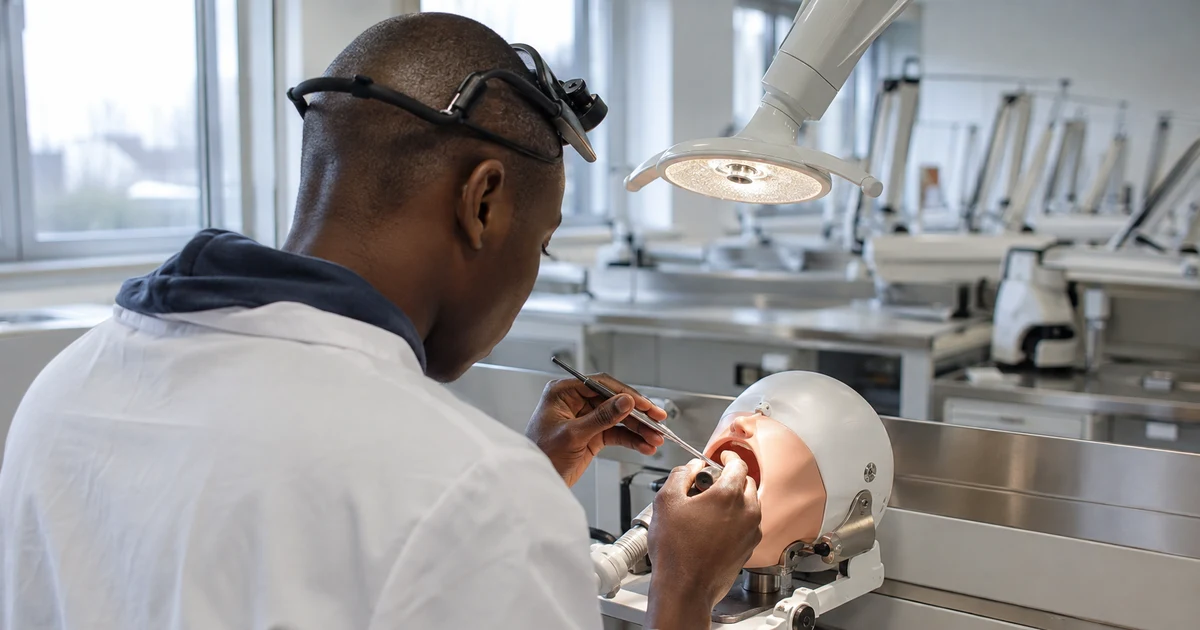
TL;DR: Dentistry in Germany is NC-selected with a tiny international quota. You need near-top grades, German C1 and often TestAS. Non-EU applicants do not go through hochschulstart at all: you apply directly to each university, on its own deadline. Seats are very limited, so it is as competitive as medicine.
Dentistry is built like medicine in Germany: a state-exam degree, NC selection, and a non-EU quota so small that the odds of direct entry are close to the worst in German higher education. That is the honest starting point. What follows is what the requirements are, and what a plan looks like when it cannot rest on this one door. See also studying medicine in Germany as an international and how NC and the quotas work.
The same structure as medicine, with fewer seats
Dentistry is one of exactly four subjects allocated nationally rather than by each university, alongside human medicine, veterinary medicine and pharmacy. Everything else in German admissions is decided locally; these four are not. Seats are scarce, demand is heavy, and the allocation machinery is correspondingly strict.
How the German quota system works, and why you sit outside it
For applicants who count as German or are treated as equivalent, places are split three ways: 30 percent by school-leaving results in the Abiturbestenquote, 10 percent in an additional aptitude quota where the school grade is ignored entirely and only things like an aptitude test or a completed medical training count, and 60 percent in each university's own selection procedure. There is no longer a waiting-time quota; those places were folded into the aptitude quota.
Here is the part most guides get wrong. If you hold a foreign school-leaving certificate and are not treated as equivalent to a German applicant, hochschulstart does not allocate you a place at all. Its own guidance says such applicants must apply directly to the universities, and that some of those universities route the application through uni-assist. You are competing inside each university's separate international allocation, one application at a time, against other international applicants.
Two things follow. Your odds are not the national NC number you read about, because that number describes a pool you are not in. And there is no single application: a shortlist of six dentistry faculties means six applications, six document sets and six deadlines.
The dates that bind you, and the ones that do not
The famous hochschulstart dates, May 31 for applicants who left school in an earlier year and July 15 for the current year's school-leavers, with a clearing round from August 25 to September 30, govern the German pool. They are worth knowing because they set the rhythm of the whole cycle, but they are not your deadline.
Yours is whatever each university publishes for applicants with a foreign qualification, and those dates are frequently earlier than the national ones because the certificate check has to happen first. Read every faculty page separately, and if uni-assist is involved, add its own lead time: it quotes four to six weeks for an evaluation and asks for submissions at least eight weeks before the university deadline. The deadlines that close earlier than July 15 explains the pattern.
C1 German, because you treat patients
The degree runs in German and the clinical training puts you in a chair opposite a patient. C1 evidenced by DSH-2/TestDaF or Goethe C1 is the requirement, and real conversational fluency is the practical standard. There is no English-taught route to the state exam.
Grades and TestAS
An excellent converted grade in the 1.x-2.0 range, usually with a TestAS result behind it. In a normal year, only the strongest non-EU profiles get an offer out of the quota, and a good but unremarkable file does not clear it.
Worth knowing what TestAS actually is before you book it. It is a standardised aptitude test for international applicants, sat in either German or English, and the language it uses is pitched at A2 to B2 so that it measures aptitude rather than fluency. It is not universally required: most universities treat a good score as something that strengthens an application, while some make it a condition of admission. It runs only on fixed dates a few times a year, with sittings on October 24 and November 26 in 2026 and February 25 in 2027, so it has to be planned into the timeline rather than added at the end.
| Step | Bar | Note |
|---|---|---|
| Where you apply | Direct to each university | not hochschulstart |
| NC ranking | Near-top | by grade |
| German | C1 | clinical work |
| Test | TestAS | fixed sitting dates |
| Non-EU quota | Small | few seats |
| Degree length | 5 years, standard period 5 years 6 months | three state exam sections |
What the degree actually is
The federal licensing regulation sets the shape. Dental training runs five years, with a standard study period of five years and six months, and the state examination comes in three separate sections rather than one final hurdle. You do not graduate with a bachelor's or a master's; you pass the third section and apply for the licence to practise.
That structure matters for planning because it is inflexible. There is no shorter track, no part-time version, and no way to arrive with credits and start in a later semester unless a faculty formally recognises them.
The alternatives worth taking seriously
Biomedical and health science degrees in Germany, or dentistry in a country with more open admission followed by recognition here, are the routes most international students end up taking. Neither is a consolation prize, and both put you inside the German system while the direct door stays shut. If you are coming straight from school, the Studienkolleg route after 12th explains the entry path.
The APS comes before anything else
Applicants from India, China, Vietnam and Mongolia need the APS certificate to apply and again for the visa. Start it the moment you decide on Germany. See the APS guide for the four countries.
A long degree means a large living bill
Dentistry runs five and a half years by design, so tuition is not the number to watch. Living costs of 900-1,200 euros a month across eleven semesters are, along with the 11,904 euros the visa requires and re-proved at each extension. At the lower end that is well over sixty thousand euros of living costs before a single fee. Do the multiplication using the cost of studying in Germany in rupees.
After the state exam
Qualified dentists can practise or specialise in Germany, moving through the 18-month job-seeker route into a work permit. See the post-study job-seeker visa.
Sources
- hochschulstart, allocation quotas
- hochschulstart, international applicants
- hochschulstart, dates and deadlines
- Dental licensing regulation, section 2: course structure
- TestAS official site
Set on dentistry? A free profile evaluation gives you a straight read on your odds and the alternatives worth holding.
Frequently Asked Questions
You probably qualify for more than you think.
Students who get evaluated find programmes they had no idea existed — at universities that charge nothing. 2 minutes, no cost. The only downside is not checking.
Want our guides higher up in Google?
Mark GradGermany as a preferred source and Google gives our pages more room when you search about studying in Germany. Takes one tap, and you can undo it any time from the same screen.
Living this, or on your way to it? Tell your story.
If you are already in Germany and finding it hard, or still fighting to get here, other students need to hear it from someone real. Share your honest journey. We help shape it, and nothing goes live until you approve it.
Related Guides
Free German Quiz · No Login
Can you score 10/10 on today's German challenge?
10 new words every day · 4,500+ words from A1 to C1 · takes about a minute.