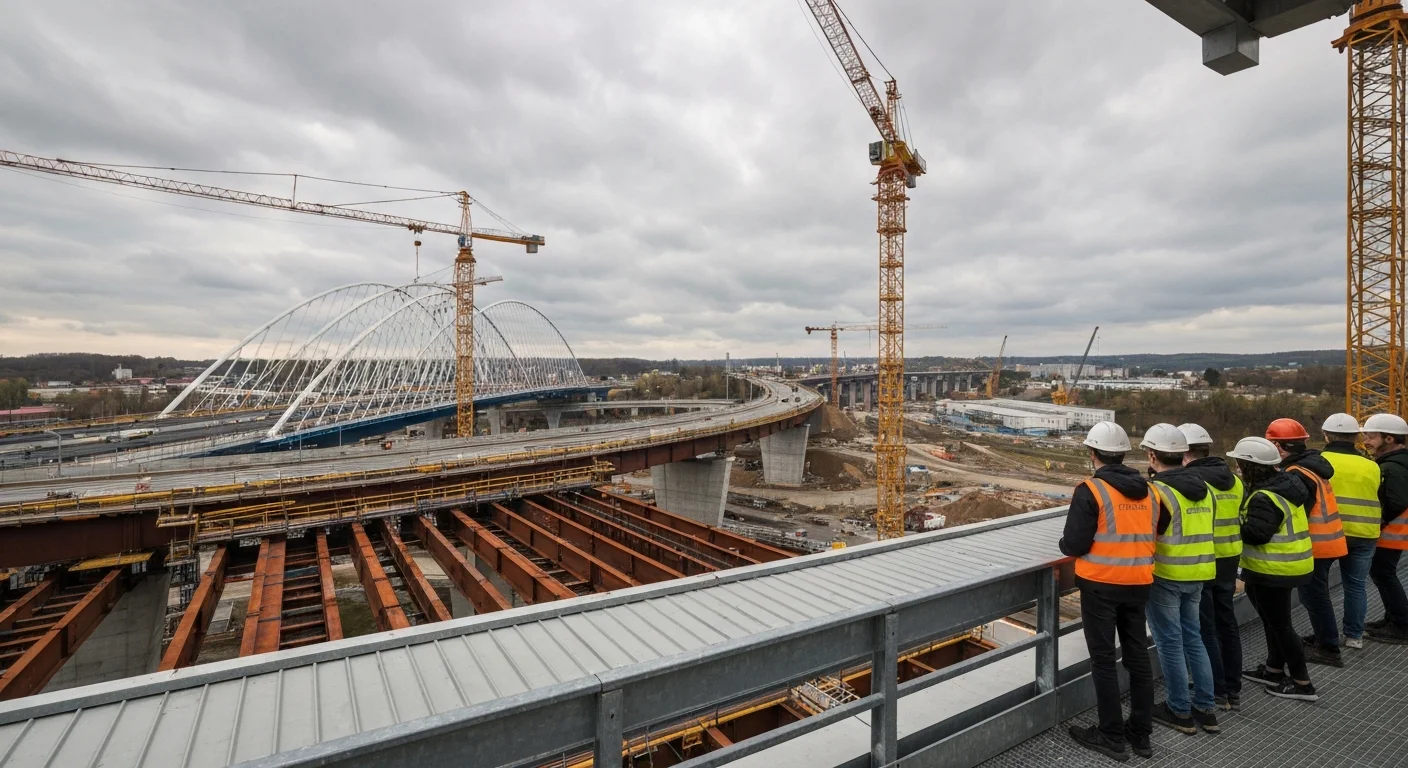
Civil Engineering in Germany
Germany is Europe's largest construction market and a global leader in infrastructure innovation. Study Civil Engineering at world-renowned technical universities with zero tuition fees and gain access to cutting-edge research in sustainable construction, structural engineering, and smart infrastructure.
Leading Universities in Germany
World-class education with strong industry ties and international recognition.
Technische Hochschule Deggendorf
Deggendorf, Bayern
Applied civil engineering with practical training and construction industry connections.
Technische Universität München
München, Bayern
Top-ranked for civil engineering with structural, geotechnical, and environmental research.
RWTH Aachen
Aachen, Nordrhein-Westfalen
Excellent civil engineering faculty with focus on construction management and water engineering.
Universität Stuttgart
Stuttgart, Baden-Württemberg
Strong civil engineering with urban planning and sustainable construction research.
Bauhaus-Universität Weimar
Weimar, Thüringen
Bauhaus tradition meets modern construction. Leading programmes in architecture and civil engineering.
Technische Universität Dresden
Dresden, Sachsen
Excellence university with outstanding structural engineering and water management research.
Showing 625–648 of 719 programmes
Schiffbetriebstechnik/Anlagentechnik und Versorgungstechnik, B.Sc.
Hochschule Wismar - University of Applied Sciences: Technology, Business and Design · Rostock
Stadtforschung - Urban Studies, M.A.
Technische Universität Darmstadt · Darmstadt
Stadtökologie (Urban Ecosystem Sciences), M.Sc.
Technische Universität Berlin · Berlin
Stadtplanung Teilzeit (BSP TZ), B.A.
Technische Hochschule Ostwestfalen-Lippe · Detmold
Stadtplanung und Städtebau, B.Sc.
Brandenburgische Technische Universität Cottbus-Senftenberg · Cottbus
Stadtplanung Vollzeit (BSP VZ), B.A.
Technische Hochschule Ostwestfalen-Lippe · Detmold
Stadtplanung, B.Eng.
Hochschule für Wirtschaft und Umwelt Nürtingen-Geislingen · Nürtingen
Apply by 30 Sep · 14d leftStadtplanung, B.Eng.
Frankfurt University of Applied Sciences · Frankfurt am Main
Stadtplanung, B.Sc.
HafenCity Universität Hamburg · Hamburg
Stadtplanung, B.Sc.
Technische Hochschule Lübeck · Lübeck
Stadtplanung, M.Eng.
Hochschule für Technik Stuttgart · Stuttgart
Apply by 1 Nov · 46d leftStadtplanung, M.Sc.
Rheinland-Pfälzische Technische Universität Kaiserslautern-Landau · Kaiserslautern
Stadtplanung, M.Sc.
HafenCity Universität Hamburg · Hamburg
Stadtplanung, M.Sc.
Technische Hochschule Lübeck · Lübeck
Stadtplanung, Master
RWTH Aachen · Aachen
Sustainable Civil Engineering, B.Eng.
Technische Hochschule Ingolstadt · Neuburg a.d. Donau
Sustainable Design, Construction and Management of the Built Environment, M.Sc.
Technische Hochschule Mittelhessen - THM · Gießen
Sustainable Energy and Hydrogen Infrastructures, M.Sc.
Technische Universität Dortmund · Düsseldorf
Sustainable Engineering of Infrastructure, M.Eng.
Fachhochschule Erfurt · Erfurt
Sustainable Landscape Design and Development, M.A.
Technische Hochschule Ostwestfalen-Lippe · Höxter
Sustainable Urban Development, M.Sc.
Technische Universität Darmstadt · Darmstadt
Systems Engineering in der Umwelt- und Gebäudetechnik, M.Sc.
Westfälische Hochschule Gelsenkirchen, Bocholt, Recklinghausen · Gelsenkirchen
Technische Gebäudeausrüstung mit Digitaler Infrastruktur, B.Sc.
HafenCity Universität Hamburg · Hamburg
Technische Gebäudeausrüstung und Versorgungstechnik - Dual, B.Eng.
Hochschule Trier - Trier University of Applied Sciences · Trier
Check My Fit
3 quick questions — every result gets a fit tag based on your budget and languages. Stored only on this device.
Tags are an indication based on tuition and teaching language — for a real assessment, get a free profile evaluation.
What You'll Study — Core Subjects & Specializations
A civil engineering degree in Germany builds from a rigorous foundation in mathematics, mechanics and materials before branching into applied specializations. Bachelor's programmes generally run six to seven semesters and are mostly taught in German, while consecutive Master's programmes typically run four semesters and offer a growing number of English-taught options.
Foundational core
Engineering mathematics · technical mechanics & statics · strength of materials · construction materials science · surveying and geodesy · hydraulics and fluid mechanics · soil mechanics and geotechnics · and computer-aided design (CAD) with building information modelling (BIM).
Common specialization tracks
Structural engineering · geotechnical engineering · transportation and traffic engineering · water resources and hydraulic engineering · environmental and sustainable construction · construction management and project delivery · and the increasingly popular fields of computational engineering and smart, digital infrastructure.
Many universities embed an industry internship and a research-led thesis, and Germany's strong tradition of applied research means you will often work directly with construction firms, engineering consultancies and public infrastructure agencies. Not sure which track fits your background? A free profile evaluation can map your studies so far against the specializations on offer.
Entry Requirements for Civil Engineering in Germany
Requirements vary by university and by intake, but the building blocks below are typical. Always confirm the exact criteria on the official programme page before you apply.
Academic background
For a Master's, a recognised Bachelor's in civil engineering or a closely related field with a solid grade average is generally expected. For a Bachelor's, applicants from some countries may first need a Studienkolleg (foundation year) depending on how their school-leaving qualification is recognised on anabin.
Language proof
English-taught Master's programmes typically ask for IELTS around 6.5 (or an equivalent TOEFL). German-taught programmes usually require proof such as TestDaF or DSH at roughly C1 level. A working knowledge of German is also valuable for internships and everyday life.
Documents & APS
Applicants from India, China and Vietnam generally need an APS certificate before applying or before the visa stage. Many universities process applications through uni-assist. The GRE is generally not required for civil engineering in Germany.
Recognition of your qualification is the single biggest variable — it depends on your intake, the institution type, and your anabin and APS status. Our consultants check this for you as part of the free profile evaluation.
Careers & Salaries for Civil Engineers in Germany
Germany is Europe's largest construction market, and an ageing infrastructure base, the energy transition and major rail and transport projects keep demand for qualified civil engineers steady. Common roles include structural engineer, site and project manager, geotechnical engineer, transport planner, BIM coordinator and water-management engineer.
Figures are approximate and vary widely by region, employer, specialization and experience — salaries tend to run higher in cities such as Munich, Stuttgart and Frankfurt. After graduating, non-EU students can generally apply for an 18-month residence permit to look for a job related to their degree, and qualifying roles can later lead to an EU Blue Card. To see which programmes and career paths best match your profile, start with a free profile evaluation or explore how GradGermany helps.
Frequently Asked Questions About Civil Engineering in Germany
Germany is synonymous with engineering excellence, and its civil engineering sector is no exception. As Europe's largest economy and biggest construction market, Germany leads the continent in infrastructure development, sustainable building technologies, and urban planning innovation. The TU9 alliance of leading technical universities — including TU Munich, RWTH Aachen, TU Berlin, TU Dresden, University of Stuttgart, and KIT Karlsruhe — offers some of the most rigorous civil engineering programmes in the world, known locally as Bauingenieurwesen. With over 50 accredited programmes nationwide, students gain access to state-of-the-art structural testing labs, computational modelling facilities, and strong industry ties with firms such as Hochtief, Strabag, and Bilfinger. Tuition is free at public universities, and graduates benefit from an 18-month post-study work visa with a clear pathway to permanent residency in Germany.
Yes. The vast majority of public universities charge no tuition fees for Civil Engineering programmes, even for international students. The only mandatory cost is a semester contribution of approximately €150–€350, which typically includes a public transport pass valid across the entire state. This applies at top institutions such as TU Munich, RWTH Aachen, TU Berlin, TU Dresden, and KIT Karlsruhe. The sole exception is Baden-Württemberg, where non-EU students pay €1,500 per semester — still far below comparable programmes in the US ($30,000–$60,000 per year), UK (£20,000+), or Australia (AUD 40,000+). For your student visa, you will need a blocked account with €11,904 to cover living expenses. With over 50 civil engineering programmes nationwide, Germany delivers world-class construction engineering education at a fraction of the global average cost.
Yes, several German universities offer Civil Engineering Master's programmes taught entirely in English. At the Bachelor's level most programmes are delivered in German, but English-taught Master's options are available at institutions like TU Munich (Computational Mechanics, Construction and Building), RWTH Aachen (Civil Engineering), TU Dresden (Access to Drinking Water), and University of Stuttgart (Infrastructure Planning). German-taught programmes require a DSH-2 or TestDaF 4 certificate. English-taught programmes typically require IELTS 6.5+ or TOEFL 90+. Application deadlines generally fall in July for the winter semester and January for the summer semester. Indian applicants should also prepare their APS certificate early, as processing can take several weeks. Learning German alongside your studies gives a significant competitive edge when entering the German construction job market after graduation.
Germany is a global pioneer in sustainable construction and green building technology. The country's ambitious climate goals and Energiewende programme emphasise energy-efficient building design, renewable energy infrastructure, and sustainable urban development. Students gain hands-on exposure to passive house standards, green concrete research, circular construction methods, and advanced BIM (Building Information Modelling) — skills increasingly in demand worldwide. Universities like TU Munich and KIT Karlsruhe operate dedicated sustainability labs, while RWTH Aachen leads research in digital construction and 3D-printed structures. The Fraunhofer Institute for Building Physics (IBP) collaborates with students on real-world pilot projects. Germany's strict building energy codes (GEG) set the global benchmark, and graduates trained in these standards are highly employable across Europe, the Middle East, and Asia.
Applicants typically need a Bachelor's degree in Civil Engineering or a related field such as Structural Engineering, Construction Engineering, or Architecture, with a minimum GPA equivalent to the German grade of 2.5 or better. English-taught Master's programmes require B2/C1 level English (IELTS 6.5+ or TOEFL 90+). Unlike many US programmes, German universities generally do not require GRE scores, making the application process simpler and more accessible. Application deadlines are typically July 15 for the winter semester (October start) and January 15 for the summer semester. Most international applicants apply through the uni-assist portal, which charges a processing fee of €75. Indian students must also obtain an APS certificate and open a blocked account with €11,904 for the visa application.
Germany's construction industry faces a significant shortage of qualified engineers, with thousands of positions unfilled annually. Starting salaries average €48,000–€55,000 per year, with experienced professionals in project management, structural design, and infrastructure planning earning €65,000–€80,000 or more. Major employers include Hochtief (one of the world's largest construction firms), Strabag, Bilfinger, Bauer Group, and Züblin. Germany is investing heavily in transport infrastructure, renewable energy construction, and affordable housing, creating sustained demand for civil engineers. The country's 18-month post-study job seeker visa provides ample time to secure employment, and civil engineering is classified as a shortage occupation, which means work permits are processed faster. Graduates also qualify for the EU Blue Card with starting salaries in this range.
The leading institutions include TU Munich (ranked #1 in Germany for engineering, with strong structural and geotechnical research), RWTH Aachen (home to one of Germany's largest civil engineering faculties with over 10 institutes), TU Berlin (excellent in urban infrastructure and transport planning), TU Dresden (leader in computational structural mechanics and bridge engineering), University of Stuttgart (renowned for lightweight construction and sustainable building), and KIT Karlsruhe (pioneering work in seismic engineering and hydraulic research). All six belong to the prestigious TU9 alliance of Germany's top technical universities. These institutions offer state-of-the-art structural testing halls, wind tunnels, and geotechnical centrifuges, and maintain strong partnerships with firms like Hochtief, Strabag, and the Federal Highway Research Institute (BASt).
Yes. Germany's 18-month post-study job seeker visa (Section 20 (3) of the Residence Act) provides graduates with ample time to secure employment without needing a job offer in advance. During this period, you can work in any field to support yourself while searching for a civil engineering position. Once you find a qualifying role, you transition to an EU Blue Card or standard work permit. Starting salaries of €48,000–€55,000 comfortably exceed the Blue Card threshold. After 21–33 months of employment, graduates can apply for permanent residency (Niederlassungserlaubnis). The strong demand for civil engineers across Germany — especially in infrastructure renewal, sustainable construction, and transport planning — makes finding employment after graduation highly achievable for international graduates with a German degree.
Explore More Programmes in Germany
Ready to Study Civil Engineering
in Germany?
Get a free profile evaluation from our experts. We will assess your academic background, recommend the best civil engineering programmes for your profile, and guide you through the entire application process.