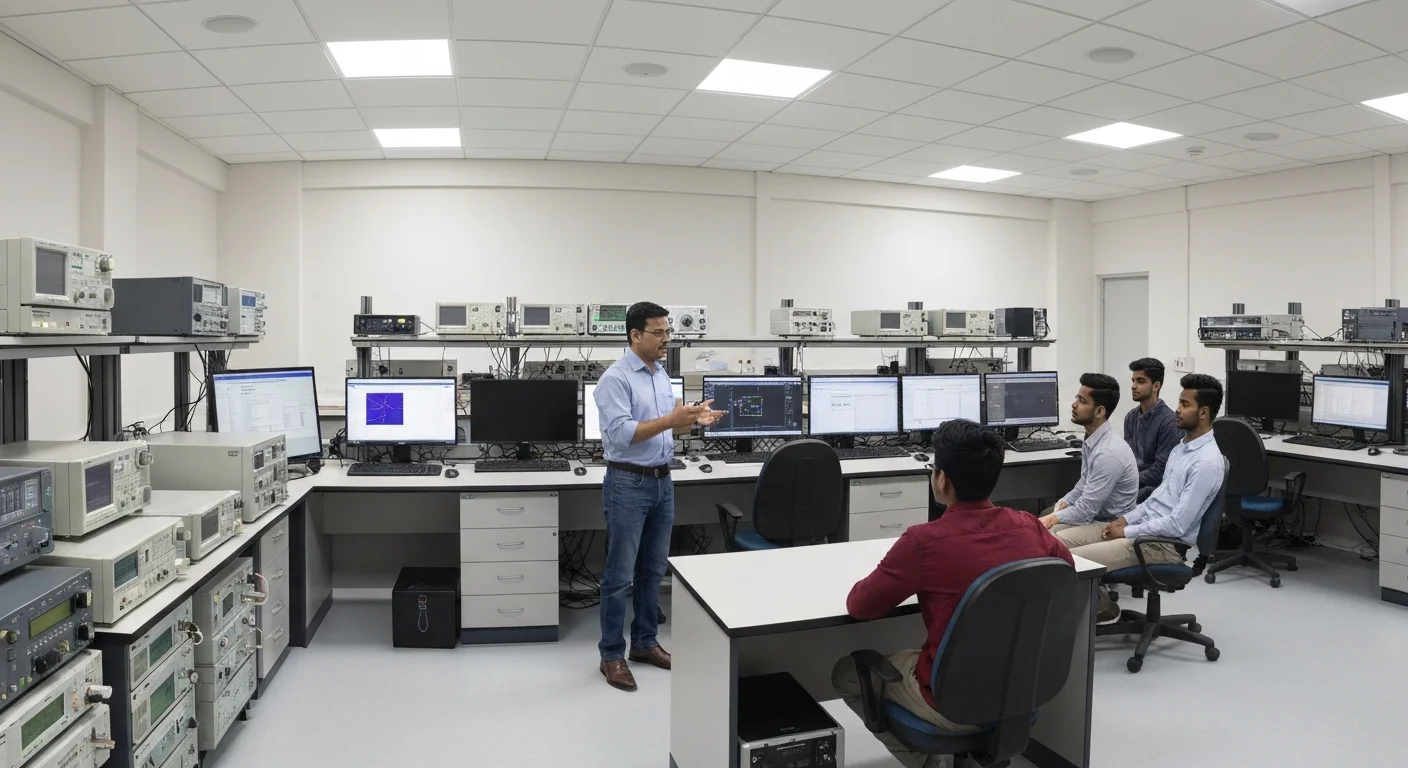
Electrical Engineering in Germany
Germany is the heart of Europe's engineering industry and home to global leaders in power systems, semiconductors, and renewable energy. Study Electrical Engineering at world-class TU9 universities with zero tuition fees and an 18-month post-study work visa.
Leading Universities in Germany
World-class education with strong industry ties and international recognition.
Technische Hochschule Deggendorf
Deggendorf, Bayern
Applied electrical engineering with hands-on lab work and industry partnerships.
Technische Universität München
München, Bayern
Top-ranked for electrical engineering with leading microelectronics and power systems research.
RWTH Aachen
Aachen, Nordrhein-Westfalen
Excellent EE faculty with strong ties to Siemens, Infineon, and Ericsson.
Technische Universität Darmstadt
Darmstadt, Hessen
Pioneer in power electronics, telecommunications, and signal processing research.
Technische Universität Dresden
Dresden, Sachsen
Strong EE programmes with semiconductor and microelectronics research excellence.
Karlsruher Institut für Technologie
Karlsruhe, Baden-Württemberg
Leading research in energy systems, optics, and embedded systems engineering.
Showing 361–384 of 652 programmes
Energiesysteme und Umwelttechnik, M.Eng.
Hochschule Braunschweig/Wolfenbüttel, Ostfalia Hochschule für angewandte Wissenschaften · Wolfenbüttel
Energiesystemtechnik, B.Eng.
Hochschule für Technik, Wirtschaft und Medien Offenburg · Offenburg
Energiesystemtechnik, M.Eng.
Westfälische Hochschule Gelsenkirchen, Bocholt, Recklinghausen · Gelsenkirchen
Energiesystemtechnik, M.Sc.
Technische Universität Clausthal · Clausthal-Zellerfeld
Energietechnik - Regenerative und Effiziente Energiesysteme, B.Eng.
Hochschule Trier - Trier University of Applied Sciences · Trier
Energietechnik (dual), M.Ed.
Bergische Universität Wuppertal · Wuppertal
Energietechnik dual, B.Eng.
FH Münster University of Applied Sciences · Steinfurt
Apply by 15 Nov · 60d leftEnergietechnik PLUS, B.Eng.
FH Münster University of Applied Sciences · Steinfurt
Apply by 15 Nov · 60d leftEnergietechnik und Energiewirtschaft, B.Sc.
Brandenburgische Technische Universität Cottbus-Senftenberg · Cottbus
Energietechnik und Energiewirtschaft, M.Sc.
Brandenburgische Technische Universität Cottbus-Senftenberg · Cottbus
Energietechnik und Erneuerbare Energien, B.Eng.
Hochschule für angewandte Wissenschaften Coburg · Coburg
Apply by 30 Sep · 14d leftEnergietechnik und Ressourcenoptimierung, B.Eng.
Hochschule Hamm-Lippstadt · Hamm
Energietechnik, B.Eng.
FH Münster University of Applied Sciences · Steinfurt
Apply by 15 Nov · 60d leftEnergietechnik, B.Eng.
Hochschule Bremen · Bremen
Energietechnik, B.Eng.
Technische Hochschule Mittelhessen - THM · Gießen
Energietechnik, B.Sc.
Gottfried Wilhelm Leibniz Universität Hannover · Hannover
Energietechnik, Energieeffizienz und Klimaschutz, B.Eng.
Ostbayerische Technische Hochschule Amberg-Weiden · Amberg
Apply by 1 DecEnergietechnik, M.Ed.
Bergische Universität Wuppertal · Wuppertal
Energietechnik, M.Eng.
Hochschule für angewandte Wissenschaften Kempten · Kempten
Energietechnik, M.Eng.
Hochschule Bremen · Bremen
Energietechnik, M.Sc.
Universität Bayreuth · Bayreuth
Energietechnik, M.Sc.
Technische Universität Hamburg · Hamburg
Energietechnik, M.Sc.
Technische Hochschule Mittelhessen - THM · Gießen
Energietechnik, M.Sc.
Universität Stuttgart · Stuttgart
Check My Fit
3 quick questions — every result gets a fit tag based on your budget and languages. Stored only on this device.
Tags are an indication based on tuition and teaching language — for a real assessment, get a free profile evaluation.
What You’ll Study — Electrical Engineering Specializations
A German master’s in Electrical Engineering generally builds on a strong mathematical and physics foundation, then lets you specialise. Most programmes share a common core — circuit theory, signals and systems, electromagnetics, control engineering, electronics and a substantial programming or simulation component — before you choose a focus area in the second and third semesters, usually finishing with a research thesis.
Power & Energy Systems
High-voltage engineering, smart grids, power electronics and the integration of renewable energy — a strong fit given Germany’s ongoing energy transition (Energiewende).
Microelectronics & Semiconductors
Integrated-circuit design, nanoelectronics, chip fabrication and embedded systems — closely tied to Germany’s growing semiconductor manufacturing base.
Communications & Signal Processing
Wireless and optical communications, information theory, antennas and digital signal processing, including 5G/6G research themes.
Automation & Control
Control theory, mechatronics, robotics and industrial automation — central to Germany’s Industrie 4.0 manufacturing.
Automotive & E-Mobility
Electric drivetrains, battery systems, sensors and embedded automotive electronics — relevant to the country’s large automotive sector.
Biomedical & Photonics
Medical electronics, imaging, optics and laser engineering for those who want to apply electrical engineering to health and photonics.
Exact module names and available tracks vary by university, so always check the specific programme. Not sure which specialization matches your background? A free profile evaluation can help you shortlist programmes that fit your profile.
Entry Requirements for Electrical Engineering in Germany
Requirements differ by university and programme, but most Electrical Engineering master’s applicants are assessed on the points below. Treat these as typical guidance rather than fixed cut-offs — always confirm with the official programme page.
Academic background
A recognised bachelor’s degree in electrical engineering or a closely related field (electronics, communications, mechatronics). Universities typically expect a solid grade average and a curriculum that overlaps with their core modules. The recognition of your university is checked via the anabin database.
Language proficiency
For English-taught programmes, an English test such as IELTS or TOEFL is usually required — many programmes look for around IELTS 6.5. German-taught programmes generally require proof of German (for example TestDaF or DSH). Some everyday German is recommended either way.
APS certificate
Applicants with qualifications from India, China and Vietnam generally need an APS certificate verifying their academic documents. It is also required for the student visa, so it is worth starting early as the certificate can be reused for multiple applications.
Application & GRE
Some universities require you to apply through uni-assist, others through their own portal. The GRE is usually not required for German master’s programmes, though a small number of competitive courses may ask for it — check each programme individually.
Careers & Salaries for Electrical Engineers in Germany
Germany has a long-standing demand for engineers, and electrical engineering graduates are sought across automotive, energy, semiconductors, industrial automation and telecommunications. Major employers commonly associated with the field include companies such as Siemens, Bosch, Infineon and SAP, alongside a deep network of specialised Mittelstand (mid-sized) firms and research institutes such as the Fraunhofer and Max Planck institutes.
Approximate typical starting gross salary for a master’s graduate, varying by region, sector and company size.
Indicative range as you take on more responsibility in design, R&D or project roles.
Experienced engineers in high-demand fields such as semiconductors and automotive can earn more, especially in leadership tracks.
Salary figures above are approximate, before tax, and depend heavily on location, industry and employer — use them as a rough orientation, not a guarantee. After graduating, international students can typically apply for an 18-month post-study residence permit to look for a job related to their qualification, and graduates who secure a qualifying role may be eligible for an EU Blue Card. To map your degree to realistic German career paths, start with a free profile evaluation or explore more options on the GradGermany homepage.
Frequently Asked Questions About Electrical Engineering in Germany
Germany has a tradition of electrical engineering excellence stretching back to pioneers like Werner von Siemens and Heinrich Hertz. Today the country hosts global industry leaders including Siemens, Bosch, Infineon Technologies, Continental, and ABB. The TU9 alliance of leading technical universities -- TU Munich, RWTH Aachen, KIT, TU Berlin, TU Darmstadt, and TU Dresden -- are internationally recognised for research in electrical power engineering, microelectronics, embedded systems, signal processing, and control theory. Germany's electrical and electronics industry employs over 900,000 people and generates annual revenue exceeding €220 billion. The ongoing Energiewende (energy transition), semiconductor expansion, and electric vehicle revolution are creating unprecedented demand for EE graduates, making this one of the most future-proof fields to study. German EE programmes at TU9 universities combine rigorous theoretical foundations with hands-on laboratory work and industry internships, ensuring graduates are prepared for immediate employment.
Yes. Most public universities charge no tuition fees for Electrical Engineering programmes, even for international students. The only cost is a nominal semester contribution of approximately €150–€350, which typically includes a public transport pass. The sole exception is Baden-Württemberg, where non-EU students pay €1,500 per semester at universities like KIT Karlsruhe. Even so, a two-year EE Master's in Germany costs under €25,000 total including living expenses, compared to $50,000–$100,000 at top US engineering schools. Monthly living costs average €934 according to the DAAD, and students may work up to 140 full days per year. Indian students must open a blocked account (Sperrkonto) of €11,904 for the student visa, covering one year of living expenses. Many EE students also take paid research assistant (HiWi) positions at their university. This makes a German degree dramatically more affordable than comparable programmes in the US, UK, or Australia.
Yes, a growing number of German universities offer Electrical Engineering programmes taught entirely in English, especially at the Master's level. Institutions like TU Munich (Communications Engineering, Power Engineering), RWTH Aachen (Electrical Power Engineering), KIT Karlsruhe (Electrical Engineering and Information Technology), and TU Darmstadt (Information and Communication Engineering) offer English-taught specialisations in power systems, microelectronics, and telecommunications. German-taught programmes require DSH-2 or TestDaF TDN 4 certification. While German is not mandatory for English-taught courses, learning it to B1 level is strongly recommended for daily life and career advancement. Most universities provide free German language classes to international students alongside their engineering programme. Notable additional options include TU Berlin (Communications Systems), University of Stuttgart (Electrical Engineering), and TU Braunschweig (Electronics and Electrical Engineering). For German-taught programmes, DSH-2 or TestDaF TDN 4 certification is required. Learning German to at least B1 level is strongly recommended for daily life and career advancement in the German engineering industry.
Germany's Energiewende (energy transition) is one of the most ambitious energy transformation projects in the world, aiming to source 80% of electricity from renewables by 2030 and achieve full climate neutrality by 2045. This has created enormous demand for electrical engineers specialising in renewable energy systems, smart grids, energy storage, power electronics, and electric vehicle charging infrastructure. Companies like Siemens Energy, E.ON, EnBW, RWE, and SMA Solar are actively recruiting engineers who can design and optimise the power systems of the future. Germany has already installed over 60 GW of solar and 65 GW of wind capacity, and the ongoing expansion of offshore wind farms in the North Sea requires thousands of additional EE professionals. Starting salaries in the renewable energy sector average €50,000–€56,000, making this a particularly exciting and well-compensated destination for students interested in sustainable energy engineering.
Germany's semiconductor sector is experiencing rapid growth, driven by EU Chips Act investments exceeding €43 billion. With Infineon Technologies headquartered in Munich (Europe's largest semiconductor company), Bosch Sensortec in Reutlingen, and major new fabrication plants being built by Intel in Magdeburg (€30 billion investment) and TSMC in Dresden, Germany is positioning itself as Europe's semiconductor hub. The "Silicon Saxony" cluster around Dresden already employs over 76,000 people in microelectronics. EE graduates with expertise in chip design, power electronics, embedded systems, and MEMS technology are in exceptionally high demand. Starting salaries in the semiconductor sector average €52,000–€58,000, with experienced engineers earning €75,000–€95,000 at companies like Infineon, Bosch, and GlobalFoundries. The European Chips Act is investing over €43 billion in semiconductor manufacturing capacity across the EU, with Germany receiving the largest share. This investment is creating thousands of new high-paying positions for EE graduates specialising in chip design, power electronics, and MEMS technology.
Applicants typically need a Bachelor's degree in Electrical Engineering, Electronics, Telecommunications, or a closely related field with a minimum GPA equivalent of 2.5 on the German scale or approximately 65%+ in the Indian grading system. You also need English proficiency at B2/C1 level (IELTS 6.5+ or TOEFL 90+), strong academic transcripts, a statement of purpose, and a CV highlighting relevant projects or internships. Indian applicants must obtain an APS certificate from the German Embassy in New Delhi, which takes 4–8 weeks and costs approximately €150. German universities do not require GRE scores, removing a significant financial and logistical barrier compared to US admissions. Some programmes may require prerequisite modules in specific areas like signal processing, control theory, or electromagnetics. Applications are typically submitted through uni-assist, the centralised portal, which charges €75 for the first application and €30 for each additional one.
Germany faces a persistent shortage of qualified engineers, with the VDE (Association for Electrical, Electronic and Information Technologies) reporting tens of thousands of unfilled positions in the electrical and electronics sector annually. Graduates can expect starting salaries of €50,000–€55,000 per year, with experienced professionals in automotive, energy, and semiconductors earning €70,000–€90,000 or more. Senior engineers at Siemens, Infineon, Bosch, or Continental frequently exceed €100,000. Top employers include Siemens, Bosch, Continental, Infineon, ABB, Siemens Energy, E.ON, and BMW. Germany's 18-month post-study job seeker visa provides ample time to find employment, and permanent residency (Niederlassungserlaubnis) is achievable after just two years of work with a German degree. The EU Blue Card, available for EE professionals earning above €45,300 annually, provides an additional fast-track immigration pathway. Germany's central European location also makes it an ideal base for careers spanning the entire EU single market.
Explore More Programmes in Germany
Ready to Study Electrical Engineering
in Germany?
Get a free profile evaluation from our experts. We will assess your academic background, recommend the best Electrical Engineering programmes for your profile, and guide you through the entire application process.