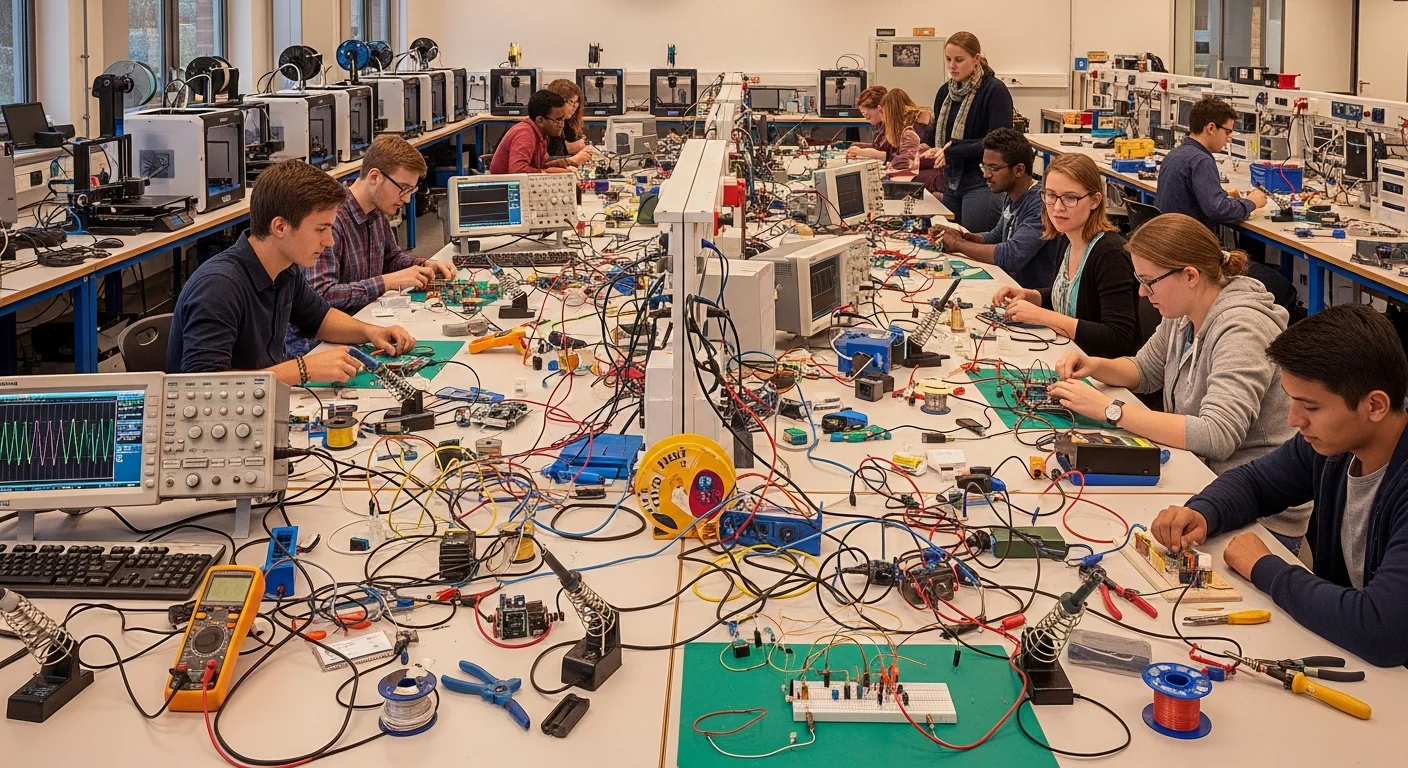
Embedded Systems & IoT
Programmes in Germany
Germany pioneered Industry 4.0 — the fusion of embedded systems, IoT, and smart manufacturing. Study at the birthplace of intelligent industrial systems with direct industry connections.
Programmes
Tuition at Public Universities
Pioneer
Manufacturing Hub
Showing 49–72 of 311 programmes
Biomedical Engineering, B.Eng.
Technische Hochschule Ingolstadt · Ingolstadt
Biomedical Engineering, M.Sc.
Hochschule Furtwangen - Informatik, Technik, Wirtschaft, Medien, Gesundheit · Villingen-Schwenningen
Biomedical Engineering, M.Sc.
RWTH Aachen · Aachen
Biomedical Engineering: Signal Processing-, Imaging- and Control-Systems M.Sc., M.Sc.
HAW Hamburg · Hamburg
Biomedical Micro Engineering, B.Eng.
Hochschule Kaiserslautern (University of Applied Sciences) · Zweibrücken
Apply by 15 Nov · 60d leftBiomedical Sciences, M.Sc.
Hochschule Albstadt-Sigmaringen · Sigmaringen
Biomedizinisches Management und Marketing, M.Sc.
Hochschule Hamm-Lippstadt · Hamm
Biomolecular Engineering - Molekulare Biotechnologie, B.Sc.
Technische Universität Darmstadt · Darmstadt
Biomolecular Engineering - Molekulare Biotechnologie, M.Sc.
Technische Universität Darmstadt · Darmstadt
Biopharmazeutisch-Medizintechnische Wissenschaften, M.Sc.
Hochschule Biberach - Architektur und Bauwesen, Betriebswirtschaft und Biotechnologie · Biberach
Biopharmazeutisch-Medizintechnische Wissenschaften, M.Sc.
Universität Ulm · Ulm
Apply by 15 Nov · 60d leftBioprozessinformatik, B.Sc.
Hochschule für angewandte Wissenschaften Weihenstephan-Triesdorf · Freising
Biosystemtechnik, B.Sc.
Otto-von-Guericke-Universität Magdeburg · Magdeburg
Biosystemtechnik, M.Sc.
Otto-von-Guericke-Universität Magdeburg · Magdeburg
Biotechnik - Lehramt für die beruflichen Fächer der Sekundarstufe II, M.Ed.
Universität Duisburg-Essen · Essen
Biotechnische Chemie, B.Sc.
Technische Universität Ilmenau · Ilmenau
Apply by 15 Nov · 60d leftBiotechnische Chemie, M.Sc.
Technische Universität Ilmenau · Ilmenau
Apply by 15 Nov · 60d leftBiotechnologie (BB), B.Sc.
Technische Hochschule Mannheim · Mannheim
Biotechnologie / Bioingenieurwesen, M.Sc.
Hochschule für angewandte Wissenschaften Weihenstephan-Triesdorf · Freising
Biotechnologie der Marinen Ressourcen, B.Sc.
Hochschule Bremerhaven · Bremerhaven
Apply by 30 Sep · 14d leftBiotechnologie im Praxisverbund, B.Sc.
Hochschule Emden/Leer · Emden
Biotechnologie mit Praxis- oder Auslandssemester, B.Sc.
FH Aachen · Jülich
Biotechnologie mit Praxissemester, M.Sc.
FH Aachen · Jülich
Biotechnologie und Angewandte Ökologie, M.Sc.
Hochschule Zittau/Görlitz · Zittau
Apply by 30 Sep · 14d leftCheck My Fit
3 quick questions — every result gets a fit tag based on your budget and languages. Stored only on this device.
Tags are an indication based on tuition and teaching language — for a real assessment, get a free profile evaluation.
What You'll Study — Core Subjects & Specializations
A Master's in Embedded Systems or IoT in Germany generally blends low-level hardware engineering with modern software and networking. The exact curriculum varies by university, but most programmes build on a shared foundation before branching into specialization tracks. Expect a strong project and lab component — German technical universities are known for hands-on, industry-aligned teaching rather than theory alone.
Common core modules
- · Microcontroller & processor architecture (ARM Cortex, RISC-V)
- · Embedded C/C++ and real-time operating systems
- · Digital design, FPGA and hardware description languages (VHDL/Verilog)
- · Sensors, signal processing and data acquisition
- · Wireless & IoT communication protocols (BLE, LoRaWAN, MQTT)
- · Computer networks and cyber-physical systems
Typical specialization tracks
- · Automotive & functional-safety software
- · Industrial IoT and Industry 4.0 automation
- · Edge computing and TinyML (machine learning on devices)
- · Embedded security and trusted hardware
- · Robotics, control systems and mechatronics
- · Wireless & 5G communication systems
Most programmes close with a six-month Master's thesis, frequently carried out in partnership with a company or a research institute. Not sure which track fits your background? A free profile evaluation can map your degree and interests to suitable programmes.
Entry Requirements for International Students
Admission criteria differ between universities, so always confirm the details on each programme's official page. That said, the requirements for embedded systems and IoT Master's programmes generally follow a familiar pattern.
Academic background
A relevant Bachelor's degree — typically Electrical Engineering, Electronics, Computer Engineering, Computer Science, or Mechatronics — with solid coursework in programming (C/C++) and digital electronics. Competitive applicants generally have a good academic record; many programmes look for a German grade equivalent of around 2.5 or better, though thresholds vary.
Language requirements
Many relevant Master's programmes are taught in English and ask for proof such as IELTS or TOEFL (a common benchmark is around IELTS 6.5). German-taught programmes typically require a recognised certificate such as TestDaF or DSH. Even on an English track, basic German helps with daily life and part-time work.
APS certificate, uni-assist & GRE
Applicants from India, China and Vietnam generally need an APS certificate verifying their academic documents before applying or before the student visa. Many universities process applications through uni-assist, which checks foreign qualifications for a fee. The GRE is usually not required for German engineering Master's programmes, though a few may request it — check each programme.
Careers & Salaries in Germany
Embedded systems sit at the heart of Germany's largest industries — automotive, industrial automation, medical technology and telecommunications. Employers such as Bosch, Siemens, Infineon, Continental and ZF, alongside the Fraunhofer research institutes and a growing IoT startup scene, hire embedded and IoT engineers regularly.
Typical roles
- · Embedded software / firmware engineer
- · IoT solutions engineer
- · Hardware / FPGA design engineer
- · Automotive ECU or ADAS developer
- · Control systems / automation engineer
- · Embedded security engineer
Approximate salary ranges
Figures vary by city, employer and experience, but as a rough guide entry-level embedded roles typically pay around €50,000–€60,000 per year. With a few years of experience, salaries commonly rise to roughly €65,000–€80,000+. Treat these as indicative ranges rather than guarantees.
After graduating, international students can generally apply for an 18-month post-study residence permit to look for a job related to their qualification in Germany. Once employed, graduates may move on to a longer-term work permit or EU Blue Card. Explore live openings and programmes through our programme finder, or start with a quick check on GradGermany.
Frequently Asked Questions About Embedded Systems & IoT in Germany
Germany coined Industry 4.0 and leads the world in smart manufacturing. Automotive giants such as BMW, Mercedes-Benz, and Volkswagen depend on embedded systems for autonomous driving, ADAS, and electric vehicle platforms. Industrial leaders like Siemens, Bosch, and Infineon hire thousands of embedded engineers each year. The Fraunhofer Institutes — Europe's largest applied-research organization — run dedicated IoT labs where Master's students collaborate on real industry projects. Public universities charge €0 tuition, so you only cover the semester fee of roughly €150–€350. International students must open a blocked account with €11,904 to obtain a visa. With starting salaries of €50,000–€60,000 and an 18-month post-study work visa, Germany offers an unmatched return on investment for embedded systems graduates.
Programmes cover a comprehensive range of embedded and IoT disciplines. Core modules include Microcontroller Programming (ARM Cortex, RISC-V), Real-Time Operating Systems (FreeRTOS, Zephyr), Sensor Networks, Wireless Communication (BLE, LoRaWAN, 5G NR), FPGA Design using VHDL and Verilog, Cyber-Physical Systems, Edge Computing, and Industrial IoT protocols such as OPC UA and MQTT. Advanced electives may include automotive embedded software (AUTOSAR), functional safety (ISO 26262), and machine learning on embedded hardware. Most Master's programmes at universities like TU Munich, TU Dresden, and RWTH Aachen integrate hands-on lab work using industry-standard development boards from Infineon, STMicroelectronics, and Texas Instruments, ensuring graduates are job-ready from day one.
Yes. Several leading technical universities offer English-taught Master's programmes in Embedded Systems, Cyber-Physical Systems, and related fields. TU Munich offers an M.Sc. in Electrical and Computer Engineering with embedded systems specializations. TU Chemnitz offers an M.Sc. in Embedded Systems, and University of Freiburg runs an English-taught M.Sc. in Embedded Systems Engineering. RWTH Aachen and TU Darmstadt also offer relevant English-medium Master's tracks. These programmes are designed for international students with a Bachelor's in a related field and typically require IELTS 6.5 or TOEFL 90+. Many include collaborative industry projects with partners such as Bosch, Continental, and Siemens, giving students practical experience alongside academic learning and strong professional networks before graduation.
Germany's industrial landscape creates diverse opportunities for embedded systems engineers. The automotive sector (BMW, Mercedes-Benz, Continental, ZF) hires for ECU development, ADAS, and electric vehicle control systems. Industrial manufacturing (Siemens, KUKA, Festo) needs engineers for PLC programming, robotics, and factory automation. The medical devices sector (Siemens Healthineers, Dräger, B. Braun) develops embedded firmware for imaging systems and patient monitors. Aerospace firms like Airbus and MTU Aero Engines require safety-critical embedded software engineers. Telecommunications companies and smart home technology startups round out the market. Starting salaries typically range from €50,000–€60,000, rising to €75,000+ with 3–5 years of experience. Germany's 18-month post-study work visa allows graduates to secure employment after completing their degree.
A Bachelor's degree in Electrical Engineering, Computer Engineering, Computer Science, or Mechatronics is typically required, with a minimum GPA equivalent to a German grade of 2.5 or better. Strong skills in C/C++ programming, digital electronics, and microprocessor architecture are essential. Some programmes also expect foundational knowledge of signal processing and control systems. Language requirements for English-taught programmes are usually IELTS 6.5 or TOEFL 90. Indian applicants must obtain an APS certificate (Akademische Prüfungsstelle) from the German Embassy before applying. Most winter semester programmes have application deadlines between March 15 and July 15. Submit your application through uni-assist or the university's own portal. A strong statement of purpose highlighting embedded systems project experience significantly improves your admission chances at competitive universities like TU Munich and RWTH Aachen.
Direct collaboration with industry sets German embedded systems programmes apart from universities anywhere else. Many programmes include lab projects using Bosch, Infineon, or Siemens hardware, giving students hands-on experience with production-grade components. Fraunhofer Institutes — such as Fraunhofer IIS (integrated circuits) and Fraunhofer AISEC (cybersecurity) — offer applied research positions where Master's students work on real products. Germany's dual education philosophy means thesis projects are often conducted at companies like Continental, ZF, or Harman, frequently leading to job offers. Universities such as TU Dresden host the Centre for Advancing Electronics Dresden (cfaed), a world-leading semiconductor research cluster. With €0 tuition at public universities and access to Europe's largest manufacturing ecosystem, German embedded systems education delivers a unique combination of academic rigour, industrial relevance, and affordability.
Explore More Programmes in Germany
Build the Future with
Embedded Systems
Get a free profile evaluation from our experts. We'll assess your academic background, recommend the best Embedded Systems and IoT programmes, and guide you through the entire application process.