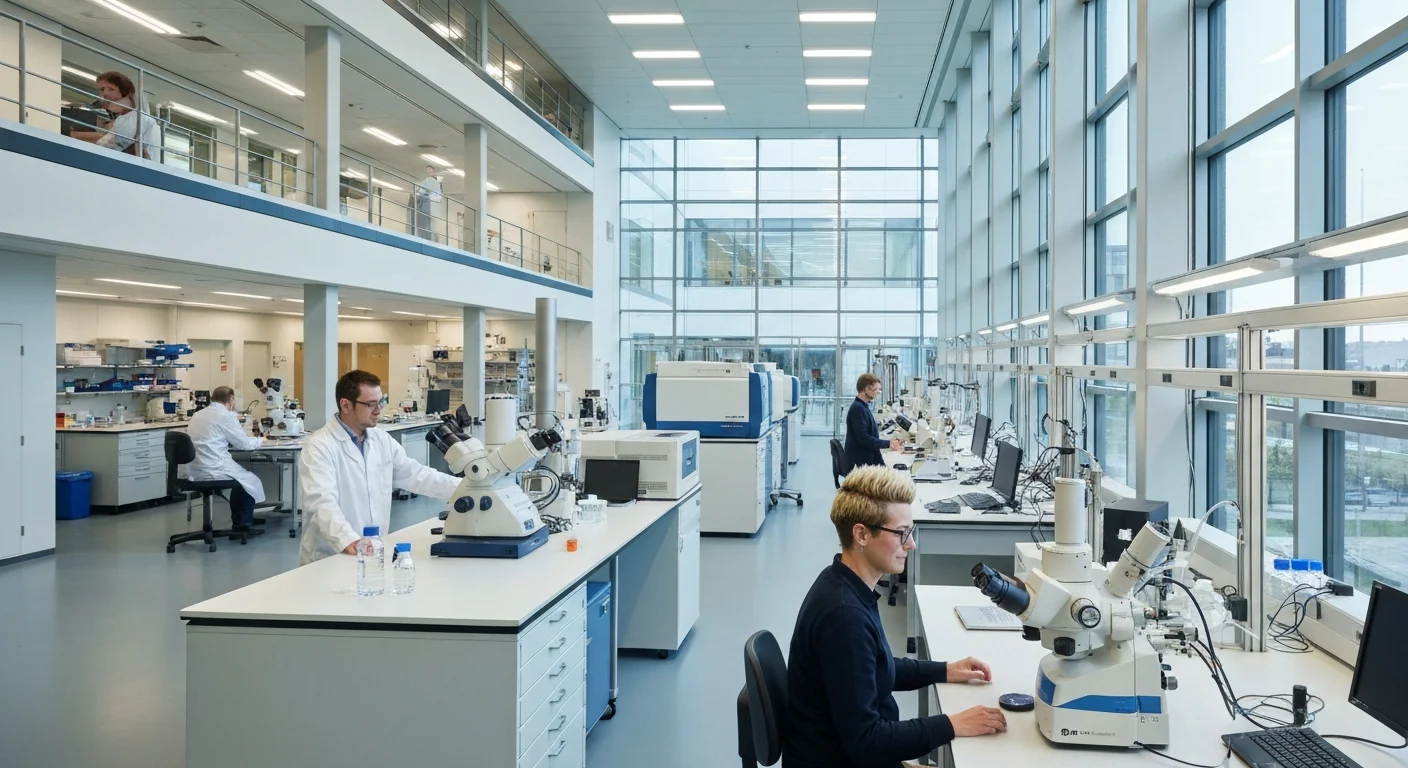
Materials Science in Germany
Germany leads in materials research — lightweight composites, nanomaterials, advanced ceramics. Home to Max Planck Institutes, Fraunhofer, and Helmholtz research centres. Zero tuition, 18-month work visa.
Leading Universities in Germany
World-class education with strong industry ties and international recognition.
Technische Hochschule Deggendorf
Deggendorf, Bayern
Applied materials science with strong industry focus.
RWTH Aachen
Aachen, Nordrhein-Westfalen
Leading metals & materials research cluster.
Technische Universität München
München, Bayern
Advanced materials, nanotechnology labs.
Friedrich-Alexander-Universität Erlangen-Nürnberg
Erlangen, Bayern
Strong materials engineering and polymer science.
Technische Universität Darmstadt
Darmstadt, Hessen
Materials characterisation & testing excellence.
Universität Stuttgart
Stuttgart, Baden-Württemberg
Composites and lightweight engineering research.
Showing 1–24 of 81 programmes
Additive Fertigung - Werkstoffe, Entwicklung und Leichtbau., B.Eng.
Hochschule Landshut - Hochschule für angewandte Wissenschaften · Landshut
Angewandte Materialwissenschaften, B.Eng.
Technische Hochschule Georg Agricola · Bochum
Angewandte Materialwissenschaften, B.Eng.
Technische Hochschule Nürnberg Georg Simon Ohm · Nürnberg
Angewandte Materialwissenschaften, B.Sc.
Hochschule Furtwangen - Informatik, Technik, Wirtschaft, Medien, Gesundheit · Tuttlingen
Angewandte Physik, alt: Physikalische Technik (bis 24.09.2018), B.Sc.
Hochschule RheinMain, RheinMain University of Applied Sciences Wiesbaden, Rüsselsheim · Rüsselsheim
Bauingenieurwesen, B.Sc.
Bauhaus-Universität Weimar · Weimar
Bio-Materials Engineering, B.Sc.
Technische Universität Darmstadt · Darmstadt
EEIGM: École Européenne d'Ingénieurs en Génie des Matériaux, B.A.
Universität des Saarlandes · Saarbrücken
Apply by 15 JanEnergie und Materialphysik, B.Sc.
Technische Universität Clausthal · Clausthal-Zellerfeld
Apply by 15 JanFunktionswerkstoffe, B.Sc.
Julius-Maximilians-Universität Würzburg · Würzburg
Apply by 15 JanGeneral Engineering Science, B.Sc.
Technische Universität Hamburg · Hamburg
General Engineering, B.Sc.
Technische Hochschule Ostwestfalen-Lippe · Lemgo
Holz und Holzwerkstofftechnik, B.Eng.
Duale Hochschule Sachsen · Dresden
Ingenieur- und Werkstoffwissenschaften, B.Sc.
Technische Universität München · Garching
Ingenieurwesen und Management in ausgewählten Branchen, B.Eng.
Berufsakademie Melle e. V. · Melle
Ingenieurwissenschaften (Elektrotechnik, Maschinenbau, Umwelttechnik, Werkstofftechnik, Wirtschaftsingenieurwesen), B.Eng.
Hochschule für Angewandte Wissenschaften Hof · Hof
Apply by 30 Nov · 40d leftIngenieurwissenschaften, B.Eng.
Technische Hochschule Ingolstadt · Ingolstadt
Innovative Textilien, B.Eng.
Hochschule für Angewandte Wissenschaften Hof · Hof, Münchberg
Apply by 30 Nov · 40d leftKeramik (Werkstofftechnik), Materialwissenschaften, B.Sc.
Technische Universität Darmstadt · Darmstadt
Konservierung und Restaurierung von Kunstwerken auf Papier, Archiv- und Bibliotheksgut, B.A.
Staatliche Akademie der Bildenden Künste Stuttgart · Stuttgart
Konservierung und Restaurierung, B.Sc.
HAWK Hochschule für angewandte Wissenschaft und Kunst, Hildesheim/Holzminden/Göttingen · Hildesheim
Kunststofftechnik, B.Eng.
Fachhochschule Südwestfalen · Iserlohn
Lightweight Engineering & Composites (vorher: Verbundwerkstoffe / Composites), B.Eng.
PFH - Private Hochschule Göttingen · Stade
Lightweight Engineering & Composites, B.Eng.
PFH - Private Hochschule Göttingen · Stade
Check My Fit
3 quick questions — every result gets a fit tag based on your budget and languages. Stored only on this device.
Tags are an indication based on tuition and teaching language — for a real assessment, get a free profile evaluation.
What You'll Study & Specialisations
Materials Science & Engineering in Germany sits at the intersection of physics, chemistry and engineering. Bachelor's programmes usually build a broad foundation, while Master's programmes — the level most international students enter — let you specialise around the structure, properties, processing and performance of materials.
Core foundations
- · Thermodynamics & phase transformations
- · Crystallography and the structure of solids
- · Mechanical behaviour & materials characterisation
- · Materials processing and manufacturing
- · Computational materials science & simulation
Common specialisation tracks
- · Nanomaterials & nanotechnology
- · Metals, alloys & metallurgy
- · Polymers & composites
- · Ceramics & functional materials
- · Semiconductor & electronic materials
- · Biomaterials & energy materials (batteries, hydrogen, photovoltaics)
Specialisation names vary by university, so check each programme's module catalogue before applying. Not sure which track fits your background? A free profile evaluation can help you shortlist programmes that match your degree.
Entry Requirements
Exact requirements are set by each university, but Materials Science applicants generally need to cover the following. Always confirm the details on the official programme page before you apply.
Academic background
For a Master's, you typically need a recognised Bachelor's degree in materials science, engineering, physics, chemistry or a closely related field, with a strong grade average. Many programmes review your transcript for prerequisite coursework in maths, thermodynamics and materials fundamentals.
Language: English-taught vs German-taught
Many Master's programmes are taught in English and generally ask for IELTS (often around 6.5) or an equivalent TOEFL score. German-taught programmes usually require proof such as TestDaF or DSH. Even on an English-taught course, some everyday German helps with daily life and finding part-time or working-student roles.
APS certificate & uni-assist
Applicants from India, China and Vietnam generally need an APS certificate verifying their academic documents before applying for admission and a visa. Many universities also process international applications through uni-assist, which checks and forwards your documents. GRE is usually not required for materials science programmes in Germany, though a few may request it — check each listing.
Requirements and processes change over time. Browse current Materials Science programmes or start from the GradGermany homepage to plan your application.
Careers & Salaries
Materials science graduates are in demand across Germany's industrial base — automotive, aerospace, semiconductors, energy, chemicals and medical technology — as well as in research institutes such as Max Planck, Fraunhofer and Helmholtz. The figures below are approximate ranges and vary widely by role, employer, region and experience.
Typical roles
- · Materials / R&D engineer
- · Process & quality engineer
- · Characterisation / lab specialist
- · Simulation & computational scientist
- · Doctoral researcher
Approximate salary ranges
Entry-level roles typically pay around €45,000–€58,000 per year. With a few years of experience, salaries generally rise to roughly €60,000–€75,000+, with senior and specialised positions higher still. These are indicative gross figures.
Staying to work
After graduating, international students can generally apply for an 18-month post-study residence permit to look for a job related to their degree. Once employed, you may be able to move on to a work permit or EU Blue Card, depending on your role and salary.
Frequently Asked Questions About Materials Science in Germany
Germany is a global powerhouse in materials research and engineering. The country hosts over 50 dedicated research institutes focused on materials — including Max Planck Institutes for Polymer Research (Mainz), Iron Research (Düsseldorf), and Intelligent Systems (Stuttgart), alongside Fraunhofer institutes for applied materials research and Helmholtz centres for energy materials. German industry depends heavily on advanced materials for its automotive, aerospace, chemical, and electronics sectors, making materials scientists highly sought-after graduates. Universities such as RWTH Aachen, TU Munich, and FAU Erlangen-Nürnberg are globally ranked for materials science research in nanotechnology, composites, ceramics, and semiconductor materials. With zero tuition fees at public universities, an 18-month post-study work visa, and starting salaries of €48,000–€54,000, Germany offers an exceptional return on investment for materials science graduates.
Yes. The vast majority of public universities charge no tuition fees for Materials Science programmes, even for international students. Students pay only a nominal semester contribution of approximately €150–€350, which typically includes a public transport pass valid across the state. This applies at top institutions such as RWTH Aachen, TU Munich, FAU Erlangen-Nürnberg, University of Stuttgart, and TU Darmstadt. The sole exception is Baden-Württemberg, where non-EU students pay €1,500 per semester — still far below comparable programmes in the US ($30,000–$60,000 per year) or UK (£20,000+). For your student visa, you will need to open a blocked account with €11,904 to cover annual living expenses. This makes world-class materials science education dramatically more affordable than comparable programmes globally.
Yes, several German universities offer Materials Science Master's programmes taught entirely in English. Specialisations available in English include Advanced Materials, Nanotechnology, Polymer Science, Materials Engineering, and Computational Materials Science at institutions such as RWTH Aachen, TU Darmstadt, and FAU Erlangen-Nürnberg. Bachelor's programmes in English are less common but available at select institutions. English proficiency requirements typically include IELTS 6.5+ or TOEFL 90+. Application deadlines generally fall in July for the winter semester and January for the summer intake. Indian applicants should prepare their APS certificate early, as processing takes several weeks. Learning German alongside your studies can further boost career prospects, especially when working at German industrial employers like BASF, thyssenkrupp, or Schott.
Germany offers unparalleled research infrastructure for materials science. Students can work at Max Planck Institutes (fundamental research in polymers, metals, ceramics, and nanomaterials, with HiWi positions paying €12–€15 per hour), Fraunhofer Institutes (applied research in surface engineering, structural durability, and manufacturing), and Helmholtz Centres (energy materials and large-scale research facilities including the DESY synchrotron in Hamburg). Many Master's programmes integrate thesis work at these institutes, giving students direct access to cutting-edge labs, electron microscopes, synchrotron beamlines, and computational modelling clusters. Additional funding for research is available through DAAD scholarships and the DFG (German Research Foundation). This research infrastructure is a key reason Germany produces more materials science publications per capita than almost any other nation.
Career prospects are excellent. Materials Science graduates are in high demand across Germany's automotive, aerospace, semiconductor, chemical, and energy industries. Starting salaries average €48,000–€54,000 per year, with experienced professionals in R&D, quality engineering, or product development earning €65,000–€90,000 annually. Top employers include BASF (advanced polymers), thyssenkrupp (steel and alloys), Schott AG (specialty glass), Heraeus (precious metals technology), and Infineon (semiconductor materials). Many graduates also pursue doctoral research positions at Max Planck or Fraunhofer institutes, which pay €45,000–€55,000 during the PhD. Germany's 18-month post-study job seeker visa provides ample time to secure employment and transition to an EU Blue Card, with a clear pathway to permanent residency after 21–33 months.
Admission typically requires a Bachelor's degree in Materials Science, Materials Engineering, Physics, Chemistry, Mechanical Engineering, or a closely related discipline with a minimum GPA equivalent to the German grade of 2.5 or better. English proficiency must be at B2/C1 level (IELTS 6.5+ or TOEFL 90+), and strong academic transcripts are expected, particularly in mathematics, physics, and chemistry. GRE scores are generally not required by German universities, removing a significant barrier compared to US admissions. Application deadlines are typically July 15 for the winter semester and January 15 for the summer intake. Most international applicants apply through the uni-assist portal (€75 fee). Indian students must also obtain an APS certificate and open a blocked account with €11,904 for the student visa process.
The leading institutions include RWTH Aachen (renowned for metals, ceramics, and steel research with close ties to thyssenkrupp), TU Munich (strong in functional materials, nanotechnology, and the Munich Institute of Robotics and Machine Intelligence), FAU Erlangen-Nürnberg (leading in advanced ceramics, glass science, and polymer engineering), University of Stuttgart (known for composite materials and aerospace materials with adjacent DLR facilities), and TU Darmstadt (excellent in computational materials science and electronic materials). All belong to the prestigious TU9 alliance or are Excellence Strategy universities. They maintain close partnerships with Max Planck Institutes, Fraunhofer Institutes, and major industrial employers like BASF, Heraeus, and Infineon, offering students direct access to cutting-edge electron microscopy labs, synchrotron beamlines, and industrial pilot plants.
Explore More Programmes in Germany
Ready to Study Materials Science
in Germany?
Get a free profile evaluation from our experts. We will assess your academic background, recommend the best Materials Science programmes for your profile, and guide you through the entire application process.