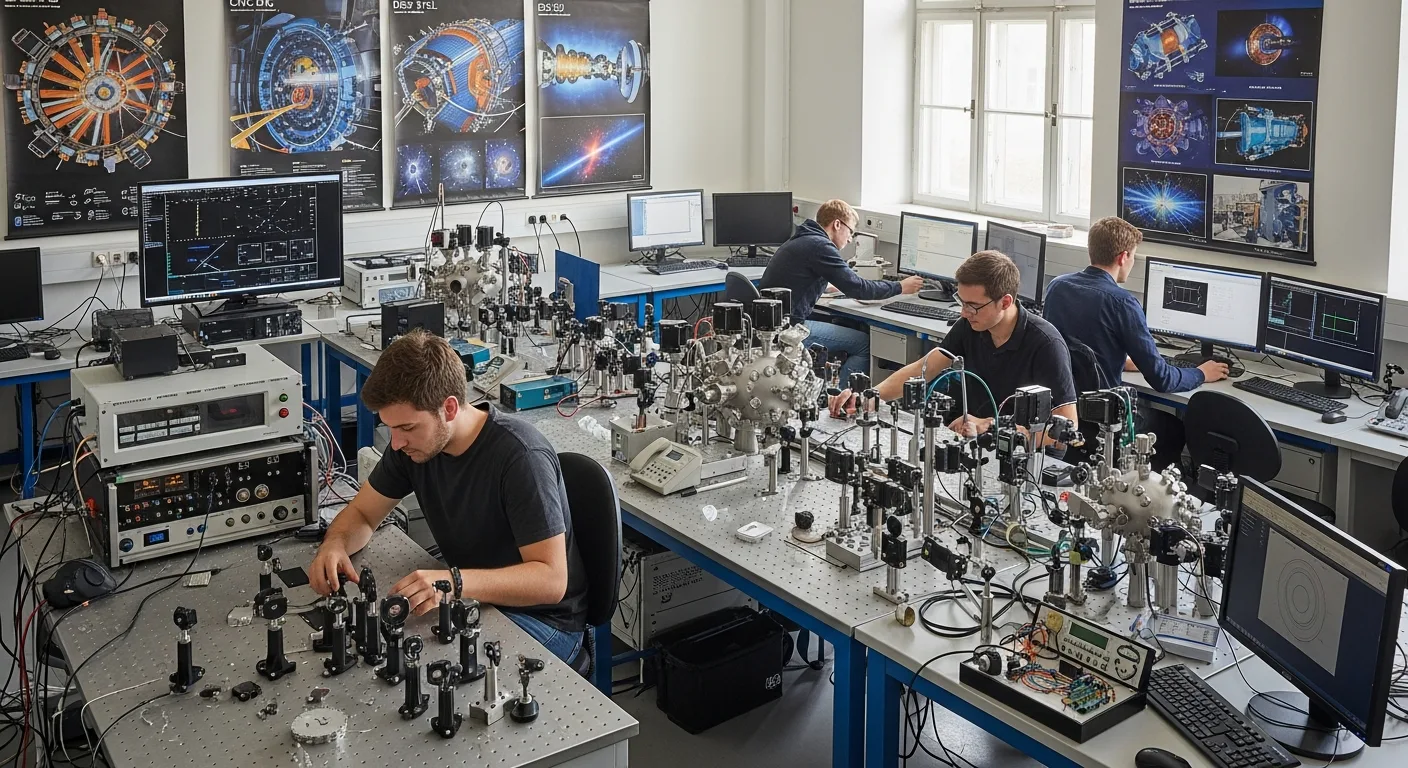
Physics
Programmes in Germany
Germany is the birthplace of modern physics — home to Einstein, Planck, and Heisenberg. Study at tuition-free public universities with access to world-leading research at Max Planck Institutes, DESY, and CERN collaborations. From theoretical physics to quantum computing, launch your career in the heart of European science.
Physics Programmes
Tuition at Public Universities
Max Planck Institutes
Nobel Laureates in Physics
Showing 145–168 of 543 programmes
Mechanics, M.Sc.
Technische Universität Darmstadt · Darmstadt
Mechanik, M.Sc.
Technische Universität Darmstadt · Darmstadt
Mechatronik, B.Sc.
Karlshochschule International University · Chemnitz
Apply by 15 Nov · 60d leftMedical Photonics, M.Sc.
Friedrich-Schiller-Universität Jena · Jena
Medical Physics and Physics of Living Systems, M.Sc.
Technische Universität Dortmund · Dortmund
Medizinische Physik und Strahlenschutz, B.Sc.
Technische Hochschule Mittelhessen - THM · Gießen, Friedberg
Medizinische Physik, B.Sc.
Martin-Luther-Universität Halle-Wittenberg · Halle
Medizinische Physik, B.Sc.
Heinrich-Heine-Universität Düsseldorf · Düsseldorf
Medizinische Physik, M.Sc.
Technische Hochschule Mittelhessen - THM · Gießen
Medizinische Physik, M.Sc.
Heinrich-Heine-Universität Düsseldorf · Düsseldorf
Medizinische Physik, M.Sc.
Hochschule für Technik und Wirtschaft des Saarlandes · Saarbrücken
Medizinische Physik, M.Sc.
Rheinland-Pfälzische Technische Universität Kaiserslautern-Landau · Kaiserslautern
Medizinische Physik, M.Sc.
Martin-Luther-Universität Halle-Wittenberg · Halle
Apply by 15 DecMedizinphysik, B.A.
Universität Bielefeld · Bielefeld
Apply by 15 Nov · 60d leftMedizinphysik, M.Sc.
Technische Universität Dortmund · Dortmund
Medizinphysik: Bildgebung und Therapie, M.Sc.
Universität Greifswald · Greifswald
Meteorologie und Geophysik, B.Sc.
Rheinische Friedrich-Wilhelms-Universität Bonn · Bonn
Meteorologie und Klimaphysik, B.Sc.
Karlsruher Institut für Technologie · Karlsruhe
Meteorologie, B.Sc.
Johannes Gutenberg-Universität Mainz · Mainz
Meteorologie, B.Sc.
Gottfried Wilhelm Leibniz Universität Hannover · Hannover
Meteorologie, M.Sc.
Gottfried Wilhelm Leibniz Universität Hannover · Hannover
Meteorology and Climate Physics, M.Sc.
Karlsruher Institut für Technologie · Karlsruhe
Micro- and Nanoelectronics, M.A.
Brandenburgische Technische Universität Cottbus-Senftenberg · Cottbus
Micro- and Nanoengineering, B.Eng.
Hochschule Kaiserslautern (University of Applied Sciences) · Zweibrücken
Apply by 15 Nov · 60d leftCheck My Fit
3 quick questions — every result gets a fit tag based on your budget and languages. Stored only on this device.
Tags are an indication based on tuition and teaching language — for a real assessment, get a free profile evaluation.
What You'll Study — Physics Specializations in Germany
A German physics master's typically blends a rigorous theoretical core with advanced laboratory and computational work, then lets you specialise through elective modules and a research-heavy thesis. The first year generally deepens the fundamentals; the second is usually dominated by your specialisation and a master's thesis carried out inside a research group. Most master's programmes run for around two years (120 ECTS credits).
Core foundations
Advanced quantum mechanics, statistical physics, classical and quantum field theory, electrodynamics, and mathematical methods — the backbone shared across nearly every German physics master's.
Theoretical & particle physics
High-energy and particle physics, cosmology, and string theory, often linked to research at CERN collaborations and DESY in Hamburg.
Quantum technologies
Quantum optics, quantum information and computing, and photonics — a fast-growing track backed by significant German and EU investment.
Condensed matter & materials
Solid-state physics, nanoscience, semiconductors, and soft matter — closely tied to Germany's strong materials-science and industry base.
Astrophysics & astronomy
Observational and theoretical astrophysics, gravitational-wave science, and cosmology, with ties to Max Planck Institutes for Astrophysics and related research centres.
Biophysics & medical physics
Imaging, radiation physics, and the physics of living systems — an interdisciplinary route that bridges into healthcare and the life sciences.
Not sure which track fits your background? A free profile evaluation matches your transcript and research interests to suitable programmes before you commit to an application.
Entry Requirements for Physics Master's in Germany
Admission is decided programme by programme, but most physics master's at German universities look for a similar profile. Always confirm the exact criteria on the official programme page before you apply.
Academic background
A recognised bachelor's degree in physics (or a closely related field such as engineering physics or applied mathematics) with a strong grounding in quantum mechanics, theoretical physics, and lab work. Competitive programmes generally expect good grades, and admissions teams pay close attention to the physics and maths modules on your transcript.
Language requirements
Many physics master's are taught in English, typically asking for IELTS around 6.5 or an equivalent TOEFL score. German-taught programmes generally require proof such as TestDaF or DSH. Even on an English track, learning some German helps with daily life and part-time work.
APS certificate & document checks
Applicants who studied in India, China, or Vietnam usually need an APS certificate verifying their academic documents before applying or before the student visa. It is worth starting this early, as processing takes time. Many universities also receive applications through uni-assist for document evaluation.
GRE & standardised tests
Unlike many US graduate schools, German physics programmes generally do not require the GRE. A strong transcript, a motivation letter, and relevant project or research experience usually carry far more weight.
Careers & Salaries for Physics Graduates in Germany
A physics degree is highly transferable, and Germany's research institutes and technology-driven industry give graduates a wide range of options — from academia and R&D to data science, finance, and engineering. The figures below are approximate, gross annual ranges; actual pay varies by role, sector, employer, city, and experience.
R&D & industry physicist
Roles in semiconductors, optics, photonics, and instrumentation. Entry-level salaries typically fall around €48,000–60,000, rising with experience.
Data scientist & ML engineer
Physics graduates are valued for their modelling and analytics skills. Entry-level pay often sits around €50,000–65,000, with strong upward potential.
Quantitative & finance roles
Quant analyst and risk-modelling positions in banking and insurance. Compensation varies widely but tends to be at the higher end of the graduate range.
Academic & research scientist
PhD positions at universities, Max Planck Institutes, Helmholtz, and Fraunhofer centres are commonly salaried research roles rather than unpaid study.
Medical & radiation physics
Clinical and imaging physics roles in hospitals and medtech, often requiring additional certification, with solid and stable demand.
Engineering & consulting
Simulation, energy, and technical-consulting roles where physics-trained problem-solving transfers directly into industry projects.
Staying in Germany after graduation
International graduates of a German university can generally apply for an 18-month residence permit to look for a job related to their qualification. Once you find a suitable role, you can usually switch to a work residence permit or an EU Blue Card, which can also open a path toward longer-term residence. Germany's ongoing shortage of skilled STEM workers makes physics graduates well positioned in the job market. See more on studying in Germany with GradGermany.
Frequently Asked Questions About Physics in Germany
Yes. Public universities in Germany charge no tuition fees for physics programmes at both Bachelor's and Master's level, regardless of your nationality. Students pay only a small semester contribution of €150–€350, which typically includes a public transport pass covering the entire university region. The sole exception is Baden-Württemberg, where non-EU students pay €1,500 per semester. Monthly living costs average €934 according to the DAAD, making a two-year physics Master's achievable for under €25,000 in total. This is dramatically cheaper than comparable programmes in the US, UK, or Australia, where tuition alone can exceed $50,000. Indian students must open a blocked account (Sperrkonto) of €11,904 for the student visa. Many physics students also earn €12–€15 per hour as research assistants (HiWi positions) at their department or affiliated Max Planck Institute, helping offset living expenses while gaining invaluable laboratory experience.
Germany boasts several world-class physics departments. LMU Munich and TU Munich consistently rank among the global top 50, with strengths in quantum physics, particle physics, and condensed matter. Heidelberg University, Germany's oldest, excels in astrophysics and theoretical physics through its connections to the Max Planck Institute for Astronomy and the European Southern Observatory. RWTH Aachen offers outstanding experimental physics with direct links to CERN and Jülich Research Centre. Humboldt University Berlin, where Einstein once taught, maintains excellence in mathematical physics and quantum optics. University of Göttingen carries the legacy of Born, Heisenberg, and Planck with strong programmes in biophysics and condensed matter. Karlsruhe Institute of Technology (KIT) is a leader in photonics and optics research. The Excellence Strategy funding programme ensures that these universities receive substantial federal investment for cutting-edge laboratories and international research collaborations.
Yes. A growing number of German universities offer physics programmes taught entirely in English, particularly at the Master's level. LMU Munich, TU Munich, Heidelberg University, University of Bonn, University of Göttingen, and RWTH Aachen all offer English-language Master's tracks in physics or specialised areas like astrophysics, quantum science, and photonics. Admission typically requires an IELTS score of 6.5+ or TOEFL 90+, along with a Bachelor's degree in physics or a closely related field. At the Bachelor's level, most physics programmes are taught in German, though a few international programmes exist. While German language skills are not required for English-taught programmes, learning German to A2 or B1 level significantly improves daily life and broadens your career options after graduation. Many physics departments conduct research seminars in English, and international research groups at Max Planck Institutes operate almost exclusively in English, making the transition seamless for international students.
Admission to physics programmes in Germany requires a strong academic background in mathematics and physics. For Master's programmes, you need a Bachelor's degree in physics or a closely related subject (e.g., mathematics, engineering physics) with a minimum GPA equivalent to the German grade of 2.5 or better (approximately 65–70% in the Indian system). Most universities require transcripts demonstrating coursework in classical mechanics, electrodynamics, quantum mechanics, thermodynamics, and mathematical methods. English-taught programmes require IELTS 6.5+ or TOEFL 90+. Some competitive programmes at LMU Munich or Heidelberg may require GRE Physics subject test scores, though this is not universal. Indian students must have their credentials evaluated through uni-assist, the centralised application portal. Letters of recommendation, a statement of purpose outlining your research interests, and evidence of laboratory or research experience strengthen your application. Application deadlines are typically January 15 for the summer semester and July 15 for the winter semester, though exact dates vary by university.
Physics graduates in Germany enjoy exceptional career prospects across both academia and industry. In research, Germany offers positions at over 80 Max Planck Institutes, Helmholtz Centres, DESY, and the European XFEL facility, with PhD stipends of €2,000–€2,500 per month. In industry, physicists are highly sought after by technology companies, automotive manufacturers (BMW, Mercedes-Benz, Bosch), semiconductor firms (Infineon, Zeiss, TRUMPF), financial institutions, and management consultancies. Entry-level salaries for physicists in Germany range from €50,000 to €65,000, with experienced professionals commanding €80,000–€100,000+. Germany's 18-month post-study work visa gives graduates ample time to find employment, and the EU Blue Card provides a fast track to permanent residency. The country's central European location also opens doors to physics careers at CERN in Geneva, ESA in the Netherlands, and leading research labs across the EU. Physicists with computational skills are also in high demand in data science, quantitative finance, and AI roles.
Germany offers unparalleled research infrastructure for physics students. The Max Planck Society operates dedicated physics institutes in quantum optics (Garching), gravitational physics (Potsdam), nuclear physics (Heidelberg), plasma physics (Greifswald), and solid-state research (Stuttgart), among others. The Helmholtz Association runs major facilities including DESY (particle physics and photon science in Hamburg), the Karlsruhe Tritium Neutrino Experiment (KATRIN), and GSI Helmholtz Centre for Heavy Ion Research in Darmstadt. Germany is a key contributor to CERN, and students at universities like RWTH Aachen, Heidelberg, and LMU Munich regularly join ATLAS and CMS experiments. The European XFEL in Hamburg provides the world's brightest X-ray laser for materials and molecular research. Students access these facilities through thesis projects, HiWi research assistant positions, and collaborative seminars. Many Master's programmes include a full semester of research work, and international graduate schools like the Munich Physics School and Heidelberg Graduate School provide structured PhD pathways with generous funding.
Explore More Programmes in Germany
Start Your Physics Career
in Germany
Get a free profile evaluation from our experts. We'll assess your academic background, recommend the best Physics programmes, and guide you through the entire application process.