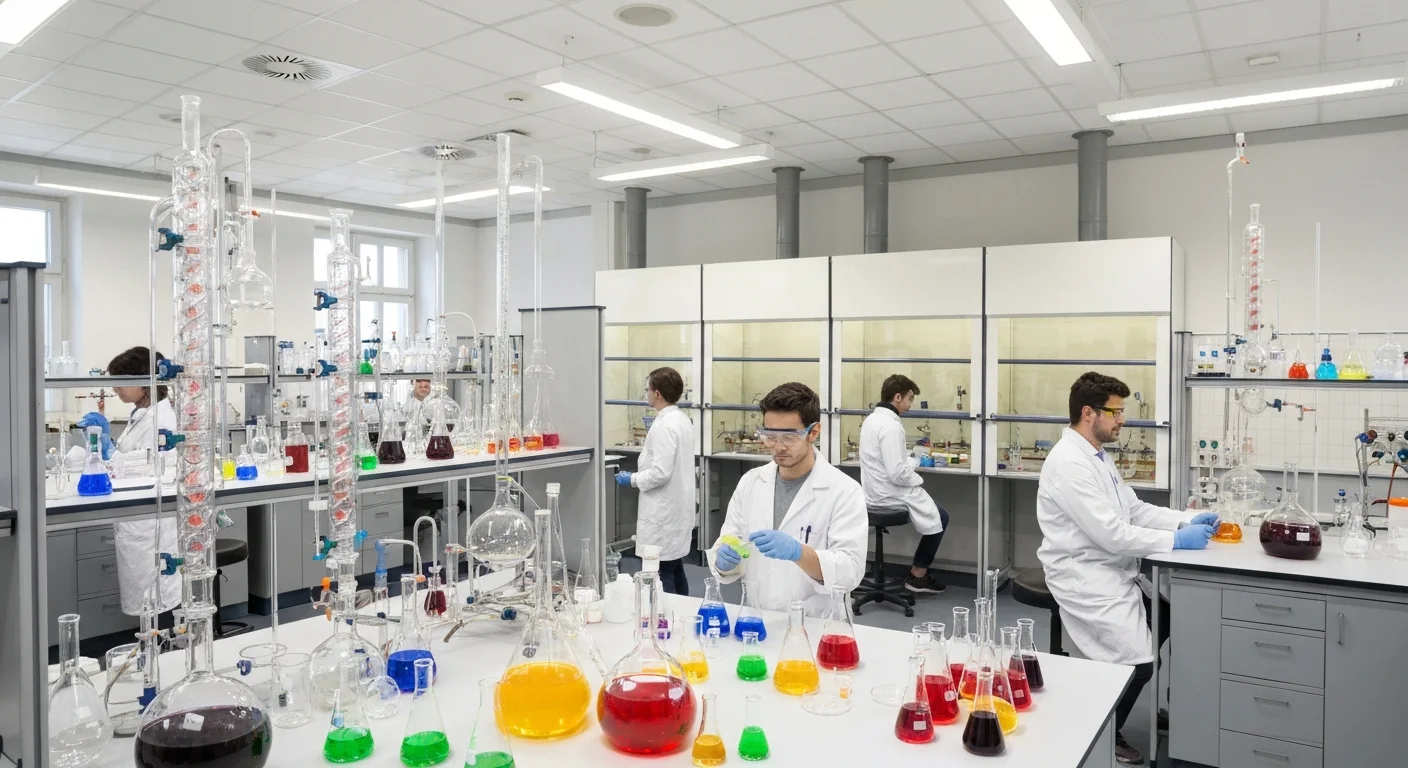
Process & Chemical Engineering in Germany
Germany is Europe's largest chemical producer and home to BASF (world's largest chemical company), Bayer, Evonik, Covestro. Study process engineering with zero tuition and access to world-leading chemical industry clusters.
Leading Universities in Germany
World-class education with strong industry ties and international recognition.
Technische Hochschule Deggendorf
Deggendorf, Bayern
Applied chemical engineering with industry labs.
RWTH Aachen
Aachen, Nordrhein-Westfalen
AVT institute - leading process engineering research.
Karlsruher Institut für Technologie
Karlsruhe, Baden-Württemberg
Chemical engineering with Karlsruhe research hub.
Technische Universität München
München, Bayern
Catalysis and reaction engineering excellence.
Technische Universität Dortmund
Dortmund, Nordrhein-Westfalen
BCI faculty - top chemical engineering in NRW.
Ruhr-Universität Bochum
Bochum, Nordrhein-Westfalen
Strong industrial chemistry & process engineering.
Showing 121–144 of 1,519 programmes
Bio-, Chemie- und Pharmaingenieurwesen, B.Sc.
Technische Universität Carolo-Wilhelmina zu Braunschweig · Braunschweig
Apply by 30 NovBio-/Pharma- und Prozesstechnik, M.Eng.
Hochschule Trier - Trier University of Applied Sciences · Birkenfeld
Biochemical Engineering 120 CP, M.Eng.
Hochschule Fresenius · Idstein
Biochemical Engineering, 60 CP, M.Sc.
Hochschule Fresenius · Idstein
Bioingenieurwesen, B.Sc.
Technische Universität Dortmund · Dortmund
Biomechanical Engineering, M.Eng.
Otto-von-Guericke-Universität Magdeburg · Magdeburg
Biomechatronik, B.Eng.
Hochschule Reutlingen · Reutlingen
BioMechatronik, M.Sc.
Universität Bielefeld · Bielefeld
Apply by 1 DecBiomedizinische Wissenschaften, B.Sc.
Hochschule Reutlingen · Reutlingen
Biotechnik - Lehramt für die beruflichen Fächer der Sekundarstufe II, M.Ed.
Universität Duisburg-Essen · Essen
Biotechnologie und chemische Verfahrenstechnik, M.Sc.
Universität Bayreuth · Bayreuth
Biotechnologie und Lebensmitteltechnologie, B.Sc.
Hochschule Flensburg · Flensburg
Bioverfahrenstechnik in der Lebensmittelindustrie, B.Sc.
Hochschule Osnabrück · Osnabrück
Bioverfahrenstechnik, B.Eng.
Frankfurt University of Applied Sciences · Frankfurt am Main
Bioverfahrenstechnik, B.Sc.
Technische Universität Hamburg · Hamburg
Bioverfahrenstechnik, M.Sc.
Technische Universität Hamburg · Hamburg
BWL - Spedition, Transport und Logistik, B.A.
Duale Hochschule Baden-Württemberg · Mannheim, Heidenheim +1
Apply by 1 Oct · 15d leftChemical and Bioprocess Engineering, M.Sc.
Technische Universität Hamburg · Hamburg
Chemical and Energy Engineering, M.Sc.
Otto-von-Guericke-Universität Magdeburg · Magdeburg
Chemical Biotechnology, M.Sc.
Technische Universität München · Straubing
Apply by 30 NovChemical Engineering - Nachhaltige Chemische Technologien, M.Sc.
Friedrich-Alexander-Universität Erlangen-Nürnberg · Erlangen
Chemical Engineering, B.Sc.
Provadis School of International Management and Technology · Frankfurt am Main
Chemical Engineering, M.Sc.
Provadis School of International Management and Technology · Frankfurt am Main
Chemical Engineering, M.Sc.
Universität Ulm · Ulm
Apply by 15 Nov · 60d leftCheck My Fit
3 quick questions — every result gets a fit tag based on your budget and languages. Stored only on this device.
Tags are an indication based on tuition and teaching language — for a real assessment, get a free profile evaluation.
What You'll Study & Specializations
Process & Chemical Engineering in Germany blends the fundamentals of chemistry, physics, and mechanical engineering with the design and operation of large-scale industrial processes. Most programmes are built around a shared core, then let you branch into a specialization track in the later semesters of a Bachelor's or throughout a Master's.
Core foundations
Across German universities the shared backbone typically includes:
- Thermodynamics & heat and mass transfer
- Fluid mechanics & transport phenomena
- Reaction engineering & reactor design
- Separation & unit operations (distillation, extraction, filtration)
- Process control, plant design & safety
Common specialization tracks
At Master's level you can usually focus on a track such as:
- Bioprocess & biochemical engineering — fermentation, downstream processing
- Process systems engineering — modelling, simulation & optimization
- Pharmaceutical & specialty chemicals engineering
- Energy & sustainable process technology
- Materials & polymer process engineering
The exact track names vary by university, and many programmes weave in a substantial lab, project, or industry-placement component. Not sure which specialization fits your background? A free profile evaluation can help you shortlist the right programmes.
Entry Requirements
Exact requirements are set by each university and programme, but most Process & Chemical Engineering applications share a common shape. Treat the points below as general guidance and always confirm the details on the official programme page.
Academic background
For a Master's, a relevant Bachelor's (chemical, process, mechanical, or related engineering, or applied chemistry) is generally expected, with a solid GPA. For a Bachelor's, a strong school record in mathematics, physics, and chemistry helps. Recognition of your prior degree depends on the institution and its anabin status.
Language proof
English-taught programmes typically ask for IELTS around 6.5 (or an equivalent TOEFL score). German-taught programmes generally require proof such as TestDaF or DSH. Even on an English track, basic German is strongly recommended for daily life and internships.
APS, uni-assist & GRE
Applicants from India, China, and Vietnam generally need an APS certificate before applying. Many universities process applications through uni-assist. The GRE is usually not required for German engineering programmes, though a few may request it.
Requirements and intake deadlines differ between universities and can change year to year, so verify each programme directly. If you'd like a structured read on where your profile fits, start with a free profile evaluation.
Careers & Salaries in Germany
Germany's chemical and process sector is one of Europe's largest, anchored by employers such as BASF, Bayer, Evonik, and Covestro alongside hundreds of specialist mid-sized (Mittelstand) firms. That breadth gives graduates a wide range of roles in manufacturing, pharma, energy, and engineering services.
Typical roles
- Process engineer · plant / production engineer
- Process design & commissioning engineer
- R&D / process development engineer
- Quality, safety & environmental (HSE) engineer
- Project engineer in pharma or energy
Approximate salary ranges
Salaries vary widely by role, employer, region, and experience. As a rough guide:
- Entry-level roles typically pay around €48,000–€60,000 gross per year
- With a few years' experience, figures commonly rise to €65,000–€85,000+
- Senior & management roles can go meaningfully higher
These are approximate, illustrative ranges — not a guarantee of any specific salary.
Staying to work after graduation
International graduates of German universities can generally apply for an 18-month post-study residence permit to search for a job related to their qualification. Once you have a qualifying job offer, you can usually switch to a work residence permit or an EU Blue Card. With Germany's persistent demand for engineers, Process & Chemical Engineering graduates are well positioned in the labour market. Explore more pathways on the GradGermany home page.
Frequently Asked Questions About Process & Chemical Engineering in Germany
Germany is Europe's largest chemical producer and the third-largest globally. The country is home to BASF (the world's largest chemical company, headquartered in Ludwigshafen with the world's largest integrated chemical complex), Bayer (Leverkusen), Evonik (Essen), Covestro (Leverkusen), Lanxess, and Henkel. The German chemical industry generates over €230 billion in annual revenue and employs more than 460,000 people. Universities such as RWTH Aachen, KIT Karlsruhe, and TU Munich maintain direct research partnerships with these companies. With zero tuition fees at public universities, starting salaries of €50,000–€56,000, and an 18-month post-study work visa, Germany creates an unrivalled ecosystem for studying process and chemical engineering.
Yes. The vast majority of public universities charge no tuition fees for Chemical and Process Engineering programmes, even for international students. Students pay only a nominal semester contribution of approximately €150–€350, which typically includes a public transport pass valid across the state. This applies at institutions like RWTH Aachen, KIT Karlsruhe, TU Munich, TU Dortmund, and FAU Erlangen-Nürnberg. The sole exception is Baden-Württemberg, where non-EU students pay €1,500 per semester — still far below comparable programmes in the US ($30,000–$60,000 per year) or UK (£20,000+). For your student visa, you will need to open a blocked account with €11,904 to cover annual living expenses. This makes world-class chemical engineering education dramatically more affordable than comparable programmes globally.
Yes, several German universities offer Chemical and Process Engineering Master's programmes taught entirely in English. Specialisations available in English include Bioprocess Engineering, Reaction Engineering, Process Systems Engineering, and Pharmaceutical Engineering at institutions such as RWTH Aachen, KIT Karlsruhe, and TU Dortmund. Bachelor's programmes in English are less common but available at select institutions. Application deadlines typically fall in July for the winter semester and January for the summer intake. English proficiency requirements include IELTS 6.5+ or TOEFL 90+. Indian applicants should prepare their APS certificate early. Learning German alongside your studies will significantly boost career prospects at major chemical employers like BASF, Bayer, and Evonik, where German is the primary working language.
German universities maintain exceptionally strong ties with the chemical industry. BASF in Ludwigshafen runs one of the world's largest internship and thesis programmes for chemical engineering students, offering paid positions of €800–€1,200 per month. Bayer in Leverkusen offers research collaborations with nearby RWTH Aachen and University of Cologne. Major chemical parks such as Chempark (Leverkusen, Dormagen, Krefeld-Uerdingen) and Industriepark Höchst (Frankfurt) host dozens of companies offering student positions. Evonik and Covestro also run structured student programmes across their German sites. Many Master's theses are conducted directly at industry sites, giving students real-world experience with industrial-scale reactors, pilot plants, and process optimisation. These connections frequently lead to full-time job offers, with starting salaries of €50,000–€56,000 per year upon graduation.
Career prospects are outstanding. Germany faces a persistent shortage of qualified chemical and process engineers across the pharmaceutical, petrochemical, food processing, and specialty chemicals sectors. Starting salaries average €50,000–€56,000 per year, with experienced professionals in R&D, plant design, or production management earning €70,000–€95,000 annually. Top employers include BASF (Ludwigshafen), Bayer (Leverkusen), Evonik (Essen), Covestro, Merck (Darmstadt), and Henkel (Düsseldorf). Engineers in the Rhine-Ruhr and Rhine-Main chemical corridors enjoy particularly high demand. Germany's 18-month post-study job seeker visa provides ample time to secure employment and transition to an EU Blue Card, with a clear pathway to permanent residency after 21–33 months of qualifying employment.
Admission typically requires a Bachelor's degree in Chemical Engineering, Process Engineering (Verfahrenstechnik), Chemistry, or a closely related discipline with a minimum GPA equivalent to the German grade of 2.5 or better. English proficiency must be at B2/C1 level (IELTS 6.5+ or TOEFL 90+), and strong academic transcripts are expected, particularly in chemistry, thermodynamics, and fluid mechanics. GRE scores are generally not required by German universities, removing a significant barrier compared to US admissions. Application deadlines are typically July 15 for the winter semester and January 15 for the summer intake. Most international applicants apply through the uni-assist portal (€75 fee). Indian students must also obtain an APS certificate and open a blocked account with €11,904 for the student visa application.
The leading institutions include RWTH Aachen (Germany's largest and highest-ranked chemical engineering faculty with over 15 dedicated institutes), KIT Karlsruhe (strong in process engineering, catalysis, and hydrogen technology), TU Munich (excellent in bioprocess and pharmaceutical engineering), TU Dortmund (renowned for its BCI faculty and process simulation with the annual ProcessNet conference), FAU Erlangen-Nürnberg (leading in reaction engineering and particle technology), and Ruhr-Universität Bochum (strong in industrial chemistry and process systems engineering). All maintain close partnerships with BASF, Bayer, Evonik, and other major employers. These universities offer state-of-the-art pilot plant facilities, computational process design labs, and access to Fraunhofer institutes for applied chemical research, providing students with hands-on experience alongside theoretical coursework.
Explore More Programmes in Germany
Ready to Study Process & Chemical Engineering
in Germany?
Get a free profile evaluation from our experts. We will assess your academic background, recommend the best Chemical Engineering programmes for your profile, and guide you through the entire application process.