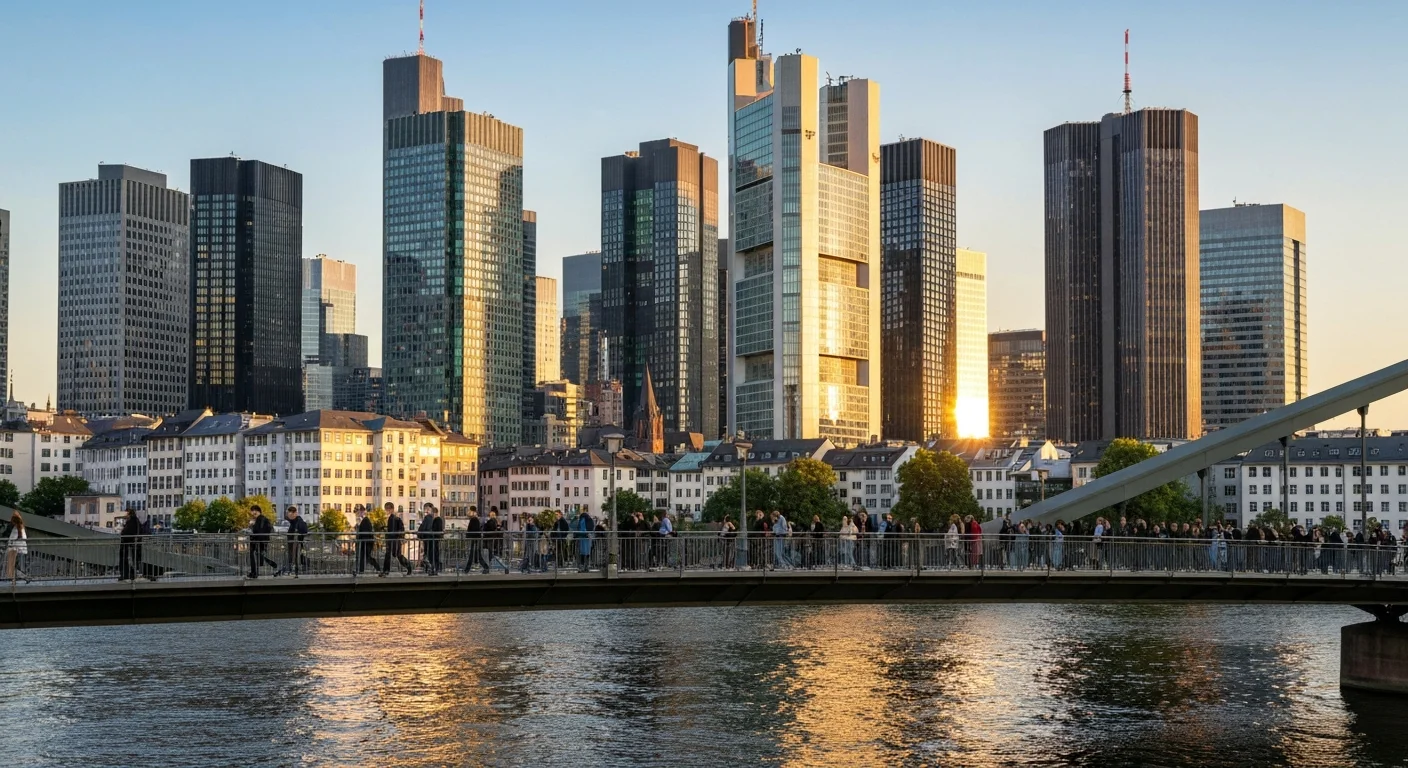
Study in Frankfurt
The Banking Hub of Europe
Frankfurt is home to the European Central Bank, Deutsche Bundesbank and Germany's main stock exchange. With Goethe University, Frankfurt School of Finance & Management and Frankfurt UAS, it is a top destination for business, finance and economics.
15+
Universities
60,000+
Students
EUR 0
Public Tuition
EUR 1,100-1,500
Monthly Cost
Top Universities in Frankfurt
Frankfurt and the surrounding Rhein-Main region host several well-established institutions for international students:
- Goethe University Frankfurt - one of Germany's largest public research universities, especially strong in finance, economics, law, social sciences, natural sciences and medicine.
- Frankfurt University of Applied Sciences (Frankfurt UAS) - a public university of applied sciences with industry-focused programmes in engineering, computer science, business and architecture.
- Frankfurt School of Finance & Management - a prominent private business school known for finance and management; note that private institutions usually charge substantial tuition.
- Specialist academies such as the University of Music and Performing Arts (HfMDK) and the Staedelschule art academy.
The nearby Technical University of Darmstadt (a TU9 member) sits in the wider Rhein-Main area, roughly half an hour away.
Cost of Living in Frankfurt
As a major financial hub, Frankfurt is one of Germany's more expensive cities, broadly comparable to Munich and pricier than cities like Leipzig or many in eastern Germany. Budget for housing first, since rooms are in high demand.
- Rent (room in a shared flat / WG): roughly EUR 450-750 per month, with central locations at the higher end.
- Food and groceries: around EUR 200-300 per month if you mostly cook at home.
- Transport: a student semester contribution typically includes a regional transport ticket, so day-to-day travel is largely covered.
- Total: realistically around EUR 950-1,400 per month, depending heavily on rent and lifestyle.
Student Life in Frankfurt
Frankfurt is compact, walkable and exceptionally international, which makes settling in easier for newcomers. Its skyline, museum quarter (Museumsufer) along the river Main, and busy cafe and food scene give it a distinctly cosmopolitan feel.
Popular areas with students include Bockenheim and Westend near the Goethe campuses, and lively districts like Sachsenhausen and Nordend. The U-Bahn, S-Bahn and tram network is efficient, and the airport plus central rail station make travel across Germany and Europe simple.
There is a large international community and many people speak English, especially in the finance sector and at the universities. Learning German still helps greatly with daily life, housing and part-time work.
Careers & Industry in Frankfurt
Frankfurt is Germany's financial capital and home to the European Central Bank, the Deutsche Bundesbank, the Frankfurt Stock Exchange (Deutsche Boerse), and major banks such as Deutsche Bank and Commerzbank. The Big Four accounting and consulting firms also have a strong presence.
Beyond finance, the region offers aviation and logistics around Fraport (Frankfurt Airport) and Lufthansa, trade-fair work via Messe Frankfurt, and chemical and pharmaceutical employers in the wider area. This concentration creates strong opportunities for graduates in finance, IT, engineering and business.
After graduating from a recognised German university, international students can generally apply for a post-study residence permit (around 18 months) to seek qualified work, and may later qualify for an EU Blue Card.
Showing 577–600 of 1,571 programmes
Heilpädagogik, B.A.
Hochschule Fresenius · Köln, Idstein
Hethitologie (Nebenfach), B.A.
Philipps-Universität Marburg · Marburg
High Integrity Systems, M.Sc.
Frankfurt University of Applied Sciences · Frankfurt am Main
Historisch-vergleichende Sprachwissenschaft (Hauptfach), B.A.
Philipps-Universität Marburg · Marburg
Historisch-vergleichende Sprachwissenschaft (Nebenfach), B.A./B.Sc.
Philipps-Universität Marburg · Marburg
Historisch-Vergleichende Sprachwissenschaft, M.A.
Philipps-Universität Marburg · Marburg
Historische Interpretationspraxis, M.Mus.
Hochschule für Musik und Darstellende Kunst Frankfurt am Main · Frankfurt am Main
Human Movement Analytics: Biomechanics, Motor Control, and Learning, M.Sc.
Justus-Liebig-Universität Gießen · Gießen
Human Resources Management, M.A.
Hochschule Fresenius · Berlin, München +3
Human Resources Management, M.A.
Hochschule Fresenius · Berlin, München +5
Human Rights in Politics, Law and Society, M.A.
Hochschule Fulda - University of Applied Sciences · Fulda
Apply by 15 DecHumanbiologie, M.Sc.
Philipps-Universität Marburg · Marburg
Humanbiologie/Biomedical Science, B.Sc.
Philipps-Universität Marburg · Marburg
Hybride Gefahrenabwehr, B.Sc.
Hochschule Fresenius · Idstein
Immobilien- und Facility Management, B.Sc.
Technische Hochschule Mittelhessen - THM · Friedberg
Immobilien- und Facility Management, M.Sc.
Technische Hochschule Mittelhessen - THM · Friedberg
Immobilienmanagement, B.Eng.
Hochschule RheinMain, RheinMain University of Applied Sciences Wiesbaden, Rüsselsheim · Wiesbaden
Immobilienwirtschaft mit Praxissemester, B.A.
Hochschule Fresenius · Berlin, München +4
Immobilienwirtschaft, B.A.
Hochschule Fresenius · Berlin, München +4
Immobilienwirtschaft, M.Sc.
Hochschule Fresenius · Berlin, München +4
Impact MBA in Sustainability, Innovation & Leadership, MBA
Tomorrow University of Applied Sciences · Frankfurt am Main
Apply by 16 Nov · 36d leftInclusive Design - (ID) - Zukunft gemeinsam gestalten vorher: Inclusive Design - Zukunft interdisziplinär gestalten (bis 30.09.2020), M.Sc.
Frankfurt University of Applied Sciences · Frankfurt am Main
Inclusive Education / Heilpädagogik, B.A.
Evangelische Hochschule Darmstadt (staatlich anerkannt) - Kirchliche Körperschaft des öffentlichen Rechts · Darmstadt
Inclusive Education / Heilpädagogik, M.A.
Evangelische Hochschule Darmstadt (staatlich anerkannt) - Kirchliche Körperschaft des öffentlichen Rechts · Darmstadt
Check My Fit
3 quick questions — every result gets a fit tag based on your budget and languages. Stored only on this device.
Tags are an indication based on tuition and teaching language — for a real assessment, get a free profile evaluation.
Frequently Asked Questions About Studying in Frankfurt
Yes. Public universities in Hessen (including Frankfurt) charge no tuition fees for any student, regardless of nationality. You only pay a semester contribution of approximately €350–€390, which includes one of Germany's best Semestertickets — covering the entire RMV regional transport network across all of Hessen, including ICE trains within the state. This means free travel to Wiesbaden, Darmstadt, Marburg, and Kassel. By comparison, a finance Master's at a UK or US university costs €25,000–€60,000 per year in tuition alone. International students must open a blocked account with €11,904 for the German student visa. Monthly living costs in Frankfurt range from €1,050–€1,300. With zero tuition at Goethe University, access to Europe's financial capital, and Germany's 18-month post-study work visa, Frankfurt delivers exceptional value for money.
Goethe University Frankfurt is one of Germany's largest universities with over 45,000 students, founded in 1914 and named after Frankfurt's most famous son. It has particular strengths in economics, finance (the House of Finance research centre), law, medicine, and natural sciences. It is a member of the prestigious German U15 university network. Frankfurt School of Finance & Management is a world-renowned private business school with triple accreditation (AACSB, EQUIS, AMBA) — one of fewer than 100 business schools worldwide holding all three. It is ranked among Europe's top 20 business schools by the Financial Times. Other notable institutions include Frankfurt University of Applied Sciences (engineering and IT), Hochschule für Musik und Darstellende Kunst (performing arts), and nearby TU Darmstadt (TU9 member, 30 minutes by train).
Yes. Frankfurt offers a strong selection of English-taught programmes, especially in finance, business, and economics. Goethe University offers English-taught Master's programmes in Money and Finance (one of Europe's most respected finance programmes), Quantitative Economics, International Management, and Molecular Biotechnology. Frankfurt School of Finance & Management offers its entire MBA, Master in Finance, Master in Management, and Master in Applied Data Science fully in English. Frankfurt University of Applied Sciences has English-taught Master's tracks in High Integrity Systems and Global Logistics. The region's international banking environment — with over 200 banks, the ECB, and the European Insurance and Occupational Pensions Authority (EIOPA) — creates strong demand for English-language education. Admission typically requires IELTS 6.5–7.0 or TOEFL 90–100 and an APS certificate for Indian applicants.
The average monthly cost for students in Frankfurt ranges from €1,050 to €1,300. Rent is the primary expense: €450–€650 for a room in a shared flat (WG) in student-friendly neighbourhoods like Bockenheim, Bornheim, or Nordend. Studentenwerk Frankfurt offers subsidised dormitory rooms from €280–€400, but waiting lists can be several months long. Groceries and Mensa meals cost roughly €200–€250 per month. Statutory health insurance for students under 30 is approximately €110/month. Frankfurt's exceptional Semesterticket (included in the ~€370 semester fee) covers the entire RMV Hessen network, eliminating transport costs. International students must prove €11,904 in a blocked account for the visa. Frankfurt is moderately priced compared to Munich, and the outstanding Semesterticket and zero tuition at Goethe University make it one of Germany's best-value study cities.
Frankfurt is the financial capital of continental Europe, home to the European Central Bank (ECB), Deutsche Bundesbank, Deutsche Bank, Commerzbank, DZ Bank, KfW, and over 200 international banks. The city is also a major hub for management consulting (McKinsey, BCG, and all Big 4 firms have Frankfurt offices), fintech startups, and professional services. Post-Brexit, many financial institutions relocated operations from London to Frankfurt, creating additional demand for qualified professionals. Starting salaries in banking and consulting range from €50,000–€65,000, with investment banking analysts earning up to €85,000 including bonuses. Germany's 18-month post-study work visa gives graduates ample time to secure employment and transition to an EU Blue Card. Students can work 120 full days or 240 half days per year, and Werkstudent positions at banks pay €15–€25/hour.
Goethe University accepts applications through its own online portal or uni-assist, depending on the programme. Winter semester deadlines are typically July 15 for international applicants. Frankfurt School of Finance & Management has its own admissions process with rolling deadlines — applying early significantly increases scholarship chances. Frankfurt University of Applied Sciences uses a direct application portal. Required documents include certified academic transcripts, degree certificates, language certificates (IELTS/TOEFL for English programmes or TestDaF/DSH for German programmes), a motivation letter, and a CV. Indian applicants must obtain an APS certificate from the German Embassy in New Delhi, which takes 4–8 weeks to process. The uni-assist processing fee is approximately €75 for the first application and €30 for additional universities. For competitive finance and economics programmes, start your preparation at least 8 months before the deadline.
Explore More Programmes in Germany
Ready to Study
in Frankfurt?
Get a free profile evaluation from our Germany education experts. We will assess your eligibility, recommend the best universities in Frankfurt, and guide you through every step of the application process.