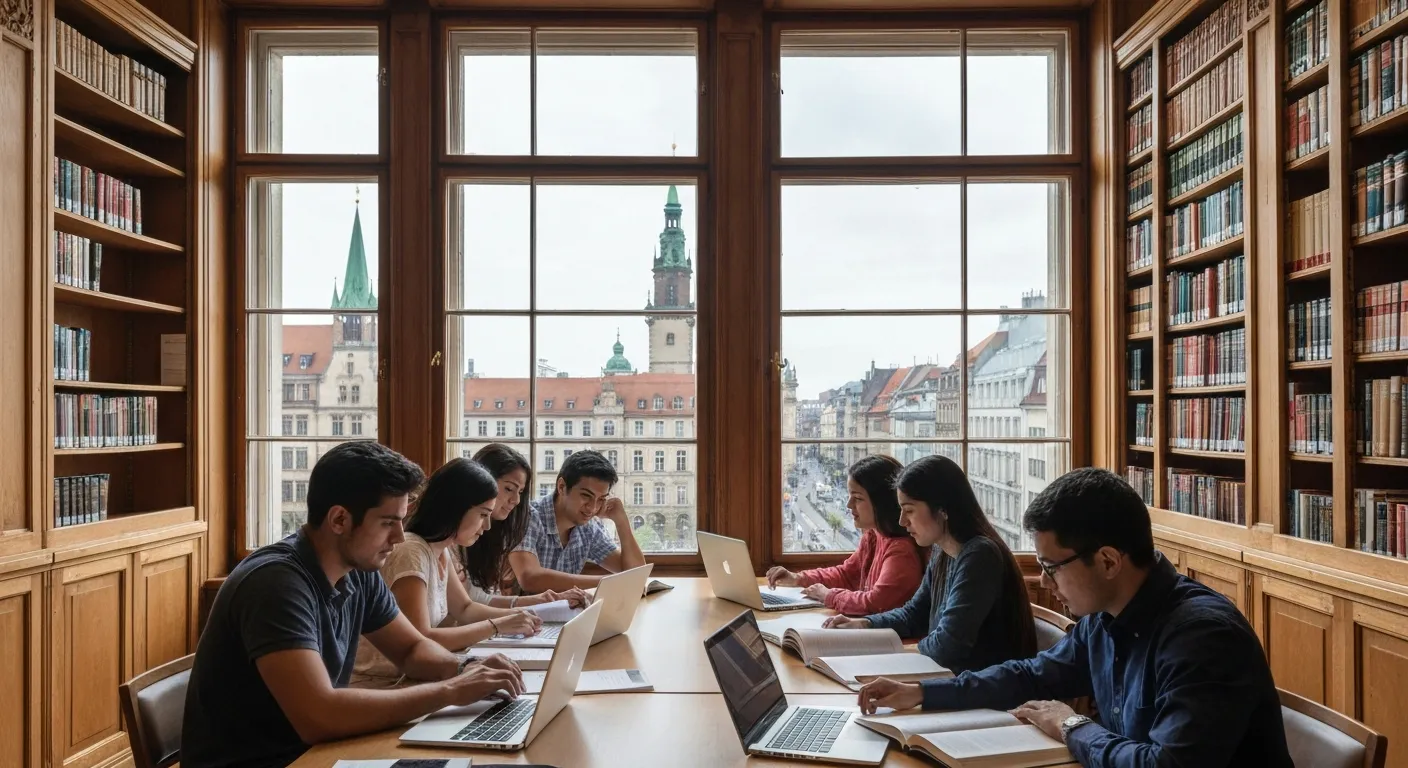
Your Mexican Degree Costs
MXN 1M+
MXN 0 in Germany
Private universities in Mexico charge MXN 5–25 thousand MXN per year. German public universities charge zero tuition — just €150–€350 per semester. Over 10,000 Mexican students already made the switch. We guide you through the blocked account, documents, and visa. No GRE. No GMAT. 2,000+ English-taught programmes at 400+ world-class universities. 18-month work visa after graduation.
No GRE. No GMAT. Your Mexican degree is fully recognised.
Mexico vs Germany — Side by Side
Same quality education. Wildly different price tag. Whether you want a Bachelor's or Master's in Germany from mexico, the savings are dramatic. Free tuition Germany Mexican students can count on.
Typical Mexican Private University
- Tuition (4 years)
- MXN 80,000–250,000/year
- Living costs (4 years)
- MXN 60,000–120,000/year
- Job market after graduation
- Low salaries, limited jobs
- International recognition
- Limited outside South Asia
- Post-grad work abroad
- Separate visa needed
- Average graduate salary
- MXN 15,000–30,000/month
German University
- Tuition (2-yr Master's)
- €0 (public universities)
- Semester fee (2 years)
- €600 – €1,400 total
- Living costs (2 years)
- €18,000 – €24,000
- GRE/GMAT required
- Not required
- International recognition
- Globally top-ranked
- Post-study work visa
- 18 months (guaranteed)
You Could Save
MXN 500,000 – 2,000,000+
And earn a globally recognised degree from a TU9 or Excellence University
Your Document Checklist — What You Need
Good news: as a Mexican national you do not need an APS certificate. Here is what you need to prepare for your German university application.
Academic Documents
Gather your degree certificate, transcripts, and passport. All documents must be notarised with certified translations into German or English. Start collecting 2–3 months before the application deadline.
Language Proof
For English-taught programmes, submit IELTS 6.5+ or TOEFL 90+. German-taught programmes require TestDaF or DSH. TestAS is optional and can strengthen a Bachelor's application.
Motivation Letter & CV
Write a focused motivation letter and an academic CV tailored to each programme. Highlight your coursework, thesis, and key projects. A strong, programme-specific letter makes a real difference.
Apply & Get Admitted
Apply via uni-assist or directly to each university, depending on the programme. Processing typically takes 4–8 weeks — apply to multiple programmes to maximise your offers.
Programmes Available
Tuition at Public Universities
Mexican Students in Germany
Post-Study Work Visa
Scholarships for Mexican Students in Germany
DAAD — Top Funding Source
The DAAD (German Academic Exchange Service) has a regional office covering Mexico. DAAD scholarships cover monthly living allowances (€934–€1,300/month), health insurance, and travel costs. Since tuition is already free, DAAD recipients study in Germany at virtually zero cost.
DAAD scholarships are available for Master's, PhD, and research stays. Applications typically open 12–14 months before the programme start date. Mexican students with strong academic records are competitive candidates given the high demand from Mexico.
Other Scholarships
- Erasmus+ / Erasmus Mundus — EU-funded scholarships covering full tuition + living costs for joint Master's programmes across multiple European universities.
- Deutschlandstipendium — €300/month merit-based scholarship available after enrolment. Open to all nationalities including Mexican students.
- Heinrich-Böll / Friedrich-Ebert / Konrad-Adenauer — German political foundation scholarships covering €934/month + tuition at private universities.
- CONACYT/CONAHCYT (Mexico) — Mexico's national science council offers Becas al Extranjero scholarships for Master's and PhD study abroad, including in Germany. Check conahcyt.mx for current calls.
Showing 1921–1944 of 2,356 programmes
Physics, M.Sc.
Universität Bremen · Bremen
Physik - Lehramt für die beruflichen Fächer der Sekundarstufe II, M.Ed.
Universität Siegen · Siegen
Apply by 15 Nov · 60d leftPhysik (Kern-, Teilchen- und Astropysik), M.Sc.
Technische Universität München · Garching
Apply by 30 NovPhysik (Lehramt an berufsbildenden Schulen), M.Ed.
Universität Osnabrück · Osnabrück
Physik (Lehramt an Haupt- und Realschulen), M.Ed.
Technische Universität Carolo-Wilhelmina zu Braunschweig · Braunschweig
Apply by 30 NovPhysik (Lehramt an Haupt- und Realschulen), M.Ed.
Universität Osnabrück · Osnabrück
Physik (Physik der kondensierten Materie), M.Sc.
Technische Universität München · Garching
Apply by 30 NovPhysik und Wirtschaft, B.Sc.
Philipps-Universität Marburg · Marburg
Physik, B.Sc.
Universität Siegen · Siegen
Physik, B.Sc.
Ruprecht-Karls-Universität Heidelberg · Heidelberg
Physik, B.Sc.
Julius-Maximilians-Universität Würzburg · Würzburg
Physik, M.Ed.
Freie Universität Berlin · Berlin
Physik, M.Ed.
Rheinische Friedrich-Wilhelms-Universität Bonn · Bonn
Physik, M.Sc.
Universität des Saarlandes · Saarbrücken
Physik, M.Sc.
Universität Siegen · Siegen
Physik, M.Sc.
Freie Universität Berlin · Berlin
Physik, M.Sc.
Karlsruher Institut für Technologie · Karlsruhe
Physik, M.Sc.
Julius-Maximilians-Universität Würzburg · Würzburg
Physik, M.Sc.
Technische Universität Kaiserslautern (jetzt: RPTU) · Kaiserslautern
Physik, M.Sc.
Technische Universität Dresden · Dresden
Physik, M.Sc.
Gottfried Wilhelm Leibniz Universität Hannover · Hannover
Physik, M.Sc.
Rheinische Friedrich-Wilhelms-Universität Bonn · Bonn
Physiotherapy, B.Sc.
Hochschule Osnabrück · Osnabrück
Planetary Sciences and Space Exploration, M.Sc.
Freie Universität Berlin · Berlin
Check My Fit
3 quick questions — every result gets a fit tag based on your budget and languages. Stored only on this device.
Tags are an indication based on tuition and teaching language — for a real assessment, get a free profile evaluation.
Frequently Asked Questions — Mexican Students Studying in Germany
Yes. German public universities charge zero tuition fees for all students, including Mexican citizens. You pay only a semester contribution of €150–€350 (~MXN 22,000–50,000), which typically includes unlimited public transport. The sole exception is Baden-Württemberg, where non-EU students pay €1,500 per semester — still far less than Mexican private university tuition. This policy applies to Bachelor's, Master's, and PhD programmes at over 400 public universities.
Yes. Mexico is on the APS-required list. Mexican students must obtain an APS (Akademische Prüfstelle) certificate to verify their academic credentials. You apply through the APS office that covers Mexico (via New Delhi). The process involves submitting your documents and completing a 15–20 minute academic interview. Alternatively, you can take the TestAS standardised aptitude test. Processing takes 4–8 weeks. GradGermany guides you through every step of the APS process.
Over 2,000 programmes are taught entirely in English, especially at the Master's level. Fields like computer science, data science, engineering, business, and natural sciences have extensive English-taught options. For English-taught programmes, you typically need IELTS 6.0–6.5 or TOEFL 80–90. That said, learning basic German (A1–A2) significantly improves your daily life and career prospects. Many universities offer free German courses for enrolled students.
Apply for a German student visa at the German Embassy in Mexico City. Requirements: university admission letter, APS certificate, blocked account (Sperrkonto) with €11,904 (~MXN 17 thousand MXN) through Expatrio or Fintiba, health insurance proof, and valid passport. Processing takes 6–10 weeks. Book your visa appointment early — wait times can be long during peak season. After graduation, you qualify for an 18-month job-seeker visa automatically.
A two-year Master's degree in Germany costs approximately €18,000–€26,000 total (~MXN 26–37 thousand MXN) in living expenses, with €0 in tuition. This includes rent, food, insurance, and transport. Compare this to MXN 10–25 thousand MXN in tuition alone at Mexican private universities, plus living costs. The blocked account requirement is €11,904 (~MXN 17 thousand MXN), released monthly at ~€992. Many students work part-time (140 full days/year) to offset costs.
Germany offers every graduate an 18-month post-study work visa — no lottery, no employer sponsorship. Germany has 700,000+ unfilled STEM positions. Starting salaries for Master's graduates average €45,000–€55,000 (~MXN 65–80 thousand MXN/year), with tech and engineering roles reaching €60,000+. Compare this to average Mexican graduate salaries of MXN 3–5 thousand MXN/year. The EU Blue Card pathway leads to permanent residency within 21 months.
Step 1: Get your APS certificate (start 4–6 months before deadline). Step 2: Choose programmes on GradGermany. Step 3: Prepare documents — APS certificate, degree/transcripts, motivation letter, CV, language proof. No GRE or GMAT needed. Step 4: Apply through uni-assist (€75 first, €30 each additional) or directly. Step 5: Once accepted, open blocked account and apply for student visa at the German Embassy in Mexico City. Deadlines: July 15 (winter) and January 15 (summer). Start 8–10 months early.
Mexico has the 2nd highest search interest globally for studying in Germany, and over 10,000 Mexican students are already enrolled. The reasons: €0 tuition (vs MXN 10–25 thousand MXN/year in Mexico), globally recognised degrees, 18-month work visa, high graduate salaries (€45K+ vs MXN 3–5 thousand MXN in Mexico), and a clear pathway to permanent residency. Germany has been a top destination for Mexican students seeking quality education at affordable cost, especially in engineering, IT, and management fields.
Explore More Programmes in Germany
10,000 Mexican Students
Can't Be Wrong
Mexico has the 2nd highest demand globally for studying in Germany. Over 10,000 Mexican students are already thriving at German universities. No APS certificate is required for Mexican applicants — and with zero tuition, a 18-month post-study work visa, and salaries far higher than in Mexico, it is absolutely worth it. We guide you through documents, applications, and your visa.
No obligations. 100% free evaluation. The choice is entirely yours.